Research School of Accounting
Does the Manager Matter to Users of Management Earnings Forecasts?
by
Tejshree Kala
A thesis submitted for the degree of Doctor of Philosophy of The Australian National University.
Certificate of Authorship
I, Tejshree Kala, hereby declare that, except where otherwise acknowledged in the customary manner, and to the best of my knowledge and belief this work is my own, and has not been submitted for a higher degree at any other university or institution.
Signed:
________________________________
Acknowledgements
I would like to express my gratitude to the chair of my supervisory panel, Professor Greg Shailer, for his patient guidance in the completion of this thesis. I would also like to thank my supervisors Associate Professor Mark Wilson and Professor Juliana Ng for their support and insightful comments.
My sincere thanks to Professor Neil Fargher and Dr Sonali Walpola for reading drafts of my thesis and providing very useful suggestions and comments. I am thankful to the current and former PhD students and staff members of the Research School of Accounting for their support and collegiality. I am also thankful to all my friends for their support throughout the doctoral program.
A special thanks to my parents, Kumar and Ansuya, and my brother Deepak, for their love and continuous encouragement throughout the doctoral program.
This research is supported by an Australian Government Research Training Program (RTP) Scholarship.
Abstract
Prior research provides evidence on how manager attributes affect characteristics of management earnings forecasts and how firm characteristics affect market participants’ perception of the credibility of management earnings forecasts. Using a manager-firm matched panel dataset, this thesis examines whether the perceived credibility of management earnings forecasts, as measured by investors’ and analysts’ responses to management earnings forecasts news, are influenced by: (1) the forecasting track records of individual managers, and (2) manager attributes. The results indicate that, overall, investors’ responses to management earnings forecasts vary with the firms’ forecasting track records but not with the forecasting track records of individual managers or with manager attributes. The results indicate that analysts’ responses to management earnings forecasts are positively associated with managers’ individual forecasting track records. Results also indicate that analysts react less strongly to management earnings forecasts issued by CEOs with CFO experience, and react more strongly to management earnings forecasts issued by managers who are also the chairperson. Overall, the results suggest that analysts, being more sophisticated users, consider both manager- and firm-specific characteristics in their assessments of management earnings forecasts. This thesis contributes to the literature by providing a more comprehensive understanding of whether manager-specific forecasting track records and manager attributes matter to investors and analysts. The findings reported in this thesis may help to inform the communicators (firms and managers) of management earnings forecasts about what matters to users, which may help them vary their forecasting behaviours. Results may also help inform boards of directors about what matters to users of management earnings forecasts and help the board better monitor managers in this regard, and, inform observers such as regulators and commentators in providing signals about what matters to users in terms managers’ forecasting behaviours and attributes.
Contents
CERTIFICATE OF AUTHORSHIP ... II ACKNOWLEDGEMENTS ... III ABSTRACT ...IV CONTENTS ... V LIST OF TABLES ...VIII
CHAPTER 1 INTRODUCTION ... 1
1.1 INTRODUCTION ... 1
1.2 CONTRIBUTION ... 10
1.3 STRUCTURE OF THESIS ... 11
CHAPTER 2 LITERATURE REVIEW AND HYPOTHESIS DEVELOPMENT... 12
2.1 INTRODUCTION ... 12
2.2 BACKGROUND... 12
2.2.1 Potential Costs of Issuing Management Earnings Forecasts ... 13
2.2.2 Potential Benefits of Issuing Management Earnings Forecasts ... 14
2.3 THE PERCEIVED CREDIBILITY OF MANAGEMENT EARNINGS FORECASTS ... 16
2.4 FACTORS THAT MAY INFLUENCE THE PERCEIVED CREDIBILITY OF MANAGEMENT EARNINGS FORECASTS ... 18
2.4.1 Situational Incentives ... 18
2.4.2 Levels of External and Internal Assurance ... 19
2.4.3 Forecast Characteristics ... 20
2.4.4 Management Credibility ... 20
2.5 MANAGER-SPECIFIC FORECAST PERFORMANCE ... 24
2.5.1 Management Earnings Forecast Accuracy ... 24
2.5.2 Management Earnings Forecast Frequency ... 25
2.5.3 Management Earnings Forecast Precision ... 26
2.5.4 Hypothesis 1 ... 27
2.6 MANAGER ATTRIBUTES ... 29
2.6.1 Managers’ Personal Attributes ... 32
2.6.2 Managers’ Imputed Attributes ... 35
2.6.3 Managers’ Positional Attributes ... 36
2.6.4 Hypotheses 3 and 4 ... 38
2.7 CONCLUSION ... 39
CHAPTER 3 RESEARCH METHOD ... 40
3.1 INTRODUCTION ... 40
3.2 CONSTRUCTING A MANAGER-FIRM MATCHED PANEL AND ESTIMATING MANAGER AND FIRM FIXED EFFECTS ... 40
3.2.1 Panel Construction ... 41
3.2.2 Estimating Manager and Firm Fixed Effects on Prior Forecast Performance ... 42
3.3 DATA AND SAMPLE SELECTION ... 49
3.4 RESEARCH DESIGN FOR TESTING HYPOTHESES 1 AND 2 ... 53
3.5 RESEARCH DESIGN FOR TESTING HYPOTHESES 3 AND 4 ... 58
3.6 DESCRIPTIVE STATISTICS ... 62
3.6.1 Descriptive Statistics using Yang (2012) Study Period... 63
3.6.2 Descriptive Statistics using Extending Estimation Periods... 65
3.6.3 Descriptive Statistics for Managerial Attributes ... 67
3.7 CONCLUSION ... 70
CHAPTER 4 RESULTS ... 71
4.1 INTRODUCTION ... 71
4.2 ESTIMATION OF MANAGER AND FIRM FIXED EFFECTS ... 71
4.3 CORRELATIONS ... 75
4.4 TESTING HYPOTHESIS 1... 79
4.4.1 Testing Hypothesis 1 using Yang (2012) Study Period ... 79
4.4.2 Testing Hypothesis 1 using Yang (2012) Study Period (Adjusted for Bundled Forecasts) . ... 82
4.4.3 Testing Hypothesis 1 using Extending Estimation Periods ... 84
4.5 TESTING HYPOTHESIS 2... 86
4.6 TESTING HYPOTHESIS 3... 89
4.6.1 Results for Personal Attributes (Hypothesis 3) ... 89
4.6.2 Results for Imputed Attributes (Hypothesis 3) ... 93
4.6.3 Results for Positional Attributes (Hypothesis 3) ... 95
4.6.4 Results for all Managerial Attributes (Hypothesis 3) ... 97
4.6.5 Summary of Results for Hypothesis 3 ... 101
4.7 TESTING HYPOTHESIS 4... 102
4.7.1 Results for Personal Attributes (Hypothesis 4) ... 102
4.7.2 Results for Imputed Attributes (Hypothesis 4) ... 106
4.7.3 Results for Positional Attributes (Hypothesis 4) ... 108
4.7.4 Results for all Managerial Attributes (Hypothesis 4) ... 110
4.7.5 Summary of Results for Hypothesis 4 ... 114
4.8 CONCLUSION ... 115
CHAPTER 5 ADDITIONAL ANALYSES ... 117
5.1 INTRODUCTION ... 117
5.2 USING AN ALTERNATIVE MEASURE OF FORECAST PRECISION ... 117
5.3 THE ASSOCIATION BETWEEN MANAGER ATTRIBUTES AND MANAGER FIXED EFFECTS .. 125
5.4 RESULTS FOR HYPOTHESIS 1 AND 2:GOOD NEWS AND BAD NEWS ... 131
CHAPTER 6 CONCLUSION ... 135 6.1 SUMMARY... 135 6.2 LIMITATIONS ... 139 6.3 CONTRIBUTION ... 140 6.4 FUTURE RESEARCH ... 141 APPENDIX ... 143 REFERENCES ... 153
List of Tables
Table 1 Summary of hypotheses ... 39
Table 2 Prior forecast performance measures ... 42
Table 3 Control variables ... 44
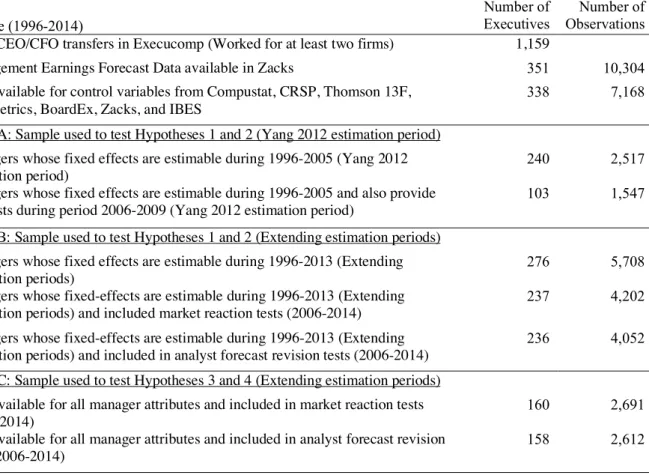
Table 4 Sample selection ... 50
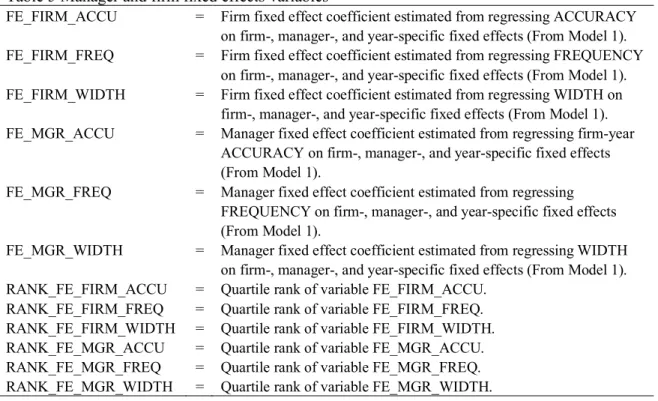
Table 5 Manager and firm fixed effects variables ... 54
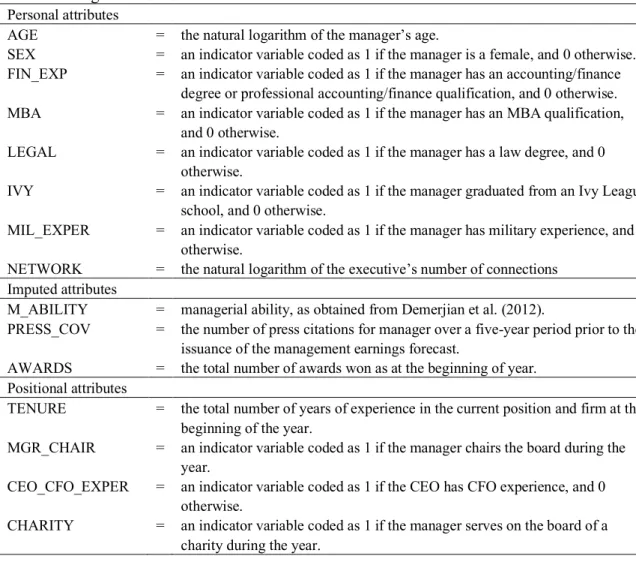
Table 6 Manager attributes ... 59
Table 7 Descriptive statistics for the period 1996-2009 (Based on Yang (2012) study period) ... 64
Table 8 Descriptive statistics for the period 1996-2014 using extending estimation periods (Used to test Hypotheses 1 and 2) ... 66
Table 9 Panel A: Descriptive statistics for manager attributes (Used to test Hypotheses 3 and 4) ... 68
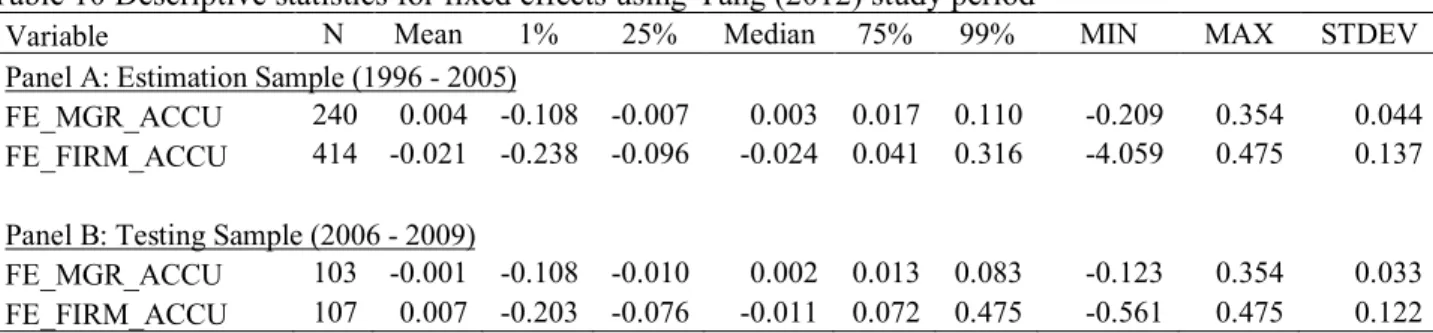
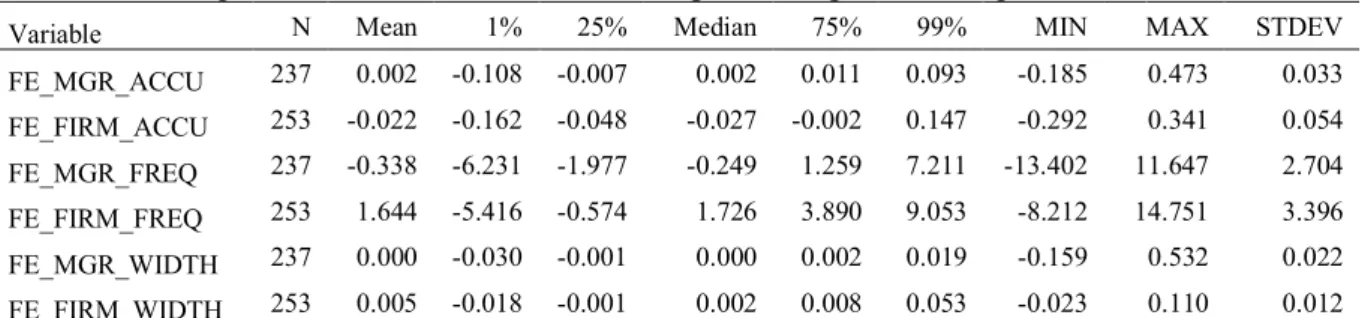
Table 10 Descriptive statistics for fixed effects using Yang (2012) study period ... 72
Table 11 Descriptive statistics for fixed effects using extending estimation periods ... 74
Table 12 Correlation matrix (Hypotheses 1 and 2) ... 77
Table 13 Correlation matrix (Hypotheses 3 and 4) ... 78
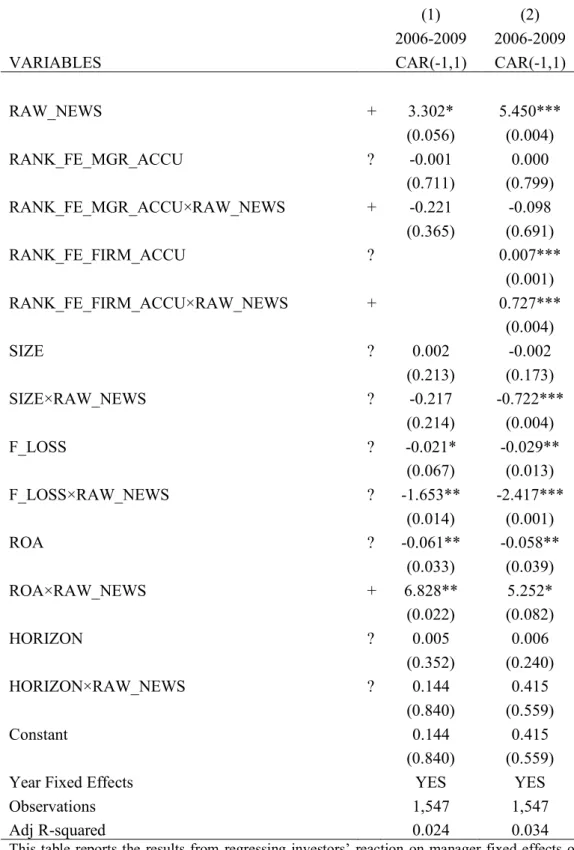
Table 14 Results using the Yang (2012) study period and raw forecast news ... 80
Table 15 Results using the Yang (2012) study period and adjusted forecast news ... 83
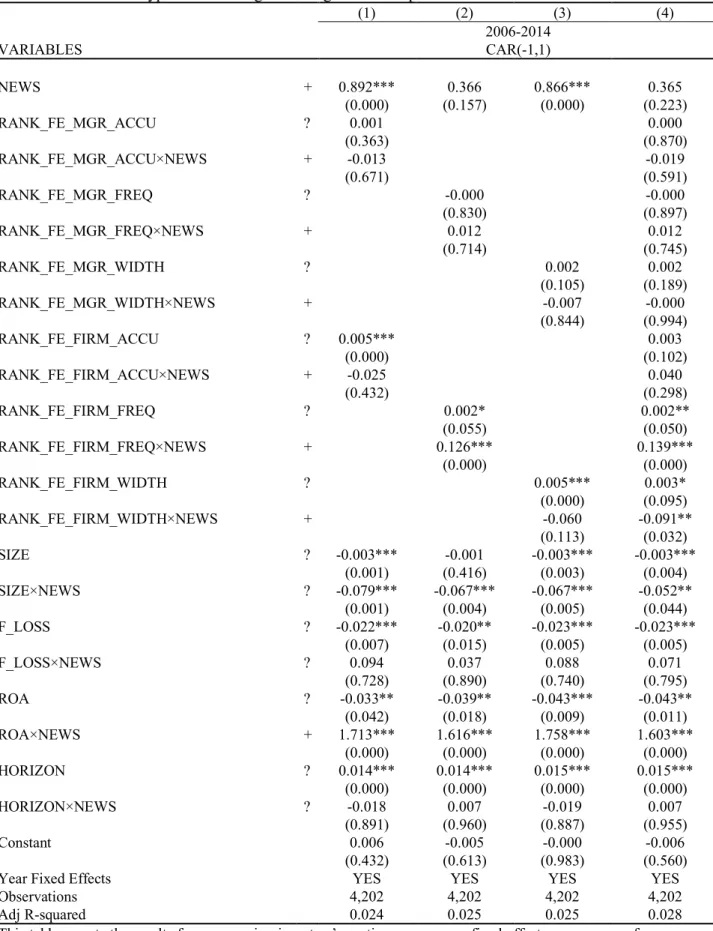
Table 16 Results for Hypothesis 1 using extending estimation periods ... 85
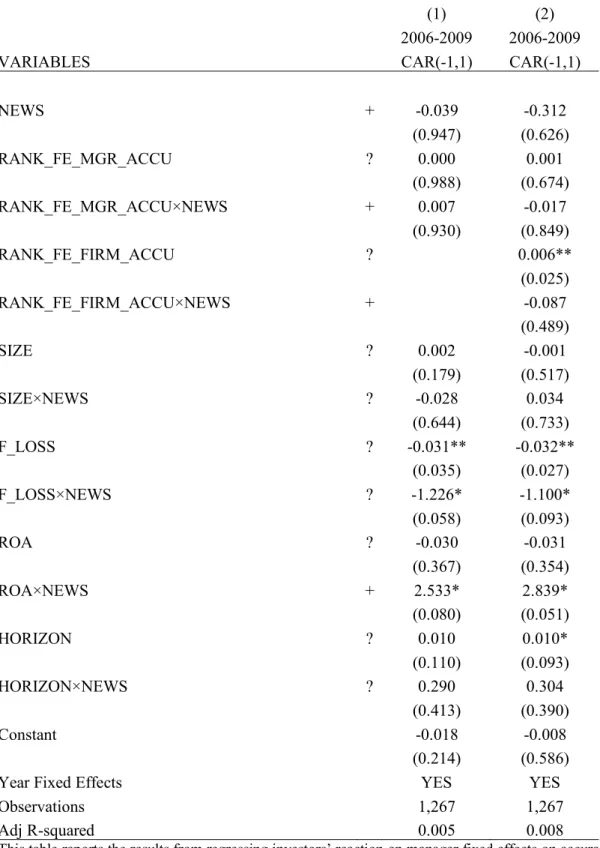
Table 17 Results for Hypothesis 2 using extending estimation periods ... 87
Table 18 Results for Hypothesis 3 (Personal attributes) ... 91
Table 19 Results for Hypothesis 3 (Imputed attributes) ... 94
Table 20 Results for Hypothesis 3 (Positional attributes) ... 96
Table 21 Results for Hypothesis 3 (All manager attributes) ... 98
Table 22 Results for Hypothesis 4 (Personal attributes) ... 103
Table 23 Results for Hypothesis 4 (Imputed attributes) ... 107
Table 25 Results for Hypothesis 4 (All manager attributes) ... 111
Table 26 Descriptive statistics for manager and firm fixed effects using the alternate forecast precision measure ... 118
Table 27 Results for Hypotheses 1 and 2 using the alternative forecast precision measure ... 120
Table 28 Results for Hypotheses 3 and 4 using the alternative forecast precision measure ... 122
Table 29 The relationship between manager attributes and manager-fixed effects on forecast performance ... 127
Table 30 Results for Hypothesis 3 and 4 (Excluding fixed effects) ... 129
Table 31 Descriptive Statistics for Good News and Bad News ... 131
CHAPTER 1
Introduction
1.1 Introduction
Manager-provided earnings forecasts (hereafter ‘management earnings forecasts’), typically issued on a per share basis, are an important source of forward-looking market information that market participants consider when predicting firm’s future earnings (Graham et al., 2005).1 Between 2009-2014, approximately half of the S&P 1,500 issued at least one management earnings forecast. Like with all communications, it is reasonable to expect that the credibility of both the source (firm and manager) and the content of the management earnings forecast (forecast characteristics) are considered by market participants. The literature on the credibility of management earnings forecasts has considered the content of the forecast, but has only largely examined the firm as a source. We have a limited knowledge of whether the manager matters as a source. The objective of this thesis is to examine whether the manager matters to users of management earnings forecasts. In particular, this thesis examines whether investors’ and analysts’ reactions to management earnings forecasts are conditioned by manager-specific prior forecast performance and manager attributes.
In their 2014 survey on earnings guidance practices of U.S. companies, the National Investor Relations Institute (NIRI) found that executives’ two most commonly cited reasons for issuing management earnings forecasts were: (1) to manage earnings expectations of market participants, and (2) to increase transparency (NIRI, 2014). This is consistent with findings of
1 This excludes earnings preannouncements (warnings) that are provided on or after the accounting fiscal period has ended but before earnings are announced. Management earnings forecasts are also referred to as management forecasts and earnings guidance.
academic studies that have found that management earnings forecasts can reduce information asymmetry (e.g., Coller and Yohn, 1997, Billings et al., 2015), and provide substantial new information to investors (e.g., Anilowski et al., 2007, Ball and Shivakumar, 2008, Beyer et al., 2010) and analysts (e.g., Waymire, 1986, Cotter et al., 2006), who often revise their forecasts within a few days of the management earnings forecast.
Management earnings forecasts can be short-term (twelve months ahead or less) and long-term (more than twelve months) forecasts of earnings. The forecasts can be in the form of point estimates (e.g. “about $0.10”), range estimates (e.g. “between $0.10 and $0.12”), open-ended estimates (e.g. “at least $0.10”), or qualitative statements (e.g. “may be below expectations”) about the future performance of the company. Short-term point and range management earnings forecasts are the most common form of management earnings forecasts.
Despite the widespread practice of issuing management earnings forecasts and, evidence that they are informative, there are conflicting views regarding the issuance of management earnings forecasts. Proponents argue that: (1) more information is useful to market participants as it leads to less uncertainty (Janjigian, 2003); and (2) management earnings forecasts are especially useful for correcting market expectations for smaller companies that do not have much analyst coverage (Venkataraman, 2006, Johnson, 2007). Critics contend that issuance of management earnings forecasts can encourage managers to emphasise short-term goals at the expense of long-term goals; this view has been expressed by researchers (e.g., Fuller and Jensen, 2002, Morgan, 2003), regulators (e.g., Levitt, 2000), lobbyists (e.g., U.S. Chamber of Commerce, 2007), non-profit organisations (e.g., The Aspen Institute, 2016), the media (e.g., Zuckerman, 2005, Plitch, 2006) and managers (e.g., Sorkin, 2016). The managers of some firms, such as Google and Berkshire Hathaway, have expressed similar concerns and have
adopted strong stances against the provision of management earnings forecasts (e.g. Page, 2004, Belvedere, 2016). Other concerns are focussed on the credibility of management earnings forecasts (e.g., Miller, 2009).
While the purported motivations of managers when issuing management earnings forecasts seem defensible and the accuracy of management earnings forecasts can be verified when earnings are announced, managers’ assertions in earnings guidance statements may not always be reliable. In the U.S., the issuance of management earnings forecasts is voluntary, the forecasts are unaudited and the Private Securities Litigation Reform (PSLR) Act 1995 safe harbor provisions shelter managers from litigation with respect to unattained projections when forecasts are provided in ‘good faith’.2 These circumstances suggest that, because management earnings forecasts are unverifiable at the time of announcement, and managers have significant discretion regarding forecast attributes such as forecast precision, there is scope for opportunistic bias in management earnings forecasts. For example, a media report about Eli Lilly and Company, reports that: “But analysts also noted that Lilly tends to lowball its guidance, and its 2015 results beat forecasts” (Staton, 2016).3 Prior studies also provide
evidence that managers have incentives to use management earnings forecasts strategically for self-serving purposes; for example, before: (1) raising external finance (Frankel et al., 1995) and seasoned equity offerings (Feng and Koch, 2010, Kim, 2016), (2) management buyouts (Hafzalla, 2009), (3) insider purchases and sales (Rogers and Stocken, 2005, Rogers, 2008, Cheng et al., 2013), and (4) stock option awards (Aboody and Kasznik, 2000), and in order to avoid missing analyst forecasts (Matsumoto, 2002, Cotter et al., 2006, Christensen et al., 2011).
2 See Section 102 of the PSLR Act 1995.
While it is generally accepted that management earnings forecasts must convey news for there to be a market reaction (Ball and Shivakumar, 2008), the extent to which market participants adjust their expectations in response to the news in the management earnings forecasts will be conditioned by the perceived reliability of the forecast (Jennings, 1987). Social psychology research argues that message credibility depends on both the message content and the source of the message (Hovland et al., 1953). This is reflected in the earnings forecast literature, which indicates that the perceived credibility of management earnings forecasts, as measured by stock market reaction and analyst reaction to the management earnings forecast news, varies with firm forecast-specific (message-specific) and other firm-specific characteristics (dimensions of the source).4 Firm forecast-specific characteristics associated with the perceived credibility of
management earnings forecasts include prior forecast accuracy (Hutton and Stocken, 2007), forecast consistency (Hilary et al., 2014), forecast specificity (Bamber and Cheon, 1998), forecast disaggregation (Lansford et al., 2013), forecast attributions (Chen et al., 2016), and forecast news (Rogers and Van Buskirk, 2013). Other firm-specific characteristics associated with the perceived credibility of management earnings forecasts include financial distress (Koch, 2002), litigation risk (Ng et al., 2013) and ownership structure (Ajinkya et al., 2005).
The general body of research on firm-specific characteristics accords with the proposition that message source matters. However, these studies have focussed on firm characteristics, but do not consider the influence of individual managers who are responsible for developing the earnings forecasts and who communicate the forecasts to the market. 5 This incomplete view of source credibility is surprising given the anecdotal evidence that analysts and investors
4Hirst et al. (2008) review message and firm characteristics and their effect on market responses to management earnings forecasts. I discuss some of these characteristics in Chapter 3.
5 Notable exceptions of studies that consider whether manager characteristics matter in investors’ assessments of the perceived credibility of management earnings forecasts include Baik et al. (2011) and Yang (2012), which are discussed a bit later in this chapter.
consider senior executives’ collective and individual attributes when evaluating management’s disclosures.
At the collective manager level, Morningstar analyst investment reports include a category for “Stewardship”, in which analysts assign a rating of “Poor”, “Standard” or “Exemplary”, to the firm’s management and board. These reports also include a section where analysts comment on various aspects of management. For example, in a Morningstar analyst note for Avnet Inc, the analyst notes that “Avnet’s management seems to be accurate about giving sound guidance, …, management discussions are open and transparent about trends in different regions” (Wahlstrom, 2014a). There is also anecdotal evidence that managers matter to financial regulators. In an OECD report, for example, Koenig (2005) writes: “Business executives appear to have a knack for recognising these trends, and filtering out transitory fluctuations” (p. 250).6 There is also a sense that management credibility is important to the broader market as analysts’ comments about management are often referenced in business reports. For example, in a media note to investors about Mylan Inc., a Credit Suisse analyst is quoted thus: “Management continues to confuse investors in the way it discusses its performance and guidance, which continues to foster a management credibility issue and hurts the stock” (Sabatini, 2008). In the case of Valeant Pharmaceuticals, an analyst is quoted as having “lost confidence in management’s ability to understand its own business and to provide reliable guidance” (Lopez, 2016).7
Anecdotal evidence that market participants attach credibility to individuals when evaluating management earnings forecasts include the following illustrative examples:
6 I thank Professor K. Ramesh for drawing my attention to this quote.
• In a Morningstar stock recommendation for Anglo American, the analyst commented that “… if Carroll and the management team are to blame, it is only that they are overly optimistic forecasters rather than poor project managers” (Rohr, 2014).
• Commenting on the CFO of Blackbaud Inc, the analyst noted that “we like Boor's up-front demeanor and transparency with investors” (Wahlstrom, 2014b).
• Commenting on Fitbit CEO’s management earnings forecasts, Cramer on CNBC notes: “James Park should be banned from making any projections …. I think these numbers mean nothing to him. I mean, he cut the guidance for next quarter but then boosted the full-year forecast” (Stevenson, 2016).8
• In a media note about Salesforce’s CFO changeover, Citigroup analyst noted: “Current CRM CFO had established a history of conservative guidance with excellent disclosure and we hope Hawkins continues this” (Ray, 2014).9
• Dichev, Graham, Harvey & Rajgopal (2013), in their study involving a survey and interviews of CFOs, report that one CFO noted, “I think when people [emphasis added] are dishonest it is very hard for an analyst with just public information to tell, at least in the short-term” (p. 27).
Overall, it is plausible that the properties of management forecasts may be associated with manager characteristics and that some market participants consider the prior forecast behaviour of individual managers when evaluating the credibility of management earnings forecasts. Two notable prior studies, Baik, Farber & Lee (2011) and Yang (2012) consider managers’ characteristics and forecasting track record in relation to the credibility of their management
8http://www.cnbc.com/2016/05/05/cramer-elon-musk-getting-away-with-financial-murder.html 9http://www.barrons.com/articles/salesforce-names-autodesks-hawkins-new-cfo-1404161016
earnings forecasts. Baik et al. (2011) examine the association between managerial ability and the stock market reaction to the management earnings forecast news. Baik et al. (2011) find that management earnings forecasts issued by higher-ability CEOs elicit a stronger market reaction than those issued by lower-ability CEOs. Yang (2012), finds that when information uncertainty is high, the market is more responsive to management earnings forecasts issued by managers with higher manager-specific forecast accuracy. However, these two studies focus on only two manager attributes (ability and forecast accuracy) and examine management earnings forecasts only in terms of investor reaction.
Despite the evident role of individual managers in the issuance of management earnings forecasts, and media and analysts reports and research evidence that manager-specific factors are associated with various attributes of management earnings forecasts (Bamber et al., 2010), we only have a modest understanding of whether market participants place weight on manager-specific factors in assessing the credibility of management earnings forecasts. In this study, I examine an extensive list of manager traits and assess the perceived credibility of management earnings forecasts using: (1) stock market reaction and (2) consensus analyst forecast revisions. I address this gap in our understanding of how market participants evaluate the credibility of management earnings forecasts by investigating the following research question:
RQ: Do manager-specific factors affect the perceived credibility of management earnings forecasts?
To address the research question, I draw on prior research to develop hypotheses focussed on whether manager-specific prior forecast performance and manager attributes matter in relation to the perceived credibility of management earnings forecasts.
First, I predict that the perceived credibility of the current management forecast varies with differences in individual managers’ prior forecasting performance. Second, I predict that the perceived credibility of management earnings forecasts varies with differences in managers’ non-forecasting attributes. Testing these hypotheses builds on prior studies in several ways.
One of the first studies to examine the effect of individual style or managerial characteristics on organisational outcomes, Bertrand & Schoar (2003), uses a manager-firm matched panel dataset that follows managers across firms and time, and finds that manager-specific effects contribute to investing, financing and organisational practices.10 More recent studies in accounting have considered idiosyncratic managerial fixed effects on accounting outcomes such as tax avoidance (Dyreng et al., 2010), discretionary accruals (Ge et al., 2011), likelihood of accounting misstatements (Ge et al., 2011), management tone in earnings calls (Davis et al., 2015), and management earnings forecasts (Bamber et al., 2010, Yang, 2012).
Using a manager-firm matched panel dataset to examine manager fixed effects on the characteristics of management earnings forecasts, Bamber et al. (2010) find managerial fixed effects on forecast frequency, forecast specificity, forecast news, forecast bias and forecast accuracy. While Bamber et al. (2010) find that managerial effects are associated with management earnings forecast issuance and forecast characteristics, they do not consider whether these effects influence capital market participants’ assessment of the credibility of management earnings forecasts. Prior studies largely have not distinguished between the forecast credibility attributable to the firm versus the manager. A notable exception is Yang (2012), who uses the Bertrand & Schoar (2003) method to extract manager-specific fixed effect
10 With the Bertrand & Schoar (2003) method, managers are tracked across firms because managers must work at more than one firm so that the manager fixed effects on corporate outcomes can be estimated. This is explained further in Chapter 3.
on forecast accuracy. Yang (2012) then investigates the capital markets responses to managers with higher forecast accuracy and finds that the market responds more strongly to forecasts by managers with higher forecast accuracy. Yang, however, only focuses on one aspect of prior forecast performance: manager-specific forecast accuracy. While accuracy might enhance management’s credibility with respect to their management earnings forecasts, evidence suggests that investors and analysts consider other factors in assessing the credibility of management earnings forecasts. This thesis extends Yang in two ways. First, by examining whether investors’ responses to management earnings forecast news vary with the manager-specific effect of two other common prior forecast performance measures including forecast frequency and forecast precision. Second, this thesis extends Yang (2012) by examining the effect of manager-specific forecast performance on analysts. Analysts are sophisticated users who can also assess the credibility of managers when considering management earnings forecasts (Baik et al., 2011). Specifically, I examine whether there is an association between manager-specific prior forecast performance and: (1) investor reaction, and (2) consensus analyst forecast revisions.
Prior research examines the effect of manager attributes on corporate outcomes and accounting disclosures.11 However, little research has focused on whether or not managers’ attributes and underlying characteristics affect the perceived credibility of their management earnings forecasts. A notable contribution is Baik et al. (2011), which measures CEO ability, as press citations, manager-specific efficiency as measured by Demerjian et al. (2012a) and industry-adjusted return on assets, and examines whether these moderate stock market reactions to management earnings forecasts. Baik et al. find that stock market reactions to management
11 See, for example, Adams et al. (2005), Aier et al. (2005), Francis et al. (2008), Bamber et al. (2010), Dyreng et al. (2010), Srinidhi et al. (2011), Demerjian et al. (2012b), Ahmed and Duellman (2013), Benmelech et al. (2015), Davis et al. (2015) and Hamm et al. (2017).
earnings forecast news are stronger for high-ability CEOs than for low-ability CEOs. Social psychology research argues that the degree to which an individual will be influenced by a communicator’s message will depend on the individual’s beliefs about the perceived credibility (expertise and trustworthiness) of the communicator (Hovland et al., 1953). For example, the degree to which an individual will be persuaded by a communicator’s message can depend on how intelligent, knowledgeable, able and sincere the individual perceives the communicator to be (Hovland et al., 1953). However, it is difficult to obtain data about executives’ innate ability and attributes. Prior research therefore suggests the use of observable characteristics of the communicator that may be correlated with the communicator’s innate ability and psychological traits (Hovland et al., 1953, Hambrick and Mason, 1984, Hambrick, 2007). In this thesis, I integrate the approaches of Yang (2012) and Baik et al. (2011) and examine whether a more comprehensive list of observable managers’ attributes are associated with stock market and analyst reaction to management earnings forecasts. Specifically, I examine whether managers’ personal, imputed and positional attributes may be correlated with factors investors and analysts consider in assessing the perceived credibility of management. Personal attributes examined include: (1) age, (2) sex, (3), educational background, (4) military experience, and (5) network size. Imputed attributes examined are: (1) managerial ability, (2) number of awards won, and (3) press coverage. Positional attributes of the manager examined include: (1) tenure, (2) manager/chair duality, (3) CEO’s CFO experience, and (4) manager’s charitable involvement.
1.2 Contribution
the credibility of disclosures, by moving away from a narrow focus on individual aspects of managers to a broader focus on the effect of manager-specific prior forecast performance as well as manager attributes on the perceived credibility of management earnings forecasts. In doing so, it contributes to the literature by providing a more comprehensive understanding of whether manager-specific factors matter to investors and analysts in their assessments of the credibility of management earnings forecasts.
This thesis also has implications for practice. By providing evidence of whether manager-specific characteristics matter to market participants, this thesis informs managers who wish to better understand the cues investors and analysts use to assess managers. This also informs: (1) firms of potential benefits from having specific managers with specific traits or characteristics, (2) boards about what matters to users which can help boards better monitor managers and, (3) regulators and commentators in providing signals about what matters to users in terms managers’ forecasting behaviour and attributes.
1.3 Structure of Thesis
This thesis proceeds as follows. Chapter 2 provides a discussion of related literature and contains the specific hypotheses to be tested. Chapter 3 provides a detailed discussion of the research design. Chapter 4 reports the results. Chapter 5 provides additional analyses. Chapter 6 provides the concluding remarks.
CHAPTER 2
Literature Review and Hypothesis
Development
2.1 Introduction
This chapter reviews the literature concerned with management earnings forecasts and the factors associated with the perceived credibility of management earnings forecasts. The review identifies the theoretical foundation necessary for the development of my hypotheses.
2.2 Background
The issuance of management earnings forecasts in the U.S. is largely voluntary. An exception is where managers issue guidance to comply with SEC Rule 10b-5 (Bochner and Clark, 2008). This rule requires managers to either disclose material private information before trading their firm’s securities or abstain from trading (Li et al., 2016). Management earnings forecasts are fairly common. Approximately 97% of the S&P 1,500 issued at least one management forecast between 1994-2014 and, between 2009-2014, approximately half of the S&P 1,500 issued at least one management earnings forecast. Issuance of management earnings forecasts has increased over time and is most commonly provided by bigger firms (Anilowski et al., 2007). At the firm level, the provision of management earnings forecasts tends to be ‘sticky’ because a forecast can create a disclosure precedent whereby the market may interpret future non-disclosure as bad news (Graham et al., 2005, Chen et al., 2011). Management earnings forecasts are now typically bundled with earnings announcements. Rogers and Van Buskirk (2013)
document that bundled management earnings forecasts constituted less than 10% of all management earnings forecasts in 1995 but increased to about 80% by 2007. As discussed in Chapter 3, this bundling practice causes a methodological challenge in separating the market participants’ reactions to management earnings forecasts from reactions to earnings announcements.
2.2.1 Potential Negative Consequences of Issuing Management Earnings Forecasts
Critics contend that issuance of management earnings forecasts can encourage managers to emphasise short-term goals at the expense of long-term goals; this view has been expressed by researchers (Fuller and Jensen, 2002, Morgan, 2003), regulators (Levitt, 2000), lobbyists (U.S. Chamber of Commerce, 2007), non-profit organisations (The Aspen Institute, 2016), the media (Zuckerman, 2005, Plitch, 2006) and managers (Sorkin, 2016). The managers of some firms, such as Google (Page, 2004) and Berkshire Hathaway (Belvedere, 2016), have expressed similar concerns and have adopted strong stances against the provision of management earnings forecasts. Mostly, criticism has been focused on the provision of quarterly management earnings forecasts. One of the main arguments against the provision of quarterly management earnings forecasts is that it can lead to ‘managerial myopia’ moving away focus from long-term goals to short-term ones (Ying Wang and Tan, 2013, Kim et al., 2017). There is some evidence that this can be damaging to firms if they are too focused on meeting or beating their own forecasts (e.g.,Cheng et al., 2005, Acito, 2011, Koch et al., 2012, Call et al., 2014). Cheng et al. (2005), for example, find that firms that frequently issue quarterly management earnings forecasts invest significantly less in R&D than firms that do not
frequently issue quarterly management earnings forecasts.12 There have been calls for firms to stop providing quarterly management earnings forecasts (e.g., Fuller and Jensen, 2002, Levitt, 2000, Morgan, 2003, Zuckerman, 2005, Plitch, 2006, Hsieh et al., 2006, Nolop, 2012, The Aspen Institute, 2016), and some major companies (e.g. Unilever, Gillette and McDonalds) have ceased providing quarterly guidance or annual guidance (Katz and McIntosh, 2009). Evidence suggests that stopping guidance can worsen the firm’s information environment (Houston et al., 2010, Chen et al., 2011).13 As such, some critics of management earnings
forecasts have suggested that companies should move away from quarterly management earnings forecasts towards annual forecasts or disaggregated forecasts (U.S. Chamber of Commerce, 2007, NIRI, 2008, Deloitte, 2009, Lansford et al., 2013, The Aspen Institute, 2016). Houston et al. (2010) find that approximately 86% of firms that ceased to provide quarterly management earnings forecasts between 2002-2005 kept providing annual management earnings forecasts.
2.2.2 Potential Benefits of Issuing Management Earnings Forecasts
Proponents for management earnings forecasts argue that: (1) more information is useful to market participants as it leads to less uncertainty (Janjigian, 2003); and (2) management earnings forecasts are especially useful as a means of correcting market expectations for smaller companies that do not have much analyst coverage (Venkataraman, 2006, Johnson, 2007, Anantharaman and Zhang, 2011). Management earnings forecasts are an important
12 There is also evidence of benefits associated with issuance of quarterly management earnings forecasts. Firms that provide quarterly management earnings forecasts tend to provide more informative disclosures to the market (Choi et al., 2011) and are associated with less earnings management (Call et al., 2014).
source of market information because they provide a key metric, earnings per share, upon which the market focuses (Graham et al., 2005, Dichev et al., 2013). Beyer et al. (2010), for example, analyse the relative contribution of various disclosures to quarterly stock return variance for the period 1994-2007 and find that management earnings forecasts provide an average of approximately 15% of accounting-based information compared to earnings announcements which provide less than 3% of accounting-based information. Similarly, Ball and Shivakumar (2008) find that, management earnings forecasts issued in 1994-2006 explain relatively more of stock price movements than earnings announcements. Therefore, management earnings forecasts can be an important tool to manage earnings expectations. Several studies find evidence that firms issue management earnings forecasts in order to avoid problems associated with unrealistic earnings expectations (e.g., Ajinkya and Gift, 1984, Hassell and Jennings, 1986, King et al., 1990, Cotter et al., 2006, Seybert and Yang, 2012, Larocque, 2013). Management earnings forecasts can also reduce information asymmetry (e.g.,Coller and Yohn, 1997, Lennox and Park, 2006, Bonsall et al., 2013b, Balakrishnan et al., 2014, Billings et al., 2015, Guay et al., 2016). Coller and Yohn (1997), for example, find that the bid-ask spreads nine days after provision management earnings forecasts are significantly smaller than spreads nine days before management earnings forecasts. Similarly, Guay et al. (2016) find a positive association between financial statement complexity and the frequency of management earnings forecasts, suggesting that managers use management earnings forecasts to help reduce negative effects associated with complex disclosures. Management earnings forecasts may also reduce the magnitude of post-earnings-announcement drift implying that they help to reduce investor under-reaction to earnings announcements (Li and Tse, 2008, Wang, 2008, Zhang, 2012).
2.3 The Perceived Credibility of Management Earnings Forecasts
Agency theory emphasises the risk that managers pursue their self-interest and respond rationally to their personal utility functions (Jensen and Meckling, 1976). As discussed in Section 2.2.2, managers possess private information about the firm and forecasts issued can inform investors and analysts about the expected future earnings of the firm (Graham et al., 2005, NIRI, 2008, Deloitte, 2009, NIRI, 2014). Empirical evidence is consistent with investors using information in the management earnings forecast to adjust their assessments of the firm’s value (Penman, 1980, Ajinkya and Gift, 1984, Atiase et al., 2005, Anilowski et al., 2007, Hutton and Stocken, 2007, Ball and Shivakumar, 2008). However, as discussed in Section 2.2.1, the issuance of management earnings forecasts may induce undesirable effects, such as ‘managerial myopia’. Also, users of management earnings forecasts cannot perfectly predict the relationship between what managers know and what they actually disclose (Crawford and Sobel, 1982, Benabou and Laroque, 1992, Stocken, 2000, Rogers and Stocken, 2005, Hamm et al., 2012, Bonsall et al., 2013, Goodman et al., 2013). Therefore, the extent to which market participants use a management forecast to adjust their expectations depends on the surprise ‘news’ element (the difference between the management forecast and existing market expectations) and on the perceived credibility of the forecast (Jennings, 1987, Mercer, 2004, Rogers and Stocken, 2005, Ng et al., 2013). That is, the perceived credibility of the forecast is a component of the usefulness of the management earnings forecast.
The perceived credibility of management earnings forecasts is a concern because of their voluntary non-audited nature, coupled with the PSLR Act 1995 safe harbor provision which protects managers against litigation for unattained forecasts provided the forecasts were issued in ‘good faith’. These circumstances, along with the core assumptions of agency theory,
suggest that managers may have incentives and opportunity to strategically use management earnings forecasts for personal gain or to overstate/understate their firm’s value (e.g., Frankel et al., 1995, Aboody and Kasznik, 2000, Matsumoto, 2002, Rogers and Stocken, 2005, Cotter et al., 2006, Rogers, 2008, Hafzalla, 2009, Choi et al., 2010, Cheng et al., 2013, Baginski et al., 2016). For example, Frankel et al. (1995), find that managers tend to release good news in their management earnings forecasts to maximize stock prices before raising external finance. Aboody and Kasznik (2000) find that managers with stock-based compensation incentives are more willing to delay good news and precipitate bad news to reduce the strike price of their stock options. Therefore, because management earnings forecasts are unverifiable at the time of announcement, there is potential for intentional bias in the magnitude, precision and timing of the forecast. Managers are constrained however because management earnings forecasts are verified when earnings are announced and because biased forecasts can hurt their reputation (Stocken, 2000). Notwithstanding these constraints, managers can strategically bias the forecasts because they have significant discretion over the forecast disclosed and forecast characteristics, such as forecast precision, timing, tone, horizon and level of disaggregation, (Kothari et al., 2009, Cheng et al., 2013, Huang et al., 2013, Davis et al., 2015). Users of management earnings forecasts therefore cannot discern the asymmetry between what managers know and what they disclose (Crawford and Sobel, 1982, Benabou and Laroque, 1992, Rogers and Stocken, 2005, Hamm et al., 2012, Bonsall et al., 2013a, Goodman et al., 2013). As articulated by Benabou and Laroque (1992):
“… private information is typically noisy, so that predictions which turn out to be incorrect can always be ascribed to honest errors. Manipulation will still hurt an insider’s reputation, but much more gradually and reversibly, through a process that he can partially control by mixing truth and lies over time to suit his best interests.” (p. 921)
2.4 Factors that may Influence the Perceived Credibility of Management Earnings Forecasts
Mercer (2004) summarises four factors that market participants use in their assessments of the credibility of management disclosures: (1) situational incentives, (2) levels of external and internal assurance, (3) forecast-specific characteristics and (4) management’s credibility. In Sections 2.4.1 to 2.4.4, I summarise the situational incentives, assurance, forecast-specific characteristics and management credibility aspects that can influence the credibility of management earnings forecasts. This thesis is focussed on the influence of management credibility on the perceived credibility of management earnings forecasts. In Section 2.4.4, I also briefly discuss how this thesis builds on prior research management credibility of management earnings forecasts.
2.4.1 Situational Incentives
Situational incentives that may affect the perceived credibility of management earnings forecasts are forecast antecedents that “exist at the time the manager decides to issue a forecast” (Hirst et al., 2008). Firm-specific situational characteristics that may be associated with the perceived credibility of management earnings forecasts include litigation risk (Skinner, 1994, Rogers and Stocken, 2005, Ng et al., 2013), financial distress (Frost, 1997, Koch, 2002), and proprietary costs (Bamber and Cheon, 1998, Wang, 2007, Koch and Park, 2011, Ng et al., 2013). For example, investors respond less strongly to management earnings forecasts issued by financially distressed firms because they are aware of potential incentives for financially distressed firms to paint a better picture of their financial health. Manager-specific incentives
are discussed in Section 2.3. Overall, Mercer (2004) argues that market participants are aware that there are incentives surrounding the issuance management earnings forecasts and incorporate these incentives when they react to the forecasts.
2.4.2 Levels of External and Internal Assurance
Prior research argues that the credibility of voluntary reports can be increased if they are verified by independent third parties (Beets and Souther, 1999, Ball et al., 2012). This is consistent with findings of prior studies that suggest that assurance can improve the perceived credibility of voluntary disclosures such as corporate social responsibility disclosures (Pflugrath et al., 2011, Moroney et al., 2012). Because they are forward-looking, management earnings forecasts are generally non-audited. However, Ball et al. (2012) suggest that the perceived credibility of management earnings forecasts can be indirectly enhanced by signalling a commitment for higher quality disclosures through higher levels of audit effort. Making the assumption that managers have some discretion over the level of audit effort, Ball et al. (2012) argue that managers can signal their commitment to more credible management earnings forecasts by seeking higher levels of audit verification (proxied by higher audit fees) of their audited financial statements. Consistent with their argument, Ball et al. (2012) find evidence that the market reaction to the issuance of management earnings forecasts is stronger for firms with higher audit fees.
2.4.3 Forecast Characteristics
Forecast-specific characteristics are the properties of the management forecast chosen by managers. For example, managers can choose the frequency, precision and the timing of their forecasts, or provide different forecast attributions and disaggregated forecasts; the latter are forecasts which include key line items underlying the forecast.14 Forecast characteristics shown to be associated with the perceived credibility of management earnings forecasts include forecast timing (e.g., Pownall and Waymire, 1989, Pownall et al., 1993), forecast accuracy (e.g., Williams, 1996, Hutton and Stocken, 2007, Zhang, 2012, Ng et al., 2013), forecast frequency (e.g., Hutton and Stocken, 2007), forecast precision (e.g., Bamber and Cheon, 1998, Baginski et al., 1993, Hirst et al., 1999), forecast consistency (e.g., Hilary et al., 2014), forecast attribution (e.g., Baginski et al., 2000, Hutton et al., 2003, Baginski et al., 2004), and forecast disaggregation (e.g., Hirst et al., 2007, Lansford et al., 2013).
2.4.4 Management Credibility
In the neoclassical economics literature concerned with firm behaviour and performance, idiosyncratic manager effects and attributes are ignored. With regards to corporate outcomes, managers are regarded as rational optimisers and homogenous inputs (Weintraub, 1993, Bertrand and Schoar, 2003). That is, even though they may be responsible for corporate choices, these choices are assumed not to be influenced by their individual styles. Following the development of upper echelons theory, studies in the management literature examining the
effect manager-specific characteristics on corporate outcomes are emerging (Plöckinger et al., 2016). Upper echelons theory posits that executives’ backgrounds, values and personalities affect how they interpret strategic situations and therefore will influence their choices (Hambrick and Mason, 1984, Hambrick, 2007). One of the first empirical studies to examine the influence of manager-specific factors in relation to corporate outcomes is the seminal study by Bertrand and Schoar (2003), which uses a manager-firm matched panel to examine the effect of managers on firm policies. Specifically, they control for firm effects and follow managers across firms and over time to identify managers’ fixed effects (commonalities) on corporate outcomes. Overall, they find that manager-specific effects contribute significantly to corporate decisions such as investing and financing practices (e.g. acquisition decisions, dividend policies, cost-cutting policies).
Since Bertrand and Schoar (2003), studies in the accounting literature have adopted upper echelons theory to argue that manager style affects corporate disclosure (e.g., Francis et al., 2008, Bamber et al., 2010, Brochet et al., 2011, Dyreng et al., 2010, Ge et al., 2011, DeJong and Ling, 2013). Ge et al. (2011), for example, use the Bertrand and Schoar method to identify CFO effects on various accounting outcomes (e.g. discretionary accruals, use of operating leases, earnings smoothing, and likelihood of accounting misstatements). Dyreng et al. (2010) use the same method to find that individual executives have a significant effect on corporate tax avoidance a firm undertakes, and Davis et al. (2015) use this method and find that managers have a significant effect on the tone of their earnings conference calls across firms. In the management earnings forecast literature, Brochet et al. (2011) examine executive effects in the issuance of management earnings forecasts and find that following a CEO turnover, if new CEOs are appointed from an external firm and have forecasting experience, they are more likely to increase issuance of management earnings forecasts. Bamber et al. (2010), following
Bertrand and Schoar, use a matched manager-firm panel dataset and find significant manager fixed effects on forecast frequency, forecast specificity, forecast news, forecast bias and forecast accuracy. Therefore, consistent with predictions from the upper echelons theory, prior studies find evidence that manager characteristics can influence their disclosure choices.
Overall, while upper echelons theory predicts that manager characteristics can influence disclosure choices and agency theory predicts the potential for self-serving behaviour, they do not predict whether users of accounting information will discriminate between manager effects and firm effects.
The issue of whether or not the source of information matters is known in social psychology as source credibility (Hovland et al., 1953). Source credibility reflect perceptions of trustworthiness, expertise, goodwill, morality, attractiveness, dynamism, authoritativeness and character (Pornpitakpan, 2004). This literature recognises that source credibility is an important part of the communication process, whereby a receiver evaluates a communicator based on perception the receiver holds of the communicator (McCroskey and Young, 1981). As expressed by Hovland et al. (1953):
“An important factor influencing the effectiveness of a communication is the person or group perceived as originating the communication - and the cues provided as to the trustworthiness, intentions, and affiliations of this source”. (p. 13)
In the finance and accounting literature, source credibility is generally conceptualised in two dimensions: competence and trustworthiness (Newell and Goldsmith, 2001). In an accounting context, source credibility has been defined as the degree to which “managers who direct the
preparation of financial statements inspire belief in the statements” (Beaulieu and Rosman, 2003). For example, in the auditing literature, research finds that auditors rely more on information provided by more credible clients (e.g., Beaulieu, 2001, Bhattacharjee et al., 2012). In relation to management earnings forecasts, Mercer (2005) defines managers’ reporting credibility as “investors’ beliefs about management’s trustworthiness and competence in financial disclosure” (p.725).
Social psychology research suggests that the degree to which market participants will be persuaded by a message (management earnings forecasts news) involves a more complex process which includes the message as well as the source (Hovland et al., 1953). As articulated by Metzger et al. (2003): “Message credibility examines how message characteristics impact perceptions of believability, either of the source or of the source’s message” (p. 302). Within the context of management earnings forecasts, the degree to which investors and analysts believe the management earnings forecast news is influenced by the perceived credibility of the message as well as the source of the management earnings forecast. The source of the management earnings forecast is both the firm and the manager. In examining the perceived credibility of management earnings forecasts, prior research has largely focused on forecast (message) characteristics and firm (source) characteristics (e.g., Hirst et al., 1999, Mercer, 2005). That is these studies do not distinguish between the credibility associated with the firm and the credibility associated with managers. This deficiency is partly addressed in Yang (2012) and Baik et al. (2011) who examine manager-specific forecast accuracy and managerial ability, respectively. This thesis builds on these two studies and examines management’s credibility with respect to their management earnings forecasts by focusing on managers’ personal forecasting track records and managers’ individual attributes. This is discussed further in the next section.
2.5 Manager-Specific Forecast Performance
Empirical evidence in the management earnings forecast literature is consistent with investors using information in the management earnings forecast to adjust their assessments of the firm’s value (Penman, 1980, Ajinkya and Gift, 1984, Atiase et al., 2005, Anilowski et al., 2007, Hutton and Stocken, 2007, Ball and Shivakumar, 2008). As previously discussed, prior studies find that investors’ reactions to the management earnings forecast news depend on the perceived credibility of management earnings forecasts. Prior research has examined the effect of prior forecast performance on credibility of management earnings forecasts. Three prior forecast performance measures shown to affect the credibility of management earnings forecasts include forecast accuracy, frequency and precision. As discussed in Section 2.4.4, using the Bertrand and Schoar method allows for the estimation of manager-specific fixed effects on disclosure outcomes including manager-specific prior forecast performance. In this section, I review the relevant literature on prior forecast performance and develop Hypotheses 1 and 2, concerned with manager-specific prior forecast performance.
2.5.1 Management Earnings Forecast Accuracy
One of the main aspects of prior forecast performance studied is forecast accuracy. Indeed, as found by Graham et al. (2005) in their survey of top executives, one of the main reasons managers issue management earnings forecasts is to develop a reputation for accuracy. Examples of studies that examine the relation between forecast accuracy and the credibility of management earnings forecasts are numerous (e.g., Hassell and Jennings, 1986, Hassell et al., 1988, Williams, 1996, Hirst et al., 1999, Hutton and Stocken, 2007, Zhang, 2012, Ng et al.,
2013). These studies use different measures of forecast accuracy and show that, irrespective of how forecast accuracy is computed,15 market participants respond more to management earnings forecasts of firms with prior forecast accuracy; that is, firms with higher prior forecast accuracy develop a reputation for credible forecasts (Ng et al., 2013). These studies do not however distinguish between the perceived credibility associated with the firm and the perceived credibility associated with managers. This deficiency is partly addressed in Yang (2012), who uses the Bertrand and Schoar (2003) method and tracks managers across firms and over time, to isolate and estimate manager-specific prior forecast accuracy, separate from firm-specific prior forecast accuracy. Yang (2012) finds that, when information uncertainty is high, the market reacts more strongly to management earnings forecast news issued by managers with higher forecast accuracy. However, Yang (2012) examines only one aspect of prior forecast performance. While accuracy might enhance management’s credibility with respect to their management earnings forecasts, other evidence suggests that investors and analysts also consider forecast frequency (Hutton and Stocken, 2007) and forecast precision (Choi et al., 2010) in assessing the perceived credibility of management earnings forecasts.
2.5.2 Management Earnings Forecast Frequency
Prior research provides evidence that firms acquire a forecasting reputation only after they have provided accurate forecasts for a substantial period of time (Hutton and Stocken, 2007). Greater forecast frequency is associated with the perceived credibility of management earnings
15 Most studies compute ex post forecast accuracy by comparing the management forecast against the actual earnings per share and deflating by price (e.g. Baik et al., 2011, Hilary et al., 2014). Other studies use forms of this ex post measure and calculate the average accuracy over a number of periods (e.g. Hutton and Stocken, 2007, Ng et al., 2013) while a few studies compute ex-ante forecast accuracy by predicting forecast accuracy based on past forecast accuracy and firm attributes (Zhang, 2012).
forecasts because it increases the precision with which investors can assess the management earnings forecasts of firms by providing more data points (Trueman, 1986, Hutton and Stocken, 2007, Ying Wang and Tan, 2013). In survey results, Graham et al. (2005) find that managers seem to be aware that the market expects firms to maintain disclosure precedent regardless of whether forecast news is good or bad. However, it can be argued that managers with lower forecasting ability issue more frequent management earnings forecasts to correct their previous forecasts. Forecasting frequency also distinguishes between firms that provide event-generated guidance versus regular management earnings forecasts. This is important because routine guiders may be more likely to spend greater resources in order to build a reputation for credibility (Acito, 2011, Bhojraj et al., 2011, Dambra et al., 2012, Ying Wang and Tan, 2013). On the other hand, management earnings forecasts issued by non-frequent guiders may be event-generated and potentially contain more news than management earnings forecasts issued by frequent guiders (Ball and Shivakumar, 2008). This could lead to a bigger reaction to forecasts issued by infrequent guiders because such forecasts contain more unexpected information.
2.5.3 Management Earnings Forecast Precision
Managers can also choose the precision of their forecasts by issuing point, range, open-ended and qualitative forecasts. A point forecast provides the highest level of precision while a qualitative forecast provides the lowest level of precision. Prior research finds that forecast precision is associated with the perceived credibility of management earnings forecasts and argue that this is because more precise earnings forecasts suggest less management uncertainty (Kim and Verrecchia, 1991, Baginski et al., 1993, Hughes and Pae, 2004, Choi et al., 2010, Du
et al., 2011). This argument reflects the logic that managers will issue more precise forecasts when they are more certain about realising their earnings projections. Research also finds that overconfident managers tend to issue more precise forecasts (Hilary and Hsu, 2011). Managers can, however, strategically vary forecast precision for their self-serving advantage (Hughes and Pae, 2004). For example, managers might issue less precise forecasts when the forecast conveys bad news possibly because they want to dampen reaction to the bad news (Hughes and Pae, 2004) or reduce litigation risk (Choi et al., 2010). Prior studies also find that management earnings forecasts of good news tend to be more precise before insider sales (Cheng et al., 2013). More recently, Hayward and Fitza (2017)provide evidence that, after a setback, managers may increase forecast precision to manage impressions. Therefore, the evidence suggests that managers may increase their forecast precision if they are more certain, overconfident or for self-serving purposes.
2.5.4 Hypothesis 1
As discussed, source credibility research finds that the perceived credibility of the message and the perceived credibility of the source are overlapping (Hovland et al., 1953). As noted by Abelson (1959): “what an audience thinks of a persuader may be directly influenced by what they think of his message” (p. 81). If managers’ prior overall forecast performance, as measured by managers’ propensity to issue more accurate, frequent and precise forecasts, affects their perceived source credibility and thereby the perceived credibility of their management earnings forecasts, then investors’ reaction to management earnings forecast news will be stronger for forecasts issued by managers with higher prior forecast performance. Formally, I hypothesise the following:
Hypothesis 1: Stock price reactions to management earnings forecast news are positively related to manager-specific prior forecasting performance.
2.5.5 Hypothesis 2
Analysts quickly revise their forecasts in response to management earnings forecasts. Research finds that analysts’ reactions vary with prior management earnings forecast performance (Waymire, 1986, Jennings, 1987, Hassell et al., 1988, Williams, 1996, Cotter et al., 2006). Management earnings forecasts also influence what analysts include in their definitions of earnings (Christensen et al., 2011). Intuitively, analysts, being sophisticated users, should have a high degree of understanding of managers’ incentives and differences between the firm-specific prior forecast performance and manager-firm-specific prior forecast performance. As previously discussed, anecdotal evidence also suggests that analysts place importance on individual managers’ forecasting ability.
However, research suggests that individual differences are more likely to matter when complexity and uncertainty is high (Hambrick and Mason, 1984, Plöckinger et al., 2016). In examining the relation between perceived credibility of potential borrowers and lending judgements, for example, Beaulieu (1994) finds that in making loan judgements in the face of negative information, experienced lenders stopped using credibility information while inexperienced lenders used both accounting and credibility information. This would imply that analysts might be less dependent on manager-specific information and more interested in firm-specific information. To this end, I hypothesise the following:
Hypothesis 2: Consensus analyst forecast revisions following management earnings forecast news are associated with manager-specific prior forecasting performance.
2.6 Manager Attributes
Psychology research defines the source’s credibility as users’ beliefs about the source’s expertise and trustworthiness (Hovland et al., 1953). In management earnings forecast research, experimental evidence suggests that investors will find management earnings forecasts issued by less credible sources less useful (Hirst et al., 1999, Mercer, 2004, Mercer, 2005, Cianci and Kaplan, 2010, Chen et al., 2016). Yang (2012) cites Mercer (2005) and alludes to source credibility by suggesting that because “past performance is a signal of the manager’s forecasting skill and credibility, market participants should assign greater (less) weight to forecasts issued by managers with higher (lower) prior forecasting accuracy” (p.168). However, as previously discussed, Yang (2012) only examines one aspect of management credibility: accuracy. Yang (2012) does not examine whether attributes of the manager affects their perceived credibility and consequently the perceived credibility of management earnings forecasts.
Using the Bertrand & Schoar (2003) manager-firm matched panel method provides estimates of manager-specific prior forecast performance. Hypotheses 1 and 2 examine whether market participants reactions to management earnings forecasts are associated with managers’ individual overall prior forecast performance. However, as noted by Hirst et al. (1999), perceptions of source credibility (expertise and trustworthiness) may not necessarily be
correlated with managers’ prior forecast performance because unforeseeable circumstances may lead to otherwise competent executives having low prior forecasting performance. Managers may also have higher prior forecast performance because they have engaged in earnings management (Kasznik, 1999) or strategically biased their management earnings forecasts (Matsumoto, 2002, Rogers, 2008). In addition, it can be argued that the fixed effects estimates obtained using the Bertrand and Schoar method are a design artefact. Hypotheses 3 and 4, examine whether a number of observable characteristics that may convey the perceived expertise and trustworthiness of managers, affect market participants’ assessment of the credibility of managers and consequently of management’s earnings forecasts.
Prior studies have examined some aspects of the source in relation to accounting choices. For example, Ge et al. (2011) and Dyreng et al. (2010), examine whether different managerial characteristics affect a number of accounting choices. Specifically, Dyreng et al. (2010), examine how age, educational background, sex, manager shareholdings, optimism and overconfidence affect propensities to reduce effective tax rates. Dyreng et al. (2010) find that these common observable characteristics are not strongly associated with propensities to reduce effective tax rates. Ge et al. (2011) find that common observable characteristics explain only a small portion of CFO styles. Similarly, Francis et al. (2008) find that observable characteristics of CEOs can explain a portion of firms’ earning quality. One reason for the small explanatory power of executive characteristics in these studies could be because of the relatively non-voluntary nature of disclosures studied. In the management earnings forecasts domain, Bamber et al. (2010) examine several demographic factors and how they relate to management earnings forecast characteristics. They find that managers with finance and accounting backgrounds tend to produce more precise forecasts while those born before WWII and with military experience tend to issue more conservative forecasts.
While prior studies have examined some aspects of the source in relation to management earnings forecasts, they have largely not examined whether observable management characteristics affect market participants’ assessment of the credibility of management earnings forecasts. A notable exception of a study that examines an aspect of management’s perceived credibility is a study by Baik et al. (2011) that examines the relation between managerial ability and the perceived credibility of management earnings forecasts. Using various measures of managerial ability, Baik et al. find that there is a greater stock market response to management earnings forecasts for firms with higher ability managers. This thesis extends Baik et al. and addresses the possibility that perceptions of management credibility may not necessarily be solely based on management’s prior forecast performance by developing Hypotheses 3 and 4. These hypotheses focus on the same issues as Hypotheses 1 and 2 but distinguish between the manager’s forecasting track record and observable attributes of the manager.
Investors and analysts may use an array of observable characteristics of managers in evaluating the expertise and trustworthiness of management and thus the believability of their management earnings forecasts. Expertise has been defined as “the extent to which a communicator is perceived to be a source of valid assertions” (Hovland et al., 1953). That is, the extent to which an individual perceives the message source as credible depends on the source’s expertise which can refer to the source’s qualifications, skills, ability, and experience (Newell and Shemwell, 1995, Metzger et al., 2003, Mercer, 2005). Trustworthiness has been defined as “the degree of confidence in the communicator’s intent to communicate the assertions he considers most valid” (Hovland et al., 1953). It is the “willingness of a person B to act favorably towards a person A, when A has placed an implicitly or explicit demand or expectation for action on B” (Ben-Ner and Halldorsson, 2010).