Keywords: Behavioural analysis, social signal processing, affective computing, machine learning
1.
Introduction
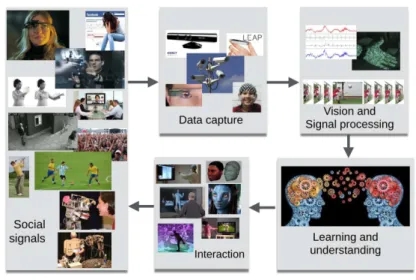
Current research programs at LAIV (Laboratory for the Analysis of Images and Vision) involve the computational modelling and understanding of human behaviors and patterns of behavioral signals captured by a variety of sensors (Figure 1). This relates to a number of tasks: i) sensing and analyzing dis-played behavioral signals including facial expressions and body gestures, in the context in which observed behavioral signals were displayed; iii) under-standing human behavior by translating the sensed human behavioral signals and context descriptors into a description of the shown behavior.
Realizations of behavioural modelling are of interest for surveillance, be-havioral biometrics, affect-sensitive systems in computer-aided learning en-vironment, customer service, intelligent driver assistance, and entertainment industry.
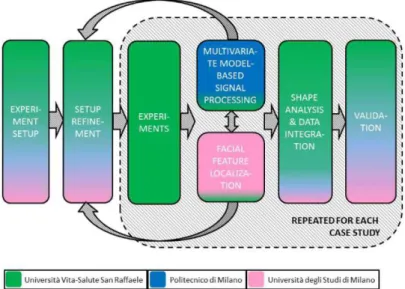
In such framework, our largest on-going research project (see Figure 2) concerns the design of a computational tool to support facial expressions and
Figure 1. LAIV research activities at a glance
biosignals based shape analysis and Bayesian networks for interpreting emo-tions (Brombin et al., 2012).
This project has been motivated by the need to provide objective and quanti-tative tools to measure/identify emotions which will allow a better understand-ing, assessment, and treatment of neuropsychiatric patients. More precisely, the aim is to clarify theoretical knowledge in the context of anxiety and eating disorders, so to improve treatment techniques, rehabilitation methods, preven-tion and early diagnosis.
Specific research issues that have been recently addressed within and be-yond the above mentioned project are summarized in the following Sections.
2.
Processing of autonomic signals
Emotional experience is embodied in peripheral physiology. Hence, sys-tems can detect emotions by analyzing the pattern of physiological changes associated with each emotion (assuming a prototypical physiological response for each emotion exists). Meanwhile, the amount of information that the phys-iological signals can provide is increasing, mainly due to major improvements in the accuracy of psychophysiology equipment and associated data analysis techniques. Sympathetic and parasympathetic functions of the autonomic ner-vous system have been analyzed through Hearth Rate Variability signals (Costa et al., 2012).
Figure 2. Interpreting emotions: integrating facial expressions, autonomic signals, shape analysis and Bayesian networks
3.
Processing of facial signals
Facial expression, together with other communicative signals such as head gestures and gaze, is a rich source of information for nonverbal interaction. In such endeavour, a crucial initial step is the detection of certain facial fea-ture points usually referred aslandmarks. Sparse coding techniques are cur-rently investigated for either feature learning for the extraction of reliable face landmarks (Boccignone et al., 2014a) and for face recognition (Adamo et al., 2012; Adamo et al., 2013). The rationale behind this approach is that unsuper-vised learning of sparse code dictionaries from face data can be an effective approach to cope with such challenging problems.
Also, in a different perspective, affective expression recognition has been addressed in the framework of the simulationist paradigm (Vitale et al., 2014).
4.
Gaze behavior processing
The relationship between the social function of gaze and its primary cog-nitive function for the gazer - to foveate and hence analyse in depth a region of the visual world - has emerged in recent years. Different stochastic mod-els for the analysis and the simulation of gaze behavior have been studied in terms of ecological foraging behavior (Boccignone and Ferraro, 2014; Boc-cignone and Ferraro, 2013b; BocBoc-cignone and Ferraro, 2013a; Clavelli et al.,
2014; Clavelli et al., 2013). Interestingly, although mental states can be in-ferred from other modalities, the eyes, are the best and most immediate ’win-dows to the mind’, and also the best indicators that we have ’connected’ with another mind. Advanced machine learning techniques have been exploited for detecting the signature of expertise through eye-movements analysis (Boc-cignone et al., 2014b).
5.
Human behavior understanding and Machine
Learning
Social Signal Processing is a multidisciplinary venture, with topics such as computer vision, signal processing and machine learning. In particular, ma-chine learning is of fundamental importance for both understanding behaviors and mining the hidden mechanisms that generated them. New general learning techniques for intrinsic dimensionality estimation and Fisher discriminant clas-sifiers have been developed in our lab (Rozza et al., 2012; Campadelli et al., 2013; Ceruti et al., 2014).
Further, the epistemological issue of levels of explanation in behavioral sci-ences is under investigation (Boccignone and Cordeschi, 2012).
6.
User Interaction
Face recognition systems aim to recognize the identity of a person depicted in a photograph by comparing it against a gallery of prerecorded images. Cur-rent systems perform quite well in controlled scenarios, but they allow for none or little interaction in case of mistakes due to the low quality of images or to algorithmic limitations. A guided user interface for improving automatic face recognition has been proposed, which allows to adjust from a fully automatic to a fully assisted modality of execution, according to the difficulty of the task and to amount of available information (gender, age, etc.) (Arca et al., 2012).
References
Adamo, Alessandro, Grossi, Giuliano, and Lanzarotti, Raffaella (2012). Sparse representation based classification for face recognition by k-limaps algorithm. In Elmoataz, Abderrahim, Mammass, Driss, Lezoray, Olivier, Nouboud, Fathallah, and Aboutajdine, Driss, editors, Image and Signal Processing, volume 7340 ofLecture Notes in Computer Science, pages 245–252. Springer Berlin Heidelberg.
Adamo, Alessandro, Grossi, Giuliano, and Lanzarotti, Raffaella (2013). Face recognition in un-controlled conditions using sparse representation and local features. In Petrosino, Alfredo, editor,Image Analysis and Processing, ICIAP 2013, volume 8157 ofLecture Notes in Com-puter Science, pages 31–40. Springer Berlin Heidelberg.
Arca, Stefano, Campadelli, Paola, Lanzarotti, Raffaella, Lipori, Giuseppe, Cervelli, Federico, and Mattei, Aldo (2012). Improving automatic face recognition with user interaction. Jour-nal of Forensic Sciences, 57(3):765–771.
Brombin, Chiara, Ferrario, Emanuela, and Lanzarotti, Raffaella (2012). Interpreting emotions: a computational tool integrating facial expressions and biosignals based shape analysis and bayesian networks. FIRB - Future in Research, Ministero dell’Istruzione, dell’Universit«a e della Ricerca. Grant: RBFR12VHR7.
Campadelli, Paola, Casiraghi, Elena, Ceruti, Claudio, Lombardi, Gabriele, and Rozza, Alessan-dro (2013). Local intrinsic dimensionality based features for clustering. In Petrosino, Al-fredo, editor,Image Analysis and Processing ICIAP 2013, volume 8156 ofLecture Notes in Computer Science, pages 41–50. Springer Berlin Heidelberg.
Ceruti, Claudio, Rozza, Alessandro, Bassis, Simone, Lombardi, Gabriele, Casiraghi, Elena, and Campadelli, Paola (2014). Danco: An intrinsic dimensionality estimator exploiting angle and norm concentration.Pattern Recognition. To appear.
Clavelli, Antonio, Karatzas, Dimosthenis, Llados, Josep, Ferraro, Mario, and Boccignone, Giuseppe (2013). Towards modelling an attention-based text localization process. In Sanches, Joao, Mic«o, Luisa, and Cardoso, Jaime S., editors,Pattern Recognition and Image Analysis, vol-ume 7887 ofLecture Notes in Computer Science, pages 296–303. Springer Berlin Heidel-berg.
Clavelli, Antonio, Karatzas, Dimosthenis, Llados, Josep, Ferraro, Mario, and Boccignone, Giuseppe (2014). Modelling task-dependent eye guidance to objects in pictures.Cognitive Computa-tion, pages 1–27.
Costa, Tommaso, Boccignone, Giuseppe, and Ferraro, Mario (2012). Gaussian mixture model of heart rate variability.PloS one, 7(5):e37731.
Rozza, Alessandro, Lombardi, Gabriele, Casiraghi, Elena, and Campadelli, Paola (2012). Novel fisher discriminant classifiers.Pattern Recognition, 45(10):3725 – 3737.
Vitale, Jonathan, Johnston, Benjamin, Williams, Mary-Anne, and Boccignone, Giuseppe (2014). Reading emotions in facial expressions: a computational framework inspired by simulation theories of empathy. InAnnual International Conference on Biologically Inspired Cognitive Architectures, BICA. Elsevier. Submitted.