OpenID
emailEnabled Browser: Towards Fixing the Broken
Web Single Sign-On Triangle
San-Tsai Sun, Kirstie Hawkey, Konstantin Beznosov
Laboratory for Education and Research in Secure Systems Engineering Department of Electrical and Computer Engineering
University of British Columbia Vancouver, Canada
{santsais,hawkey,beznosov}@ece.ubc.ca
ABSTRACT
Current Web single sign-on (SSO) solutions impose a cogni-tive burden on web users and do not provide content-hosting and service providers (CSPs) with sufficient incentives to become relying parties (RPs). We propose a browser-based Web SSO solution that requires minimal user interaction and provide RPs with clear value propositions to motivate their adoption. Our approach builds OpenID support into web browsers, hides OpenID identifiers from users by using their existing email accounts, extends the OpenID protocol to perform authentication directly by browsers, and intro-duces an OpenIDAuth HTTP access authentication scheme to convey authenticated identities automatically into web-sites that support OpenID for authentication. Our solution embeds an intuitive and consistent login experience for web users in the browser; to motivate adoption by RPs, it pro-vides them with instant marketable leads and the potential for gradual engagement of site visitors.
Categories and Subject Descriptors
D.4.6 [Security and Protection]: AuthenticationGeneral Terms
Security
Keywords
OpenID, Web Single Sign-On, Web Identity Management, Authentication, Identity-Enabled Browser
1.
INTRODUCTION
Today’s Web is site-centric; a user has to maintain a sep-arate copy of their identity and corresponding password for each content-hosting and service provider (CSP). A large-scale study of password habits found that a typical web user
Permission to make digital or hard copies of all or part of this work for personal or classroom use is granted without fee provided that copies are not made or distributed for profit or commercial advantage and that copies bear this notice and the full citation on the first page. To copy otherwise, to republish, to post on servers or to redistribute to lists, requires prior specific permission and/or a fee.
DIM’10,October 8, 2010, Chicago, Illinois, USA. Copyright 2010 ACM 978-1-4503-0090-2/10/10 ...$10.00.
has about twenty-five accounts that require passwords and types eight passwords per day [11]. Web users face the bur-den of managing this increasing number of accounts and passwords, which leads to “password fatigue” [48]. Aside from the burden on human memory, password fatigue may cause users to devise password management strategies that degrade the security of their protected information [14, 11]. Web single sign-on (SSO) systems are meant to address the root causes of the password fatigue problem [7]. A Web SSO system separates the role of identity provider (IdP) from that of relying party (RP) to enable users to leverage one identity across multiple RPs. An IdP issues identities or credentials to users, while an RP depends on the IdP(s) to assert the user credentials before allowing them access to its services. In addition to reducing users’ memory burden, a globally adopted Web SSO solution can enable content sharing across and beyond the boundaries of CSPs [42].
OpenID [37] and InfoCard [32] are mainstream Web SSO solutions targeted for Internet-scale adoptions [26, 7]; how-ever, they are facing an RP adoption problem [43]. Evidence shows that although major CSPs acted quickly to become OpenID IdPs (there are currently over one billion OpenID-enabled accounts), only a limited number of websites have adopted the role of RP [35, 22, 31, 34]. This is similar to having more than a billion keys, but few locks to use. For InfoCard, the list of RPs and IdPs is almost empty [46]. Fig-ure 1, the broken triangle of the Web SSO identity ecosys-tem, illustrates this RP adoption problem. Each dashed line indicates a lack of driving force or incentive between two ac-tors in the ecosystem. For instance, lineBshows the lack of incentive for a relying party to support SSO for users.
Fundamentally, Web SSO systems shift the functions of identity collection and authentication from RPs to IdPs. However, the incentive for RPs to rely on the identity asser-tion services provided by IdPs is insufficient, as illustrated by lineAin Figure 1. RPs are not willing to relinquish con-trol over their user base unless they can obtain user data and verify the IdP’s authentication and data collection poli-cies [23, 7]. In addition, RPs have to choose which IdPs to trust as they are liable for any losses if IdPs get compro-mised [30].
Current Web SSO solutions do not provide RPs with suf-ficient business incentives for supporting Web SSO for users (lineBin Figure 1). CSPs are reluctant to modify their login UI and process because new login procedures might confuse and upset users [12, 38]. In addition, RPs might not want to expose their users to potential business competitors because
Figure 1: The broken triangle of the Web SSO iden-tity ecosystem. Each dashed line indicates a lack of driving force or incentive between two actors.
once the attention of users has been redirected to an IdP during the login process, they might not return [7]. As early adoption does not appear to provide RPs with competitive advantages, CSPs may be waiting until Web SSO technol-ogy is mature and the cost of user training has already been absorbed by other websites.
To encourage adoption by RPs, Web SSO systems have to rely on the demand from users as the driving force (lineC
in Figure 1). However, the login interaction flows provided by today’s Web SSO solutions are shared-identity sign-on (SISO) ones rather than true single sign-on. With SISO solutions, users can use one identity to sign into multiple RPs. Nevertheless, when accessingNRPs using one IdP, the user must visitN+ 1 different login forms (one for each RP website and one on the IdP), choose an IdP to loginNtimes viaN possible ways, read the consent page (e.g., consent to release identity attributes, setup a custom identifier) on the IdPNtimes, and log outN+1 times throughN+1 different interfaces. These complex and inconsistent user experiences impose a cognitive burden on web users [12, 38, 7].
SISO redirects the user’s attention during the login pro-cess. However, in addition to usability issues [12, 7], redirec-tion exposes users to phishing attacks [24, 7, 27] and makes IdP tracking possible [26]. InfoCard [32] redirects users only to their identity selector. However, forNRPs using one IdP, the user has to provide her credential to the IdPN times unless a self-issued card (without password protection) is selected. Moreover, using multiple identities in one brows-ing session complicates the process for users even further. When users sign on with multiple IdPs in one browser ses-sion, they have to remember which identity was used for ac-cessing which RP. Mixing identities in one browser session can make it difficult for users to determine why an access failed, and whom to contact when a problem is encountered. SISO requires usable interfaces and login interaction flows from both RPs and IdPs. Simply adding an OpenID textbox or InfoCard icon to the traditional login page is not an op-tion [12, 38]. To improve the user experience, some OpenID RP adopters provide a list of IdP logos on their login form for users to choose from. The users can simply click on an IdP icon to initiate a sign-on process. However, this ap-proach leads to the “NASCAR” problem [27] when the list of IdPs grows too long to fit on the login screen. In addition,
using a list of IdPs restricts users’ freedom of choice, which impairs healthy competition in the ecosystem.
SISO is especially problematic in Web 2.0 applications that require access to personal data located on multiple CSPs. For OAuth-based applications [33] that process a user’s personal content from different providers, being pre-sented with a login form on each CSP is annoying, and imposes a cognitive impact on the user [3]. For client-side mashups that use Ajax-style web services to acquire user data from several websites, login forms will block such communications. In addition, SISO-based solutions may be more difficult to use on mobile devices that have limited input capabilities.
Our research goal is to develop a Web SSO solution that requires minimal user interaction and provides RPs with clear value propositions to motivate their adoption. In our vision of a true Web SSO system, a user should log into her IdP once and gain access to all websites that she has an account with,without being prompted to login again on each website. In other words, when accessing N RPs using one IdP, the user should provide her credential exactly once to the IdP, consent at most N times (one for each RP if the consent was not recorded for future use), and should perform a logout process only once from the IdP.
Designing an usable Web SSO solution that fulfills our vi-sion and motivates adoption by RP is challenging. To be usable, the solution must leverage the skills and experiences that an average Web user already has. It must not require any special software being installed on end-user computers or require users to manage public/secret keys or X.509 cer-tificates for performing cryptographic operations. There are currently over one billion OpenID-enabled “keys” provided by major CSPs [34], and they are too valuable to be ig-nored. Thus, the solution should be backward-compatible with existing IdPs and RPs and support gradual adoption. To facilitate adoption by RPs, the solution must not require them to modify their login UI; how to design a usable login UI and login interaction flow for web users is still an open problem that ongoing single sign-on research is attempting to address [38, 36]. Furthermore, the solution should be readily employable for emerging Web 2.0 applications that process personal data located on multiple CSPs.
To achieve our goal, we propose a new approach for Web SSO that leverages OpenID and email, and builds identity support into the browser. Our approach (1) builds OpenID support directly into web browsers, (2) hides OpenID iden-tifiers from users through the use of their existing email accounts, (3) extends the OpenID protocol to perform au-thentication directly with user-agents such as browsers (an OpenIDua extension), and (4) introduces an OpenIDAuth HTTP access authentication scheme to convey authenticated identities automatically to websites that support OpenID for authentication. To evaluate the feasibility of our approach, we implemented the proposed protocols in Java, and set up an OpenIDemail-enabled IdP and five RPs. In addition, we designed an OpenIDemail Firefox extension to demonstrate our vision of a true Web SSO solution.
With our approach, web users authenticate with their ex-isting email accounts via an OpenIDemail-enabled browser. With the user’s consent, their identity information trans-parently “flows” into websites that require it. Our approach provides users with intuitive and consistent login experiences and does not require RPs to modify their existing login
forms. In addition, our approach can turn an anonymous visitor into a marketable lead with one simple click, and it could potentially decrease the sign-up form abandonment rate on RPs’ websites through gradual engagement with vis-iting users.
This paper makes the following contributions: (1) a novel architecture and design of a browser-based Web SSO solu-tion, (2) an OpenIDua extension that enables the OpenID protocol to perform authentications directly with user agents, (3) a new HTTP access authentication scheme that enables an authenticated OpenID to be automatically provided to RPs, and (4) a prototype implementation of the proposed approach.
The rest of the paper is organized as follows. The next section discusses background and related work. Section 3 discusses our design considerations, and Section 4 presents the detailed design of our proposed solution. The prototype implementation and evaluation of our approach is discussed in Section 5. Section 6 discusses the implications of our approach, and Section 7 summarizes the paper and outlines future work.
2.
BACKGROUND AND RELATED WORK
In this section, we provide background information on Web SSO systems and present related work on browser-supported login solutions. Readers familiar with the subject can proceed directly to the next section.
2.1
Web SSO systems
To achieve Web SSO, major CSPs have provided a way for other CSPs to accept user credentials from their do-main (e.g., Microsoft Live ID, Yahoo BBAuth). However, these systems are proprietary and centralized; identity in-formation is maintained and controlled by a single admin-istrative domain. Federated identity solutions such as Lib-erty Alliance Project [25] and Shibboleth [21] enable cross-domain single sign-on. However, these solutions require pre-established trust relationships and agreements between or-ganizations in the federation, making them hard to scale on the Web.
OpenID [37] is an open, user-centric identity solution, which avoids the scalability problems of federated identity solutions. OpenID is user-centric in the sense that users are free to choose or setup their own OpenID providers. One key scalability feature of OpenID is that it does not require any pre-established trust relationships between IdPs and RPs. According to the OpenID Foundation [34], as of Septem-ber 2009, more than one billion OpenID enabled user ac-counts were provided by major CSPs (e.g., Google, Yahoo, AOL, Microsoft). OpenID is a promising solution. However, OpenID suffers from adoption [35, 22, 31, 34] and usability problems [24, 7, 27], is vulnerable to phishing attacks [24, 7, 27], and imposes privacy concerns [26].
Information cards (known as InfoCard) [32] are personal digital identities that are analogous to real-world identity cards such as passports, driver licenses, and credit cards. Each card contains assertions about a user’s identity that are either self-issued or issued by an identity provider. When logging into a web site, the user selects a card instead of typ-ing a user name and password. Information cards have im-portant features such as phishing-resistant authentication, IdP-to-RP unlinkability, and real-time user consent. How-ever, in comparison to OpenID, InfoCard is a heavy-weight
protocol. In particular, users need to install an identity selector and relying parties must have a valid SSL certifi-cate configured to provide secure channels when communi-cating with identity selectors. Furthermore, because cards are stored on the end user’s computer, they could be stolen and used to impersonate the victim if the user’s computer is compromised [18]. Additionally, InfoCard raises privacy issues when used on shared/public computers and is difficult to employ when users switch between multiple computers.
The OpenID Information Card specification [19] enables OpenID IdPs and RPs to perform OpenID authentication using InfoCards. The OpenID assertions from OpenID IdPs to the RPs is performed by the identity selector, which makes OpenID authentication resistant to phishing. Nev-ertheless, the fundamental usability, security, and adoption problems of InfoCard are not addressed.
2.2
Browser-supported login solutions
Sxipper [45] is a form manager that helps users fill-in web forms such as registration or order forms. It also recognizes login forms and leverages the Firefox built-in password man-ager for single-click login. This Firefox add-on enables web users to maintain several personae; each persona consists of a set of user attributes such as name, email, and address. When encountering a web form, Sxipper prompts the user to pick a persona and then fills the corresponding form au-tomatically. The main limitation of Sxipper is that users still have to maintain a separate copy of their identity for each CSP, which makes online profile management and con-trolled content sharing difficult. In addition, Sxipper might not detect forms correctly; and it stores sensitive informa-tion such as credit card numbers on the user’s local machine. This poses a security threat if the user’s computer is com-promised and raises portability issues when users switch be-tween computers or want to use a shared/public computer. VeriSign’s Seatbelt Firefox add-on [47] is designed to make OpenID more convenient to use by automatically filling in a user’s OpenID URL when visiting relying parties. This extension also provides an OpenID user with information about their login state with their OpenID provider and au-tomatically monitors OpenID transactions to help prevent phishing attacks. Seatbelt is easy to use; however, it may not detect OpenID login form fields precisely as a simple text matching technique (e.g., openid, oidurl, open-id, open id) is used to identify them. In addition, it requires Seatbelt specific configurations and login state provision from the participating OpenID IdPs. Furthermore, it is unable to detect “rogue relying party proxying” phishing attacks (e.g., content scraped from the real site) that do not rely on HTTP redirections when spoofing victims.
Weave Identity [29] from Mozilla Labs is a Firefox add-on that leverages a Firefox built-in password manager for single-click and automatic logins and integrates Weave server accounts for automatic OpenID sign-on. Similar to VeriSign’s Seatbelt, it might not detect and submit login forms cor-rectly; and automatic OpenID login support is limited only to Weave accounts. Moreover, Weave Identity and Seatbelt are SISO solutions rather than true SSO ones.
3.
DESIGN CONSIDERATIONS
In addition to the usability and backward-compatibility requirements discussed in Section 1, we discuss other con-siderations that affect our design decisions in this section.
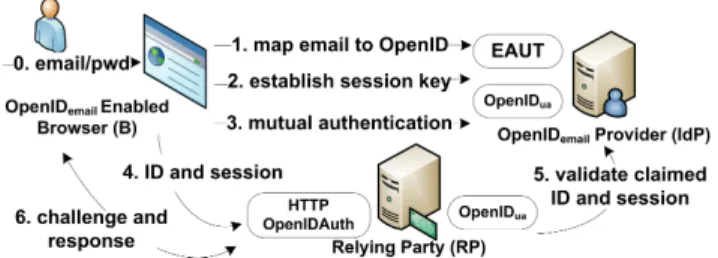
Figure 2: System architecture and high-level data flow of the proposed Web single sign-on system.
3.1
Build Identity Support Into Browser
The adoption of current Web SSO solutions is facing a classic chicken-and-egg problem: CSPs do not want to change their authentication procedures until a critical mass of users have adopted Web SSO, and users have little incentive to employ the technology unless many of their CSPs are sup-ported as RPs [39]. In addition, users have no urgent need for SSO as they can use a password manager as a limited version of a personal identity manager [28].To resolve this chicken-and-egg problem, future Web SSO development needs additional forces from other sources be-yond the actors in the Web SSO triangle [43]. As the browser is the central piece that communicates with all actors in the identity ecosystem, we conjecture that the browser can po-tentially provide driving forces for RPs to adopt SSO when it is directly augmented with identity support. Currently, most web users are not aware that they already own SSO “keys” hosted on major CSPs. To advocate users’ awareness, an identity-enabled browser could prompt users to sign in before browsing, provide users with an intuitive way for se-lecting an identity to use when visiting websites, and make it clear that they can sync their personal data from IdPs to RPs right within the browser. By embedding the SSO experience into most web users’ daily web-surfing activities, the browser could drive users to reach the necessary critical mass to overcome the resistance of CSPs to become RPs.
3.2
Motivate Adoption by RPs
A high conversion rate (i.e., the ratio of visitors who be-come registered users) is desirable for many websites. How-ever, most websites convert only a fraction of visitors into customers (the average online conversion rate is around 3%, with the highest at approximately 9%) [41]. One key factor that affects a website’s conversion rate is the form aban-donment rate—the ratio of visitors that fail to complete a sign-up form [49]. Traditionally, websites redirect visitors to sign up for an account before granting them access to the protected resources or allowing them to create personal content. For password recovery and to ensure future com-munication with users, most websites also require validation via email before activating an account. Many web services need to identify each individual user before providing the requested service (e.g., access to shared personal content that is controlled by an access-control-list). However, this requirement discourages potential customers from trying a new web service. Thus, any new solutions should provide RPs with mechanisms that could improve the conversion rate on their websites to motivate their adoption.
3.3
Security Considerations
We focus on the threats posed from the interception of user input and network traffic. The adversary’s goals are to steal a user’s password or to gain unauthorized accesses to an RP by impersonating an OpenID owner. To steal a user’s password, an attacker could capture user passwords directly or infer them from collected data. We assume a user’s computer could be compromised. An attacker could install keyloggers to capture the user’s key strokes and use proxies to watch, replay, and modify network traffic between all actors in the system. The solution should be secure even under the threats of malicious CSPs, compromised user com-puters, and network traffic sniffing and modification.
OpenID and other similar HTTP-redirection based proto-cols (e.g., Google AuthSub [15], AOL OpenAuth [2], Yahoo BBAuth [52]) may habituate users to being redirected to IdP websites for authentication. If users do not verify the authenticity of these websites before entering their creden-tials (and they usually do not [40, 9]), phishing attacks are possible. To prevent phishing attacks, users must confirm the authenticity of an IdP before entering their credentials. Research on methods of authenticating websites to users include security indicators [6, 20], secure bookmarks for known websites [8, 51, 53], and automated detection and blacklist-ing of known phishblacklist-ing sites [10]. However, studies suggest that security indicators are ineffective at preventing phish-ing attacks [9, 40]; and blacklistphish-ing known phishphish-ing sites still cause the problem of a high rate of false-positives and false-negatives [54]. Even with improved security indicators, users may ignore them [50, 40, 44].
Based on the results of user studies that evaluate the ef-fectiveness of anti-phishing techniques [50, 9, 54, 40, 44], a Web SSO solution should avoid relying on users’ cognitive capabilities to detect phishing sites.
4.
APPROACH
Our approach is based on the identity flow metaphor from the design of operating systems (OS). In an OS, a user thenticates to the OS and that authenticated identity au-tomatically “flows” into all processes launched by the user. Our approach treats a browser as an operating system and each web site the user visits as a process. A user enters her existing user name/password on the Web into a browser; and with the user’s consent, that authenticated identity au-tomatically flows into all websites that require an authenti-cated identity.
4.1
System Architecture and Data Flow
The main actors in our system are an OpenIDemail iden-tity provider, an RP that supports the OpenIDAuth HTTP authentication scheme, and an OpenIDemail-enabled browser. Figure 2 illustrates the system architecture and high-level data flow among the actors.An OpenIDemailprovider is an existing OpenID identity provider augmented with both an email-to-OpenID trans-lation service (e.g., EAUT [13], WebFinger [17]) and an OpenIDuaextension. Web users are not accustomed to using an OpenID URL as an identifier [9, 1]; email addresses on the other hand, serve as user identifiers for many CSPs [1]. Our approach is not bound to any specific email-to-OpenID translation service. In our implemented solution, we com-bine EAUT and OpenID so that web users can login using their email addresses to IdPs while transparently conveying
an OpenID identifier to RPs for identification. With EAUT, an OpenIDemail provider is free to implement any custom logic to map or translate an email to an OpenID. OpenIDua is our proposed OpenID extension that allows IdPs to au-thenticate directly with user-agents such as browsers. De-tails of the OpenIDuaextension are discussed in Section 4.2. To “flow” authenticated identities automatically into web-sites that support OpenID for authentication, we introduce an HTTP access authentication scheme named OpenIDAuth. Similar to the HTTP Basic or Digest authentication schemes, OpenIDAuth is designed to allow a web browser, or other client program, to provide credentials when making an HTTP request. However, instead of utilizing the username and password as credentials, OpenIDAuth uses OpenID and a challenge/response protocol to ensure that a user “owns” the claimed OpenID. Details of the HTTP OpenIDAuth scheme are discussed in Section 4.3.
An OpenIDemail-enabled browser is a browser extended with the OpenIDemail protocol. To login, a user mutually authenticates to her IdP directly in the browser, instead of performing authentication on the IdP’s web site. There are three main steps to this login process (Steps 1 to 3 in Figure 2):
1. Map an email address to an OpenID: After a user enters her email address into an OpenIDemail-enabled browser, the browser maps it to an OpenID identifier via an email-to-OpenID mapping service and uses that to discover the end-point of the IdP.
2. Establish a session key with IdP: The browser uses an extendedassociateoperation (defined in OpenIDua) to exchange a shared session key with the IdP.
3. Mutually Authenticate with IdP: The browser mutually authenticates with the IdP via an extended
checkid_immediateoperation. This allows the IdP to assert that the user owns the claimed OpenID iden-tifier and the browser to validate the authenticity of the IdP. During this process, the password hash of the corresponding claimed OpenID is used as the shared secret between these two parties.
Once mutual authentication has been successfully com-pleted, the browser and the IdP share a tuple: OpenID i, session handleh, and session keyk.
When the user accesses protected content of an RP, the RP responds with an HTTP 401 “Unauthorized” message to the browser with the WWW-Authenticate scheme set toOpenID:session. There are three steps required for the browser and the RP to complete an OpenIDAuth authenti-cation (Steps 4 to 6 in Figure 2):
4. Supply a claimed OpenID and the session han-dle: The browser makes an HTTP request again with the claimed OpenID i and the corresponding session handlehin the request header.
5. Validate a claimed OpenID and the session han-dle: The RP discovers an IdP based on i and then sends i and h to the IdP to ensure that iand h are valid. The IdP responds to the RP with a validation result comprised of a noncenand signature
s=HM AC(i||h||n, k).
6. Compute a response for a given challenge: If the claimed OpenID is valid, the RP responds to the browser with an HTTP 401 “Unauthorized” message; it includesi,h,nin the response header and sets the WWW-Authenticate scheme to “OpenID:challenge”. The browser computes a signatures0=HM AC(i||h||n, k) based on the stored (h, k, i) tuple and the received noncen, and it sendss0 to theRPto check whether s0=s. If the check is successful, access is granted.
4.2
OpenIDua
Extension
To allow an IdP to communicate directly with a browser rather than relying on redirections with a RP, we propose OpenIDua, which is an OpenID extension that “piggybacks” extra information on theassociateandcheckid_immediate
operation messages. OpenIDuaextends the associate op-eration to prevent man-in-the-middle (MITM) attacks. The original OpenID protocol uses the Diffe-Hellman (DH) key exchange protocol to establish a session key; however, plain DH is vulnerable to MITM attacks. To prevent this at-tack between a browser and an IdP, our design piggybacks the associate operation with a claimed OpenID. As de-scribed in Section 8.2.3 of the original OpenID Specifica-tion [37], the session key is only XORed with the hash of a DH shared key (i.e.,kenc= (k)⊗H(gab modq). It is pos-sible for an MITM attacker to perform two distinct DH key exchanges with each party, which allowing the attacker to decrypt then re-encrypt the messages passed between them. With our extension, the additionalclaimed_idfield can be used by an IdP to find the corresponding password hash which is only known to the IdP and the browser, but not to the adversary. The function used to hash the password is indicated in pwd_hash_type field. Based on our exten-sion, the IdP responds to the browser with an encrypted session key by XORing the session key with the password hash and then XORing the result with the hash of a DH shared key: kenc= (k⊗Hp(p))⊗H(gabmod q). Upon re-ceiving the IdP’s response, the browser computes the session key: k=Hp(p)⊗(H(gab modq)⊗kenc).
OpenIDuaextends thecheckid_immediateoperation with an extra field named enc_pwd_hash that contains a pass-word hash encrypted with the session keyk. This informa-tion is used by an IdP to check whether a user “owns” the claimed OpenID identifer. The encryption method is indi-cated in theenc_typefield. As this is a direct communica-tion between a browser and an IdP, the value of the original
openid.return_to field should be ignored by the IdP. In our prototype implementation, we setopenid.return_toto the browser’sUser-AgentHTTP header. Below is a sample request from a browser (text in bold font indicates our ex-tension to the message):
[Browser request:] openid.ns.ua=http://lersse.ece.ubc.ca/openid/ext/ua/1.0 openid.ua.enc pwd hash=QAWSDERF412QA openid.ua.enc type=AES-256 openid.mod=checkid immediate openid.claimed id=ece.ubc.ca/alice openid.assoc handle=123456789
openid.return to=User-Agent: Mozilla/5.0 ...
The message format of the response from an IdP is identical to the one for the original checkid_immediate operation.
This operation is also used by an RP to check whether a given claimed OpenID and its corresponding session handle have been authenticated with the IdP (withoutenc_pwd_hash
field) when processing a request for protected content.
4.3
HTTP OpenIDAuth Scheme
To transmit a claimed OpenID transparently to an OpenID-enable web site, we introduce OpenIDAuth (Steps 4 and 6 in Figure 2), which is an HTTP access authentication scheme. For a given HTTP request to a protected resource, the RP responds to the browser with the following message in order to solicit a claimed OpenID and the corresponding session handle:
[RP response:]
HTTP/1.1 401 Authorization Required
WWW-Authenticate: OpenID:session
realm=“*.ubc.ca” auth-domain=“www.ubc.ca”
Therealmvalue andauth-domainspecified in the response header are used to define the realm of an authentication session, which is the area of protected resources that shares the same user credentials. To respond to anOpenID:session
message, the browser prompts the user to select an authenti-cated identity for the specificrealmon the RP. The browser can optionally record this identity-to-realm mapping and use it for future requests without prompting the user again (for a specific period of time designated by the user). Once an authenticated OpenID is selected, the browser makes an-other HTTP request:
[Browser request:]
GET /private/content.html HTTP/1.1
Authorization: OpenID:session
user-id=“http://ece.ubc.ca/alice”, session-id=“1234”
When an RP receives such a request, it sends the sup-plied OpenID and session id to an IdP via an extended OpenIDcheck_immediateoperation to ensure the supplied information is valid. If it is valid, the IdP responds with a positive assertion that consists of a nonce nand signature s=HM AC(i||h||n, k). The RP then usesnto challenge the browser. To respond to theOpenID:challengemessage, the browser computes a signature over the list of fields specified by thesignedfield (e.g., OpenIDi, session handleh, nonce n), and then sends the signature to the RP.
The RP then checks whether the response matches the sig-nature generated by the IdP. If it does, the RP responds to the browser with the requested resource and a logout URL in the header. The browser uses the logout URL to notify the RP when the single logout event is triggered by the user.
4.4
Log into an OpenIDemail
Provider
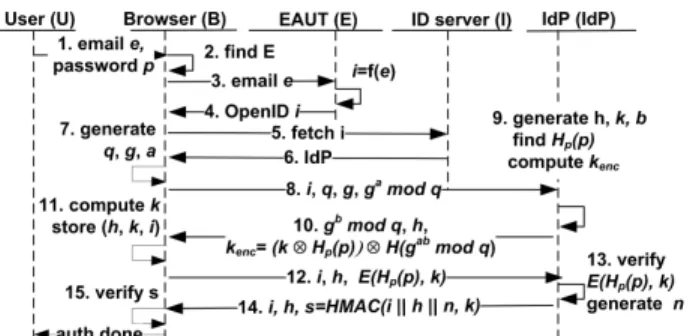
We now provide the sequence of steps for logging into an OpenIDemailprovider as illustrated in Figure 3:
1. UserUenters emaileand passwordpinto browserB. 2. B parses the domaind from e (email is in the form
user@domain) and prepends the string “http://” todto form an EAUT discovery URL.Bretrieves an XRDS document [16] on the URL, and lookups values repre-senting an EAUT serviceE.
Figure 3: Flow for logging into an OpenIDemail
provider.
3. BsendsetoE(i.e., https://lersse.ece.ubc.ca/eaut/). 4. Emapseto an OpenID identifieriand sends it back
toB.
5. Bmakes an HTTP request onito fetch the document hosted onI.
6. Iresponds with either an XRDS or HTML document that contains the IdP endpoint URLIdP.
7. Bgenerates a Diffie-Hellman (DH) modulusq, gener-atorg, and a random DH private keyato initiate an
associationoperation that establishes a session key kwithIdP(Steps 7 to 11).
8. B sends i, q, g, and the DH public key ga
mod q to
IdP.
9. IdPgenerates a new session handleh, a session keyk, and a random DH private key b. IdP then retrieves the password hashHp(p) based onifrom its credential store.
10. IdPsends gb
modq,h, and an encrypted session key kenc = (k⊗Hp(p))⊗H(gabmod q) toB. Note that kis XORed withHp(p) to prevent MITM attacks. 11. Bcomputesk=Hp(p)⊗(H(gab modq)⊗kenc) and
then stores the tuple (h,k,i).
12. To check whether Uowns the claimed OpenID iden-tifier i, B sendsi, h, andE(Hp(p), k) to IdPvia an extendedcheck_immediateoperation.
13. IdP decrypts the encrypted password hash using k, and checks whether Hp(p) matches the stored pass-word hash fori.
14. After password verification, IdP sends back i, h, a noncen, and a signatureHM AC(i||h||n, k) toB. 15. Bverifies the signature using the session key computed
at Step 11 to ensureIdPholds the same session key. Once the signature is verified, B acknowledges to U
that the authentication process has been successfully completed.
Our design allows users to log in with multiple IdPs. Users are prompted to choose an appropriate identity when ac-cessing protected content on RPs.
4.5
Access Protected Content
When the login process has completed, the browser and the IdP have been mutually authenticated and each has es-tablished a tuple of (h, k, i). We now illustrate the data flow for accessing protected content on an RP (Figure 4):
Figure 4: Flow for accessing protected content.
2. RPresponds with an HTTP 401 “Unauthorized” toB
withWWW-Authenticatescheme set toOpenID:session. 3. Bpresents an identity selection dialog forUto select
a claimed OpenID i. B sends r to RPagain with i and the corresponding session handlehin the request header.
4. RPmakes an HTTP request oni.
5. Iresponds with either an XRDS or HTML document that contains the IdP endpoint URLIdP.
6. RPsendsi,htoIdPvia an extendedcheck_immediate
operation to check whether i has associated with an authenticated sessionh.
7. IdP verifies i and h based on the stored (h , k ,i) tuple. If iand h are valid,IdPgenerates a nonce n (e.g., 2009-09-15T17:11:51 ZUNIQUE) and computes signatures=HM AC(i||h||n, k).
8. IdPsendsi,h,n, andstoRP.
9. RPresponds with an HTTP 401 “Unauthorized” toB
withWWW-Authenticatescheme set toOpenID:challenge
and uses the noncenas a challenge.
10. B computes signature s0 = HM AC(i||h||n, k) based on the stored (h,k,i) tuple and the received noncen. 11. BsendsrtoRPagain withi,h,n, ands0.
12. RP checks whether s = s0. If it does, RP returns the protected content to B and a logout URL in the response header.
Once the OpenIDAuth authentication process has com-pleted, theRPcan issue a cookie for the browserBto rep-resent the current authenticated session. B then includes this cookie in the HTTP request header for future commu-nications withRP, instead of re-initiating an OpenIDAuth process.
5.
PROTOTYPE IMPLEMENTATION AND
EVALUATION
To evaluate our approach, we implemented the proposed protocols in J2EE, and developed a Firefox extension to communicate with the new protocols. For OpenIDua, we extended OpenID4Java [5], which is an open-source Java library that offers support for implementing OpenID iden-tity providers and relying party websites. We setup an OpenIDemailprovider by augmenting an existing email server with EAUT and the OpenIDua extension. We also aug-mented five open-source J2EE web applications (Bookstore,
Employee Directory, Classifieds, Events, and Portal) fromgotocode.comto become OpenIDemailRPs.
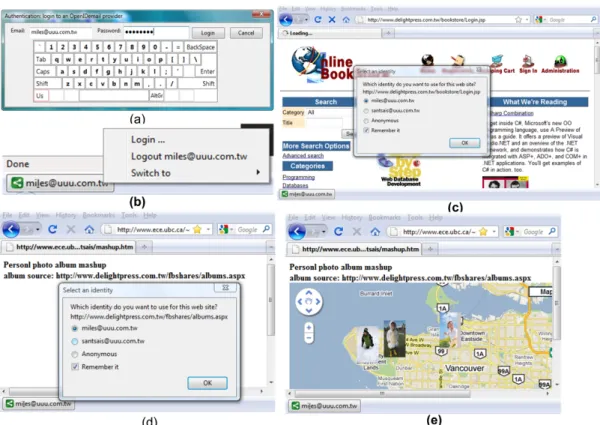
Figure 5a shows a screen shot of the OpenIDemail Fire-fox add-on when a user launches FireFire-fox, but before the UI of the browser is visible to the user. The user enters her email account and types or “clicks through” her password to start the login sequence discussed in Section 4.1, steps 1 to 3. Once logged in, the user’s current login information will be shown on an icon located on the status bar of the browser. The user can click on the icon to log out or sign in with additional accounts via a popup menu (Figure 5b). When the user is browsing to a protected resource on an RP that supports OpenIDAuth, the Firefox add-on will prompt the user to choose an identity (Figure 5c), before starting the automatic identity provisioning discussed in Section 4.1, steps 4 to 6. The add-on also records this action (i.e., “Re-member it” in Figure 5c), which allows automatic login for future access and assists users in determining which identity was used for accessing which RP.
5.1
Web 2.0 Mashup Applicability Evaluation
To evaluate the applicability of our approach in Web 2.0 applications that aggregate personal data, we designed an AJAX-style client-side mashup that combines Google Map and personal photo albums from a prior developed Facebook photo sharing application [42]. We augmented the photo sharing application with OpenIDAuth and OpenIDua exten-sion and added a location tagging function for album owners to indicate where the photos were taken. We also added a web service that returns a set of albums (in the form of a JSON object) based on the authenticated user.When a user loads the mashup, the Firefox add-on will prompt the user to choose an identity when the sharing ap-plication uses the OpenIDAuth protocol to solicit a claimed identity (Figure 5d). Based on the authenticated identity, the sharing application then returns the corresponding al-bums to the mashup. For each album, the mashup places a marker on the map using the album’s cover picture, as shown in Figure 5e.
6.
DISCUSSION
We now discuss why our approach is backward-compatible with existing OpenID IdPs and RPs, how it provides RPs with instant marketable leads and the potential for gradual engagement, and how it improves the security of the OpenID protocol.
6.1
Backward-Compatibility
Our solution is backward-compatible with existing OpenID IdPs and RPs, and therefore supports gradual adoption. First, the design of the OpenIDuaextension is based on the standard extension framework specified in the OpenID spec-ification. Therefore, OpenIDemail providers can still com-municate seamlessly with existing OpenID RPs. Second, OpenIDAuth is activated by an RPonlywhen an OpenIDemail enabled browser is detected. In our design, the browser’s OpenIDemailsupport is indicated in theuser-agentHTTP header by appending special text such asOpenIDemail/0.2.1
to this header. Thus, OpenIDAuth-enabled RPs can use the original OpenID protocol to communicate with browsers that do not have the OpenIDemailadd-on installed.
We designed the OpenIDemailFirefox add-on to demon-strate the benefits of our approach. We acknowledge that, in order to achieve widespread adoption, the proposed solution
Figure 5: Screen shots of the OpenIDemailenabled browser.
should be built directly into browsers instead of provided as an add-on to the browsers.
6.2
Gradual Engagement
With our approach, an RP can avoid sign-up forms in favor of gradual engagement. When an anonymous visitor consents to use one of her authenticated identifiers for the visiting RP, the RP can grant the user the required permis-sions for the task at hand without any interruption. This instantly turns the visitor into a marketable lead, who is identifiable by the user’s OpenID identifier and email ad-dress. Once the visitor is identifiable, the RP can gradually engage with the user to acquire additional attributes (e.g., gender, date of birth) when there is value for the user to pro-vide them. Ultimately, the RP may be able to convert the user from performing actions, such as simple page brows-ing, to performing more desired transactions, such as sales of products or software downloads.
Our approach allows users to choose (or switch) an iden-tity from the browser with one simple click and their trust may be built through gradual engagement with RPs. We hypothesize that the one-click conversion rate and the grad-ual engagement conversion rate would be higher than the conversion rate with traditional login options. We plan to conduct experimental studies as future work to assert this hypothesis.
6.3
Security
Based on our design, phishing is prevented because users enter their password only into the browser instead of on each individual IdP web site, and the IdP has to know the pass-word hash of the corresponding claimed OpenID in order
to complete the mutual-authentication process. To prevent key stroke logging attacks, we designed a virtual keyboard (Figure 5a) for user to “click-through” their passwords in-stead of keying them. The virtual keyboard is positioned differently each time it is displayed to prevent malware from inferring the password based on the captured mouse-click coordinates. The user’s email and password are only en-tered into the chrome area of the browser to prevent login form overlay attacks [27]. In addition, the proposed protocol transmits only the encrypted password hash to the IdP to prevent password sniffing or password-hash replay attacks during the login processes.
To impersonate an OpenID owner, an attacker must know the session key. Assume an attacker could route all traf-fic to a malicious IdP proxy (local or remote) during login processes. The proxy can then act as a MITM to watch and forward traffic back-and-forth between the browser and the real IdP. Thus, a MITM attacker can learn the claimed OpenID, the session handle, and all DH-related information; however, the session key cannot be derived as the password hash is unknown to the attacker. The MITM attacker can also learn the value (k⊗Hp(p)) from the IdP to the browser during association stages. Later, the attacker may discover both the passwordpand the keykby using an online brute-force or dictionary attack on all possiblep’s to discover all possible k’s. Nevertheless, similar to all other password-based authentication schemes, we assume IdPs employ cer-tain brute-force attack countermeasures (e.g., exponential delay response, n-trial account locking) to prevent online dictionary attacks.
Another way for an attacker to attempt to compromise a session key is to break in to the browser’s process to search
for the heap-allocated session key directly. To prevent such an attack, techniques such as data space randomization [4], which randomizes the representation of data stored in pro-gram memory, could be employed to effectively prevent non-control data attacks as well as code injection attacks. Even in the extreme circumstance where a session key is mali-ciously discovered, only the current login session is compro-mised. The protection of heap-allocated session keys is an important research topic, but it is outside the scope of this paper.
While our approach attempts to address OpenID’s phish-ing problem, other OpenID inherited security threats still exist (as described in the Section 15 of the OpenID Speci-fication [37]). The main threats are denial of service (DoS) attacks against an IdP, and MITM attacks between an RP and an IdP. How to make the OpenID protocol more re-silient to DoS and MITM attacks between an IdP and an RP is an open technical problem.
7.
CONCLUSION
Similar to how credit cards reduce the friction of paying for goods and services, Web SSO systems are built to reduce the friction of using the Web. However, current Web SSO solutions impose a cognitive burden on web users and do not provide CSPs with sufficient incentives to become RPs. In addition, web users do not have an urgent need for SSO and RPs would rather wait until SSO technology is mature and pervasive. In this paper, we present the architecture, design, and implementation of a browser-based Web SSO system that is a step towards fixing the broken Web SSO triangle. Our approach embeds an intuitive and consistent login experience in the browser, and can provide RPs with instant marketable leads and the potential for gradual en-gagement of website visitors to motivate their adoption.
In addition to normal browsing, our solution could be employed to make the login process more usable in other emerging application domains. For instance, our approach can be applied to Web 2.0 mashups that aggregate personal data from multiple CSPs or mobile devices that have lim-ited input capabilities. In addition, the proposed OpenIDua extension can be employed to leverage those billion OpenID-enabled accounts into traditional rich-client applications and appliance devices such as Netflix, XBox, and Zune.
For future work, we plan to conduct usability studies of our prototype implementation to ensure the proposed mech-anisms are usable to average web users. To motivate RPs adoption, we plan to extend our solution with user data exchange to enable RPs to import or synchronize user’s sonal data from IdPs to their website. We also plan to per-form a rigorous security analysis of the proposed protocols using automatic security protocol validation tools.
8.
ACKNOWLEDGMENTS
We thank members of the Laboratory for Education and Research in Secure Systems Engineering (LERSSE) who sup-plied valuable feedback on the earlier drafts of this paper. Research on the OpenIDemail-enabled browser has been par-tially supported by the Canadian NSERC ISSNet Internet-worked Systems Security Network Program.
9.
REFERENCES
[1] B. Adida. EmID: Web authentication by email address. InWeb 2.0 Security and Privacy Workshop 2008, Oakland, California, USA, 2008.
[2] AOL LLC. AOL Open Authentication API. http://dev.aol.com/api/openauth, January 2008. [3] P. Austel, S. Bhola, S. Chari, L. Koved, M. McIntosh,
M. Steiner, and S. Weber. Secure delegation for web 2.0 and mashups. InWorkshop on Web 2.0 Security And Privacy, 2008.
[4] S. Bhatkar and R. Sekar. Data space randomization. InDetection of Intrusions and Malware, and Vulnerability Assessment, volume 5137, pages 1–22, Paris, France, 2008. Lecture Notes in Computer Science.
[5] J. Bufu. OpenID4Java.
http://code.sxip.com/openid4java/, 2009. [6] CoreStreet Ltd. Spoofstick.
http://www.spoofstick.com/, 2005.
[7] R. Dhamija and L. Dusseault. The seven flaws of identity management: Usability and security
challenges.IEEE Security and Privacy, 6:24–29, 2008. [8] R. Dhamija and J. D. Tygar. The battle against
phishing: Dynamic security skins. InSOUPS ’05: Proceedings of the 2005 Symposium on Usable Privacy and Security, pages 77–88, New York, NY, USA, 2005. ACM.
[9] R. Dhamija, J. D. Tygar, and M. Hearst. Why phishing works. InCHI ’06: Proceedings of the SIGCHI conference on Human Factors in Computing Systems, pages 581–590, Montr´eal, Qu´ebec, Canada, 2006. ACM.
[10] Earthlink Inc. Earthlink toolbar: scambloker for Windows users. http://www.earthlink.net/, 2008. [11] D. Florencio and C. Herley. A large-scale study of web
password habits. InWWW ’07: Proceedings of the 16th international conference on World Wide Web, pages 657–666, New York, NY, USA, 2007. ACM. [12] B. Freeman. Yahoo! OpenID:One Key, Many Doors.
http://developer.yahoo.com/openid/ openid-research-jul08.pdf, July 2008.
[13] D. Fuelling and W. Norris. Email Address to URL Transformation 1.0. http://eaut.org/specs/1.0/, June 2008.
[14] S. Gaw and E. W. Felten. Password management strategies for online accounts. InProceedings of the second Symposium on Usable Privacy and Security, pages 44–55, 2006.
[15] Google Inc. AuthSub authentication for web applications. http://code.google.com/apis/accounts/ docs/AuthSub.html, December 2008.
[16] E. Hammer-Lahav. XRDS-Simple 1.0.
http://xrds-simple.net/core/1.0/, March 2008. [17] E. Hammer-Lahav. WebFinger. http://webfinger.net/,
August 2009.
[18] X. Hao. Attacking Certificate-based Authentication System and Microsoft InfoCard. InPower of Community Security Conference, 2009.
[19] D. Hardt and J. Bufu. OpenID Information Cards 1.0 - Draft 01. https://openidcards.sxip.com/spec/ openid-infocards.html, August 2007.
[20] A. Herzberg and A. Jbara. Security and identification indicators for browsers against spoofing and phishing attacks.ACM Trans. Interet Technology., 8(4):1–36, 2008.
[21] Internet2. Shibboleth System.
http://shibboleth.internet2.edu/, 2008. [22] JanRain Inc. Relying Party Stats.
http://blog.janrain.com/2009/01/
relying-party-stats-as-of-jan-1st-2008.html, 2009. [23] A. Jøsang, M. A. Zomai, and S. Suriadi. Usability and
privacy in identity management architectures. In ACSW ’07: Proceedings of the fifth Australasian symposium on ACSW frontiers, pages 143–152, Darlinghurst, Australia, Australia, 2007. Australian Computer Society, Inc.
[24] B. Laurie. OpenID: Phishing Heaven. http://www.links.org/?p=187, January 2007. [25] Liberty Alliance. Liberty Alliance Project.
http://www.projectliberty.org/, 2002.
[26] E. Maler and D. Reed. The venn of identity: Options and issues in federated identity management.IEEE Security and Privacy, 6:16–23, 2008.
[27] C. Messina. OpenID Phishing Brainstorm.
http://wiki.openid.net/OpenID Phishing Brainstorm, 2009.
[28] D. Mills. Identity in the Browser (Mozila Labs). https://mozillalabs.com/blog/2009/05/
identity-in-the-browser/, 2010.
[29] Mozila Labs. Weave Identity Account Manager. https://wiki.mozilla.org/Labs/Weave/
Identity/Account Manager, 2009.
[30] S. J. Murdoch and R. Anderson. Verified by visa and mastercard securecode: or, how not to design authentication. InIn the proceedings of Financial Cryptography and Data Security 2010, January 2010. [31] MyOpenID. OpenID Site Directory.
http://openiddirectory.com/, 2010.
[32] A. Nanda and M. B. Jones. Identity Selector Interoperability Profile V1.5.
http://informationcard.net/specifications, July 2008. [33] OAuth Core Workgroup. Oauth core 1.0 specification.
http://oauth.net/core/1.0/, December 2007.
[34] OpenID Foundation. Promotes, protects and nurtures the OpenID community and technologies.
http://openid.net/foundation/, 2009. [35] OpenID Foundation. OpenID Directory.
http://openiddirectory.com/, 2010. [36] OpenID Wiki. Openid user experience.
http://wiki.openid.net/browse/
view=ViewFolder¶m=user-experience, April 2010.
[37] D. Recordon and B. Fitzpatrick. OpenID authentication 2.0. http://openid.net/specs/ openid-authentication-2 0.html, December 2007. [38] E. Sachs. Usability Research on Federated Login.
http://sites.google.com/site/oauthgoog/UXFedLogin, October 2008.
[39] R. Sausner. Authentication Software: Widespread Adoption Seen As Unlikely Before 2011.
http://www.americanbanker.com/usb issues/ 116 4/-274048-1.html, 2006.
[40] S. E. Schechter, R. Dhamija, A. Ozment, and I. Fischer. The emperor’s new security indicators. In Proceedings of the 2007 IEEE Symposium on Security and Privacy, pages 51–65, Washington, DC, USA, 2007. IEEE Computer Society.
[41] I. Strouchliak. Conversion rate optimization. http://www.seochat.com/c/a/Website-Marketing-Help/Conversion-Rate-Optimization/,
2009.
[42] S.-T. Sun, K. Hawkey, and K. Beznosov. Secure Web 2.0 content sharing beyond walled gardens. In Proceedings of the 25th Annual Computer Security Applications Conference (ACSAC), pages 409–418. ACSA, IEEE Press, December 7-11 2009.
[43] S.-T. Sun, Y. BoshMaf, K. Hawkey, and K. Beznosov. A Billion Keys, but Few Locks: The Crisis of Web Single Sign-On. InProceedings of the New Security Paradigms Workshop (NSPW), Concord, MA, USA., to appear.
[44] J. Sunshine, S. Egelman, H. Almuhimedi, N. Atri, and L. F. Cranor. Crying Wolf: An empirical study of SSL warning effectiveness. InProceedings of 18th USENIX Security Symposium, pages 399–432, 2009.
[45] Sxipper Inc. Sxipper form manager Firefox extension. http://www.sxipper.com/, 2009.
[46] The Information Card Foundation. Advance the use of Information Card.
http://informationcard.net/foundation, 2009. [47] VeriSign Inc. VeriSign OpenID SeatBelt Plugin.
https://pip.verisignlabs.com/seatbelt.do, 2009. [48] Wikipedia. Password fatigue.
http://en.wikipedia.org/wiki/Password fatigue, 2009. [49] L. Wroblewski.Web Form Design: Fill in the blanks, chapter Gradual Engagement. Rosenfeld media, 2008. [50] M. Wu, R. C. Miller, and S. L. Garfinkel. Do security
toolbars actually prevent phishing attacks? InCHI ’06: Proceedings of the SIGCHI conference on Human Factors in Computing Systems, pages 601–610, New York, NY, USA, 2006. ACM.
[51] M. Wu, R. C. Miller, and G. Little. Web wallet: preventing phishing attacks by revealing user intentions. InSOUPS ’06: Proceedings of the second symposium on Usable privacy and security, pages 102–113, New York, NY, USA, 2006. ACM.
[52] Yahoo Inc. Browser-Based Authentication (BBAuth). http://developer.yahoo.com/auth/, December 2008. [53] K.-P. Yee and K. Sitaker. Passpet: convenient
password management and phishing protection. In SOUPS ’06: Proceedings of the Second Symposium on Usable Privacy and Security, pages 32–43, New York, NY, USA, 2006. ACM.
[54] Y. Zhang, S. Egelman, L. Cranor, and J. Hong. Phinding phish: Evaluating anti-phishing tools. In Proceedings of the 14th Annual Network and
Distributed System Security Symposium (NDSS 2007), 2007.