A preliminary version of this paper appears in the the Proceedings of Eurocrypt 2012. This is the full version.
Standard Security Does Not Imply Security Against
Selective-Opening
Mihir Bellare1 Rafael Dowsley2 Brent Waters3 Scott Yilek4
October 2011
Abstract
We show that no commitment scheme that is hiding and binding according to the standard definition is semantically-secure under selective opening attack (SOA), resolving a long-standing and fundamental open question about the power of SOAs. We also obtain the first examples of IND-CPA encryption schemes that are not secure under SOA, both for sender corruptions where encryption coins are revealed and receiver corruptions where decryption keys are revealed. These results assume only the existence of collision-resistant hash functions.
1
Department of Computer Science & Engineering, University of California San Diego, 9500 Gilman Drive, La Jolla, California 92093, USA. Email: [email protected]. URL:http://cseweb.ucsd.edu/~mihir. Supported in part by NSF grants CNS-0627779 and CCF-0915675.
2 Department of Computer Science & Engineering, University of California San Diego, 9500 Gilman Drive, La Jolla, California 92093, USA. Email: [email protected]. URL:http://cseweb.ucsd.edu/~rdowsley.
3
Department of Computer Science, University of Texas at Austin, 1616 Guadalupe, Suite 2.408, Austin, TX 78701, USA. Email: [email protected]. URL:http://www.cs.utexas.edu/~bwaters.
4
Contents
1 Introduction 1
2 Technical approach 4
3 Preliminaries 5
4 SOA-C insecurity of CE schemes 7
5 SOA-K insecurity of encryption schemes 11
6 SOA insecurity without Auxiliary Input 13
Bibliography 15
A Details for Section 6 16
1
Introduction
A commitment scheme E can be applied to a message m and coins r to (deterministically) produce a commitment c ← E(m;r) that is sent to a receiver. The sender can later “open” the commitment by providing m, r and the receiver checks that E(m;r) = c. The first security requirement, often called hiding, is formalized as IND-CPA, namely an adversary knowing m0, m1 and E(mb;r) for random b, r
has negligible advantage in computing challenge bit b. The second requirement, binding, asks that it be hard for an adversary to produce r0, r1 and distinct m0, m1 such that E(m0;r0) =E(m1;r1) 6= ⊥. Let us refer to a commitment scheme as HB-secure (Hiding and Binding) if it satisfies both these properties. HB-security is the standard requirement and HB-secure commitment schemes are a fundamental tool in cryptography in general and in protocol design in particular. HB-secure commitment implies PRGs [31], PRFs [21] and ZK proofs for NP[24].
Suppose there are n committers, the i-th computing its commitment c[i]← E(m[i];r[i]) to its mes-sage m[i] using coins r[i], the coins of different committers being of course not only random but also independent of each other. An adversary computes, as a function of the vector c of commitments, a subset I ⊆ {1, . . . , n} of the senders, and obtains the corresponding openings, namely hm[i] :i∈Ii and hr[i] :i∈Ii. This is called a selective opening attack (SOA). We say thatE is SOA-secure if privacy of the un-opened messages is preserved, meaning the adversary, after its SOA, cannot learn anything about hm[i] : i6∈ Ii other than it would from possession of hm[i] : i∈ Ii. (That is, the coins are unhelpful.) SOAs arise quite naturally in multi-party cryptographic protocols and SOA-security is desirable in many such settings.
A fundamental question that was posed in this area is whether (standard) HB-security implies SOA-security, meaning, is a HB-secure commitment scheme also SOA-secure? So far, the question has received neither a positive nor a negative answer. Intuitively, the answer would appear to be “yes,” for how could the coins accompanying the opened messages help, beyond the opened messages themselves, in revealing something about the un-opened messages? Yet attempts to prove SOA-security of a commitment scheme based on its HB-security have failed. But attempts to find a counter-example have also failed. We do not have a single example, even artificial, of a HB-secure commitment scheme that is demonstrably not SOA-secure. This situation has vexed and intrigued cryptographers for many years and been the subject or inspiration for much work [11, 19, 12, 35, 2, 20, 29, 6, 28].
This paper answers this long-standing open question. We show that the answer is negative. We give an example of a HB-secure commitment scheme which we prove is not SOA-secure. In fact our result is much stronger. It shows that no HB-secure commitment scheme is SOA-secure. Given any HB-secure commitment scheme, we present an attack showing it is not SOA-secure. Before going on to our results on encryption let us expand on this result on commitment including its implications and its relation to previous work.
SOA-secure commitment. Dwork, Naor, Reingold and Stockmeyer (DNRS) [19] gave a definition of SOA-secure commitments, henceforth referred to as SS-SOA, that captures semantic security for relations via a simulation-based formalization. Suitable for applications and widely accepted as the right definition, SS-SOA is what we use in our results. We show that no HB-secure commitment scheme is SS-SOA-secure by presenting, for any given HB-secure commitment scheme E, an adversary for which we prove that there is no successful simulator. We do not assume the simulation is blackbox. The only assumption made is the existence of a collision-resistant (CR) hash function.
Implications for IND-SOA-CRS.An indistinguishability-based definition of SOA-secure commitment is given in [2, 29]. It only applies when the message vectormis drawn from what’s called a “conditionally re-samplable (CRS) distribution,” and accordingly we denote it IND-SOA-CRS. This definition is of lim-ited use in applications because message distributions there are often not CRS, but for CRS distributions the definition is intuitively compelling and sound.
Letting SS-SOA-CRS denote the restriction of SS-SOA to CRS distributions, [2, 29] had noted that SS-SOA-CRS implies IND-SOA-CRS and asked whether the converse was true. We settle this question in the negative, showing that SS-SOA-CRS is strictly stronger. We arrive at this separation by combining two facts. First, the message distribution underlying our negative result is CRS, meaning we say that there does not exist a HB-secure commitment scheme that is SS-SOA-CRS, not just SS-SOA. Second, it is known that there does exist a HB-secure commitment scheme that is IND-SOA-CRS [2, 29].
Hofheinz [2, 29] shows that any commitment scheme that is statistically hiding and binding is IND-SOA-CRS. This positive result does not contradict our result, because, as we have just seen (indeed, invoking this positive result to do so), IND-SOA-CRS is a strictly weaker requirement than SS-SOA or SS-SOA-CRS. A question that still remains open is whether HB-security implies IND-SOA-CRS security.
Message distribution. It has been suggested that the difficulty in showing that HB-security implies SS-SOA is that the messages in the vector m may be related to each other. Our results imply that although showing HB-security implies SS-SOA-security is not just hard but impossible, it is not for this reason. We have already noted that our negative result holds for a message distribution that is CRS. In fact, the message distribution is uniform, meaning the messages in the vector are uniformly and independently distributed strings. Even for this uniform distribution, no HB-secure commitment scheme is SS-SOA secure. This may at first glance appear to contradict known results, for DNRS [19] showed that HB-security implied SOA-security for independently distributed messages. The difference is that they only showed this for what they called semantic security for functions, a notion implied by, but not known to imply their main notion of semantic security for relations that we call SS-SOA. Thus, not only is there no contradiction, but our results settle an open question from [19]. Namely we show that their result does not extend to SS-SOA and also that SS-SOA is strictly stronger than semantic security for functions.
Random oracles. Our result holds in the standard model and in the non-programmable random oracle (RO) model [32]. (In the latter the simulator is given oracle access to the RO and cannot define it.) In the standard (programmable) RO model [4], where the simulator can define the RO, our result is not true: there do exist HB-secure schemes that are SS-SOA secure. As an example, commitment scheme EH(m;r) =H(m;r), whereH is the RO, is HB-secure in the non-programmable RO. Our results show it
is not SS-SOA in this model. However, it can be easily shown SS-SOA in the programmable RO model. Consequently, our results yield another separation between the programmable and non-programmable RO models complementing that of [32].
Previous negative results. Hofheinz [2, 29] shows that no HB-secure scheme can be proven SS-SOA secure via blackbox reduction to “standard” assumptions. (A “standard” assumption as defined in [17, 2, 29] is one specified by a certain type of game.) However, it might still be possible to prove that a particular HB-secure scheme was SS-SOA in some ad hoc and non-blackbox way. The blackbox separation does not yield a single example of an HB-secure scheme that is not SS-SOA secure, let alone show, as we do, that all HB-secure schemes fail to be SS-SOA secure.
Interaction. Our result applies to non-interactive commitment schemes. When commitment involves an interactive protocol between sender and receiver the corresponding claim is not true. There does exist an interactive HB and SS-SOA secure commitment scheme. Specifically, Hofheinz [2, 29] presents a particular construction of such a scheme based on one-way permutations. Further results on interactive SOA-secure commitment are [39, 34].
withnsenders and one receiver, the latter having public encryption keyek. Senderipicks random coins r[i], encrypts its message m[i] via c[i]← E(ek,m[i];r[i]), and sends ciphertext c[i] to the receiver. The
adversary selects, as a function of c, a set I ⊆ {1, . . . , n} of the senders and corrupts them, obtaining their messages hm[i] :i∈Ii and coinshr[i] :i∈Ii. As before, we say thatE is SOA-secure if privacy of the un-opened messages is preserved. An SS-SOA definition analogous to the one for commitment was given in [2, 7].
The standard and accepted security condition for encryption since [26] is of course IND-CPA. SOA-security was identified upon realizing that it is necessary to implement the assumed-secure channels in multi-party secure computation protocols like those of [8, 13]. The central open question was whether or not IND-CPA implies SS-SOA. Neither a proof showing the implication is true, nor a counter-example showing it is false, had been given. We show that IND-CPA does not imply SS-SOA by exhibiting a large class of IND-CPA encryption schemes that we prove are not SS-SOA. The class includes many natural and existing schemes.
DNRS [19] had pointed out that the obstacle to proving that IND-CPA implies SS-SOA is that most encryption schemes are “committing.” Our results provide formal support for this intuition. We formalize a notion of binding-security for encryption. Our result is that no binding encryption scheme is SS-SOA secure. As with commitment, it holds when the distribution on messages is uniform.
The existence of a decryption algorithm corresponding to the encryption algorithm means that for any
ekcreated by honest key-generation, there do not existr0, r1and distinctm0, m1such thatE(ek, m0;r0) = E(ek, m1;r1). Binding strengthens this condition to also hold whenek is adversarially chosen, while also
relaxing it from unconditional to computational. It is thus a quite natural condition and is met by many schemes.
Inability to show that IND-CPA implies SS-SOA led to the search for specific SS-SOA secure encryp-tion schemes. Non-commiting encrypencryp-tion [11] yields a soluencryp-tion when the number of bits encrypted is bounded by the length of the public key. The first full solution was based on lossy encryption [2, 7]. De-niable encryption [10] was used to obtain further solutions [20, 6]. More lossy-encryption based solutions appear in [28]. In all these solutions, the encryption scheme is not binding. Our results show that this is necessary to achieve SS-SOA security.
SOA-security has so far been viewed as a theoretical rather than practical issue because even if there was no proof that IND-CPA implies SS-SOA, there were no attacks on standard, practical schemes such as ElGamal. Our results change this situation for they show that ElGamal and other practical schemes are not SS-SOA secure. Thus, the above-mentioned schemes that achieve SS-SOA in more involved ways are necessary if we want SS-SOA security.
IND-CCA doesn’t help: The Cramer-Shoup scheme [14] meets our definition of binding and is thus not SS-SOA secure. As with commitment, our results imply that IND-SOA-CRS security is strictly weaker than SS-SOA-CRS security, answering an open question from [2, 7]. Subsequent to our work, the relations between different notions of SOA-security under sender corruptions were further clarified in [9] but whether there exist schemes that are IND-CPA but not IND-SOA-CRS secure remains open.
SOA-secure encryption for receiver corruptions. In a dual of the above setting, there are n receivers and one sender, receiver ihaving public encryption key ek[i] and secret decryption key dk[i]. For each i the sender picks random coins r[i], encrypts message m[i] via c[i] ← E(ek[i],m[i];r[i]), and sends ciphertext c[i] to receiver i. The adversary selects, as a function of c, a set I ⊆ {1, . . . , n} of the receivers and corrupts them, obtaining not only the messages hm[i] :i∈Ii but also the decryption keys hdk[i] :i∈Ii. As usual, we say that E is SOA-secure if privacy of the un-opened messages is preserved. An SS-SOA definition analogous to the ones for commitment and sender-corruptions in encryption is given in Section 5.
such that it is hard to findek,dk0,dk1 and distinctm0, m1 such thatW(ek,dk0, m0) andW(ek,dk1, m1)
both accept. We show that no IND-CPA and decryption-verifiable encryption scheme is SS-SOA secure. Standard encryption schemes like ElGamal are decryption verifiable (even though they are not robust) so our result continues to rule out SS-SOA security for many natural schemes.
Non-committing encryption [11] yields an SS-SOA scheme secure for receiver corruptions when the number of bits encrypted is bounded by the length of the secret key. Nielsen [32] showed that any non-committing encryption scheme has keys larger than the total number of message bits it can securely encrypt. This result is not known to extend to SS-SOA, meaning the existence of an SS-SOA scheme for receiver corruptions without this restriction is open. Our results do not rule out such a full solution but indicate that the scheme must not be decryption-verifiable.
2
Technical approach
We provide a high-level description of our approach, focusing for simplicity on commitment schemes and the claim that no HB-secure commitment scheme is SS-SOA secure. We then discuss extensions and variants of our results.
The definition. Let E be a commitment scheme. To compact notation, we extend it to vector inputs by letting E(m;r) be the vector whosei-th component isE(m[i];r[i]). LetMbe a message sampler that outputs a vector mof messages and letRbe a relation. AdversaryA, given ciphertext vectorc=E(m;r) will corrupt a subset I of the senders, get their messages and coins, and output a value w. It is said to win if R(m, I, w) is true. The simulator, given no ciphertexts, can also corrupt a subsetI of senders but gets back only the corresponding messages, and outputs a value w. It too is said to win if R(m, I, w) is true. Security requires that for everyM,Rand adversaryAthere is a simulatorS such thatS wins with about the same probability as A. DNRS [19, Sec 7.1] require this to be true even for any auxiliary input agiven initially to Aand also to S. See Section 4 for a formal definition.
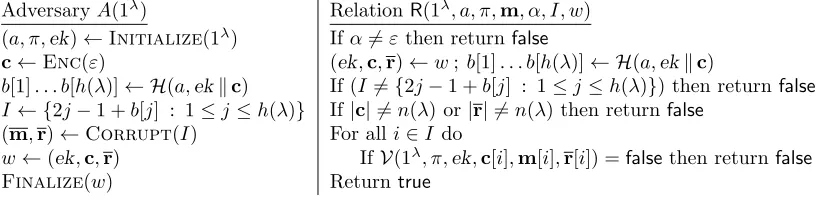
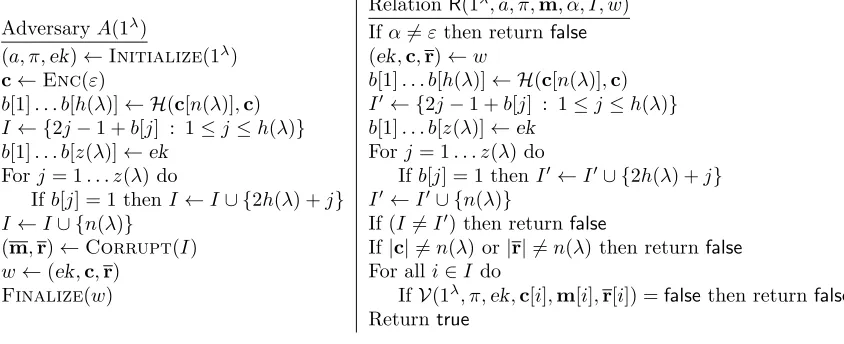
The attack. Let E be any, given HB-secure commitment scheme. We construct M,R, A for which we prove there is no simulator. We let Moutputn= 2h randomly and independently distributed messages, each of length ℓ. Our adversary A applies to the vectorc=E(m;r) of commitments a hash function H to get back anh-bit stringb[1]. . . b[h] and then corrupts the set of indicesI ={2j−1 +b[j] : 1≤j ≤h} to get back hm[i] : i ∈ Ii and hr[i] : i ∈Ii. Its output w consists of c and hr[i] : i ∈Ii. We define R, on inputs m, I andw, to check two constraints. Theopening constraint is thatE(m[i];r[i]) =c[i] for all i ∈I. The hash constraint is that I ={2j−1 +b[j] : 1 ≤j ≤h} for b[1]. . . b[h] = H(c). A detailed description of Aand Ris in Figure 3.
The simulator gets no ciphertexts. It must corrupt some set I of indices to get back hm[i] :i ∈Ii. Now it must create a ciphertext vector c and a list hr[i] : i∈ Ii of coins to output as w to R, and to satisfy the latter it must satisfy both constraints. Intuitively, the simulator faces a Catch-22. It is helpful for the intuition to think of H as a random oracle. The simulator could first pick I in some way, get hm[i] :i∈Ii from its oracle, and computec and hr[i] :i∈Ii to satisfy the opening constraint. But it is unlikely, given only poly(·) queries to H, to satisfy the hash constraint. On the other hand it could pick some c, define I to satisfy the hash constraint, and get hm[i] : i∈Ii from its oracle. But now it would have a hard time satisfying the opening constraint because the commitment scheme is binding.
This intuition that the simulator’s task is hard is, however, not a proof that a simulator does not exist. Furthermore, the intuition relies on the hash function being a random oracle and we only want to assume collision-resistance. Our proof takes an arbitrary simulator and proves that the probability that it makes the relation true is small unless it finds a hash collision or violates binding. The proof involves backing up the simulator, feeding it different, random responses to its corruption query, and applying a Reset Lemma analogous to that of [3]. We do not assume the simulation is blackbox. See Theorem 4.1.
however quite different. Also in [23] the simulator is assumed to make only blackbox calls to the adversary (verifier) and we make no such assumption, and they use a pairwise independent hash rather than a CR one. We point out that although the seed of our technique can be traced back 20 years it was not noted until now that it could be of use in settling the long-standing open question of whether HB-secure commitments are SS-SOA-secure.
Adaptive security. Our definition of SS-SOA, following [19, 2, 6] is one-shot, meaning the adversary gets all the ciphertexts at once and performs all its corruptions in parallel. A definition where the adversary can make adaptive ciphertext-creation and corruption requests is more suitable for applications. But our result is negative so using a restricted adversary only makes it stronger. (We are saying there is an attack with a one-shot adversary so certainly there is an attack with an adaptive adversary.)
The flip side is that if the adversary is allowed to be adaptive, so is the simulator. Our theorems only consider (and rule out) one-shot simulators for simplicity, but the proofs can be extended to also rule out adaptive simulators. We discuss briefly how to do this following the proof of Theorem 4.1.
Auxiliary inputs. As indicated above, the definition of DNRS [19] that we use allows both the adversary and simulator to get an auxiliary input, denoted “z” in [19, Sec 7.1]. The simplest and most basic form of our result exploits the auxiliary input to store the key describing the CR hash function. (If the simulator can pick this key the function will not be CR.)
Auxiliary inputs model history. They were introduced in the context of zero-knowledge by Goldreich and Oren [25] who showed that in their presence ZK had natural and desirable composability properties absent under the original definition of [27]. They have since become standard in zero-knowledge and also in simulation-based definitions in other contexts [18, 19] to provide composability. Their inclusion in the SS-SOA definition of commitment by DNRS [19] was thus correct and justified and we put them to good use.
Later definitions [2, 29] however appear to have dropped the auxiliary inputs. Although this appears to be only for notational simplicity (modern works on ZK also often drop auxiliary inputs since it is well understood how to extend the definition to include them) it does raise an interesting technical question, namely what negative results can we prove without auxiliary inputs?
A simple solution is to use one of the messages as a key. The adversary would corrupt the correspond-ing party to get this key, thereby defincorrespond-ing the hash function, and then proceed as above. This however makes the adversary adaptive, and while this is still a significant result, we ask whether anything can be shown for one-shot adversaries without using auxiliary inputs.
This turns out to be technically challenging. The difficulty is that the simulator can control the hash key. In Section 6 we present a construction relying on a new primitive we call an encrypted hash scheme (EHS). The idea is that there is an underlying core hash function whose keys are messages and an encrypted hash function whose keys are ciphertexts. We show how to build an EHS based on DDH.
We remark that from a practical perspective these distinctions are moot since hash functions like SHA-256 are keyless. Also, it is possible to work theoretically with keyless hash functions [38]. But in classical asymptotic theoretical cryptography, hash functions are keyed and we were interested in results in this setting.
3
Preliminaries
Notation and conventions. Ifn∈Nthen let 1ndenote the string ofnones and [n] the set{1, . . . , n}. The empty string is denoted by ε. By akbwe denote the concatenation of strings a, b. Ifais tuple then (a1, . . . , an) ← a means we parse a into its constituents. We use boldface letters for vectors. If x is a
vector then we let |x|denote the number of components of x and for 1 ≤i ≤ |x| we let x[i] denote its i-th component. For a set I ⊆[|x|] we letx[I] be the |x|-vector whosei-th component isx[i] if i∈I and ⊥ otherwise. We let ⊥n denote then-vector all of whose components are ⊥. We define the Embedding
Initialize(1λ)
b←${0,1}; π←$P(1λ)
(ek,dk)←$K(π)
Return (π,ek)
LR(m0, m1)
c←$E(1λ, π,ek, mb)
Returnc
Finalize(b′)
Return (b′=b)
Initialize(1λ) π←$P(1λ)
Returnπ
Finalize(ek, c, m0, m1, r0, r1)
d0← V(1λ, π,ek, c, m0, r0) d1← V(1λ, π,ek, c, m1, r1)
Return (d0∧d1∧(m06=m1))
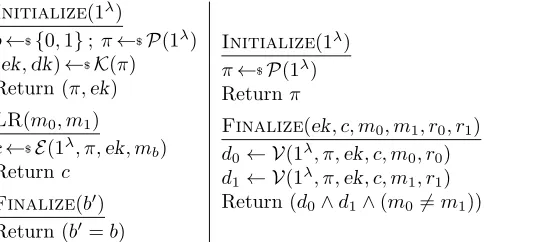
Figure 1: Game INDΠ (left) and game BINDΠ (right) defining, respectively, IND-CPA privacy and binding security of CE scheme Π = (P,K,E,V).
of xwith x∗ embedded in the positions indexed by I. More precisely, Subroutine Emb(1n, I,x∗,x)
j←0 ; Fori= 1, . . . , n do Ifi∈I then j←j+ 1 ; x[i]←x∗[j] Returnx.
All algorithms are randomized, unless otherwise specified as being deterministic. We use the abbreviation PT for polynomial-time. If Ais an algorithm theny←A(x1, . . . , xn;r) represents the act of running the
algorithm Awith inputsx1, . . . , xn and coins r to get an outputy andy←$A(x1, . . . , xn) represents the act of picking r at random and letting y ←A(x1, . . . , xn;r). By [A(x1, . . . , xn)] we denote the set of all
y for which there exists r such thaty=A(x1, . . . , xn;r).
Games. We use the language of code-based game-playing [5]. A game (see Figure 1 for examples) has an Initialize procedure, procedures to respond to adversary oracle queries, and a Finalize procedure. A game G is executed with an adversary Aand security parameter λas follows. A is given input 1λ and can then call game procedures. Its first oracle query must be Initialize(1λ) and its last oracle query
must be to Finalize, and it must make exactly one query to each of these oracles. In between it can query the other procedures as oracles as it wishes. The output of Finalize, denoted GA(λ), is called the output of the game, and we let “GA(λ)” denote the event that this game output takes valuetrue.
CE Schemes. We introduce CE (Committing Encryption) schemes as a way to unify commitment and encryption schemes under a single syntax and avoid duplicating similar definitions and results for the two cases. A CE scheme Π = (P,K,E,V) is specified by four PT algorithms. Via π←$P(1λ) the parameter-generation algorithm P generates system parameters such as a description of a group. Via (ek,dk)←$K(π) the key-generation algorithm K generates an encryption key ek and decryption key dk. Via c ← E(1λ, π,ek, m;r) the encryption algorithm deterministically maps a message m and
coins r ∈ {0,1}ρ(λ) to a ciphertext c ∈ {0,1}∗ ∪ {⊥} where ρ: N → N is the randomness length as-sociated to Π and c 6= ⊥ iff |m| = ℓ(λ) where ℓ: N → N is the message length associated to Π. Via d ← V(1λ, π,ek, c, m, r), deterministic verification algorithm V returns true or false. We require
that V(1λ, π,ek,E(1λ, π,ek, m;r), m, r) = true for all λ ∈ N, all π ∈ [P(1λ)], all (ek,dk) ∈ [K(π)], all r ∈ {0,1}ρ(λ) and all m∈ {0,1}∗ such that E(1λ, π,ek, m;r)6=⊥. We say that the verification algorithm
V is canonical if V(1λ, π,ek, c, m, r) returns the boolean (E(1λ, π,ek, m;r) =c6=⊥).
Game INDΠ of Figure 1 captures the standard notion of indistinguishability under chosen-plaintext attack (IND-CPA) [26] and serves to define privacy for CE schemes. The adversary is allowed only one
LRquery and the messagesm0, m1 involved must be of the same length. Game BINDΠcaptures binding security. For adversaries A, B we let
AdvindcpaΠ,A (λ) = 2 Pr[INDAΠ(λ)]−1 and AdvbindΠ,B(λ) = Pr[BINDBΠ(λ)].
Discussion. Commitment and encryption schemes can be recovered as special cases of CE schemes as follows. We say that Π is a commitment scheme if K always returns (ε, ε). We see that our two security requirements capture the standard hiding and binding properties. In Section 1 we had simplified by assuming the verification algorithm is canonical and there were no parameters but here we are more general. We say thatD is a decryption algorithm for CE scheme Π if D(1λ, π,dk,E(1λ, π,ek, m;r)) =m
for all λ ∈ N, all π ∈ [P(1λ)], all (ek,dk) ∈ [K(π)], all r ∈ {0,1}ρ(λ) and all m ∈ {0,1}∗ such that E(1λ, π,ek, m;r)6=⊥. We say that Πadmits decryption if it has a PT decryption algorithm and in that
case we say Π is an encryption scheme. IND-CPA is then, of course, the standard privacy goal.
Typical encryption schemes are perfectly binding under canonical verification with some added checks. For example, the ElGamal encryption scheme over a order-pgroup Gwith generator g (these quantities in the parameters) is binding under a verification algorithm that performs the re-encryption check and then also checks that quantities that should be in G or Zp really are. RSA-based schemes can be made binding by requiring the encryption exponent to be a prime larger than the modulus.
Lossy encryption schemes [2, 30, 37] are not binding because the adversary could provide a lossy encryption key and, under this, be able to generate encryption collisions. Non-commiting [11, 16] and deniable [10, 33] encryption schemes are intentionally not binding. These types of encryption schemes have been shown to have SOA security. Our results show that the lack of binding was necessary for their success at this task.
Hash Functions. A hash function Γ = (A,H) with associated output lengthh: N→Nis a tuple of PT algorithms. Viaa←$A(1λ) the key-generation algorithmAproduces a keya. Viay← H(a, x) the deter-ministic hashing algorithm Hproduces the h(λ)-bit hash of a string x under key a. Collision-resistance is defined via game CRΓ whose Initialize(1λ) procedure returns a←$A(1λ) and whoseFinalize pro-cedure on input (x, x′) returns (x 6= x′)∧(H(a, x) = H(a, x′)). There are no other procedures. The advantage of an adversary C is defined by AdvcrΓ,C(λ) = Pr
CRCΓ(λ)
. We say that Γ is collision-resistant (CR) ifAdvcrΓ,C(·) is negligible for every PTC. The following says that CR hash functions must have super-logarithmic output length and will be useful later:
Proposition 3.1 Let Γ = (A,H) be a hash function with associated output length h: N → N. If Γ is collision-resistant then the function 2−h(·) is negligible.
4
SOA-C insecurity of CE schemes
Here we show that no CE-scheme that is binding is SOA-C secure. This implies that no HB-secure commitment scheme is SOA-secure and that no binding IND-CPA encryption scheme is SOA-secure under sender corruptions. In Section 5 we establish similar results for SOA-K to show that no robust IND-CPA encryption scheme is SOA-secure for receiver corruptions.
SOA-C Security. A relation is a PT algorithm with boolean output. A message sampler is a PT algorithm M taking input 1λ and a string α and returning a vector over {0,1}∗. There must exist a function n: N →N (called the number of messages) and a function ℓ: N× {0,1}∗ ×N→ N (called the message length) such that |m|=n(λ) and |m[i]| =ℓ(λ, α, i) for all m∈ [M(1λ, α)] and all i∈[n]. An auxiliary-input generator is a PT algorithm.
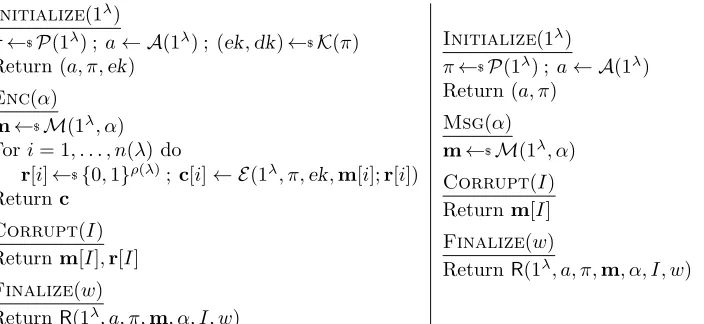
Let Π = (P,K,E,V) be a CE-scheme, Ra relation, M a message sampler and A an auxiliary-input generator. We define SOA-C security via the games of Figure 2. “Real” game RSOACΠ,M,R,A will be executed with an adversary A. An soa-c adversary’s (mandatory, starting) Initialize(1λ) call results in
Initialize(1λ)
π←$P(1λ) ; a← A(1λ) ; (ek,dk)←$K(π)
Return (a, π,ek)
Enc(α)
m←$M(1λ, α)
Fori= 1, . . . , n(λ) do
r[i]←${0,1}ρ(λ); c[i]← E(1λ, π,ek,m[i];r[i])
Returnc
Corrupt(I) Returnm[I],r[I]
Finalize(w)
ReturnR(1λ, a, π,m, α, I, w)
Initialize(1λ)
π←$P(1λ) ; a← A(1λ)
Return (a, π) Msg(α)
m←$M(1λ, α)
Corrupt(I) Returnm[I]
Finalize(w)
ReturnR(1λ, a, π,m, α, I, w)
Figure 2: Game RSOACΠ,M,R,A capturing the real-world SOA-C attack to be mounted by an adversary (left) and game SSOACΠ,M,R,Acapturing the simulated-world SOA-C attack to be mounted by a simulator (right).
SSOACΠ,M,R,A and gets back only auxiliary input and parameters from its Initialize(1λ) call, there being no encryption key in its world. It is then required to make exactly one Msg(α) call resulting in creation of a message vector but the simulator is returned nothing related to it. It must then make its Corrupt(I) and Finalize(w) calls like the adversary and wins under the same conditions. The soa-c-advantage of an soa-c-adversary A with respect to CE-scheme Π, message sampler M, relationR, auxiliary input generator A and soa-c simulator S is defined by
Advsoa-cΠ,M,R,A,A,S(λ) = Pr
RSOACAΠ,M,R,A(λ) −Pr
SSOACSΠ,M,R,A(λ) .
We say that Π is (M,A)-SOA-C-secure if for every PTRand every PT soa-c adversaryA there exists a PT soa-c simulator S such that Advsoa-cΠ,M,R,A,A,S(·) is negligible. We say that Π is SOA-C-secure if it is (M,A)-SOA-C-secure for every PTM,A.
Result. The following implies that any binding CE-scheme is not SOA-C-secure.
Theorem 4.1 Let Π = (P,K,E,V) be a binding CE-scheme with message length ℓ: N → N. Let Γ = (A,H) be a collision-resistant hash function with associated output length h: N → N. Let n(·) = 2h(·) and let M be the message sampler that on input 1λ, α (ignores α and) returns a n(λ)-vector whose
components are uniformly and independently distributed over {0,1}ℓ(λ). Then there exists a PT soa-c adversary A and a PT relation R such that for all PT simulators S there is a negligible function ν such that AdvsoaΠ,M-c,R,A,A,S(λ)≥1−ν(λ) for allλ∈N.
Thus, Π is not (M,A)-SOA-C-secure and hence cannot be SOA-C-secure. Moreover, this is true when the distribution on messages is uniform. These claims would only require Advsoa-cΠ,M,R,A,A,S(·) in the theorem to be non-negligible, but we show more, namely that it is almost one. Note that ℓis arbitrary and could even be ℓ(·) = 1, meaning we rule out SOA-C-security even for bit-commitment and encryption of 1-bit messages. The proof will make use of the following variant of the Reset Lemma of [3].
Lemma 4.2 LetV ={Vλ}λ∈Nbe a collection of non-empty sets. LetP1, P2 be algorithms, the second with boolean output. The single-execution acceptance probability AP1(P1, P2, V, λ) is defined as the probability that d=true in the single execution experiment St←$P1(1λ) ; m∗←$Vλ; d←$P2(St,m∗). The double-execution acceptance probability AP2(P1, P2, V, λ) is defined as the probability that d1 = d2 = true and
m∗0 6= m∗1 in the double execution experiment St←$P1(1λ) ; m∗
0,m∗1←$Vλ ; d0←$P2(St,m∗
0) ; d1←$ P2(St,m∗1). Then AP1(P1, P2, V, λ) ≤ 1/|Vλ|+
p
AP2(P1, P2, V, λ) for all λ∈N.
AdversaryA(1λ)
(a, π,ek)←Initialize(1λ) c←Enc(ε)
b[1]. . . b[h(λ)]← H(a,ekkc)
I← {2j−1 +b[j] : 1≤j ≤h(λ)} (m,r)←Corrupt(I)
w←(ek,c,r)
Finalize(w)
RelationR(1λ, a, π,m, α, I, w)
Ifα6=εthen returnfalse
(ek,c,r)←w;b[1]. . . b[h(λ)]← H(a,ekkc)
If (I6={2j−1 +b[j] : 1≤j≤h(λ)}) then returnfalse
If|c| 6=n(λ) or|r| 6=n(λ) then returnfalse
For alli∈I do
IfV(1λ, π,ek,c[i],m[i],r[i]) =falsethen returnfalse
Returntrue
Figure 3: AdversaryAand relation Rfor the proof of Theorem 4.1.
Proof of Lemma 4.2: Let δ = 1/|Vλ|. Let X(ω) = Pr[d=true] in the experiment St ← P1(1λ;ω) ;
m∗←$Vλ;d←$P2(St,m∗). SoE[X] =AP1(P1, P2, V, λ) where the expectation is over the coinsωofP1. Let a1 =AP1(P1, P2, V, λ) anda2 =AP2(P1, P2, V, λ). Then
a2 ≥ E[X(X−δ)] = E[X2]−δ·E[X] ≥ E[X]2−δ·E[X] = a21−δ·a1 where the third step above is by Jensen’s inequality. Now a21−δ·a1 = (a1−δ/2)2−δ2/4 so
a1 ≤ δ/2 + p
a2+δ2/4 ≤ δ/2 +√a2+ p
δ2/4 = δ+√a 2 which yields the lemma.
Proof of Theorem 4.1: The adversary A and relation Rare depicted in Figure 3. Let S be any PT soa-c simulator. In the real game the adversary always makes the relation return truehence
Advsoa-cΠ,M,R,A,A,S(λ) = 1−Pr
SSOACSΠ,M,R,A(λ) . We will construct a binding-adversary B and cr-adversaryC such that
Pr
SSOACSΠ,M,R,A(λ)
≤ 2−h(λ)ℓ(λ)+ q
AdvcrΓ,C(λ) +AdvbindΠ,B(λ). (1) The assumptions that Γ is collision-resistant, Π is binding, together with Proposition 3.1, imply that the RHS of Eq. (1) is negligible, which proves the theorem. It remains to construct B and C. Given S we can define sub-algorithms S1, S2 such thatS can be written in terms of S1, S2 as follows:
Simulator S(1λ)
(a, π)←Initialize(1λ) ; Msg(1λ, ε) ; (St, I)←$S
1(a, π)
m←Corrupt(I) ; w←S2(St,m) ; Finalize(w)
We clarify that we are not definingS; the latter is given and arbitrary. Rather,any S has the form above for some S1, S2 that can be determined given S. Specifically, S1 runsS until S makes its Corrupt(I) query, returning I along with the current state St of S. Then S2, given the response m to the query, feeds it back toS and continues executingS fromSt. By havingS1 put allS’s coins inSt we can assume S2 is deterministic. We may assume wlog that|I| is always h(λ) and that the argument α inS’s Msg call is ε since otherwiseR rejects. We now define adversary B. The embedding subroutine Emb it calls and the notation ⊥n(λ) were defined in Section 3:
AdversaryB(1λ)
π←Initialize(1λ) ; a←$A(1λ) ; (St, I)←$S
1(a, π) ; m∗0,m∗1←$({0,1}ℓ(λ))h(λ)
m0 ←Emb(1n(λ), I,m∗0,⊥n(λ)) ; m1←Emb(1n(λ), I,m∗1,⊥n(λ))
w0 ←S2(St,m0) ; (ek0,c0,r0)←w0; w1 ←S2(St,m1) ; (ek1,c1,r1)←w1; t←$I For all i∈I do Ifm0[i]6=m1[i] then t←i
Finalize(ek0,c0[t],m0[t],m1[t],r0[t],r1[t])
AdversaryC(1λ)
a←Initialize(1λ) ; π←$P(1λ) ; (St, I)←$S
1(a, π) ; m∗0,m∗1←$({0,1}ℓ(λ))h(λ)
m0 ←Emb(1n(λ), I,m∗0,⊥n(λ)) ; m1←Emb(1n(λ), I,m∗1,⊥n(λ))
w0 ←S2(St,m0) ; (ek0,c0,r0)←w0; w1 ←S2(St,m1) ; (ek1,c1,r1)←w1
Finalize((ek0kc0,ek1kc1)).
The analysis will use Lemma 4.2. Let Vλ= ({0,1}ℓ(λ))h(λ) and V ={Vλ}λ∈N. DefineP1, P2 via:
Algorithm P1(1λ)
π ← P(1λ) ; a←$A(1λ) ; (St, I)←$S
1(a, π)
m←$({0,1}ℓ(λ))n(λ); St←(1λ, a, π,m, I,St) Return St
AlgorithmP2(St,m∗) (1λ, a, π,m, I,St)←St m←Emb(1n(λ), I,m∗,⊥
n(λ)) ; w←S2(St,m)
m←Emb(1n(λ), I,m∗,m) ReturnR(1λ, a, π,m, ε, I, w)
Above the argument m∗ to P2 is drawn fromVλ. Now
Pr
SSOACSΠ,M,R,A(λ)
= AP1(P1, P2, V, λ) ≤ 2−h(λ)ℓ(λ)+ p
AP2(P1, P2, V, λ) (2) Above the equality is from the definitions and the inequality is by Lemma 4.2. Finally we claim that
AP2(P1, P2, V, λ) ≤ AdvcrΓ,C(λ) +AdvbindΠ,B(λ). (3)
Eqs. (2) and (3) imply Eq. (1) and conclude the proof. We now justify Eq. (3). To do so it is helpful to write down the double-execution experiment underlying AP2(P1, P2, V, λ):
π ← P(1λ) ; a←$A(1λ) ; (St, I)←$S
1(a, π) ; m←$({0,1}ℓ(λ))n(λ); m∗
0,m∗1←$({0,1}ℓ(λ))h(λ)
m0 ←Emb(1n(λ), I,m∗0,⊥n(λ)) ; m1 ←Emb(1n(λ), I,m∗1,⊥n(λ))
w0 ←S2(St,m0) ; w1←S2(St,m1) ; (ek0,c0,r0)←w0; (ek1,c1,r1)←w1
m0 ←Emb(1n(λ), I,m∗0,m) ; m1 ←Emb(1n(λ), I,m∗1,m) Return R(1λ, a, π,m
0, ε, I, w0)∧R(1λ, a, π,m1, ε, I, w1)∧(m∗0 6=m∗1).
Assume this experiment returns true. By definition of R it must be that I = {2j−1 +b0[j] : 1 ≤ j ≤h(λ)} where b0[1]. . . b0[h(λ)] = H(a,ek0kc0) and also I = {2j−1 +b1[j] : 1≤ j ≤ h(λ)} where b1[1]. . . b1[h(λ)] =H(a,ek1kc1). However,I is the same in both cases, so we must have H(a,ek0kc0) = H(a,ek1kc1), meaning we have a hash collision. This means that C succeeds unlessek0kc0 =ek1kc1.
But we now argue that in the latter case, B succeeds. We know m∗0 6= m∗1 so there is some t ∈ I such that m0[t]6=m1[t]. The definition of R implies that V(1λ, π,ek0,c0[t],m0[t],r0[t]) =true and also V(1λ, π,ek
1,c1[t],m1[t],r1[t]) =true. But sinceek0kc0 =ek1kc1 we have V(1λ, π,ek0,c0[t],m0[t],r0[t]) =trueand also V(1λ, π,ek0,c0[t],m1[t],r1[t]) =truewith m0[t]6=m1[t] soB wins.
Extensions, applications and remarks. The SOA-C definition could be weakened by allowing the simulator’s corruptions to be adaptive, meaning S is allowed multiple queries to procedure Corrupt
that now would take inputi∈[n(λ)] and returnm[i]. The proof strategy of Theorem 4.1 no longer works but can be extended to also rule out adaptive simulators. We would back S up to its last Corrupt
query and give a new response only to this query. We would now require ℓ(·) to be super-logarithmic so that collisions are rare on single messages. We omit the details.
Theorem 4.1 applies to all commitment schemes since they are binding by definition. Not all encryp-tion schemes are binding, but many popular ones are. For example, the ElGamal scheme is binding. The Cramer-Shoup scheme [14] is also binding, showing that IND-CCA is not a panacea against SOAs.
5
SOA-K insecurity of encryption schemes
Here we show that no decryption-verifiable IND-CPA encryption scheme is SOA-secure for receiver cor-ruptions. The techniques are very similar to those of Section 4.
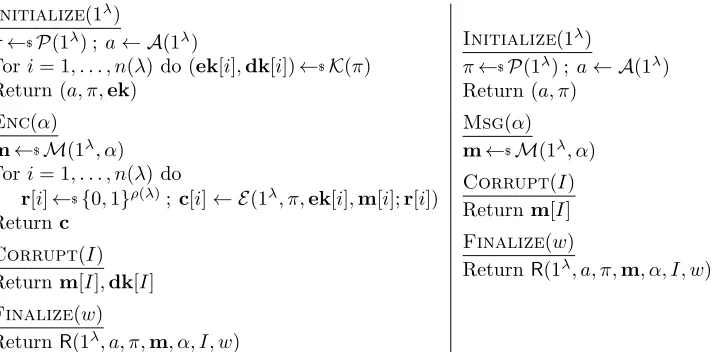
SOA-K Security. This is the dual of SOA-C where there are multiple receivers and a single sender rather than a single receiver and multiple senders, and corruptions reveal decryption keys rather than coins. The definition uses games RSOAKΠ,M,R,Aand SSOAKΠ,M,R,Aof Figure 4. The soa-k-advantage of an soa-k-adversaryAwith respect to the encryption scheme Π, message samplerM, relationR, auxiliary input generator Aand soa-k simulator S is defined by
Advsoa-kΠ,M,R,A,A,S(λ) = Pr
RSOAKAΠ,M,R,A
−Pr
SSOAKSΠ,M,R,A
.
We say that Π is (M,A)-SOA-K-secure if for every PT Rand every PT soa-k adversary A there exists a PT soa-k simulator S such that Advsoa-kΠ,M,R,A,A,S(·) is negligible. We say that Π is SOA-K-secure if it is (M,A)-SOA-K-secure for every PTM,A.
Decryption verifiability. Let Π = (P,K,E,V) be an encryption scheme. A decryption verifier for Π is a deterministic PT algorithm W which on inputs 1λ, π,ek,dk, c, m returnstrue or false. We require
that W(1λ, π,ek,dk,E(1λ, π,ek, m;r), m) =true for all λ∈N, all π ∈[P(1λ)], all (ek,dk) ∈[K(π)], all
r ∈ {0,1}ρ(λ) and allm∈ {0,1}∗ such thatE(1λ, π,ek, m;r)6=⊥. We say that the decryption verifierW
is canonical if W(1λ, π,ek,dk, c, m) returns (D(1λ, π,dk, c) = m) where D is the decryption algorithm
associated to Π. Game DVΠ,W of Figure 5 captures decryption verifiability. We let AdvdvΠ,W,W(λ) =
Pr[DVWΠ,W(λ)]. We say that Π is decryption-verifiable if AdvdvΠ,W,W(·) is negligible for all PT W and perfectly decryption verifiable if AdvdvΠ,W,W(·) = 0 for all (not necessarily PT) W.
When the decryption verifier is the canonical one, decryption verifiability is a form of robustness as defined in [1] but our formulation is more general, allowing verification to do more than merely decrypt. This results in a weaker requirement than robustness, which means that our result applies to a wider class of schemes. For example the ElGamal encryption scheme is not robust [1] but it is (perfectly) decryption verifiable, and thus our result below applies to it.
Result. The following implies that any decryption-verifiable encryption scheme is not SOA-K-secure.
Theorem 5.1 LetΠ = (P,K,E,V) be a decryption-verifiable encryption scheme with decryption verifier W and message length ℓ: N →N. Let Γ = (A,H) be a collision-resistant hash function with associated output lengthh: N→N. Letn(·) = 2h(·)and letMbe the message sampler that on input1λ, α(ignoresα
and) returns a n(λ)-vector whose components are uniformly and independently distributed over{0,1}ℓ(λ). Then there exists a PT soa-k adversary A and a PT relation R such that for all PT soa-k simulators S there is a negligible function ν such thatAdvsoaΠ,M-k,R,A,A,S(λ)≥1−ν(λ) for all λ∈N.
Thus, Π is not (M,A)-SOA-K-secure and hence cannot be SOA-K-secure.
Proof of Theorem 5.1: The adversary A and relation Rare depicted in Figure 6. Let S be any PT soa-k simulator. In the real game the adversary always makes the relation return true hence
Advsoa-kΠ,M,R,A,A,S(λ) = 1−Pr
SSOAKSΠ,M,R,A(λ) . We will construct a dv-adversary W and cr-adversaryC such that
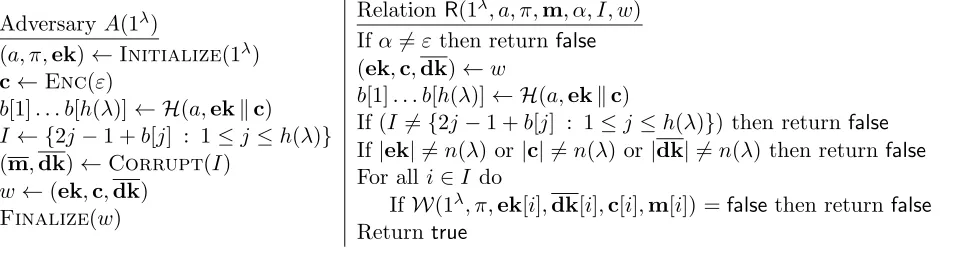
Pr
SSOAKSΠ,M,R,A(λ)
≤ 2−h(λ)ℓ(λ)+ q
AdvcrΓ,C(λ) +AdvΠdv,W,W(λ). (4) But since we assumed that Γ is collision-resistant and that Π is decryption-verifiable, we conclude that the right hand side of Eq. (4) is negligible when we also take Proposition 3.1 into account, and this implies the verity of the theorem. We present the adversaries W and C below.
We break the simulator S into sub-algorithms S1, S2 in the same way that was done in Section 4. We now define the adversaries W andC that for the most part are equal to the respective ones of Section 4.
Initialize(1λ)
π←$P(1λ) ; a← A(1λ)
Fori= 1, . . . , n(λ) do (ek[i],dk[i])←$K(π)
Return (a, π,ek)
Enc(α)
m←$M(1λ, α)
Fori= 1, . . . , n(λ) do
r[i]←${0,1}ρ(λ); c[i]← E(1λ, π,ek[i],m[i];r[i])
Returnc
Corrupt(I) Returnm[I],dk[I]
Finalize(w)
ReturnR(1λ, a, π,m, α, I, w)
Initialize(1λ)
π←$P(1λ) ; a← A(1λ)
Return (a, π) Msg(α)
m←$M(1λ, α)
Corrupt(I) Returnm[I]
Finalize(w)
ReturnR(1λ, a, π,m, α, I, w)
Figure 4: Game RSOAKΠ,M,R,A capturing the real-world SOA-K attack to be mounted by an adver-sary (left) and game SSOAKΠ,M,R,A capturing the simulated-world SOA-K attack to be mounted by a simulator (right).
Initialize(1λ)
π←$P(1λ) Return π
Finalize(ek, c, m0, m1,dk0,dk1) d0 ← W(1λ, π,ek,dk0, c, m0) d1 ← W(1λ, π,ek,dk1, c, m1) Return (d0∧d1∧(m0 6=m1))
Figure 5: Game DVΠ,W defining the decryption verifiability of encryption scheme Π with decryption verifier W.
π←Initialize(1λ) ; a←$A(1λ) ; (St, I)←$S1(a, π) ; m∗
0,m∗1←$({0,1}ℓ(λ))h(λ)
m0 ←Emb(1n(λ), I,m∗0,⊥n(λ)) ; m1←Emb(1n(λ), I,m∗1,⊥n(λ))
w0 ←S2(St,m0) ; (ek0,c0,dk0)←w0; w1←S2(St,m1) ; (ek1,c1,dk1)←w1; t←$I For all i∈I do Ifm0[i]6=m1[i] then t←i
Finalize(ek0[t],c0[t],m0[t],m1[t],dk0[t],dk1[t])
AdversaryC(1λ)
a←Initialize(1λ) ; π←$P(1λ) (St, I)←$S1(a, π) ; m∗
0,m∗1←$({0,1}ℓ(λ))h(λ)
m0 ←Emb(1n(λ), I,m∗0,⊥n(λ)) ; m1←Emb(1n(λ), I,m∗1,⊥n(λ))
w0 ←S2(St,m0) ; (ek0,c0,dk0)←w0; w1←S2(St,m1) ; (ek1,c1,dk1)←w1
Finalize((ek0kc0,ek1kc1)).
Let Vλ = ({0,1}ℓ(λ))h(λ), let V ={Vλ}λ∈N and define the algorithmsP1, P2 as in Section 4. Then Pr
SSOAKSΠ,M,R,A(λ)
= AP1(P1, P2, V, λ) ≤ 2−h(λ)ℓ(λ)+ p
AP2(P1, P2, V, λ) (5) Finally we will prove that
AP2(P1, P2, V, λ) ≤ AdvcrΓ,C(λ) +AdvdvΠ,W,W(λ). (6)
Writing down the double-execution experiment underlyingAP2(P1, P2, V, λ): π ← P(1λ) ; a←$A(1λ) ; (St, I)←$S
1(a, π) ; m←$({0,1}ℓ(λ))n(λ); m∗
0,m∗1←$({0,1}ℓ(λ))h(λ)
m0 ←Emb(1n(λ), I,m∗0,⊥n(λ)) ; m1 ←Emb(1n(λ), I,m∗1,⊥n(λ))
Adversary A(1λ)
(a, π,ek)←Initialize(1λ)
c←Enc(ε)
b[1]. . . b[h(λ)]← H(a,ekkc) I ← {2j−1 +b[j] : 1≤j≤h(λ)} (m,dk)←Corrupt(I)
w←(ek,c,dk)
Finalize(w)
RelationR(1λ, a, π,m, α, I, w)
Ifα6=εthen return false
(ek,c,dk)←w
b[1]. . . b[h(λ)]← H(a,ekkc)
If (I 6={2j−1 +b[j] : 1≤j ≤h(λ)}) then returnfalse
If|ek| 6=n(λ) or |c| 6=n(λ) or |dk| 6=n(λ) then returnfalse
For all i∈I do
IfW(1λ, π,ek[i],dk[i],c[i],m[i]) =false then returnfalse
Returntrue
Figure 6: AdversaryAand relation Rfor the proof of Theorem 5.1.
m0 ←Emb(1n(λ), I,m∗0,m) ; m1 ←Emb(1n(λ), I,m∗1,m) Return R(1λ, a, π,m
0, ε, I, w0)∧R(1λ, a, π,m1, ε, I, w1)∧(m∗0 6=m∗1).
As in Section 4, if this experiment returns true, then H(a,ek0kc0) =H(a,ek1kc1). Hence C succeeds unlessek0kc0 =ek1kc1. But ifek0kc0 =ek1kc1, thenc0[t] =c1[t] andek0[t] =ek1[t] and due to the tests performed by R we have thatW(1λ, π,ek
0[t],dk0[t],c0[t],m0[t]) =true and W(1λ, π,ek0[t],dk1[t],
c0[t],m1[t]) =true. ThereforeW wins the decryption verifiability game. Eqs. (5) and (6) together prove Eq. (4).
6
SOA insecurity without Auxiliary Input
The model of Section 4, following [19], allows the adversary and simulator a common auxiliary input a. The model is well-justified becausearepresents history that is not under the simulator’s control and the auxiliary input model has through an extensive history come to be viewed as the “right” one for simulation-based definitions. However it is technically interesting to ask what can be shown when the simulator has the extra power of not being constrained to a given auxiliary input. In this section, we show that there are encryption schemes that fail to be SOA-C secure even in this case.
We could “cheat” by having the encryption scheme put the auxiliary input in the system parameters which in Section 4 are also a common input to adversary and simulator. Thus, we also consider only encryption schemes without system parameters. Formally, let A returnεon any input and let P return 1λ on input 1λ. We will show that there is a CE scheme Π = (P,K,E,V) and a message sampler Msuch
that Π is not (M,A)-SOA-C secure.
We would like to use the same idea as in the previous section, but now the adversary no longer has access to a hash function key in the auxiliary input. We cannot let the adversary pick the key and put it inw for then the simulator could pick a key under which the function is not CR. Instead, the adversary will use part of the ciphertext vector as the hash key. However the simulator gets to choose the ciphertext vector, and thus the hash key. Thus, any proof that tried to embed a hash key runs into a problem.
Initialize(1λ)
Return 1λ
Msg(ek)
m←${0,1}ℓ
Returnm
Finalize(c0, c1, r0, r1, v0, v1)
d0← V(1λ,1λ,ek, c0, m, r0) d1← V(1λ,1λ,ek, c1, m, r1)
d2←(H(1λ, c0, v0) =H(1λ, c1, v1)) d3←(v06=v1)
Return (d0∧d1∧d2∧d3)
AlgorithmHc(1λ, K, x)
(m1, m2, m3, m4, m5)←K
(x1, x2, x3, x4, x5)←x
Returnmx1
1 mx
2
2 mx
3
3 mx
4
4 mx
5
5 AlgorithmH+(1λ, K, T)
(t1, . . . , tn+1)←pad(T)
y0←0k
Fori= 1 ton+ 1 do
yi=H(K, yi−1kti)
Returnyn+1
AlgorithmE(1λ, π,ek, m)
(m1, m2, m3, m4, m5)←m g←$G∗
λ; s←$Zp; h←gs u1, u2, u3, u4, u5←$Gλ
w1←m1·us
1; w2←m2·us2 w3←m3·us
3; w4←m4·us4 w5←m5·us
5
Return (g, h, u1, u2, u3, u4, u5, w1, w2, w3, w4, w5)
AlgorithmH(1λ, K, x)
(g, h, u1, u2, u3, u4, u5, w1, w2, w3, w4, w5)←K
(x1, x2, x3, x4, x5)←x Y1←ux1
1 ux
2
2 ux
3
3 ux
4
4 ux
5
5 Y2←wx1
1 wx
2
2 wx
3
3 wx
4
4 wx
5
5
Return (g, h, Y1, Y2)
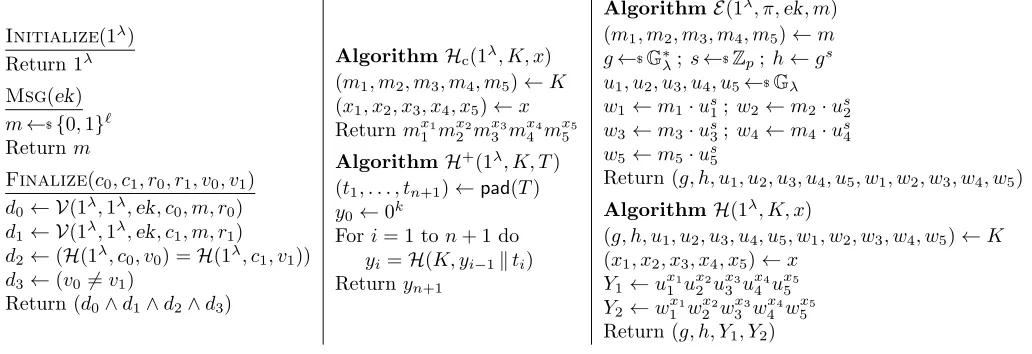
Figure 7: Game SCR∆ (left) and algorithmsE,H,H+, and Hcused in our construction.
can be proven special collision-resistant. We now formally define encrypted hash schemes and describe our construction.
Encrypted Hash Schemes. LetP be the identity function. Let Π = (P,K,E,V) be a CE-scheme with message length ℓand randomness length ρ. Let H be a deterministic algorithm which on input 1λ, K, x
returns an h(λ)-bit string. We callh: N→ N the output length. We refer to ∆ = (P,K,E,V,H) as an encrypted hash scheme.
Adversary C must make exactly one Msg query in game SCR∆ of Figure 7 and its scr-advantage is Advscr∆,C(λ) = Pr
SCRC
∆(λ)
. We say that ∆ is special collision resistant if Advscr∆,C(·) is negligible for all PT C. In this game, the keys c0, c1 for the hash function are ciphertexts under partial adversary control. They must encrypt a random message chosen by the game, but the public key and coins are chosen by the adversary.
The proof that an EHS scheme is not SOA-C secure is very similar to the proof of Theorem 4.1 and can be found in Appendix A.1. The difficulty is building an EHS scheme that is special collision resistant, and it is this we now turn to.
Construction. We letGbe a deterministic PT algorithm called thefixed group generator that on input 1λ returns a cyclic group G
λ of prime orderpλ, which is possible under conjectures on the distribution
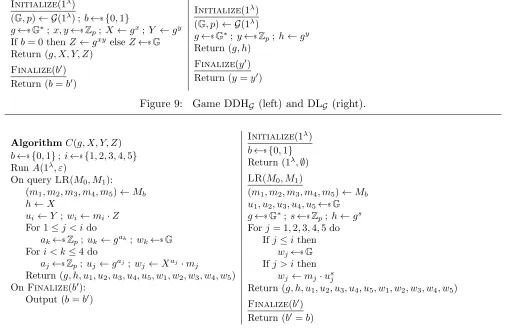
of prime numbers in intervals. We remark that if it were possible to deterministically also produce generatorsg, hofGλ such that logg(h) is hard to compute our problem would trivialize because we could define a keyless CR hash, but this appears to be a much stronger assumption. Under our assumption there is no known way to get a keyless CR hash function. But we will get an EHS. We assume there is an injective, PT encoding of a ℓ(λ)-bit string as an element of G5λ and implicity assume this when writing statements such as (m1, m2, m3, m4, m5) ← m to indicate that bitstring m is parsed into its encoding. We will assume hardness of DL and DDH relative to G as defined in Figure 9.
Now we can describe our encrypted hash scheme. Let Π = (P,K,E,V) be a CE scheme with P the identity function, K that outputs (ε, ε), E as shown in Figure 7, and the canonical V. Our EHS is ∆+= (P,K,E,V,H+) whereH+ is defined in Figure 7. Here k <5 logp
λ is the size in bits to represent
H. The second lemma shows us that we can apply Merkle-Damg˚ard to H and the resulting encrypted hash scheme still has special collision resistance.
References
[1] M. Abdalla, M. Bellare, and G. Neven. Robust encryption. In D. Micciancio, editor,TCC 2010, volume 5978 ofLNCS, pages 480–497. Springer, Feb. 2010. 3, 11
[2] M. Bellare, D. Hofheinz, and S. Yilek. Possibility and impossibility results for encryption and commitment secure under selective opening. In A. Joux, editor, EUROCRYPT 2009, volume 5479 of LNCS, pages 1–35. Springer, Apr. 2009. 1, 2, 3, 5, 7
[3] M. Bellare and A. Palacio. GQ and Schnorr identification schemes: Proofs of security against impersonation under active and concurrent attacks. In M. Yung, editor,CRYPTO 2002, volume 2442 ofLNCS, pages 162–177. Springer, Aug. 2002. 4, 8
[4] M. Bellare and P. Rogaway. Random oracles are practical: A paradigm for designing efficient protocols. In V. Ashby, editor,ACM CCS 93, pages 62–73. ACM Press, Nov. 1993. 2
[5] M. Bellare and P. Rogaway. The security of triple encryption and a framework for code-based game-playing proofs. In S. Vaudenay, editor,EUROCRYPT 2006, volume 4004 ofLNCS, pages 409–426. Springer, May / June 2006. 6
[6] M. Bellare, B. Waters, and S. Yilek. Identity-based encryption secure against selective opening attack. In Y. Ishai, editor,TCC 2011, volume 6597 ofLNCS, pages 235–252. Springer, Mar. 2011. 1, 3, 5
[7] M. Bellare and S. Yilek. Encryption schemes secure under selective opening attack. Cryptology ePrint Archive, Report 2009/101, 2009. http://eprint.iacr.org/. 3
[8] M. Ben-Or, S. Goldwasser, and A. Wigderson. Completeness theorems for noncryptographic fault-tolerant distributed computations. In20th ACM STOC, pages 1–10. ACM Press, May 1988. 3
[9] F. B¨ohl, D. Hofheinz, and D. Kraschewski. On definitions of selective opening security. Cryptology ePrint Archive, Report 2011/678, 2011. http://eprint.iacr.org/. 3
[10] R. Canetti, C. Dwork, M. Naor, and R. Ostrovsky. Deniable encryption. In B. S. Kaliski Jr., editor, CRYPTO’97, volume 1294 ofLNCS, pages 90–104. Springer, Aug. 1997. 3, 7
[11] R. Canetti, U. Feige, O. Goldreich, and M. Naor. Adaptively secure multi-party computation. In28th ACM STOC, pages 639–648. ACM Press, May 1996. 1, 3, 4, 7
[12] R. Canetti, S. Halevi, and J. Katz. Adaptively-secure, non-interactive public-key encryption. In J. Kilian, editor,TCC 2005, volume 3378 ofLNCS, pages 150–168. Springer, Feb. 2005. 1
[13] D. Chaum, C. Cr´epeau, and I. Damg˚ard. Multiparty unconditionally secure protocols. In20th ACM STOC, pages 11–19. ACM Press, May 1988. 3
[14] R. Cramer and V. Shoup. Design and analysis of practical public-key encryption schemes secure against adaptive chosen ciphertext attack. SIAM Journal on Computing, 33(1):167–226, 2003. 3, 10
[15] I. Damg˚ard. A design principle for hash functions. In G. Brassard, editor,CRYPTO’89, volume 435 ofLNCS, pages 416–427. Springer, Aug. 1990. 14, 23
[16] I. Damg˚ard and J. B. Nielsen. Improved non-committing encryption schemes based on a general complexity assumption. In M. Bellare, editor,CRYPTO 2000, volume 1880 ofLNCS, pages 432–450. Springer, Aug. 2000. 7
[17] Y. Dodis, R. Oliveira, and K. Pietrzak. On the generic insecurity of the full domain hash. In V. Shoup, editor, CRYPTO 2005, volume 3621 ofLNCS, pages 449–466. Springer, Aug. 2005. 2
[18] D. Dolev, C. Dwork, and M. Naor. Nonmalleable cryptography. SIAM Journal on Computing, 30(2):391–437, 2000. 5
[20] S. Fehr, D. Hofheinz, E. Kiltz, and H. Wee. Encryption schemes secure against chosen-ciphertext selective opening attacks. In H. Gilbert, editor,EUROCRYPT 2010, volume 6110 ofLNCS, pages 381–402. Springer, May 2010. 1, 3
[21] O. Goldreich, S. Goldwasser, and S. Micali. How to construct random functions. Journal of the ACM, 33:792–807, 1986. 1
[22] O. Goldreich and H. Krawczyk. On the composition of zero-knowledge proof systems. In M. Paterson, editor, ICALP 90, volume 443 of LNCS, pages 268–282. Springer, July 1990. 4
[23] O. Goldreich and H. Krawczyk. On the composition of zero-knowledge proof systems. SIAM Journal on Computing, 25(1):169–192, 1996. 4, 5
[24] O. Goldreich, S. Micali, and A. Wigderson. Proofs that yield nothing but their validity or all languages in NP have zero-knowledge proof systems. Journal of the ACM, 38(3):691–729, 1991. 1
[25] O. Goldreich and Y. Oren. Definitions and properties of zero-knowledge proof systems. Journal of Cryptology, 7(1):1–32, 1994. 5
[26] S. Goldwasser and S. Micali. Probabilistic encryption. Journal of Computer and System Sciences, 28(2):270– 299, 1984. 3, 6
[27] S. Goldwasser, S. Micali, and C. Rackoff. The knowledge complexity of interactive proof systems. SIAM Journal on Computing, 18(1):186–208, 1989. 5
[28] B. Hemenway, B. Libert, R. Ostrovsky, and D. Vergnaud. Lossy encryption: Constructions from general assumptions and efficient selective opening chosen ciphertext security. In D. H. Lee and X. Wang, editors, ASIACRYPT 2011, LNCS, page ? Springer, Dec. 2011. 1, 3
[29] D. Hofheinz. Possibility and impossibility results for selective decommitments. Journal of Cryptology, 24(3):470–516, July 2011. 1, 2, 5
[30] G. Kol and M. Naor. Cryptography and game theory: Designing protocols for exchanging information. In R. Canetti, editor,TCC 2008, volume 4948 ofLNCS, pages 320–339. Springer, Mar. 2008. 7
[31] M. Naor. Bit commitment using pseudorandomness. Journal of Cryptology, 4(2):151–158, 1991. 1
[32] J. B. Nielsen. Separating random oracle proofs from complexity theoretic proofs: The non-committing encryp-tion case. In M. Yung, editor,CRYPTO 2002, volume 2442 ofLNCS, pages 111–126. Springer, Aug. 2002. 2, 4
[33] A. O’Neill, C. Peikert, and B. Waters. Bi-deniable public-key encryption. In P. Rogaway, editor, CRYPTO 2011, volume 6841 ofLNCS, pages 525–542. Springer, Aug. 2011. 7
[34] R. Ostrovsky, V. Rao, A. Scafuro, and I. Visconti. Revisiting lower and upper bounds for selective decommit-ments. Cryptology ePrint Archive, Report 2011/536, 2011. http://eprint.iacr.org/. 2
[35] S. Panjwani. Tackling adaptive corruptions in multicast encryption protocols. In S. P. Vadhan, editor, TCC 2007, volume 4392 ofLNCS, pages 21–40. Springer, Feb. 2007. 1
[36] T. P. Pedersen. Non-interactive and information-theoretic secure verifiable secret sharing. In J. Feigenbaum, editor,CRYPTO’91, volume 576 ofLNCS, pages 129–140. Springer, Aug. 1992. 1
[37] C. Peikert, V. Vaikuntanathan, and B. Waters. A framework for efficient and composable oblivious transfer. In D. Wagner, editor,CRYPTO 2008, volume 5157 ofLNCS, pages 554–571. Springer, Aug. 2008. 7
[38] P. Rogaway. Formalizing human ignorance. In P. Q. Nguyen, editor, Progress in Cryptology - VIETCRYPT 06, volume 4341 ofLNCS, pages 211–228. Springer, Sept. 2006. 5
[39] D. Xiao. (nearly) round-optimal black-box constructions of commitments secure against selective opening attacks. In Y. Ishai, editor,TCC 2011, volume 6597 ofLNCS, pages 541–558. Springer, Mar. 2011. 2