S T U D I E S O N INDUCED M U T A T I O N I N MAIZE'
E. J. D O L L I N G E R Z
Brookhaven National Laboratory, Upton, L. I., N . Y .
Received March 10, 1954
is known that mutations constitute diverse types of genetic phenomena. ITDeficiencies, duplications, rearrangements giving position effects, trans- positions of heterochromatin next to euchromatin, and recombination products of genic elements following both normal and unequal crossing over have all been shown to simulate true gene mutation. Indeed, it may be questioned if true gene mutation has been established experimentally, although it is believed that such mutations do occur and constitute a basis for evolutionary changes. I t has not been possible with our present techniques to demonstrate unequivo- cally that any specific mutational change does not involve an extragenic altera- tion. A deficiency or chromosomal rearrangement so minute as to be cytologi- cally or genetically undetectable, may be responsible for the mutant phenotype. Thus the student of the mutation process is not able to discriminate between point mutations and gene mutations although he can in many cases demonstrate that the mutant phenotype is inseparably associated with some gross chromo- somal alteration.
Mutations, broadly defined, arise spontaneously and following exposure of germinal material to mutagenic agents such as short wave irradiation and certain chemicals. Some studies with Drosophila suggest that there is no essential difference between spontaneous mutations and those induced by short wave radiation. On the other hand', certain investigations in maize indicate that X-ray induced mutations may consist solely of extragenic alterations while spontaneous mutations include many mutational changes which have not been associated with chromosomal rearrangements. Since there is no way by which mutations induced at miscellaneous loci can be classified as to the type of genetic change, it is apparent that only detailed study of mutation at selected loci enables one to attempt to separate true gene mutations from extragenic alterations simulating gene mutation. In 'their study of X-ray in- duced mutation at the Al locus in maize, STADLER and ROMAN (1948) found that the induced mutations were all associated with deficiencies ; some of these were so minute as to be cytologically undetectable but could be demonstrated by genetic tests.
The purpose of this investigation is to study further the nature of in- duced mutation at certain selected loci in maize. Numerous monographs and
Research carried out at Brookhaven National Laboratory under the auspices of the Submitted in partial fulfillment for the degree of Doctor of Philosophy in the Faculty U. S. Atomic Energy Commission.
of P u r e Science, Department of Botany, Columbia University.
I N D U C E D M U T A T I O N I N M A I Z E
75
1 reviews have been published on induced mutation and only papers pertinent to the present study will be cited.MATERIALS, METHODS AND RESULTS
Pollen treatment with X-rays. Part of this study is concerned with X-ray induced mutations at specific loci in maize and with a subsequent cytological examination in an attempt to determine the extent to which these mutations were associated with chromosomal alterations. The loci chosen for investiga- tion were yg2 (yellow green), lgl (liguleless), and gl2 (glossy). The yg2 locus is particularly useful for this study since MCCLINTOCK (1944) has shown that it is located in the first chromomere proximal to the terminal knob in the short arm of chromosome 9. This distal position permists the detection of minute aberrations at pachytene which probably would not be observable at more proximal loci.
For the yg2 locus, individual plants from homozygous dominant Y g stocks (anthocyanin for aleurone and plant color) were used as pollen parents. Ma- ture pollen was collected, given either 1000 o r 2000 r of X-rays, and placed on silks of either y g y g or Y g y g (nonanthocyanin for aleurone and plant color) plants. The control data came from similar crosses made with non- irradiated pollen. At maturity, kernels with anthocyanin aleurones were se- lected and planted. If no change had occurred at the Y g locus, all ensuing plants should be green. Individuals showing the yg phenotype arise from loss of Yg o r its mutation to yg. (Maternal haploids are readily detected since they are both yg and nonanthocyanin plants, and subsequent cytological analy- sis proved this to be so in the five cases found.) Microsporocytes were col- lected from the yellow green plants, fixed and stored in propionic alcohol. Acetocarmine or orcein smears were made and the material analyzed for chromosomal aberrations.
Of the 15 yg mutants examined (table l ) , 14 proved to be associated with gross chromosomal changes which resulted in the loss of the chromomere containing the Y g locus. Of the 14, three possessed only one chromosome 9. Six had a chromosome 9 univalent and a ring; of these, three plants were variegated green and yellow green. Four plants possessed terminal deficiencies for part of the short arm of chromosome 9. One plant (fig. 1 ) had a deficiency for part of the short arm of chromosome 9 with the centric portion trans- located to another chromosome (unidentified) at the point of breakage; the knob and doubtless the first chromomere were missing from chromosome 9 in this translocation. One plant (320( 5) ) showed no observable aberrations for chromosome 9 (fig. 2). This plant represents either a mutation of Y g to y g
o r a deficiency in the first chromomere so minute as to escape detection. This is probzbly true also for plant 20(1) (not listed in table 1) since no ob- servable aberration could be detected at pachynema ; however, there was not enough material to complete the analysis.
752 E. J. DOLLINGER
T A B L E 1
A n a l y s i s of mutation and chromosomal aberration induced b y X-rays (2000 1 )
in mature p o l l e n for the y g p locus (yg y g or Y g y g x Y g Y g ) .
_ ~ _ _ _ - _ _ _ _ . _ _ _ _ _ . _ ~ ______
Mutant plant
Chromosomal aberrations
P l a n t phenotype
number Yellow
green Chromosome 9 Other chromosomes
4 (1) S Univalent Normal
320 (3)
x
Univalent Normal320 (4)
x
Univalent Normal4 (2) S * * Univalent, ring Normal
239 (1) S Univalent, ring Normal
284 (1) ? ( * * Univalent, ring Normal
324 (1)
x
Univalent, ring Normal1 5 (1) S * * Univalent, ring T ,4-G
247 (1)'
s
Univalent, ring T,1-2318 (1) S Terminal df., 9s Normal
273 (1) S Terminal df., 9s T,6-7, univalent 6 ,
320 (1) S Terminal df., 9s Univalent, ring for
321 ( 2 )
x
232 ( 1 ) S Terminal df., 9S- Unidentified
T,2-4
chromosome 7
Terminal df., 9s Two unidentified
translocations
T, unidentified translocation
chromosome
320 ( 5 ) S No observable Probable s m a l l
aberr.ttioas df., 3.S
*Mature pollen given 1000r, X-rays. **Variegated green and yellow green.
over units (EMERSON, BEADLE and FRAZER 1935). The Zg locus is known to be located within the terminal four chromomeres ( MCCLINTOCK 1931). MU- tants were induced and sporocytes collected and smears made by methods similar to those described for the yg locus using L g L g
GI GI
and lg lg g l glI N D U C E D M U T A T I O N IS M.4JZE 753
1.
4.
3.
/
I
6.
FIGURES 1-2.-Pachytene configurations of chromosome 9 derived from plants sub- jected to irradiation. FIGURE 1.-Bivalent chromosome 9 from plant 232( 1 ) showing a terminal deficiency in the short arm. T h e deficient arm of chromosome 9 is translocated to an a r m of an unidentified chromosome. The unidentified chromosome is represented by dotted lines and extends beyond the point indicated by the arrow. There is non- homologous pairing between the short a r m of the normal chromosome 9 and an arm of the unidentified chromosome. Camera lucida line drawing
x
850. FIGURE 2.- Normal bivalent chromosome 9 from plant 320(5). Photographx
1000. FIGURES 3-6. Pachytene configurations of chromosome 2 derived from plants subjected to irradiation. FIGURE 3.-Translocation 2-6L from plant 128(1). T h e parts of chromosome 2 which have been translocated t o chromosome 6 are represented by dotted lines. A minimum of one break in chromosome 6 and two breaks in chromosome 2 must have occurred to produce this translocation. There is nonhomologous pairing between the parts ofchromosome 2. FIGURE 4.-Bivalent chromosome
2 from plant 132(2) showing a terminal deficiency of one-half of the short arm. Camera lucida line drawing
x
1300. FIGURE 5.-Reciprocal translocation 2S-8L from plant 157( 1). Segments of chromosome 2 a r e represented by dotted lines. Camera lucida line draw- ingx
590. FIGURE 6.-Translocation 2-8L from plant 142(2). T h e parts of chromosome 2 which have been translocated to chromosome 8 are represented by dotted lines. A minimum of one break in chromosome 8 and two breaks in chromosome 2 must have occurred t o produce this translocation. There is nonhomologous pairing between seg- ments of chromosome 2. Camera lucida line drawine X 590.sumption that all of the above liguleless-glossy mutants resulted from loss of the Lg and
Cl
loci.Since the extensive work of
STADLER
on both spontaneous and induced mutation in maize provides excellent data on the mutation rate, such data will not be presented here. However, it was noted that the majority of in- duced mutations were both liguleless and glossy, and those examined cytologi- cally all resulted from chromosomal alteration. This is in agreement with the754 E. J. DOLLINGER
TABLE 2
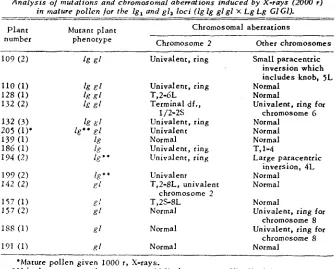
Analysis oj mutations and chromosomal aberrations induced b y X-rays (2000 r )
in mature pollcn /or the l g , and g12 loci (lg lg g l g l X Lg Lg G1 GI).
~ _ - - - . _ _ _
Chromosomal aberrations
Plant Mutant plant
Chromosome 2 Other chromosomes
number phenotype
109 ( 2 ) k g f Univalent, ring Small paracentric
inversion which
includes knob, 5L
110 (1)
k
er
Univalent, ring Normal128 (1)
k
R [ T.2-6L Normal132 (2) 1s
er
Terminal df., Univalent, ring for132 ( 3 )
k
81 Univalent, ring Normal205 (1)' %" P I Univalent Normal
133 (1) I(: Normal Normal
186 (1) 18 Univalent, ring T, 1-4
134 (2) ig.8 Univalent, ring Large paracentric
139 (2) I,*' Univalent Normal
142 ( 2 ) r l T,2-8L, univalent Normal
157 (1) 8: T,2S-8L Normal
1 5 7 ( 2 ) g f Normal Univalent, ring for
IS8 ( 1 ) g f Normal Univalent, ring for
191 (1) R I Normal Normal
1/2-2s chromosome 6
inversion, 4 L
chromosome 2
chromosome 8
chromosome 8
'Mature pollen given 1000 r, X-rays.
'*Ligule o n mature plant, none at mldrib, l e a v e s erect like l i g u l e l e s s .
early work of STADLER (1931), who reported that with X-rays, the majority of induced recessive mutations for the linked genes C, Shl and W x involved simultaneous " mutation " of all three loci. This was assumed to be the result
of deficiencies. LONGLEY (1950) also reported that in maize, using X-ray and Bikini-treated material, there is a prevalence of breaks in regions adjacent to the centromere.
I N D U C E D M U T A T I O N I N M A I Z E 755
In the case of the five glossy mutants analyzed, there were no visible aber- rations for chromosome 2 in three of the plants. However the glossy locus is not definitely located cytologically and extremely small alterations may be difficult to detect. Two of the three plants with no aberrations possessed a univalent and ring for chromosome 8. One glossy mutant had a 2s-8L re- ciprocal translocation (fig. 5 ) . The simplest explanation as to the cause of mutation in this case would appear to be the loss of the dominant glossy allele. In another glossy mutant parts of chromosome 2 (including the centromere) were translocated to the long arm of chromosome 8 (fig. 6 ) . A minimum of one break in chromosome 8 and two breaks in chromosome 2 must have oc- curred to produce this translocation. It seems a logical assumption that the GI
allele was lost while the Lg allele is located in one of the two parts of chromo- some 2 which was translocated to chromosome 8.
An investigation was made to study the effect of irradiation upon antho- cyanin formation in the aleurone of a stock recessive for one of the factors whose dominant allele is ordinarily necessary for anthocyanin production. In maize a number of independent complementary loci are concerned with antho- cyanin formation. In the aleurone the dominant factors Al,
Az,
C and R are ordinarily necessary for anthocyanin production. Purple colored aleurone re- sults if the dominant Pr allele is present while a red aleurone is produced if the recessive pr allele is homozygous. The recessive al allele was chosen for study. This allele mutates to a series of higher A1 alleles in the presence of the dominant gene Dt (Dotted) which is located in the terminal heterochro- matic knob on the short arm of chromosome 9 ( RHOADES 1936, 1938, 1941a, 1941b, 1945). MCCLINTOCK (1950) found that recessive o1 mutates to the dominant if the short arm of chromosome 9 is disturbed in a stock recessive for the dt locus (al is stable in the presence of recessive d t ) . This was ac- complished by subjecting the short arm of chromosome 9 ,to structural modi- fication by its involvement in a breakage-fusion-bridge cycle.I n the present experiment a homozygous al d t stock was used. The plants were grown in a nonirradiation area. Mature pollen was given 2000 r of X-rays and used to pollinate sister plants. The resulting kernels were classi- fied for the presence of anthocyanin.
TABLE 3
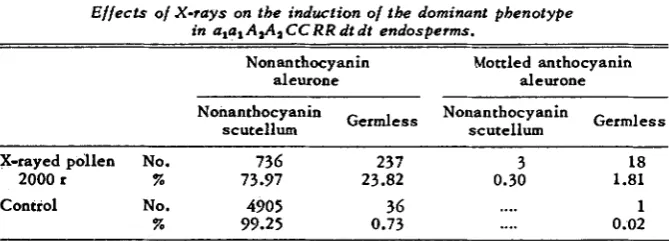
Effects of X-rays on the induction of the dominant phenotype in a 1 a l A d A , C C R R dt dt endosperms.
Nonanthocyanin Mottled anthocyanin
aleurone aleurone
Germless
Nonanthocyanin Germless Nonanthocyanin
scutellum scutellum
X-rayed pollen No. 736 237 3 18
2000 r % 73.97 23.82 0.30 1 .81
Control No. 4905 36
....
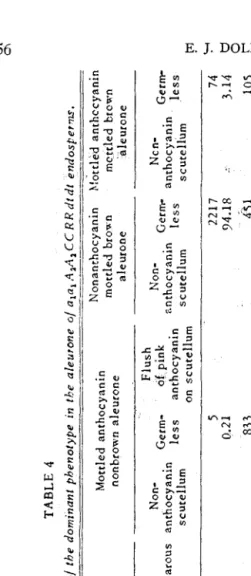
1TABLE 4 Effects of chronic y irradiatzon on the induction o/ the dominant phenotype in the aleurone G/ a,a,.4,A2CCRR dfdt endospern-. ____--___ Nonanthocyanin nonbrown aleurone Irradiation Mottled anthocyanin nonbrown aleurone Nonanthocyanin b!ottled anthccyanin mottled brown mcttled brown a 1 e ur one aleurone expressed of pink znthocyanin anthocyanin Germ in r units per day anthocyanin Germ- Of pink Viviparous anthocyanin Germ- less anthocyanin Flush Flush Non- Nc n- scutellum scutellum Non- Non- scutellum scutellum less less less
anthocyanin on
scutellum on scutellum FJ 670 No. 58 5 2217 74 4 % 2.46 0.21 94.18 : 3.14 368 No. 1765 % 55.96 % 52.30 27.87 0.67 230 No. 625 333
a
833 26.41 33 136 I 2.76 11.38 0.08 156 No. 2209 103 28 21 5 29 % 83.93 4.61 1.25 0.34 0.22 1.30 113- NO. 1564 41 5 10 1 8 64 % 95.77 2.51 0.31 0.61 0.06 0.43 54- No. 1035 47 1 12 2 4 46 % 93.83 4.26 0.09 1.03 0.18 0.36 451 14.30 14 3 .bO 43 1.17 1 0.08 U105 3.33
I N D U C E D M U T A T I O N I N M A I Z E 757
A moEled anthocyanin aleurone of the " flush " type was induced in two
percent of the endosperms, and of these 85 percent were germless. There were approximately 24 percent of nonanthocyanin germless kernels (table 3 ) .
Post fertilization treatment with chronic 7-irradiation. This experiment was designed, to study the effect of chronic y-irradiation upon anthocyanin forma- tion in the developing aleurone in a stock recessive for one of the factors whose dominant allele is ordinarily necessary for anthocyanin production. The a1 allele was chosen for study for reasons explained previously.
A homozygous a l d t stock was used throughout. Plants were grown in pails in a nonirradiation area and were selfed or sibbed. At 24 o r 48 hours after pollination, the plants were placed at various distances from a 145 curie
CosO source, and remained there until maturity. The ears were then har-
vested and the kernels classified for anthocyanin.
Kernels on ears exposed to a dose of 670 r/day were germless, small, and highly deformed (table 4 ) . The majority of the endosperms were mottled for a brown aleurone color (94.2 percent), some were mottled for a pink aleurone, some had a mixture of pink and brown, and a small percentage showed! no color.
A t a dose of 368 r/day, all of the kernels were germless, as in the case of the higher dose, and the endosperms showed numerous defective areas, i.e., degenerate endosperm tissue. However, the kernels were considerably less deformed than at the 670 r/day dose. A high percent (26.4 percent) of the endosperms showed a mottled anthocyanin aleurone of the flush type. The majority of the mottled aleurones were pink in color ; however, an occasional aleurone was purple o r a mixture of pink and purple. The mottled areas were irregular in shape and varied in size. The number of mottled brown aleurones decreased sharply at this dose of y-irradiation.
At doses of 230 r/day and lower, the percentage of germless kernels was further decreased and the endosperms were normal in size with only an occa- sional defective endosperm. I t is evident in the data from the lower doses of irradiation that the majority of the kernels showing the flush pattern of antho- cyanin pigmentation were germless. A t a dose of 230 r/day, 80.5 percent of the kernels with flush aleurones were germless while only 34.8 percent of those with no anthocyanin and 24.6 percent of those with mottled brown aleurones were germless. At a dose of 156 r/day, 85.3 percent of the flush aleurones were germless while 4.9 percent of those with no anthocyanin and
TABLE 5 Effects of chronic y irradiation on the inducfion of recessive premeiotic mutation at the A,Pr, and Btl loci (alal bflbtlprpr X AIA,BtlBtIPr PI). - ______.. __ Nonbrittle endosperm Brittle endosperm
Total dose
of
Purple
aleurone
irradiation
parent
expressed in
r units Purple Germ- scutellum less Mottled Fractional aleurone non- aleurone aleurone aleurone aleurone ? Fractional or R loss anthocyanin type aleurone purple and ____ red ~ ~ aleurone purple purple and Nonanthocyanin Red Purple Nonanthocyanin F Red Non- aleurone Purple Purple anthocyanin Purple Red Purple Purple Germ- scutellum scutellum scutellum scutellum scutellum scutellum scutellum less
L
Z6
INDUCED MUTATION IN MAIZE 759
In general, kernels with mottled brown aleurone occurred a t higher doses of y-irradiation than did those with anthocyanin in the aleurone. A small per- centage of the controls were germless and one germless kernel was mottled for pink aleurone.
Plants have been obtained from kernels with flush aleurone (nongermless), mottled brown aleurone (nongermless), pink scutellum, and colorless aleurone. Several of these plants showed inheritance of flush o r mottled brown aleurone. There appears to be no association of endosperm phenotype with mutation in the embryo which results in flush or brown aleurone in post-pertilization irradi- ated kernels. Tests are in progress to determine the nature of inheritance.
PREMEIOTIC MUTATION
1 . Recessive mutation. Preliminary experiments were made for the A1, AB,
Bt, (Brittle endosperm), Pr and R loci, respectively, in an attempt to induce recessive mutation by irradiation in premeiotic cells. The
AI,
AB,
Pr and R loci are concerned with anthocyanin formation as described previously. If muta- tions can be induced by irradiation in premeiotic cells, it is a reasonable as- sumption that a cell in which a mutation occurred should by subsequent mitoses give rise to a sector of the tassel or ear which would be heterozygous for the mutant gene. Thus, depending upon the size of the sector, a number of gametes carrying the same mutant would be produced. If the incidence of premeiotic mutation were high, this would be a useful tool for inducing muta- tion since a large number of gametes would carry the same mutation and the two sperm cells of the male gametophyte which unite with the egg and polar nuclei would be identical with respect to mutation.The AB, Bt and Pr loci are located on chromosome 5. The A2 locus is located in the short arm while Bt and Pr are both located in the long arm. The Bt locus is nearer the centromere and is approximately 24 crossover units from Pr. The Al locus is located on chromosome 3 and the R locus on chro- mosome 10. Appropriate homozygous dominant stocks were used as pollen parents except in one case when a heterozygous Ala1 stock was used. Indi- vidual plants were grown in pails and the young plants placed near a constant Co60 source. Some plants were irradiated for short periods when very young, some for short periods shortly before meiosis, and some during most of the interval before meiosis. After irradiation, the plants were moved to a non- irradiation area. Pollen from individual plants was collected and placed upon
6 6 pr pr bt bt or al al or r r silks. The megaspore parent stocks were grown
in a nonirradiation area. For controls, the same stocks were grown in a non- irradiation area and similar crosses made. After harvest, the kernels were classified for mutation.
TABLE 7 Effects of chrc.iic y irradiation on the induction of recessive premeiotic mutation at the A, locus (a,a,Prpr X AlalPrpr).* -
Fractional red
and
Fractional
Fractional purple
and aleurone
m
aleurone 3 purple nonanthocyanin anthocyanin and red aleurone non- Totalirradiation expressed
dose of Purple aleurone Red aleurone parent in r units
5
Nongermless Germless Nongermless Germless Nongermless Germless Nongermless Nongermlessr
c
No. 1302 3057 No. 33 8 19 5
Z 0 M
I N D U C E D M U T A T I O N I N M A I Z E
TABLE 6
Effects of chronic y irradiation on the induction of r e c e s s i v e premeiotic
mutation at the A, locus (alal Pspr X AIA, Pr Pr).
Fractional
Total purple and
76 1
Fractional
dose of Purple aleurone Nonanthocyanin purple and Red
red aleurone
aleurone
irradiation anthocyanin a'eurone
expressed aleurone
in units Non- Germ- Non- Anthocyanin Gem- Non- Non-
germless l e s s germless scutdlum l e s s germless germless
Totalof 1803- No. 6058 33 40 1 1 22 5
Control No. 2453 16 8 2 1
11 plants 5218 % 98.34 0.54 0.65 0.02 0.02 0.36 0.08
% 98.91 0.66 0.32 0.08 0.04
of the brittle locus. All of the mutant brittle endosperms had an anthocyanin aleurone, thus ruling out the poss2bility of contamination. Preliminary cyto- logical investigation of this mutant indicates there are no observable chromo- somal aberrations for chromosome
5.
No premeiotic mutations were found at the A2 and Pr loci.In the two experimental series for the A I locus (tables 6 and 7), one plant
in a total of 32 irradiated possessed a premeiotic mutation. ( I n as much as a heterozygous A , ul pollen parent was used for the second series (table 7)
and the resulting ratios of anthocyanin and nonanthocyanin endosperms were equal, only the anthocyanin kernels are represented in the analysis.) The phenotype of this mutant (plant 1302(2), table 7) is characterized by an aleu- rone with an anthocyanin background witth many small nonanthocyanin areas per kernel. This anthocyanin pattern also extended to the scutellum. Prelimi- nary cytological investigations of this mutant indicate that no sterility or ob- servable chromosomal aberrations are involved.
The data for the R locus (table 8) indicated that no premeiotic mutations occurred in the seven plants tested.
In general, considering the data for all loci tested, the use of 7-irradiation on premeiotic cells was not an efficient means for producing mutation. The total dose of irradiation was in many cases far in excess of that which would
TABLE 8
Effects of chronic y irradiation on the induction o / r e c e s s i v e prenretotic
mutation at the R locus (rsyy X R R Y Y ) .
-__
Total Fractional Nonanthocyanin
purple and a 1 e uron e
non anthocyan in yellow
d o s e of Purple aleurone
irradiation
e x m e s s e d aleurone endosperm
Nongermless Germless Nongermless Nongermless
in r units
Total of 1855- No. 1636 2 3 3
7 plants 4321 % 99.51 0 . 1 2 0.18 0 . 1 8
Control No. 94 5 1 1
TABLE
9
Effects
of
chronic
y
irradiation
on
the
premeiotic
cells
which
result
in
the
expression
of
the
dominant
phenotype
in
the
aleurone
of
alat
AaAa
CC
RR
dt
dt
endosperms.
Nonanthocyanin mottled
brown
aleurone
Nonanthocyanin
Mottled
anthocyanin
Nonanthoc
yanin
Total dose
of
irradiation expressed
Nonanthocyanin
nonbrown
aleurone
nonbrown
aleurone
nonbrown
aleurone
Pollen parent
Of
pink
Nonanthocyanin
scutellum
Germless
Viviparous
anthocyanin on
scutellum
in
r
units
scutellum
Germless
scutellum
Total
of
1759-
No.
22154
,203
1
28
G
1
1
17
plants
5966
%
98.93
0.91
0.004
0.13
0.03
0.004
0.004
Control
No.
4905
36
%
99.25
0.73
1
0.02
I N D U C E D M U T A T I O N I N M A I Z E 763
be effective in inducing mutation if applied at later stages in the formation of gametes. At no stage of development before meiosis were the cells, which later give rise to sporogenous tissue, more susceptible to irradiation than in any other, as far as " mutation " as observed is concerned.
2. Dominant phenotype mutation. This experiment represents an attempt to
induce premeiotic mutations which can affect anthocyanin production in the aleurone of a stock recessive for the a, locus. The method used was the same as that described previously for premeiotic studies except a homozygous al dt
stock was used as the pollen parent for crosses to sister plants.
Inspection of the data (table 9) indicates that y-irradiation was ineffective in producing premeiotic mutation which affects the production of the domi- nant phenotype.
DISCUSSION
Cytological analysis of the yg2, lgl and g12 loci gives evidence that most of the mutants resulting from X-irradiation of mature pollen are the result of chromosomal alteration which results in the loss of the locus concerned. In so much as the largest number of mutants possessed a ring chromosome o r lost the entire chromosome one may predict that " mutations " produced under
similar circumstances which result in the simultaneous loss of several linked genes, may in most cases, be due to similar cytological events.
Within the resolution of the light microscope, the examination of the first chromomere in chromosome 9 (which contains the yg locus) is one of the best cytological tests available in plants for the detection of minute aberra- tions. Since no alteration of the first chromomere could be found in one mutant there seems no a priori reason to assume that this mutation is due to a minute deficiency. Unfortunately, the occurrence of an aberration in the short arm of chromosome 3 makes pollen analysis of little value in this case. STADLER and ROMAN (1948) reported X-ray induced mutations at the A I
locus; some of these mutations were due to dekiencies so small as to be cytologically undetectable. However, this was not an exacting cytological test since the A1 locus is an interstitial locus and its exact location unknown, a small loss of a few chromomeres may readily go undetected under such cir- cumstances.
I t is interesting to note that chromosomal a6errations involving chromo- some 8 were present in four of the five glossy mutants analyzed cytologically. Two of these mutants had translocations which involved chromosome 2 and the long arm of chromosome 8 while the other two had a univalent and a ring for chromosome 8, and chromosomes 2 had no aberrations which could be detected. It is not clear why chromosome 8 should be so frequently involved in aberrations when mutation occurs at the glossy locus. Although the number of cases is admittedly small, this nonrandom involvement of chromosome 8 may be of significance.
764 E. J. DOLLINGER
teresting from the standpoint of effects of ionizing radiation. Early experi- ments by other workers gave negative evidence for the induction of dominant mutation at recessive loci by irradiation. In maize, STADLER (1944) reported that X-ray failed to induce the (1.1 allele to mutate to higher alleles.
In Drosophila the " dominant visible mutations " which are often lethal
when homozygous, are usually associated with structural alterations of the chromosome. They may involve large inversions (Curly), small inversions (Dichaete) , small duplications (Bar and Hairy wing), or small deficiencies (Notch and Minutes). Most of the phenotypic changes are probably position effects, although this has not been proven in all cases.
I n the present study, the induced dominant phenotype appears similar to that previously described by SAGER (1948) and by BRAWN (1949) as flush. As mentioned previously, the al allele is known to mutate to higher alleles under the influence of the D t locus (Rhoades 1945) and also when the short arm of chromosome 9 is subjected to breakage events when dt dt is present
( MCCLINTOCK 1950). The resulting mosaic phenotype is a dotted pattern of anthocyanin in 'the aleurone which is readily recognizable. The dots are circular, regular in outline and somewhat uniform in size. No kernels were found in the present experiments which could be definitely classified as the dotted phenotype which is known to result from mutation of a1 +
Al.
The flush phenotype reported here forms a mottled pattern; the small areas of anthocyanin are irregular in shape and vary in size. They are readily dis- tinguishable from the dotted phenotype described by RHOADES. Recently, how- ever, NUFFER (1951) reported an allele of al called AM, which in the pres- ence of Dt forms a mottled anthocyanin pattern in which the dots are angular, irregular in shape and vary widely in size. This phenotype appears to be similar in some respects to that reported here ; however, the flush phenotype is often accompanied by a so-called germless condition. In this case, it seems possible that the effect of irradiation may be upon modifiers rather than muta- tion of the recessive al allele to a higher allele. Since MCCLINTOCK (1950) found that a1 will mutate to Al when the short arm of 9 is subjected to struc-tural modification, it seems a logical assumption that irradiation should pro- duce structural modifications in the short arm of chromosome 9 which would cause a1 to mutate to higher alleles. However, no dotted phenotypes occurred in these experiments, which is in agreement with the X-ray work of STADLER (1944). However, the X-ray treatments used by STADLER failed to induce the flush phenotype. If the induction of the flush phenotype proves to be due to the action of modifiers it seems likely that STADLER'S failure to induce the flush phenotype may be due to the use of a different al stock; either the q
I N D U C E D M U T A T I O N I N M A I Z E 765
effect of irradiation is to increase the mutation rate. Further experiments should provide information concerning the nature and inheritance of the flush phenotype.
The studies on premeiotic mutation show that 7-irradiation was ineffective in producing either dominant mutation o r the dominant phenotype in reces- sive al d t cells. Likewise, considering the data for all loci concerned, it appears that 7-irradiation is either not very effective in producing recessive pre-meiotic mutation, o r if mutation is induced, few of 'the cells survive to produce viable gametes. Although the rate of induced recessive premeiotic mutation is low it appears considerably higher than the spontaneous rate. I t is interesting to note that in the case of the two premeiotic mutations found, preliminary cytological examination reveals no detectable chromosomal alterations. It seems possible that this method of inducing mutation may screen out most gross chromosomal changes.
S U M M A R Y
1. Recessive mutations were induced at the Yg locus by X-ray treatment of pollen. Cytological analysis revealed that in 14 of the fifteen mutants an- alyzed, the mutation was associated with chromosomal alteration which re- sulted in the loss of the Chromomere containing the Y g locus. In one mutant no visible chromosomal alteration could be detected in chromosome 9. In this case the mutant must have arisen either by mutation of Yg to yg o r by a chromosomal alteration in the chromomere containing the Y g locus which was so minute as to escape detection.
A similar study was made involving the Lg and GI loci. Of the 15 mutant plants analyzed, 11 were found to be associated with breakage in chromosome 2. In the case of four mutants, no visible aberrations could be detected in chromosome 2.
In another experiment a flush anthocyanin phenotype was induced in re- cessive al dt endosperms by means of X-ray treated pollen. The flush pheno- type was found in two percent of the kernels, and most of these were germless. 2. An experiment was made to study the effect of y-irradiation on the in- duction of the dominant phenotype in cells homozygous recessive for one of the factors whose dominant allele is ordinarily necessary for expression of the dominant phenotype. After fertilization, developing homozygous recessive al dt kernels were treated with y-irradiation. A dominant flush anthocyanin phenotype was induced in the aleurone in many kernels, particularly at the higher doses of irradiation. The majority of endosperms with flush aleurones were also germless. A mottled brown aleurone was also induced. Both types are heritable and provide material for further study.
766 E. J. D O L L I N G E R
tested for the
A 2
and P r loci. In general, y-irradiation of premeiotic cells is not a very effective method of producing mutations ; however, those induced in this study possessed no observable chromosomal alterations.,4n experiment was made in which premeiotic cells of homozygous reces- sive al d t plants were treated with 7-irradiation. Although a few of the result- ing kernels showed a flush phenotype, this method was largely ineffective in inducing the dominant phenotype.
ACKNOWLEDGMENT
The author wishes to express his sincere appreciation to DR. BARBARA MCCLINTOCK who proposed the experiments and provided guidance during the course of study. The author also is indebted to DR. W. RALPH SINGLETON for his advice and for providing laboratory facilities, and to DR. M. M. RHOADES for his many helpful suggestions in the preparation of the manuscript.
LITERATURE CITED
BRAWN, R. I., 1949 LONGLEY, A. E., 1950
Pink aleurone color. Maize Genetics Coop. News Letter 23: 65-66. Cytological analysis of translocations in corn chromosomes re- sulting from ionizing radiation of the test Able atomic bomb and x-rays and of translocations from other sources. Director of Ship Material, Bureau of Medicine and Surgery Research Group Report, Appendix No. 10 to the Final Report.
MCCLINTOCK, BARBARA, 1931 Cytological observations of deficiencies involving known genes, translocations and an inversion in Zea mays. Missouri Agric. Expt. Sta. Res. Bull. 163: 1-30.
1944 The relation of homozygous deficiencies to mutations and allelic series in maize. Genetics 29: 478-502.
1950 The origin and behavior of mutable loci in maize. Proc. Natl. Acad. Sci. 36: 344-355.
NUFFER, M. G., 1951 A highly mutable allele of A,. Maize Genetic Coop. News Letter 25: 38-39,
RHOADES, M. M., 1936 The effect of varying gene dosage on aleurone color in maize. J. Genet. 33: 347-354.
1938 Effect of the Dt gene on the mutability of the al allele in maize. Genetics 1941a T h e genetic control of mutability in maize. Cold Spring Harbor Symp. Quant. Biol. 9: 138-144.
1941b Mutation of al to different alleles. Maize Genetics Coop. News Letter 15: 6. 1945 On the genetic control of mutability in maize. Proc. Natl. Acad. Sci. 31: 91-95.
23: 377-395.
SAGER, RUTH, 1948 STADLER, L. J., 1931
Maize Genetics Coop. News Letter 22: 11-12.
T h e experimental modification of heredity in crop plants. 1. Induced chromosomal irregularities. Scientific Agriculture. 11, No. 9.
1944 T h e effect of x-rays upon dominant mutation in maize. Proc. Natl. Acad. Sci. 30: 123-128.
T h e effect of X-rays upon mutation of the gene A in maize. Genetics 33: 273-303.