20th International Conference on Structural Mechanics in Reactor Technology (SMiRT 20) Espoo, Finland, August 9-14, 2009 SMiRT 20-Division 6, Paper 1821
The Effects of Design Parameters on the Thermal Response of an LBE Capsule
Young Hwan Kang, Myoung Hwan Choi, Bong Goo Kim, and Young Kee Kim
Korea Atomic Energy Research Institute, Daejon, 305-353, Korea, e-mail:
[email protected]Keywords: HANARO, Capsule, LBE, Thermal Analysis, High Temperature Irradiation
1
ABSTRACT
The development of a SFR as one of the advanced reactor systems in Korea requires high temperature irradiation tests of new fuels, claddings, and structural materials. Literature surveys about the system design characteristics of various irradiation devices being developed or used in foreign research reactors were conducted to develop new design concepts. One of the candidate thermal media was selected as an LBE (Lead-Bismuth Eutectic) for the high temperature irradiation devices. Under the current HANARO capsule design practice, in order to evaluate the relative significance of the various parameters on a thermal response, the temperature calculations for the concept of a capsule using an LBE were performed using a finite element analysis program, ANSYS. The analysis model for a circular cylinder with multi specimens is generated by the coupled-field elements of PLANE223 with a 2-D structural-thermal field. The results of these studies indicated that the gap between the LBE container and the external tube can have a great impact on the thermal response. However, variations in the gap size between a specimen and a specimen’s holder and the thickness of a holder material seem to have no significant effect on the specimen temperature. The results could be used for developing a new capsule for a high temperature irradiation test.
2
INTRODUCTION
The development of an SFR (sodium fast reactor) as one of the advanced reactor systems requires new fuels, claddings, and structural materials. To characterize the performance of these new materials, it is necessary for us to have leading-edge technology applied under the specific test requirements, such as the conditions of high neutron exposures (~ 200 dpa), high operating temperatures (390-700 ) and a specific chemistry (Na). The existing design concept of a capsule, however, is not satisfactory for the high temperature tests. Thus, various approaches, i.e. usability of several test holes of HANARO, applicability of new materials as a cooling medium and design changes such as the internal geometry and shapes of a capsule, have been investigated at KAERI (Kang, 2008a). In particular, literature surveys about the system design characteristics of various irradiation devices being developed or used in the foreign research reactors(i.e. ATR (Grover, 2004), MITR (Hu, 2005), JHR (Carrasou, 2005), which are helpful in understanding the key issues for the on-going R&D programs related to a SFR, were conducted to develop new design concepts. For an application of the high temperature irradiation tests in the HANARO reactor, the candidate thermal media should have a high gamma heat rate, which is needed to obtain the required temperature, and a proper thermal resistance with high conductivity which allows a small temperature difference within the specimens. From an extensive survey of the literature, one of the candidate thermal media was selected as an LBE (44.5w/o Pb+55.5 w/o Bi) for the high temperature irradiation devices. LBE has been a candidate for high power spallation neutron target (Tsujimoto, 2005) and nuclear coolant due to its proper chemical, thermal, physical, and nuclear properties (Gromov, 1999). However, the corrosion problem for steels becomes a critical barrier for the high temperature and longtime application. Many researchers have shown that these problems will be solved near future with the introduction of advanced technologies. At present, LBE is expected to perform reliably well at relatively high temperature.
considered as variables. The analysis results could provide a reasonable demonstration and guidance on its limitations or applications.
3
LBE CAPSULE DESCRIPTION
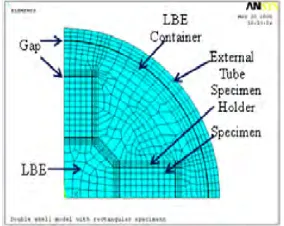
An irradiation using an LBE capsule is expected to begin in 2010 for the SFR fuel and materials tests. The test will be performed in the OR-5 test position of the HANARO reactor at KAERI. The overall shape of an LBE capsule is a double wall configuration and quite similar to the present standard material capsule (Kang, 2004) except for the use of an LBE as a thermal media. The main body of the capsule, which is about 56mm in diameter and approximately 876 mm long, consists of specimen holders with structural components, test specimens, an LBE container and an external tube (main body of a capsule). In order to maximize the specimen space in a capsule, four columns of 10x10mm specimens are placed in a rectangular array within an LBE cylinder as shown in Fig 1. He gas gap exists between the LBE container and the external tube, and between specimens and specimen holder for heat transfer purposes.
4
FINITE ELEMENT ANALYSIS
4.1 Modelling and Boundary conditions
The temperature calculations for a capsule were performed using a finite element analysis program, ANSYS (ANSYS Inc, 2006). The analysis model for a circular cylinder with multi specimens was generated by the coupled-field elements of PLANE223 with a 2-D structural-thermal field. Fig. 1 shows the two-dimensional analysis model for a quarter section with 4-specimens. However, the simple structural components for supporting the specimens in an LBE container was not considered in this model because the model is seems to be enough to allow performing the parametric evaluations necessary to understand the thermal response as well as to determine which parameters are important to the thermal response. The LBE zone was modelled as a conductive region. The same materials data that were usedin the previous study(Kang, 2008b) were usedin this work.
Figure 1. Typical finite element model of an LBE capsule
In the reactor, the specimens, the LBE, and the internal and the external tube of a capsule act as a heat source due to a high γ-ray flux. The temperature distribution within a capsule as well as the specimens depends on its detailed configuration and thermal environments in which a capsule is operating at the HANARO reactor. To evaluate comparatively the effect of design variables such as G1, G2, and T1, it is essential to vary one variable at a time and to hold other variables constant.
5
RESULTS AND DISCUSSIONS
A series of studies have been conducted using a model to study the effects of variation in input design parameters on the peak temperature of specimens, temperature difference within a specimen, and a surface temperature of a capsule.
5.1
Thermal characteristics of a capsule using a solid and liquid thermal media
Under the current HANARO capsule design practice, preliminary thermal analysis for a comparison of the capsules with Mo and LBE thermal media was carried out using a finite element analysis program, ANSYS. Fig 2 shows the typical radial temperature distribution of a capsule with a liquid thermal media LBE (a) and a capsule with a solid media Mo (b). From the figure, it showed that both capsule concepts, compared with a typical capsule using an Al media, can provide better environments favorable to the high temperature test. In particular, specimen’s peak temperature of the capsules is similar, but the temperature difference between specimen and thermal media is quite different. In addition, the temperature distribution of an LBE capsule in the longitudinal direction is relatively uniform as compared with the data of a capsule using a solid thermal media and consequently, an LBE capsule can provide a more precise and stable temperature control for a user's test.
Figure 2. Typical radial temperature distribution of the capsules with a liquid thermal media LBE (a) and a solid thermal media Mo (b) (Kang, 2009)
5.2
Effects of the gap G1, G2, thickness T1 on the specimen’s peak temperature
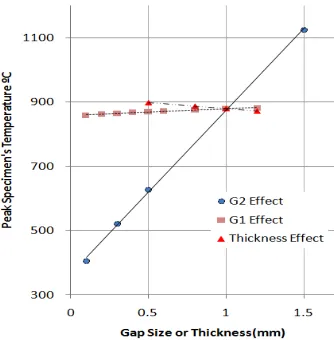
Fig. 3 shows the effects of the gap size G1, G2 and thickness T1 on the specimen’s temperature of an LBE capsule. From the figure, the G1 effect among the concerned variables appears to be significant, and the G2 effect seems to be almost negligible, and the T1 shows an adverse affect with an increase of concerned variables. For example, the peak temperature of the specimen is increased linearly with an increase of G1 from 0.1 to 1.5mm and varies from 406 to 1124 oC at the OR5 hole. The faster rise on the temperature is due to the unique physico-chemical and stable nuclear properties of an LBE and large thermal gradients near the primary coolant zone. For the effect of a gap-size G2 on the temperature, a holder thickness T1 and a gap size G1 is fixed as 0.5 and 1 mm in size, respectively, while the gap size for an analysis varied from 0.1 to 1.2 mm. The data in Fig 3 indicates that the temperature dependence of a gap size G2 is quite low but it shows positive effect, compared with that of the effect of G1. The figure clearly shows that the specimen temperature increases a little bit from 859 oC at a gap size G2 of 0.1 mm and 882 oC at a gap size G2 of 1.2mm. This means that the specimen’s temperature remained relatively constant over the studied range of the gap size G2 due to the small thermal resistance and thus, the specimen’s temperature does not affect much with an increase of the gap size G2. The effect of variation of thickness of the specimen’s holder on the specimen’s temperature is also shown in the figure. However, as the thickness T1 increases, the specimen’s peak temperature decreases due to increase in thermal resistance of a holder material, and thus, reduces the heat flux of LBE. Increase in the thickness of the holder from 0.5 mm to 1.2 mm has resulted in decrease of the temperature of a specimen by 2.9 %.
Figure 3. Effects of the He gap size G1, G2, and a holder’s thickness on the specimen temperature of an LBE capsule
5.3
Effect of the gap G1, G2, thickness T1 on the surface temperature of a capsule
Fig. 4 shows the effects of the gap size G1, G2 and thickness T1 on the surface temperature of an LBE capsule. Since onset of nucleate boiling (ONB) on the surfaces of a capsule exposed to the HANARO primary coolant must be avoided, the surface temperature is quite important with a respect of a safety. From the figure, G2 and T1 effects seem to be almost negligible with an increase of concerned variables except G1, which shows adversely affect. All the surface temperatures for three design parameter’s effects are nearly constant(less than around 42 oC), which meets the temperature criterion (< 124 oC) of onset of nuclear boiling in the HANARO reactor.
Figure 4. Temperature changes with different gap size G1, G2 and thickness T1 at the surface temperature of an LBE capsule
5.4
Effect of the gap G1, G2, and thickness T1 on the temperature difference within a specimen
results, we found that the larger gap size G1 could cause a small temperature difference, which means a more uniform temperature distribution.
Figure 5. Effects of the G1, G2 and the thickness T1 on the temperature difference within a specimen of an LBE capsule
6
CONCLUSION
Based on the performed evaluations, it is concluded that specimen temperature of a capsule is affected by the gap size of G1 and G2, and thickness of the specimen container. Particularly, G1 has the greatest effect on the temperature of an LBE capsule and is important in determining the target temperature. All the surface temperatures for three design parameter’s effects are nearly constant(less than around 42 oC), which meets the temperature criterion (< 124 oC) of onset of nuclear boiling in the HANARO reactor. For a high temperature test at HANARO, when used in proper combination with a gap G1 and the thickness T1 of specimen container, the test requirements would substantially meet for a high temperature irradiation of new materials in the HANARO reactor. Thus, the design parameters must be optimized to achieve an acceptable performance of an LBE capsule for a high temperature test in the HANARO reactor. Final design activities will include a detailed nuclear analysis with a position of control rods in the normal operating range of HANARO to correctly place the experiment relative to the reactor centerline.
Acknowledgements
The authors would like to express their appreciation to Korea Science and Engineering Foundation (KOSEF) and the Ministry of Education, Science and Technology (MEST) of the Republic of Korea for the support of this work through the Nuclear R&D Project.
REFERENCES
ANSYS Inc., 2006. ANSYS User’s manual, Ver. 10.0.
Carassou, S., et al, 2005. Experimental material irradiation in the JHR, TRTR2005/IGORR-10, Sep. 12-16, Gaithersburg, MD, U.S.A.
Cho, M.S., et al., 2008. A performance test of a capsule for a material irradiation in the OR holes of HANARO, Proc. of KNS Spring Mtg., Gyeongju, Korea, May 29-30.
Gromov, B.F., et al., 1997. Use of Lead-Bismuth coolant in nuclear reactors and accelerator-driven systems, Nuclear Engineering & Design, 173, 207-17.
Grover, S.B., 2004. Testing of gas reactor materials and fuel in the ATR, ANES 2004, Oct, Miami, Florida U.S.A.
Hu, L. W. and Bernard, J., 2005. The MIT research reactor as a national user facility for advanced materials and fuel research, TRTR2005/IGORR-10, Sep. 12-16, Gaithersburg, MD, U.S.A.
Kang, Y. H., et. al., 2008a. A study on the high temperature irradiation test possibility for the HANARO outer core region, KAERI Technical Report No. KAERI/TR-3530/2008.
Kang, Y. H., et. al., 2008b. The gap size effects on the specimen temperature for an LBE Capsule development, Proc. of KNS Autumn Mtg., PyeongChang, Korea, October 30-31.
Kang, Y. H., et al., 2009. A feasibility study for an LBE alloy utilization as a thermal media for an irradiation device, KAERI Technical Report No., KAERI/TR-3721/2009.
Oh, S. Y., 2008. Neutronic data for an LBE capsule, KAERI Internal memo, HAN-NE-CR-920-08-14, KAERI.