Comparative Static and Dynamic Study on
Seismic Analysis of Uniform and Non Uniform
Column Sections in a Building
Santosh Kumar Adhikari1, Dr K. Rajasekhar 2 1
P.G. Student, Department of Civil Engineering (Structural Engineering), Andhra University
Visakhapatnam, Andhra Pradesh India
2
Asst.Professor, Department of Civil Engineering (structural Engineering), Andhra University
Visakhapatnam, Andhra Pradesh India
ABSTRACT: An attempt is made to understand difference of dynamic and static earthquake analysis and corresponding shear forces arising in 8 -storied reinforced concrete frame structure with column section varying at certain floor levels for case1 of the model and column section remaining uniform throughout the building in case2 of the model . The comparison between two models is made for both static and dynamic earthquake analysis. Conclusions are derived regarding the effects of varying column sections and uniform column section between two models. The values of storey drift, storey maximum displacements, storey shear forces were plotted for both cases of models. Both models were checked for Soft Storey and reinforcement of columns were designed and compared with each other.
KEYWORDS:Static Analysis, Dynamic Analysis, Comparative, Soft Storey, Uniform, Non-Uniform, Storey Shear
I. INTRODUCTION
Many of the buildings are analysed for earthquake loads and designed accordingly. This study includes analysis of RCC frame by both static and dynamic methods and hence compare the difference between the two methods. Static method includes seismic coefficient method and dynamic method includes response spectrum method. It is intended to know comparative variation in shear forces, displacements and drifts in columns for both cases of the building where except column size all loading conditions are same. Both cases of building are designed for 20 different load combinations given by ETABS and selection of appropriate model is done based on analysis and design results.
[1]S.S. Patil et al analysed high rise buildings by response spectrum method using STAADPRO with various conditions of lateral stiffness system. Analysis was done with response spectrum method. Analysis produced the effect of higher modes of vibration & actual distribution of forces in elastic range in a better way. Test results including base shear, story drift and story deflections were presented and got effective lateral load resisting system
.
considered in this study to compare the seismic performance of different Zones i.e. II and V were Base Shear, Storey Moment and lateral forces.
[4] Sayed Mahmoud and Waleed Abdallah studied about response analysis of multi-storey RC buildings under equivalent static and dynamic loads according to Egyptian code. This research studied reinforced concrete building as a typical fourteen storey flat slab-column system located in Cairo. In order to account for the modal damping effect, the complete quadratic combination (CQC) technique, which takes into account the statistical coupling between closely spaced modes caused by modal damping, was used for modal combination. The first modelling step with ETABS involves defining the physical properties of the used materials.
[5]Mohammed Yousuf ,P.M. Shimpale did a research about "Dynamic Analysis of Reinforced Concrete Building with Plan Irregularities". Paper aimed towards the dynamic analysis of reinforced concrete building with plan irregularity. Four models of G+5 building with one symmetric plan and remaining irregular plan had been taken for the investigation.
II. STATEMENT OF THE PROBLEM Case 1
:
Plan area =12(m)*12(m)
Beam size =300(mm)*400 (mm)
Column size =300(mm)*600 (mm) -1st storey
=300(mm)*500(mm) - 2nd 3rd 4thstorey =300(mm)*400(mm) - 5th 6th 7th 8th storey
Slab =125 mm
Beam length and column c/c spacing =4m
Typical storey height = 3m
Bottom storey height = 4m
Live load =3kN/m²
Wall load =10 kN/m in all beams
Beam clear cover =25 mm
Column clear cover =40 mm
M25, Fe415 ,Zone V , Soil Type (II)
Case 2:
Column size =300(mm)*600(mm) throughout the building
III. ANALYSIS RESULTS
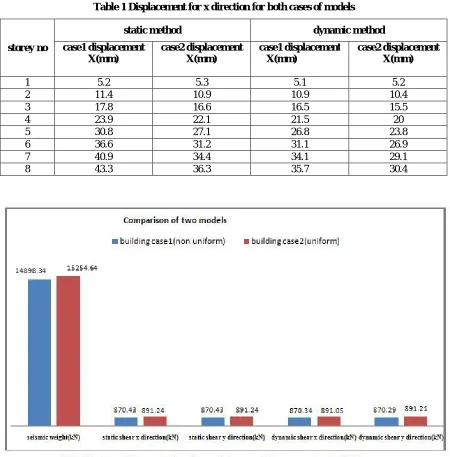
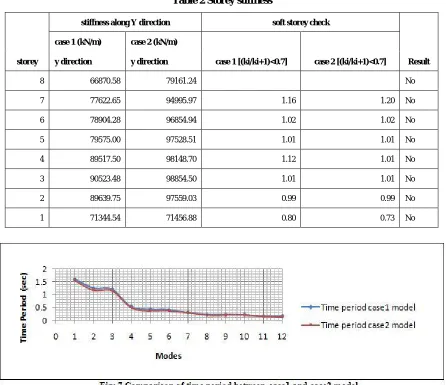
Analysis was done in ETABS. Results from both static and dynamic analysis were obtained. The values of displacements, storey shears, storey stiffness, time periods were compared between two models.
Table 1 Displacement for x direction for both cases of models
storey no
static method dynamic method
case1 displacement X(mm)
case2 displacement X(mm)
case1 displacement X(mm)
case2 displacement X(mm)
1 5.2 5.3 5.1 5.2
2 11.4 10.9 10.9 10.4
3 17.8 16.6 16.5 15.5
4 23.9 22.1 21.5 20
5 30.8 27.1 26.8 23.8
6 36.6 31.2 31.1 26.9
7 40.9 34.4 34.1 29.1
Table 2 Storey stiffness
storey
stiffness along Y direction soft storey check
Result
case 1 (kN/m) case 2 (kN/m)
case 1 [(ki/ki+1)<0.7] case 2 [(ki/ki+1)<0.7]
y direction y direction
8 66870.58 79161.24 No
7 77622.65 94995.97 1.16 1.20 No
6 78904.28 96854.94 1.02 1.02 No
5 79575.00 97528.51 1.01 1.01 No
4 89517.50 98148.70 1.12 1.01 No
3 90523.48 98854.50 1.01 1.01 No
2 89639.75 97559.03 0.99 0.99 No
IV. DESIGN RESULTS
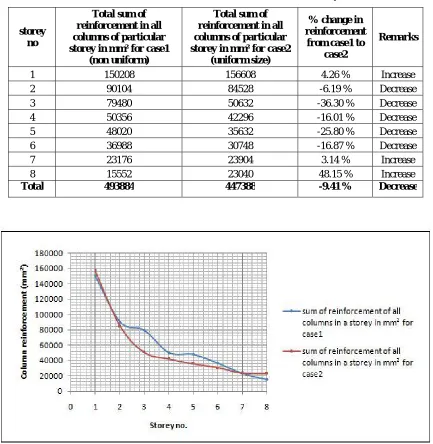
Both cases of buildings were designed for 20 load combinations given by ETABS software. The longitudinal reinforcement of all columns in each storey was found out. Summation of reinforcement per metre length of all column in a storey was calculated for both buildings. Graph is plotted between reinforcements in column and compared with two cases in each storey. It is seen that from case2 to case1 total seismic weight of building decreases by 2.33 %.
From case2 to case1 total reinforcement of columns increases by 10.23%. Details are shown by table and figure below.
Table 3 Sum of total reinforcement of columns in a storey
storey no
Total sum of reinforcement in all columns of particular storey in mm² for case1
(non uniform)
Total sum of reinforcement in all columns of particular storey in mm² for case2
(uniform size)
% change in reinforcement
from case1 to case2
Remarks
1 150208 156608 4.26 % Increase
2 90104 84528 -6.19 % Decrease
3 79480 50632 -36.30 % Decrease
4 50356 42296 -16.01 % Decrease
5 48020 35632 -25.80 % Decrease
6 36988 30748 -16.87 % Decrease
7 23176 23904 3.14 % Increase
8 15552 23040 48.15 % Increase
V. CONCLUSIONS a. Conclusions From Analysis
It is seen that ETABS gives less value for dynamic shear by response spectrum method. Those values
should be scaled up appropriately according to IS code 1893 -2000 clause 7.8.2. to make it at least in the range of static shear by seismic coefficient method. For case1 scale up ratios were 1.7 for x direction and 2.05 for y direction similarly for case2 scale up ratios were 1.58 and 1.98 for x and y direction respectively.
Due to increase in column size, seismic weight from case1 to case2 increases by 356 kN(2.29%) thevalues of base shear increases by 20 kN(2.27%) and displacement decreases by 5.4 mm(12.55%) (average)
.
If bottom storey height is made more than other storey height for parking purposes stiffness of bottom storey is decreased than upper stories so it is better to decrease the column section in upper storey so as to decrease the variation of stiffness between two storey and prevent soft storey effect. It is seen from table 2 that stiffness for y direction for case2 bottom storey is only 0.73 times stiffness of 2nd storey which is very near to critical margin (0.7). By decreasing column size in 2nd storey we can keep safety margin up to 0.8 as in case1.
Top displacement values from dynamic analysis is 16 % lesser than the displacement from static analysis for both cases of building.
Static approach gives higher values of forces and moments which makes building uneconomical hence consideration of dynamic approach is also needed.
Lateral force at floor level due to static shear is almost same for both building but due to dynamic shear it is less in storey 4 & 5 in case1 and more in storey 8 than case2. (see Fig:5)
From both buildings it is concluded that lateral force arising due to dynamic shear distribution is significantly more than force due to static shear in lower stories up to storey four after that for higher stories force due to static shear exceeds the force due to dynamic shear.(see Fig:6)
b. Conclusions From Design
Except top storeys (7&8) it is seen that decrease in size of column yields increase in amount of reinforcement.
At 1st storey where size of column is same, column reinforcement is more by 4.26 % for building with more seismic weight i.e. for case2.
For top storeys (7 &8) the columns with lesser cross section case1 will need lesser reinforcement because minimum reinforcement of 0.8% of column section ( IS456 code clause 26.5.3.1) is enough to carry developed earthquake induced forces and moments. In 7th and 8th storey, column reinforcement decreases by 3.04 % & 32.5 % from case2 (uniform) to case1 (non uniform).
If column section is reduced in upper stories as in case1 the amount of reinforcement needed considering all columns of building as a whole will increase by 10.39 % and seismic weight of building decreases by 2.33 %.
It is seen that total wt of reinforcement of column for case1 (non uniform section) is 12.85 tons
whereas total wt of reinforcement of columns for case2 (uniform section) is 11.8 tons hence save in reinforcement from case1 to case2 is 1.05 tons. If only 7th and 8th storey column section for uniform case is decreased as in non uniform case, further reinforcement of 0.3 tons could be saved from
VI. DISCUSSIONS
It is observed that to get minimum reinforcement in building, it is better to decrease column section in storey 7th and 8th as in case1 and take uniform column section up to storey six as in case2. 7th and 8th storey columns in non uniform case has less reinforcement than uniform case. In higher stories there is very less axial loads and moments in columns so smaller section is ok.
REFERENCES
[1] Prof. S.S. Patil "Seismic Analysis of High-Rise Building by Response Spectrum Method ", International Journal Of Computational Engineering Research (Ijceronline.Com)
[2] Bahador Bagheri, Krishna Nivedita, Ehsan Salimi Firoozabad ,"Comparative damage assessment of irregular building based on static and dynamic analysis" international journal of civil and structural engineering
[3] B. Srikanth, V.Ramesh journal on "Comparative Study of Seismic Response for Seismic Coefficient and Response Spectrum Methods", International Journal of Engineering Research and Applications.
[4] Sayed Mahmoud, Waleed Abdallah Saudi Arabia "Response Analysis of Multi-Storey RC Buildings under Equivalent Static and Dynamic Loads according to Egyptian Code ", International Journal of Civil and Structural Engineering Research .
[5] Mohammed Yousuf, P.M. Shimpale journal on "Dynamic Analysis of Reinforced Concrete Building with Plan Irregularities", International Journal of Emerging Technology and Advanced Engineering.