Updated GROUND-MOTION MODEL FOR THE CENTRAL AND
EASTERN UNITED STATES
Lawrence A. Salomone1, Gabriel R. Toro2, Robert R. Youngs3, Robin K. McGuire4, Martin Chapman5, J. Carl Stepp6, Serkan B. Bozkurt7, and Robert P. Kassawara8
1Consultant, Electric Power Research Institute, Palo Alto, CA ([email protected]) 2Senior Principal Engineer, Lettis Consultants International, Acton, MA
3Principal Engineer, AMEC Environment & Infrastructure, Oakland, CA 4Senior Principal, Lettis Consultants International, Boulder, CO
5Professor, Virginia Tech, Department of Geosciences, Blacksburg, VA 6Consultant, Earthquake Hazards Solution, Blanco, TX
7GIS Manager, Lettis Consultants International, Walnut Creek, CA
8Senior Project Manager, Electric Power Research Institute, Palo Alto, CA
ABSTRACT
The paper describes the results from a project funded by the Electric Power Research Institute (EPRI) to provide industry with information necessary to respond to the Nuclear Regulatory Commission (NRC) Request for Information (RFI) dated March 12, 2012 (USNRC, 2012). The purpose of the project is to determine whether the EPRI (2004, 2006) Ground-Motion Model (GMM) requires updating, considering currently available data and seismological understanding of ground motions in the central and eastern United States (CEUS); if it does require updating, an update of the model would be developed. Shear wave velocity measurements at 33 seismic recording stations were obtained to reduce uncertainty by adjusting ground motions to reference conditions. Phase 1 showed that an update of the EPRI (2004, 2006) Ground-Motion Model (GMM) was warranted. An Updated EPRI (2004, 2006) GMM was developed in Phase 2. The Updated EPRI (2004, 2006) GMM was used with the CEUS SSC model (2012) to calculate seismic hazard curves at seven CEUS test sites in different hazard environments. Using the Updated EPRI (2004, 2006) GMM with the CEUS SSC model (2012) resulted in reductions in seismic hazard at all frequencies except peak ground acceleration (PGA).
STUDY AREA
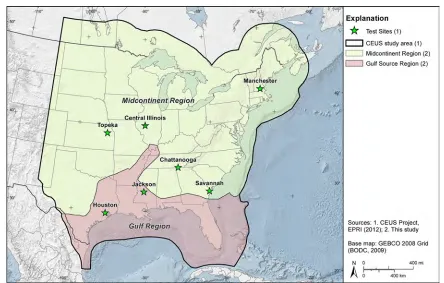
The project study region (Figure 1) represents the same region as the CEUS SSC Model (2012). The project study region is divided into two sub regions: the Midcontinent Region and Gulf Region. The Updated EPRI (2004, 2006) GMM is applicable to all sites within the project study region. The western boundary is located approximately along the foothills of the Rocky Mountains at longitude 105°W. On the north, the study region extends a minimum of 322 km (200 mi.) from the U.S.-Canadian border. Only areas that lie within continental crust are included. Areas that are not included are those outside the study region boundaries; this applies to the Western United States (WUS), Mexico, Canada, and the Caribbean Plate boundary area.
PRODUCTS OF PROJECT
Updated EPRI (2004, 2006) Ground-Motion Model
Figure 1- Study area showing ground-motion model sub-regions and test sites
Prepare an up-to-date database of ground-motion recordings for use in testing the available central and eastern North America (CENA) ground-motion prediction equations (GMPEs), using as a starting point the ground-motion database assembled by the PEER NGA-East Project.
Check the consistency of corrected data and adjust, if necessary.
Identify GMPEs and assign GMPEs to clusters by reviewing the literature, conducting interviews, and holding a workshop with current ground-motion experts.
Establish analytical and empirical approaches for adjusting recording site conditions using shear-wave-velocity measurements at strong-motion recording sites.
Compute GMPE and cluster weights.
Evaluate the epistemic uncertainty.
Update the EPRI (2006) aleatory variability model.
EPRI (2004, 2006) GMM Review Project Report (EPRI, 2013) provides details regarding the evaluation and integration activities for development of the Updated EPRI (2004, 2006) GMM.
Hazard Input Document
Documentation of Literature Review, Expert Interviews and PPRP Correspondence
In order to demonstrate the structured and systematic evaluation of the range of diverse interpretations from the larger technical community, the TI Team conducted literature reviews and interviewed experts (resource experts and proponents) whose work was either not published or was awaiting publication. Appendix B in the EPRI (2004, 2006) GMM Review Project Report (EPRI, 2013) provides the documentation for literature reviews, including literature review tables that document the results of the reviews by the TI Team. Appendix C provides the documentation for the interviews conducted by the TI Team with resource experts and proponents who are working on CEUS ground motion modeling. The TI Team obtained information from copies of papers under review or in press, as well as from updates about these experts’ ongoing work. Appendix H and the EPRI (2004, 2006) GMM Review Project Report (EPRI, 2013) provide the Participatory Peer Review Panel (PPRP) reports.
Project Database
The purpose of compiling the project database was to organize and store those data and resources that had been carefully and thoroughly collected and described for the TI Team’s use. Development of the project database began at the inception of the project to provide TI Team members with the current version of the NGA-East ground-motion database, the shear-wave-velocity database for seismic recording stations, and a current set of data, maps, and figures. The Database Manager established an FTP site for the TI Team and Project Manager to access the project database. Appendix A in the EPRI (2004, 2006) GMM Review Project Report (EPRI, 2013) provides details regarding the Project Database.
Shear-Wave Velocity Measurements at Seismic Recording Stations
The GeoVision Report (EPRI, 2013a), available on the EPRI website at epri.com, describes the investigation conducted by GeoVision and its subcontractor, Dr. Ken Stokoe, between May 15 and July 19, 2012, to develop S-wave velocity (VS) models to a depth of 30 m (or more) and to estimate the
average shear wave velocity of the upper 30 m (VS30) at 33 seismic recording stations located in the
CEUS.
The U.S. Geological Survey (USGS) measured shear wave velocity at 24 seismic recording stations during 2011 and 2012 (Kayen et.2013). The results of these measurements were provided to the EPRI (2004, 2006) GMM Review Project as part of the productive cooperation agreement arranged by the Project Manager. The measurements are based on surface wave dispersion. A summary of results from each of the recording site locations is provided in Chapter 4. Observations from the investigation follow.
The NGA-East profile database was also used. This database contains measured profiles compiled from the literature.
OBSERVATIONS FROM SHEAR WAVE VELOCITY MEASUREMENT INVESTIGATION
Based on the investigation conducted including evaluating the results from the shear wave velocity measurements at the overlapping stations (ET.SWET and US.CBN), the following observations are warranted:
Shear wave velocity for hard rock sites are, in general, below the CEUS reference rock velocity of 2800 m/s for developing GMPE; Some recording stations had shear wave velocities at about the reference rock velocity at depths greater than 30 m (e.g. PN.PPBLN - Indiana and US.WMOK - Oklahoma).
Velocity inversions occurred at some sites; Shear Wave Velocity of Layer 1 in the profile can be higher than Layer 2.
The geology at the recording stations can be highly variable; Lateral velocity variation is an important issue at many sites; Future investigations may require more testing arrays.
Different array locations, anisotropy and depth of water table assumed can cause differences when making shear wave velocity measurements.
EPRI (2004, 2006) GROUND-MOTION MODEL (GMM)
Framework
The Updated EPRI (2004, 2006) GMM (2013) utilized the conceptual framework of the EPRI (2004) GMM. The framework used in the EPRI (2004) is presented in this section to assist readers in recalling the basis for the EPRI (2004) GMM. EPRI (2004) essentially updated a study performed by EPRI 16 years earlier for purpose of evaluating and quantifying uncertainty in ground motion modeling in the CEUS and developing a CEUS GMM that incorporated both epistemic and aleatory uncertainty and seismological aspects of ground motion prediction considering the current available database. Although the study preceded publication of the Senior Seismic Hazard Analysis Committee (SSHAC) Guidance, it was conducted following a SSHAC-3 like process.
Consistent with the SSHAC Guidance the project participants consisted of: 1) a three-person TI Team, including experienced ground motion modeling experts; 2) a six-person expert panel; and 3) a participatory peer review panel (PPRP). The expert panel consisted of proponent GMPE development experts who broadly represented the range seismological attributes of then existing proponent GMPEs. The PPRP included nationally recognized experts in ground motion modeling for engineering application as well as recognized expertise in application of seismic hazard modeling in seismic regulation (EPRI, 2004).
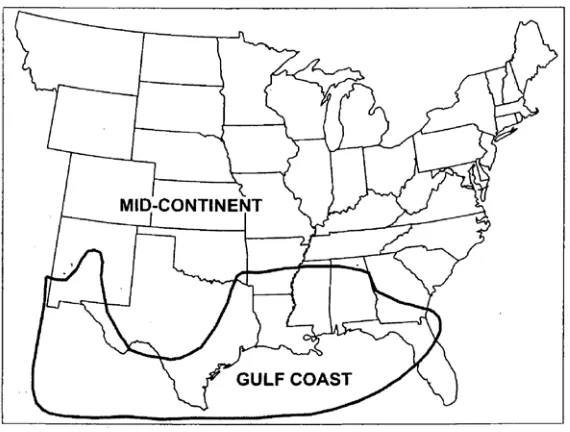
Figure 2: EPRI (2004) regionalization
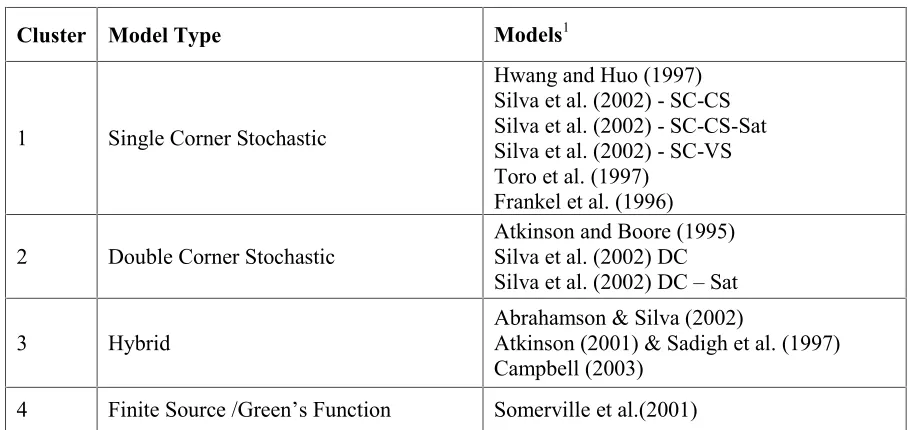
grouping the GMPEs into four clusters based on similar seismological (primarily representation of the earthquake source) attributes. This structure permitted evaluation and assessment of within cluster epistemic uncertainty as well as epistemic uncertainty based on an assessment of the seismologic attributes of the four clusters. Implementation of the cluster structure resulted in four model clusters defined as: Single Corner Stochastic (Cluster 1), Double Corner Stochastic (Cluster 2), Hybrid (Cluster 3) and Finite Source/Greens Function (Cluster 4). The 13 technically defensible then existing GMPEs were grouped into the four clusters shown in Table 1. EPRI (2004) regionalization is shown on Figure 2.
Table 1: EPRI (2004) Ground-motion models grouped by cluster
Cluster Model Type Models1
1 Single Corner Stochastic
Hwang and Huo (1997) Silva et al. (2002) - SC-CS Silva et al. (2002) - SC-CS-Sat Silva et al. (2002) - SC-VS Toro et al. (1997)
Frankel et al. (1996)
2 Double Corner Stochastic Atkinson and Boore (1995)Silva et al. (2002) DC Silva et al. (2002) DC – Sat
3 Hybrid Abrahamson & Silva (2002)Atkinson (2001) & Sadigh et al. (1997) Campbell (2003)
4 Finite Source /Green’s Function Somerville et al.(2001)
1SC, single corner; DC, double corner; CS, constant stress; VS, variable stress; Sat, saturation.
EPRI 2006 Aleatory Model Study: Update of the EPRI 2004 Study Sigma Model
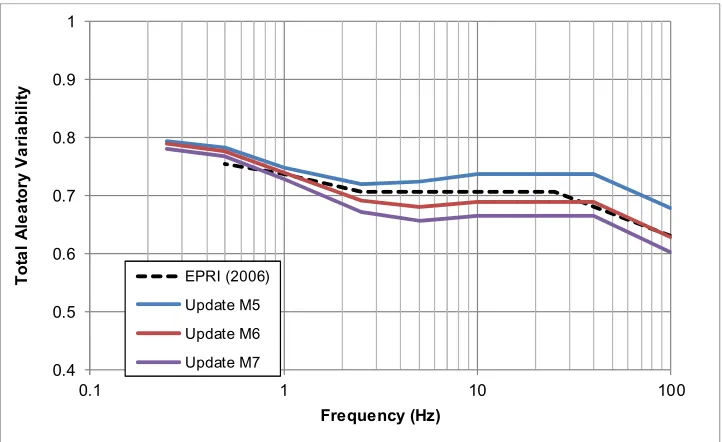
The standard deviation (sigma) developed in the EPRI (2004) ground-motion study was much larger than later studies using large western data sets of ground motions measurements showed. In consequence, EPRI performed a study for the purpose of assessing the proper aleatory variability (sigma) to assign to CENA ground-motion models. The study was conducted following a SSHAC Level 2 assessment process. The preliminary results available from NGA-West 1 constituted the primary data for the study. This study concluded that empirically-based estimates of sigma using data from active tectonic regions are appropriate with proper adjustment. In EPRI (2006), alternative models for the total standard deviation (combined intra-event and inter-event) were developed that could be applied to the CEUS.
Discussion of EPRI (2004, 2006) Ground-Motion Model
The TI Team concluded that it is appropriate to update the EPRI (2004, 2006) GMM for the following reasons:
Seven of the thirteen GMPEs underlying the EPRI (2004, 2006) GMM are no longer supported by their developers.
The CENA ground-motion database is significantly larger now than it was when the EPRI (2004) was completed. This is a consequence of the occurrence of a number of earthquakes in the last decade (including Mineral, Virginia, Sparks, Oklahoma, Val-des-Bois, Quebec, and Mt. Carmel, Illinois), and the data-collection efforts of the NGA-East project. In fact, the NGA-East CENA database available to this project is five times larger than the EPRI (2004) database.
Comparisons to the database described above indicate that the EPRI (2004, 2006) GMM over predicts ground motions at some magnitude-distance frequency ranges that are important to nuclear power plant (NPP) probabilistic seismic hazard analysis (PSHA).
The aleatory-variability portion of the EPRI (2004, 2006) is based primarily on preliminary models from the NGA study. These models have been superseded by the final NGA model released in 2008 and by the preliminary NGA-West 2 model.
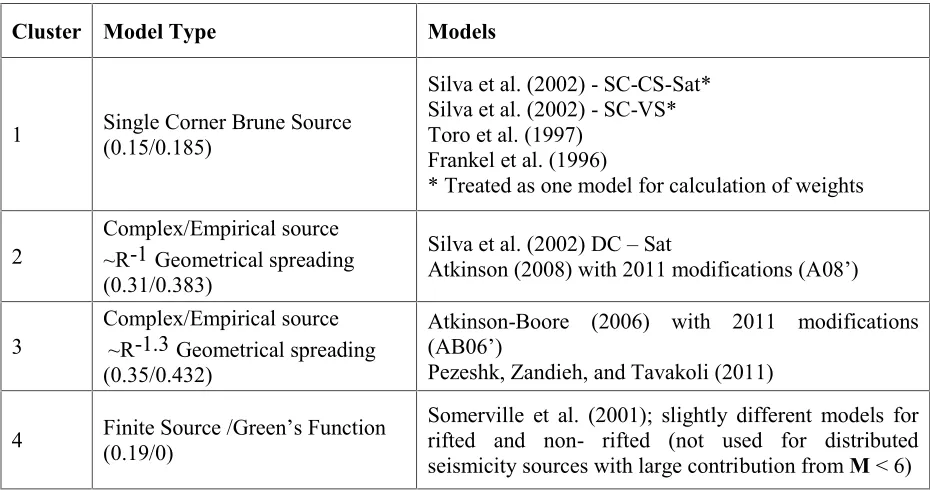
Based on the reviews and discussions with researchers, the continued use of each of the GMPEs included in the EPRI (2004) study was evaluated and new candidate GMPEs were identified. The results of these assessments are shown in Table 2 where the Updated EPRI (2004, 2006) GMM clusters and models are shown.
Table 2: Updated EPRI (2004, 2006) GMM clusters and models (taken from EPRI, 2013)
Cluster Model Type Models
1 Single Corner Brune Source(0.15/0.185)
Silva et al. (2002) - SC-CS-Sat* Silva et al. (2002) - SC-VS* Toro et al. (1997)
Frankel et al. (1996)
* Treated as one model for calculation of weights
2 Complex/Empirical source~R-1 Geometrical spreading (0.31/0.383)
Silva et al. (2002) DC – Sat
Atkinson (2008) with 2011 modifications (A08’)
3 Complex/Empirical source~R-1.3 Geometrical spreading (0.35/0.432)
Atkinson-Boore (2006) with 2011 modifications (AB06’)
Pezeshk, Zandieh, and Tavakoli (2011)
4 Finite Source /Green’s Function(0.19/0) Somerville et al. (2001); slightly different models forrifted and non- rifted (not used for distributed seismicity sources with large contribution fromM< 6)
GENERAL METHODOLOGY FOR UPDATING EPRI (2004, 2006) GMM
General
SSHAC Level
Because this is an update to an existing SSHAC Level 3 ground-motion model, a SSHAC Level 2 assessment process was selected as the appropriate level. To gain additional confidence, a number of SHHAC Level 3 features were introduced into this project, such as the engagement of a PPRP since project inception and an in-person feedback workshop. Both the PPRP and the Resource and Proponent experts provided extensive feedback.
Data
This project took advantage of two significant data collection efforts, namely the NGA-East collection and uniform processing of strong-motion and seismograph data and the EPRI-sponsored effort to characterize site conditions at a number of recording stations (the latter supplemented by a parallel USGS effort that provided data for additional stations). The station data were used to adjust the data to reference site conditions, using two alternative approaches.
Overall Structure of GMM
The Updated GMM follows the EPRI (2004) approach of grouping the candidate GMPEs into four clusters according to their technical characteristics, weighting the GMPEs within each cluster according to their consistency with the data, representing each cluster by three fitted GMMs, and calculating cluster weights on the basis of consistency with the data and other attributes of the GMMs within each cluster.
There are some differences in implementation, however. Some of these differences represent adjustments to the conditions encountered, others represent methodological improvements. In particular, the set of candidate GMPE has changed because some of the GMPEs considered by EPRI (2004) are no longer supported by their developers and proponents, and because new GMPEs are available. The new GMPEs necessitated changes in the definition of Clusters 2 and 3 because the most salient grouping of the candidate GMMs for these clusters was their difference in geometrical spreading. Also, the calculation of consistency with the data was changed to a likelihood-based formulation, which is more flexible (for instance, it allows for consideration of single-station correlation in adjustment factors) and has a strong basis in theory. In addition, the characterization of within-cluster epistemic uncertainty was modified to sidestep some problems with un-quantified correlations, to take advantage of the more abundant data in constraining the predictions at low magnitudes, and to account for uncertainty in magnitude scaling in a more direct manner. The clusters and weights (area sources and repeated large magnitude earthquake sources) for the Updated EPRI (2004, 2006) GMM are shown in Table 2.
Model for Aleatory Uncertainty
Model for Gulf Region
EPRI (2013) documents the process of modifying the Midcontinent GMM developed in the study so that one can compute ground-motion amplitudes for earthquake paths that travel primarily through Gulf-Coast crust. This modification is done by accounting for differences in anelastic attenuation between the Midcontinent and the Gulf, using the Gulf anelastic-attenuation model developed in the study and following an approach analogous to the approach followed in EPRI (2004). The geographical boundary between the Midcontinent and Gulf Regions are shown on Figure 1.
In cases where a source is wholly or partially within one region and the site is within another, the selection between the Midcontinent and Gulf model is not straightforward. It is recommended that the hazard analyst select the region that contains the majority of the travel path, which may be defined as the minimum distance from the source to the site. It is also appropriate to pro-rate the Midcontinent and Gulf ground-motion amplitudes, taking into account the fraction of the source-site path that is contained within each region.
Figure 3: Total aleatory variability for EPRI (2006) GMM and Updated EPRI GMM (2013)
SEISMIC HAZARD CALCULATIONS AT TEST SITES
Overview
The Updated EPRI (2004, 2006) GMM developed under this project was used to calculate seismic hazard at the seven test sites examined under the CEUS-SSC project (2012) to illustrate seismic hazards with the updated model. In addition, comparisons with hazard results from the CEUS-SSC project (2012) illustrate differences in hazard between the EPRI (2004, 2006) GMM and the Updated EPRI (2004, 2006) GMM. All of the calculations described in the EPRI (2004, 2006) GMM Review Project Report (EPRI, 2013) were made for demonstration purposes only and should not be used for design or analysis decisions for any engineered facility.
Seismic hazard was calculated for hard rock conditions for illustration purposes. Hard rock is defined as rock with a shear wave velocity (VS) of 2,800 m/s (9,200 ft/s) and kappa of 0.006 seconds. All
of the seismic hazard results presented in this section are for hard rock conditions. A map of the seven site test sites is shown on Figure 1.
0.4 0.5 0.6 0.7 0.8 0.9 1
0.1 1 10 100
To
ta
l A
le
at
or
y
Va
ria
bi
lit
y
Frequency (Hz) EPRI (2006)
When the geometry of the earthquake rupture is defined, the Updated EPRI (2004, 2006) GMM uses distance to the surface projection of the rupture (“Joyner Boore distance”) and closest distance to the rupture (depending on the specific equation within the model). When (for seismic hazard calculations) the rupture geometry is unknown and the earthquake is represented as a point, the EPRI (2004) report includes correction terms for the distance measures and for the aleatory standard deviation, to modify these parameters for point-source conditions. These modifications were implemented within the seismic hazard calculations, for both the EPRI (2004, 2006) GMM and the Updated EPRI (2004, 2006) GMM.
The seismic hazard calculations reported in the EPRI (2004, 2006) GMM Review Project Report (EPRI, 2013) were made with the LCI THAZ software code. This software is different from the software used to calculate and report results in the CEUS-SSC project (2012), but gives seismic hazard results that are very close to those in the CEUS-SSC project (2012). Any differences in results observed are attributable to differences in the ground motion equations.
Observations
Based on review of the seismic hazard curves in the EPRI (2004, 2006) GMM Review Project Report (EPRI, 2013), the following observations can be made:
There is an important decrease in ground motion at rock at all frequencies except peak ground acceleration (PGA) for the tests sites in the Midcontinent Region and Gulf Region when the Updated EPRI (2004, 2006) GMM is used with the CEUS SSC model (2012). For PGA, equations for the Updated EPRI (2004, 2006) GMM indicate a range of seismic hazards that are similar to the range of seismic hazards for the EPRI (2004, 2006) GMM.
The amount of reduction in ground motion varies by frequency and test site.
At sites located in the Gulf Region additional differences in hazard were apparent because of the change in geometry of the Gulf region, compared with the geometry defined in the EPRI (2004, 2006) GMM. McGuire et al. (2013) provides details on the changes between the EPRI (2004, 2006) GMM and the Updated EPRI (2004, 2006) GMM for the seven test sites.
All results from the seismic hazard calculations for each of the seven tests including a detailed discussion are provided in the EPRI (2004, 2006) GMM Review Project Report (EPRI, 2013).
CONCLUSIONS
The conclusions from the EPRI (2004, 2006) GMM Review Project are as follows:
1) The EPRI (2004, 2006) GMM Review Project demonstrates that a SSHAC Level 2 of a SSHAC Level 3 study is feasible by maintaining the conceptual framework of the SSHAC Level 3 study. 2) The Updated EPRI (2004, 2006) GMM was developed using the same process as EPRI (2004) but
using current ground-motion prediction equations (GMPEs) and considering a new ground-motion database, 80% of which was obtained after EPRI (2004).
3) Each of the prescribed steps in the SSHAC Level 2 guidelines were followed in addition to enhancements performed for this study.
4) The center, body and range (CBR) of views of the larger technical community have been captured and represented in the Updated EPRI (2004, 2006) GMM.
REFERENCES
CEUS (2012).Technical Report: Central and Eastern United Stated Seismic Source Characterization for Nuclear Facilities, Elec. Power Res. Inst. Rept. 1021097, US Nuc. Reg. Comm. Rept. NUREG-2115, US Dept. of Energy Rept. DOE/NE-0140.
EPRI (2004).CEUS Ground Motion Project Final Report,Elec. Power Res. Inst. Rept. 1009684.
EPRI (2006). Program on Technology Innovation: Truncation of the Lognormal Distribution and Value of the Standard Deviation for Ground Motion Models in the Central and Eastern United States,, Elec. Power Res. Inst. Rept. 1014381.
EPRI (2013).EPRI (2004, 2006) Ground Motion Model (GMM) Review Project Report,Elec. Power Res. Inst. Rept. (in press).
EPRI (2013a).EPRI (2004, 2006) GMM Review Project: Shear Wave Velocity Measurements at Seismic Recording Stations,Elec. Power Res. Inst. Rept. 3002000719.
Kayen, E. R. et al. (2013).Seismic-Shear Wave Velocity and Ground Motion Amplification Factors for 50 Sites Effected by the Mineral, Virginia M5.8 Earthquake of 23 August 2011. U.S. Geological Survey, Open File Report 2013-XXXX (In Press).
McGuire, R.K., G.R. Toro, and R.P. Kassawara (2013). “Updated Seismic Hazard Analyses for Nuclear Power Plants in the Central and Eastern US,”Proc.22ndConf. on Struct. Mech. In Reactor Tech.,
San Francisco, CA, Aug 18-23.
SSHAC (1997).Recommendations for Probabilistic Seismic Hazard Analysis: Guidance on Uncertainty and Use of Experts, US Nuc. Reg. Comm. Rept. NUREG/CR-6372.