Cryptanalysis of the KeeLoq block cipher
Andrey Bogdanov
Chair for Communication Security Ruhr University Bochum, Germany
Abstract. KeeLoq is a block cipher used in numerous widespread pas-sive entry and remote keyless entry systems as well as in various compo-nent identification applications. The KeeLoq algorithm has a 64-bit key and operates on 32-bit blocks. It is based on an NLFSR with a nonlinear feedback function of 5 variables.
In this paper a key recovery attack with complexity of about 252 steps
is proposed (one step is equivalent to a single KeeLoq encryption opera-tion). In our attack we use the techniques of guess-and-determine, slide, and distinguishing attacks. Several real-world applications are vulnerable to the attack. To our best knowledge this is the first paper to describe and cryptanalyze the KeeLoq block cipher.
Key words: KeeLoq block cipher, cryptanalysis, slide attacks, guess-and-determine attacks, distinguishing attacks
1
Introduction
A large proportion of modern block ciphers are built upon Feistel networks. Such cryptographic algorithms as DES [22], Blowfish [26], KASUMI [6], GOST [32] or RC5 [25] are based on balanced Feistel networks. Other block ciphers use source-heavy or target-heavy unbalanced Feistel networks (e.g. REDOC III [27], Skipjack [23], etc.). The most extreme case of a source-heavy unbalanced Feistel network [28] is a nonlinear feedback shift register (NLFSR), which can be applied in both stream cipher and block cipher designs.
A number of NLFSR-based stream ciphers have been recently proposed (e.g. Achterbahn [8] and [7], Grain [9]) and successfully cryptanalyzed using linear [2] and nonlinear [11], [24] approximations of nonlinear feedback functions.
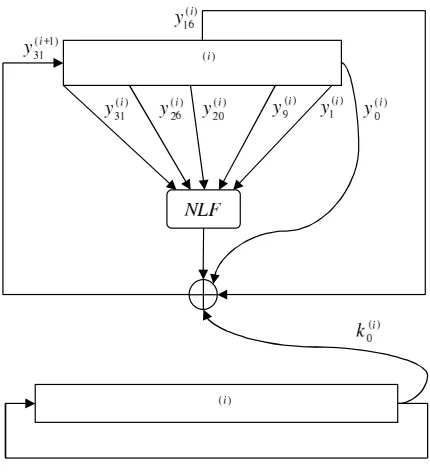
KeeLoq is a block cipher based on an NLFSR with a nonlinear boolean feedback function of 5 variables. The algorithm uses a 64-bit key and operates on 32-bit blocks. Its architecture consists of two registers (a 32-bit text register and a 64-bit key register), which are rotated in each of 528 encryption cycles, and of a nonlinear function (NLF) providing nonlinear feedback. One bit of the key is added to the output of the NLF modulo 2 in each cycle.
the existence of an efficient linear approximation of the NLF is used to recover a part of the key. Then the rest of the key bits are obtained using other linear relations within KeeLoq.
The key recovery complexity of our attack is about 252computational steps. One computational step is equivalent to a single KeeLoq encryption. The attack requires all 232 plaintext-ciphertext pairs and a memory of 232 32-bit words. Several computing devices can share the memory during the attack. All com-putations are perfectly parallelizable. The property inherited from the slide at-tacks [3], [4] is that the complexity of our attack is independent of the number of encryption cycles, which is as a rule not the case for linear or differential cryptanalysis, where the complexity often grows exponentially with the number of iterations.
The light-weight architecture of the KeeLoq cipher allows for an extremely low-cost and efficient hardware implementation. This contributed to the popu-larity of the KeeLoq cipher among designers of remote keyless entry systems, au-tomotive and burglar alarm systems, auau-tomotive immobilizers, gate and garage door openers, identity tokens, component identification systems. For instance, the KeeLoq block cipher is used in the HomeLink wireless control systems to secure communication with some garage door openers [10]. The KeeLoq tech-nology supplied by Microchip Techtech-nology Inc. includes the KeeLoq cipher and a number of authentication protocols. Our description of KeeLoq is based on the newly published article [31], [14] and a number of the manufacturer’s documents [13], [15], [19], [20].
The paper is organized as follows. Section 2 describes the KeeLoq algorithm. In Section 3 a key recovery attack on KeeLoq is proposed. In Section 4 we discuss the impact of our attack with respect to real-word applications. We conclude in Section 5.
2
Description of the KeeLoq algorithm
KeeLoq is a block cipher with a 64-bit key which operates on 32-bit words [31], [14]. Its design is based on a nonlinear feedback shift register (NLFSR) of length 32 bits with a nonlinear feedback function of 5 variables. The feedback depends linearly on two other register bits and on the next key bit taken from the rotated key register of length 64 bits.
LetVn = GF(2)nbe the set of alln-bit words andY(i)= (y31(i), . . . , y (i) 0 )∈V32, yj(i)∈ GF(2), describe the state of the text register in cycle i forj = 0, . . . ,31
and i= 0,1, . . . Let alsoK(i)= (k(i) 63, . . . , k
(i)
0 )∈V64,k (i)
j ∈GF(2), denote the state of the key register in cyclei forj = 0, . . . ,63 and i= 0,1, . . . Then each cycle of encryption can be described using the following algorithm (see Figure 1):
Compute the feedback bit:ϕ=N LF(y31(i), y(i)26, y(i)20, y9(i), y1(i))⊕y16(i)⊕y0(i)⊕k0(i)
Rotate text and insert feedback:R(i+1)= (ϕ, y(i) 31, . . . , y
(i) 1 )
Rotate key:K(i+1)= (k(i) 0 , k
(i) 63, . . . , k
Fig. 1.Thei-th KeeLoq encryption cycle
For encryption the key register is filled with the 64 key bits K= (k63, . . . k0)∈
V64,kj ∈GF(2), j = 0, . . . ,63, in the straightforward way:K(0) =K. IfX = (x31, . . . , x0)∈V32,xj∈GF(2),j= 0, . . . ,31, is a block of plaintext, the initial state of the text register isY(0) = (x
31, . . . , x0). The output of the algorithm is the ciphertextZ= (z31, . . . , z0) =Y(528)∈V32,zj∈GF(2),j= 0, . . . ,31.
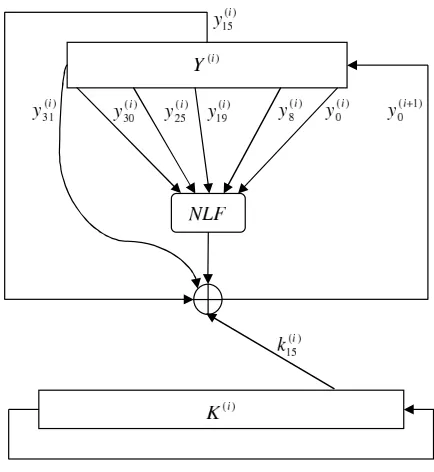
For decryption the key register is filled in the same way: K(0) = K = (k63, . . . k0) ∈V64. But the decryption procedure complements the encryption. One decryption cycle can be defined by the following sequence of operations (see Figure 2):
Compute the feedback bit:ϕ=N LF(y30(i), y(i)25, y(i)19, y8(i), y0(i))⊕y15(i)⊕y31(i)⊕k15(i)
Rotate text and insert feedback:R(i+1)= (y(i)30, . . . , y0(i), ϕ)
Rotate key:K(i+1)= (k(i)62, . . . , k0(i), k(i)63).
The ciphertext and plaintext are input/output in a similar way: The cipher-text is input into the cipher-text register before decryption,Y(0)=Z, and the plaintext can be read out after 528 decryption cycles, Y(528)=X.
The NLF is a boolean function of 5 variables and is of degree 3. In the specification [14] the NLF is assigned using a table. The vector of outputs1 is
1 The least significant and most significant bits represent the value of
0x3A5C742E. This corresponds to the following ANF:
N LF(x4, x3, x2, x1, x0) =x0⊕x1⊕
x0x1⊕x1x2⊕x2x3⊕x0x4⊕x0x3⊕x2x4⊕ x0x1x4⊕x0x2x4⊕x1x3x4⊕x2x3x4.
(1)
The NLF is balanced and its correlation immunity order is 1, cor(N LF) = 1 [29], [30]. This means that the NLF is 1-resilient [5], which is the maximum for a function of 5 variables with deg(N LF) = 3 due to Siegenthaler’s inequality [29]:
deg(N LF) + cor(N LF)≤4.
Fig. 2.Thei-th KeeLoq decryption cycle
Fig. 3.Round structure of KeeLoq encryption
The KeeLoq algorithm has the following round structure. We define a KeeLoq round as the permutation F(K) : V32 → V32 depending on the key K ∈ V64. A KeeLoq quarter round is defined as the permutation F0(K0) : V
depending on the subkey K0 = (k
15, . . . , k0) ∈ V16. Then the whole KeeLoq encryption mapping consists of successively computing 8 full round permutations F(K) and consequently applying the last quarter round permutationF0(K0), see Figure 3. Note that the first 8 full rounds are identical. The decryption can be represented in a similar way using inverse permutationsF0(K0)−1 andF(K)−1. The algorithm allows for an extremely simple hardware implementation com-prised of a 32-bit shift register with taps on fixed positions, a 64-bit shift resister with a single tap and a 32-bit (5×1) look-up table (LUT) for the NLF. The LUT can be replaced with the corresponding logical elements according to (1).
3
Attack on the KeeLoq algorithm
Our attack is based on the following weaknesses of the algorithm:
– self-similar key schedule scheme,
– relatively short blocks of 32 bits,
– existence of an efficient linear approximation of the NLF.
The attack can be outlined in the following way. For each subkeyK0= (k
15, . . . , k0) and for a random 32-bit inputI0∈V32guess the corresponding outputO0∈V32 after the 64 clock cycles which depends on the other 48 key bits (k63, . . . , k16). Using the periodic structure of the KeeLoq key schedule generate several other pairs (Ii, Oi)∈(V32)2,i= 1, . . . , N−1 (sliding step). For a successful attackN has to be about 28. For each number of such pairs we mount a distinguishing attack to obtain linear relations on some unknown key bits with a high proba-bility due to the fact that the KeeLoq NLF is not 2-resilient (correlation step). In this way it is possible to determine (k47, . . . , k16) bit by bit. After this an input/output pair for 16 encryption cycles can be represented as a triangular system of linear equations with the remaining bits (k63, . . . , k48) of K as vari-ables. It can be solved using 16 simple computational operations (linear step).
3.1 Sliding step
Using a single input/output pair (I0, O0) for the full round of 64 cycles and knowing the first 16 key bits K0 = (k
15, . . . , k0) one can produce an arbitrary number of other input/output pairs for this round. This is possible due to the fact that (almost) all rounds in KeeLoq are identical permutations which is the property on which the slide attacks by Biryukov and Wagner are substantially based [3], [4]. Once a pair (Ii, Oi) is known, the next input/output pair is pro-duced by encrypting Ii and Oi with the key to be recovered (it is a chosen plaintext attack) and obtaining (Ii+10 , O0i+1) as ciphertext. ThenIi+10 andO0i+1 are decrypted using the guessed partial key K0 = (k15, . . . , k0). The resulting plaintexts form the needed pair (Ii+1, Oi+1), see Figure 4.
As the sliding has to be performed for each guess ofK0= (k
Fig. 4.Generating input/output pairs using sliding techniques
3.2 Correlation step
Once the needed number of pairs were found in the sliding step, the following weakness of the KeeLoq NLF with respect to correlation attacks is used due to the fact that the NLF is 1-resilient, but not 2-resilient.
Lemma 1. For uniformly distributedx4, x3, x2∈GF(2)the following holds:
– Pr{N LF(x4, x3, x2, x1, x0) = 0| x0⊕x1= 0}= 58,
– Pr{N LF(x4, x3, x2, x1, x0) = 1| x0⊕x1= 1}= 58.
This means that the NLF can be efficiently approximated byx0⊕x1. So, ifx0, x1are known andx4,x3,x2 are random and unknown, we can determinef(K) by statistically filtering out the contribution of N LF(x4, x3, x2, x1, x0) to the equation
N LF(x4, x3, x2, x1, x0)⊕f(K) = 0
using a very limited number of such samples. f(K) is a key-dependent boolean function remaining constant for all samples.
Here we show how to obtaink16andk32fromIi andOi. The remaining key bits (k47, . . . , k33) and (k31, . . . , k17) can be obtain in the same way by usingk32, k16 and shifting input and output bits.
We denoteIi=Y(0)andOi=Y(64)for eachi. The idea is to make use of the correlation weakness of the dependency between the output bits y0(64),y(64)1 and the input bitsY(0). One can computeY(16) from Y(0), sinceK0= (k15, . . . , k0) is known. For the next bity(16)16 which is the first key-dependent bit one has the following equation:
y(32)16 =y31(17)=N LF(y(16)31 , y26(16), y20(16), y9(16), y(16)1 )⊕y(16)0 ⊕y(16)16 ⊕k16=
=c0⊕k16, (2)
wherec0∈GF(2) denotes the key-independent part of (2). After 32 encryption cycles the following holds:
(y(32)15 , y14(32), . . . , y0(32)) = (y(16)31 , y30(16), . . . , y16(16))∈V16.
Thus, the least significant half of Y(32) is known. Then y(64)
0 can be repre-sented as:
y0(64)=N LF(y(32)31 , y26(32), y(32)20 , y9(32), y(32)1 )⊕y0(32)⊕y(32)16 ⊕k32= =N LF(y(32)31 , y26(32), y(32)20 , y9(32), y1(32))⊕y(32)0 ⊕(c0⊕k16)⊕k32,
where y0(64), y(32)0 , y1(32), y9(32),c0 are known and y31(32), y (32) 26 ,y
(32)
20 , k32, k16 are unknown. As the first two inputs of the NLF are known, its contribution to (3) can be replaced with the random variateεusing Lemma 1:
N LF(y31(32), y(32)26 , y20(32), y(32)9 , y1(32))⊕y9(32)⊕y1(32)=ε (4)
with
Pr{ε= 0}= 5
8. (5)
Then the following holds:
y(64)0 ⊕y(32)0 ⊕c0⊕y9(32)⊕y (32)
1 =ε⊕k16⊕k32. (6)
In order to determinek16⊕k32one has to distinguish between the following two cases:k16⊕k32= 0 andk16⊕k32= 1. In the first case:
Pr{y(64)0 ⊕y(32)0 ⊕c0⊕y9(32)⊕y (32)
1 = 0}= 5 8.
Otherwise:
Pr{y(64)0 ⊕y(32)0 ⊕c0⊕y9(32)⊕y (32)
1 = 0}= 3 8.
Thus, the biasδ of the first random variable with respect to the second one is δ = 1
4. Our experiments show that about 2
7 equations (6) for different pairs
(Ii, Oi),i= 0, . . . ,27−1, are needed to recoverα=k16⊕k32with an acceptable error probability (for all 32 key-dependent linear combinations to be determined in this way), which agrees2with Theorem 6 of [1].
Next we consider y(64)1 and its dependencies from the input and key bits. Similar to (2) one has:
y16(33)=N LF(y(17)31 , y27(16), y(16)21 , y10(16), y(16)2 )⊕y(16)1 ⊕y(16)17 ⊕k17= =N LF(c0⊕k16, y27(16), y(16)21 , y10(16), y(16)2 )⊕y(16)1 ⊕y(16)17 ⊕k17= =c01⊕c2k16⊕y(16)1 ⊕y(16)17 ⊕k17=c1⊕c2k16⊕k17,
(7)
where c01 ∈ GF(2) is the free term of NLF, c2 ∈ GF(2) is its linear term with respect to k16, and c1 =c01⊕y1(16)⊕y(16)17 ∈GF(2). Here c1 andc2 are known and depend on Y(0). Then the second output bity(64)
1 is represented as follows:
y1(64)=N LF(y31(33), y(33)26 , y20(33), y(33)9 , y1(33))⊕y0(33)⊕y16(33)⊕k33= = (ε⊕y9(33)⊕y1(33))⊕y0(33)⊕(c1⊕c2k16⊕k17)⊕k33, (8)
where the random variate ε is assigned in a way similar to (4) and c0, c1, c2, y0(33),y(33)9 ,y(33)1 are known. To determinek17⊕k33pairs (Ii, Oi) withc2= 0 are
2 Strictly speaking, the mentioned Theorem 6 cannot be applied here since
selected3. Thenεin (8) is filtered out statistically, which recoversβ=k
17⊕k33. After this the remaining pairs (Ii, Oi) (with c2 = 1) are used to obtain γ = k16⊕k17⊕k33 in the same way. Thus,k16=β⊕γandk32=α⊕k16.
Nowk16,k32andk17⊕k33are known. In the next step we determinek18⊕k34 and k17⊕k18⊕k34 using the same plaintext/ciphertext pairs (Ii, Oi) and the same statistical recovery method. In this way all 32 key bits (k47, . . . , k16) are obtained in only 16 rather simple computational steps.
3.3 Linear step and key verification
The remaining key bits (k63, . . . , k48) ∈ V32 can be recovered as follows. As (k47, . . . , k0) are known,Y(48) can be computed for each pair (Ii, Oi).y(64)16 can be expressed as:
y(64)16 =N LF(y31(48), y(48)26 , y20(48), y9(48), y1(48))⊕y16(48)⊕y0(48)⊕k48, (9)
which revealsk48 since the entire state Y(48) is known. NowY(49) can be com-pletely calculated which leads to the value of k49usingy(64)17 , and so on. In this way the rest of the key is recovered.
At the end of the key recovery procedure we expect to obtain a number of key candidates. The upper bound for their average quantity is 264−32= 232 due to the known plaintext unicity distance [12], since the block length is 32 bit and the key length is 64 bit. Thus, we need to verify each key candidate against max.
d64+4
32 e= 3 plaintext-ciphertext pairs for all 528 encryption cycles.
3.4 Attack complexity
The attack consists of the following stages:
– Precompute all plaintext-ciphertext pairs for the whole cipher;
– Guess the partial keyK0and the outputO0after one round for some inputI0;
– For each pair of guesses (K0, O
0) do the following:
• Obtain 28
−1 other pairs (Ii, Oi);
• Determinek16⊕k32 by evaluatingc0 for the first 27pairs;
• Determine (k47, . . . , k16) by evaluatingc1andc2 28 times;
• Determine (k63, . . . , k48) by evaluating 24nonlinear boolean functions;
• Verify max. 232candidate keys using at most 3 plaintext-ciphertext pairs for the whole cipher and 3 full encryption operations.
If one step is equivalent to a single full KeeLoq encryption (528 encryption cycles), 232 steps are needed for the precomputation. Each element has to be stored in a memory of 232 32-bit words.
For each guess of (I0, O0) andK0operations of the following complexity have to be be performed:
3 Note that for random inputsI
ithe probability ofc2= 0 is 0.5. Therefore aboutN/2
out of N known pairs (Ii, Oi) will lead toc2 = 0. This raises the required number
– 29
−2 memory accesses for obtaining (Ii, Oi),i= 1, . . . ,28−1. We assume a single memory access equivalent to 16 encryption cycles. This leads to approximately 29/32 = 24 steps required to perform the memory accesses.
– 27 evaluations of c0 andk16⊕k32, each evaluation being equivalent to one encryption cycle. The complexity of this stage is then 27/528
≈2−2 steps.
– 16∙28 = 212 evaluations of c1 and c2 for determining (k47, . . . , k16). Each evaluation is computationally equivalent to 2 encryption cycles. This stage requires about 212∙2/528≈24 steps.
– 24 evaluations of a boolean function to determine (k63, . . . , k48). Each eval-uation is equivalent to one encryption cycle which leads to a complexity of about 24∙2−9= 2−5steps.
Max. 232 candidate keys have to be verified using at most 3 full encryptions which requires max. 234 steps. Thus, the overall computational complexity of the attack is
232+232∙216 2 ∙(2
4+ 2−2+ 24+ 2−5) + 234
≈252 steps.
The memory complexity is quite reasonable and is 23232-bit words (16 GByte). This enables an attacker to place all precomputed values into RAM which sub-stantially accelerates the implementation of the attack.
Most computations in our attack are perfectly parallelizable: The attacker can distribute the 248 combinations of guesses between a number of computa-tional machines (PCs, FPGAs, ASICs, etc.) sharing the 16 GBytes of memory containing the precomputed plaintext-ciphertext pairs.
Attacks of this type are potentially applicable to all NLFSR-based block cipher constructions of this kind. To avoid slide attacks some sort of round de-pendency should be introduced into the key schedule. Moreover, the correlation immunity order of the nonlinear feedback function has to be increased and the non-existence of efficient nonlinear approximations should be provided.
3.5 Experiments
We have implemented sliding, correlation and linear steps on a standard Pen-tium M PC with 1.73 GHz and 1 GB RAM for random keys. On the average we were able to recover the whole key in about 45000 tact cycles4 for the correct guesses of (I0, O0) and K0 as well as for the corresponding slid pairs (Ii, Ci). The implementation was performed in non-optimized C using Microsoft Visual C++ 7 compiler. Moreover, our experiments show that about 28 pairs (I
i, Oi) are required in average to recover the key correctly.
4
Attacks on KeeLoq-based systems in praxis
There are three major types of security protocols in which the KeeLoq block cipher is involved:
KeeLoq hopping codes: These are also known as rolling codes and provide authentication of an encoder to the decoder (the main system) by sending an encrypted counter value (unilateral communication), see [13]. The encoder and decoder share a 64-bit symmetric key and a 16-bit synchronized counter value. To authenticate itself the encoder encrypts the next counter value and sends it to the decoder which decrypts the message and verifies whether the received counter value is within the open window of length 16. A resynchronization mechanism exists to repair communication in case the counter value received exceeds the bounds of the open window. See also [15], [16], [18].
The KeeLoq hopping codes do not allow one to apply our attack since there are only 216 possible ciphertexts, 16 bits of the plaintext being fixed for a given encoder.
KeeLoq IFF: The IFF (Identify Friend or Foe) systems provide authentication of a transponder to the main systems (decoder) using a simple challenge-response protocol (bilateral communication), see [19]. The transponder and decoder share a 64-bit symmetric key K. To require authentication the decoder sends a 32-bit random challenge to the transponder which should reply with the KeeLoq encrypted challenge usingK. The decoder encrypts the genuine challenge using K and compares the message received as a reply with this value. See also [17].
The KeeLoq IFF systems are vulnerable to our attack since all input/output pairs are available to the attacker. Moreover, the key management schema of KeeLoq IFF [17] allows one to determine 4 bits of a 64-bit master key, which is the same for large series of encoders, by applying our attack to find a single individual key. This reduces the security of the IFF application to at least 260. Moreover, if some other KeeLoq key management schemata [13], [15], [16], [18] are used in KeeLoq IFF, 32 or 16 bits of the master key can be determined by finding a single individual key using our attack with complexity of 252. This would reduce the security of the rest of the encoders in the series to 232or 248, respectively.
PIC12F635/PIC16F636/639: Proprietary protocols based on PIC-controllers PIC12F635/PIC16F636/639 [21], [20] supplied by Microchip which are equipped with a hardware module implementing the KeeLoq block cipher.
The customized protocols using the KeeLoq block cipher with or without PIC12F635/PIC16F636/639 are potentially vulnerable to practical attacks on the algorithm and the underlying key management system, since the cipher only provides at most 52-bit security level due to our attack.
5
Conclusion
applications are vulnerable to our attack, including KeeLoq IFF systems and customized applications using the KeeLoq block cipher.
Our attack is a combination of guess-and-determine, sliding and distinguish-ing techniques. We first guess an input/output pair for one round and then use sliding to obtain more such pairs to be able to exploit some linearity of the non-linear feedback function. The attack works with complexity of 252 steps (while KeeLoq uses a 64-bit key), one step being equivalent to a single KeeLoq en-cryption. It requires all 232 plaintexts and a memory of 232 32-bit words. The complexity does not depend on the number of encryption cycles (iterations). The attack is very well parallelizable.
References
1. T. Baigneres, P. Junod, and S. Vaudenay. How Far Can We Go Beyond Linear Cryptanalysis? In Proc. of ASIACRYPT’04, volume 3329 of LNCS. Springer-Verlag, 2004.
2. C. Berbain, H. Gilbert, and A. Maximov. Cryptanalysis of Grain. In Proc. of FSE’06, volume 4047 ofLNCS. Springer-Verlag, 2006.
3. A. Biryukov and D. Wagner. Slide Attacks. In Proc. of FSE’99, volume 1636 of
LNCS. Springer-Verlag, 1999.
4. A. Biryukov and D. Wagner. Advanced Slide Attacks. In Proc. of EURO-CRYPT’00, volume 1807 ofLNCS. Springer-Verlag, 2000.
5. B. Chor, O. Goldreich, J. Hastad, J. Fridman, S. Rudich, and R. Smolensky. The Bit Extraction Problem or t-Resilient Functions. In26th Symposium on Founda-tions of Computer Science, 1985.
6. ETSI/SAGE. Specification of the 3GPP Confidentiality and Integrity Algorithms, Document 2: KASUMI Specification. Available from http://portal.etsi.org/
dvbandca/3GPPSPECIFICATIONS/3GTS35.202.pdf, 1999.
7. B. Gammel, R. Goettfert, and O. Kniffler. Achterbahn-128/80. Available from http://www.ecrypt.eu.org/stream/p2ciphers/achterbahn/achterbahn p2. pdf, June 2006.
8. B. M. Gammel, R. Goettfert, and O. Kniffler. The Achterbahn Stream Ci-pher. Available from http://www.ecrypt.eu.org/stream/ciphers/achterbahn/ achterbahn.pdf, April 2005.
9. M. Hell, T. Johansson, and W. Meier. Grain - A Stream Cipher for Constrained En-vironments. Available fromhttp://www.ecrypt.eu.org/stream/ciphers/grain/ grain.pdf, 2005.
10. HomeLink. Homelink and KeeLoq-based Rolling Code Garage Door Openers. Available fromhttp://www.homelink.com/home/keeloq.tml, 2006.
11. T. Johansson, W. Meier, and F. Muller. Cryptanalysis of Achterbahn. InProc. of FSE’06, volume 4047 ofLNCS. Springer-Verlag, 2006.
12. A. Menezes, P. van Oorshot, and S. Vanstone. Handbook of Applied Cryptography. CRC Press, 1996.
13. Microchip. An Introduction to KeeLoq Code Hopping. Available from http:
//ww1.microchip.com/downloads/en/AppNotes/91002a.pdf, 1996.
14. Microchip. Hopping Code Decoder using a PIC16C56, AN642. Available
fromhttp://en.wikipedia.org/wiki/KeeLoqandhttp://www.keeloq.boom.ru/
15. Microchip. HCS101 Fixed Code Encoder Data Sheet. Available fromhttp://ww1.
microchip.com/downloads/en/DeviceDoc/41115c.pdf, 2001.
16. Microchip. HCS301 KeeLoq Code Hopping Encoder Data Sheet. Available from
http://ww1.microchip.com/downloads/en/devicedoc/21143b.pdf, 2001.
17. Microchip. HCS410 Keeloq Code Hopping Encoder and Transponder. Available
fromhttp://ww1.microchip.com/downloads/en/DeviceDoc/40158e.pdf, 2001.
18. Microchip. HCS301 KeeLoq Code Hopping Encoder Data Sheet. Available from
http://ww1.microchip.com/downloads/en/devicedoc/21143b.pdf, 2002.
19. Microchip. Using KeeLoq to Validate Subsystem Compatibility, AN827. Available
fromhttp://ww1.microchip.com/downloads/en/AppNotes/00827a.pdf, 2002.
20. Microchip. PIC12F635/PIC16F636/PIC16F639 Cryptographic Module General Overview, TB086. Available from http://ww1.microchip.com/downloads/en/
DeviceDoc/91086A.pdf, 2005.
21. Microchip. PIC12F635/PIC16F636/639 Data Sheet. Available fromhttp://ww1.
microchip.com/downloads/en/DeviceDoc/41232B.pdf, 2005.
22. NIST. Data Encryption Standard (DES). FIPS PUB 46-3.
23. NIST. Skipjack and kea algorithm specifcations, 1998. Version 2.0, 29 May 1998, Available fromhttp://csrc.nist.gov/encryption/skipjack-kea.htm.
24. M. N. Plasencia. Cryptanalysis of Achterbahn-128/80. Available from http://
www.ecrypt.eu.org/stream/papersdir/2006/055.pdf, November 2006.
25. R. L. Rivest. The RC5 Encryption Algorithm. In Proc. of FSE’94, volume 1073 ofLNCS. Springer-Verlag, 1994.
26. B. Schneier. Description of a New Variable-Length Key, 64-Bit Block Cipher Blowfish. In Proc. of FSE’94, volume 809 ofLNCS. Springer-Verlag, 1994. 27. B. Schneier. Applied Cryptography. John Wiley & Sons, 2nd Ed. edition, 1996. 28. B. Schneier and J. Kelsey. Unbalanced Feistel Networks and Block-Cipher Design.
InProc. of FSE’96, volume 1039 ofLNCS. Springer-Verlag, 1996.
29. T. Siegenthaler. Correlation-immunity of Nonlinear Combining Functions for Cryp-tographic Applications. IEEE Trans. on Inform. Theory, IT-30(5), 1984.
30. T. Siegenthaler. Decrypting a Class of Stream Ciphers Using Ciphertext Only.
IEEE Trans. on Computers, 34(1), 1985.
31. Wikipedia. Keeloq algorithm. Available from http://en.wikipedia.org/wiki/
KeeLoq, November 2006.