Status Of Basic Urban Amenities: A Case Study
On Tarakeswar Town In Hugli District Of West
Bengal
Pintu Shee
Abstract: Basic amenities are fundamental determinants of quality of living in society. Basic amenities cover those provisions and facilities which are inevitable to human life in modern era. Access to safe drinking water, access to toilet and latrine facilities, well planned sewage system and having access to energy in the form of electricity etc. are certain fundamental determinants of quality of living. This paper deals with an intensive study on availability of urban amenities in the Tarakeswar municipal area. Mainly solid waste management, status and availability of drinking water, house lighting system, availability of latrine and bathroom facilities, sewage system have been highlighted in this research paper. Disparity of urban amenities in the municipal area has been identified. An overall survey report, dealing with the availability and disparity of selected urban amenities of this township area, has been presented here with recommendations for sustainable development of environmental condition.
Index Terms
:
Basic urban amenities, fundamental determinants, indispensable, availability, solid wastemanagement, Disparity, sustainable development.
————————————————————
1. INTRODUCTION:
The access to basic amenities like solid waste management, drinking water, sanitation, electricity, housing, drainage and others are crucial to the well being as they contribute to physical and material comfort and quality of life. They also benefits by ensuring better health, environment and providing opportunities for other useful activities. Access to basic amenities is the most important aspect of the quality of urbanization. Basic amenities cover those provisions and facilities which are indispensable to human life in modern times. Ability to reside in a stable house, access to safe drinking water, access to toilet facilities and having access to energy in the form of electricity etc. are certain fundamental determinants of quality of living. This present study is endeavor to understand the quality and availability of basic urban amenities in a religious town in developing country like India.
2. LITERATURE REVIEW
:
Urban amenities comprise the infrastructural goods and services that are collectively needed for the urban society. They are the main part to urban society without which urban society cannot emerge and sustain (Adekunle et al., 2011).The term urban amenities refer to solid waste, drinking water supply, sanitation, electricity and so on. Amenities are key to understanding quality of life because they are precisely what make some places attractive for living and working. Urban
1534 attempt to analyze the status of source and availability of
drinking water, electricity, sewage system, latrine, bathroom facilities of the residents of Tarakeswar town. Beside other objectives of the study is to search spatial variation in respect of the urban amenities in the town area.
3. STUDY AREA:
The Tarakeswar township area has been selected for study with infield investigation onavalibility of basic urban amenities. The town is located in the Chandannagar subdivision of Hugli district in Burdwan Division of West Bengal. The town obtained the status of a municipality on 6th August in 1975. At present the area of the town is 3.88km2. This municipal area is divided into 15 wards for administrative purpose. Tarakeswar town is situated at the centre of the Tarakeswar block. The town is surrounded by nine villages. Towards the north Bhanjipur, Chandur, Hauli, Towards east Baidyapur, Bajitpur, towards South east Jotsambhu, towards South Bhimpur, towards South west Bhata, towards west Gouribati village located. Total area of the adjacent villages is 1137.6 hectares. Tarakeswar town is connected with Burdwan, Medinipur, Howrah, Koltkata, Bankura, Chandannagar, Krishnanagar, Arambagh etc towns and cities through bus service. Many towns and villages of Hugli are connected through Tarakeswar, Arambagh rail line.
4. OBJECTIVES:
The main objectives of the study are
(a).To identify the status of some selected urban amenities in Tarakeswar municipal area.
(b).To assess the availability of urban amenities like solid waste management, status and availability of drinking water, latrine and sewage system etc.
(c).To assess the spatial disparity of urban amenities.
5. DATA BASE:
Mainly primary data has been used for the study. The primary source of data includes perception study of the inhabitants and photography from field. Primary data, on the other hand has been collected from the field through House hold survey, investigations and Interviews.
6. METHODOLOGY:
LOCATION MAP OF STUDY AREA
7. RESULT AND DISCUSSION:
The access to basic amenities like electricity, drinking water, toilet facility, sanitation, healthcare facilities and solid waste management are critical determinants of urban quality of life (Bhagat,2011).The result of the present study has been discussed after a through household survey in the study area. It provides a comprehensive picture about the status of some basic urban amenities in the Tarakeswar municipal area.
7.1Solid waste management:
In Tarakeswar town the number of households increased from 5756 to 6682 and total population also increased from 28187 to30947 between 2001 and 2011.So the generating rate of domestic solid waste has been also increased. To know the status of household solid waste disposal practice of the residents of municipal area, primary data collected from 600 families. Out of 600 families, 563 families (93.83%) use dustbin, 10 families (1.67%) use open drains and 27 families (4.5%) use open place to dispose solid waste. Open dumping of municipality solid waste is a common practice in the study area.
1536 Table No.1: Solid waste disposal Data
Source: Primary data collected from field
7.2 Status of drinking water
In Tarakeswar town about 41,80,000 liters drinking water is required per day. There are 46.1 km pipe lines and 13 pumps are supplying drinking water to the citizen. There are2647 domestic house connection, 242 hand tubes well, 10 water tanks and 2 water supply tractors are always used for fulfilling the demand of the drinking water. Through the field survey on 600 houses in the town, it has been identified that 566 families (94.33%) use tap water, 94 families (15.7%) use tube well and 44 families (7.33%) use open well as the source of drinking water. Mainly people of back ward class use open well. The source of drinking water of the residents of flats, apartments of the Tarakeswar town is deep tube well. Few residents of 600 use both tap and tube well for drinking water. The quality of drinking water of the town and its adjacent area is well. The water supply department of the municipality is controlling and maintaining the pipeline, tube well and the hand pump consciously.
Table No.2: Source of drinking water
Data Source: Primary data generated from field survey (Single family responded to more than one option)
7.3Availability of drinking water
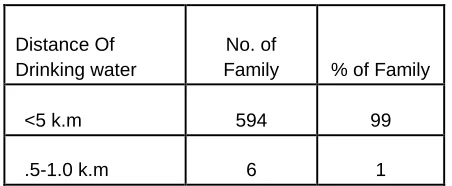
The maximum residents of the town can get drinking water within .5 km distance from their home. Out of 600 families 594 families (99%) collect drinking water from .5 km distance. These residents live in the core wards of the town. Only 6 families (1%) collect drinking water within .5 km to 1 km distance from their houses. These residents are living in the peripheral wards of the town. Mainly tap, tube well, hand pump are the source of drinking water. As a whole the facility and the availability of the drinking water for the residents of municipal area is well.
Table No.3: Distance covered for accessing drinking
Data Source: Primary data generated from field
7.4 House Lighting System
The availability of electricity facility is also very well in the municipal area. Out of 600 families in the municipal area 552 families (92.00%) have electric connection. Kerosene is used by 178 families (29.67%) as domestic fuel. Only one family has been identified to use firewood as domestic fuel. There are 15 families (2.5%) in the town where solar energy, Bio gas etc is the main source of house lighting system. So facility of electricity connection is well in the town area. It has been also identified during the primary data collection that many families responded for multiple options regarding the domestic use of the energy.
Distance Of Drinking water
No. of
Family % of Family
<5 k.m 594 99
.5-1.0 k.m 6 1
Sources Of Drinking
Water No. of Family
% of Family
Tap 566 94.33
Tube well /Hand pump 94 15.7
Open Well 44 7.33
Solid Waste
Disposal Site No. of Family % of family
Open Place 27 4.5
Open Drains 10 1.67
Dust Bin 563 93.83
Table No.4: Types of House lighting system
Data Source: Primary data generated from field survey
(Single family responded to more than one option)
7.5 Availability of Latrine
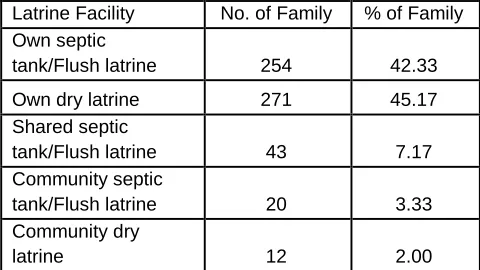
It has been identified from the field survey that the residents of Tarakeswar town use different types of latrine. Out of 600 house hold 254 families(42.33%) have own septic tank/flush latrine,271 families(45.17%) have their own dry latrine,43 families(7.17%) have shared septic tank/flush latrine,20 families(3.33%) use community septic tank /flush latrine,12 families(2.00%)use community dry latrine. From the above analysis it is clear that the Latrine facilities of the citizen are well. Some slum scheduled caste families use very lower quality latrine. Few of them use common open drains, latrine and open space. Huge tourists come in Tarakeswar to visit the temple of Lord Shiva throughout a year. The area surrounding the temple always becomes fulfilled by the pilgrims who come to worship lord Shiva in the period of Srabani mela, chaitra
mela. Many of them use open space of town and its adjacent villages for latrine. For this reasons environment mainly air, water become polluted during this period every year.
Table No.5: Types of Latrine used by the residents Data Source: Primary data generated from field
7.6 Sewage System
In Tarakeswar the view of sewage system is not very well and modern. Out of 600 households, 340 families (56.67%) are with open drains, 238 families (39.67%) have connectivity with underground drains, 1 family has digester and 21 families (3.5%) have been identified who have no drainage connectivity. Open drains are the cause of air pollution, water pollution. Besides the household who have no drainage connectivity also responsible for the environmental pollution.
Table No.6: Availability of sewage system
Data Source: Primary data generated from field
7.7
Spatial disparity of urban amenities
An idea about the extent of concentration of public facilities in different wards of the town has been obtained by taking into consideration the distribution of population in analysis. In this context the location
quotient method has been used. This method is in fact used to measure the extent to which the public
facilities in different parts such as wards in a town are in balance (Jahan & Oda,2005).The location quotient is a method for comparing a ward‘s percentage share
of a particular facility with its percentage share of its population.
L.Q= (ni/p) / (Ni/P)
(Ni =Number of facility ‗i‘ in a given ward, P=Population of the concerned ward, Ni=Number of facility ‗i‘ in Tarakeswar town P=Total population of Tarakeswar town).
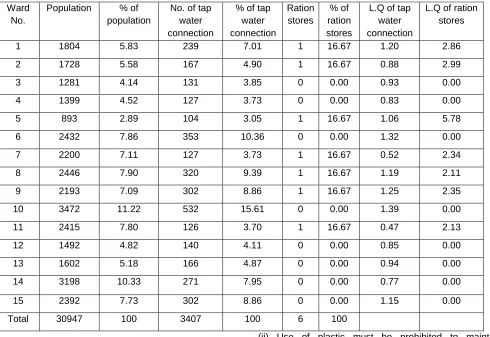
It is clear from the table that 8 wards out of 15 (53.33%) have deficiency in the establishment of tap water connection. The rest seven wards (46.67%) posses above normal concentration i.e. the per capita availability of the facility exceed that of the town as a whole. Many house hold suffer from the crisis of drinking water. The people of lower economic category anf the citizen who live in the slum are beside railway Latrine Facility No. of Family % of Family
Own septic
tank/Flush latrine 254 42.33
Own dry latrine 271 45.17
Shared septic
tank/Flush latrine 43 7.17
Community septic
tank/Flush latrine 20 3.33
Community dry
latrine 12 2.00
Sewage system No. of Family % of Family
Open Drains 340 56.67
Underground Drains 238 39.67
Digester 1 0.17
Not connected sewer 21 3.5
House Lighting System No. of family % of Family
Electric Connection 552 92.00
Kerosene 178 29.67
Fire wood 1 .02
1538 line in ward no.14 and beside 12 no. road suffer from the crisis
Table No 3.14: Ward wise number of tap water connection and Ration stores in Tarakeswar town
Data Source: Land use & Urban planning Department, Tarakeswar Municipalit
8. MAJOR FINDINGS:
i.It is clear from the above discussion that the different facilities of the urban amenities are not equally distributed in all wards of Tarakeswar town.
ii.Ward wise Disparity regarding the urban amenities like tap water connection, ration shops etc have been identified in all over the town.
iii. Maximum swage system of the study area is highly unhygienic. The open drains are filled with garbage and plastic which is thrown by the local people, daily commuters and tourists.
iv. The method of solid waste management is traditional unscientific and unhygienic.
9. RECOMENDATIONS FOR PROPER URBAN
PLANNING
(i) Government, municipal office, N.G.O organization should establish more public latrine and bathroom to control the environmental pollution.
(ii) Use of plastic must be prohibited to maintain the cleanliness of the town. Municipal authority should arrange to keep more movable dust bins in different places in the town. (iii)Large sophisticated compactor truck, small tripper trucks should be used to transport municipal solid waste to maintain the hygiene of the study area.
(iv) Door to door public awareness program should be taken to control the disposal of domestic solid waste in the open drains. (v) The conservancy department should be more active and regular to maintain the cleanliness of the town.
(vi)Different awareness programs regarding the environmental pollution should be organized to grow the sense of the pilgrimage and shop keepers about the environmental protection.
(vii) Government, municipal authority should be more active to establish tap tube wells, ration shops, common latrine, bathroom to minimize the regional disparity of civic amenities inTarakeswar town.
10. CONCLUSION: Ward
No.
Population % of population
No. of tap water connection
% of tap water connection
Ration stores
% of ration stores
L.Q of tap water connection
L.Q of ration stores
1 1804 5.83 239 7.01 1 16.67 1.20 2.86
2 1728 5.58 167 4.90 1 16.67 0.88 2.99
3 1281 4.14 131 3.85 0 0.00 0.93 0.00
4 1399 4.52 127 3.73 0 0.00 0.83 0.00
5 893 2.89 104 3.05 1 16.67 1.06 5.78
6 2432 7.86 353 10.36 0 0.00 1.32 0.00
7 2200 7.11 127 3.73 1 16.67 0.52 2.34
8 2446 7.90 320 9.39 1 16.67 1.19 2.11
9 2193 7.09 302 8.86 1 16.67 1.25 2.35
10 3472 11.22 532 15.61 0 0.00 1.39 0.00
11 2415 7.80 126 3.70 1 16.67 0.47 2.13
12 1492 4.82 140 4.11 0 0.00 0.85 0.00
13 1602 5.18 166 4.87 0 0.00 0.94 0.00
14 3198 10.33 271 7.95 0 0.00 0.77 0.00
15 2392 7.73 302 8.86 0 0.00 1.15 0.00
1540 Tarakeswar is one of the famous religious towns of India. Lakhs
of tourists visit this holy place throughout every year. Residents are also increasing due the growth of migration in the township area. So regular management of solid waste, uninterrupted supply of drinking water and electricity is very challenging work to the Munuicipal Corporation and Government authority. Municipal corporation and Government authority should be more regular, integrated and organized regarding these basic urban amenities. On the other hand local people of this small town should be more responsible to use drinking water, electricity and disposal of solid waste in future.
REFERENCES:
(1).Adekunle, Aderamo and Aina (2011): Spatial Inequalities in Accessibility to Social Amenities in Developing Countries: A Case from Nigeria. Australian Journal of Basic and Applied Sciences, 5(6): 316-322, 2011 ISSN 1991-8178.
(2).Bhagat, R. B (2010): Access to Basic Amenities in Urban Areas by Size class of Cities and Towns in India‖. International Institute for Population Sciences, Mumbai.
(3).Eyles, J.D. ( 1996): Poverty as Inequality: A Case Study. Progress in Human Geography; vol.. 6: 55-60.
(4). Jahan, S. and Oda, T. (2005): Distribution of Public Facilities in Dhaka, Bangladesh: A Spatial Analysis. University of Engineering and Technology (BUET), Dhaka Bangladesh.
(5).Kelly, A. ( 2006): Securing urban amenity, does it coincide with biodiversity conservation at the local government level? Australas. J. Environ. Manag. pp. 243–253.
(6).Mabogunje, A.L. (1997), ―Cities and Social Order‖. Ibadan: University, Press.