SUMMER 2017, Vol 3, No 1, JOURNAL OF HYDRAULIC STRUCTURES Shahid Chamran University of Ahvaz
Journal of Hydraulic Structures
J. Hydraul. Struct., 2017; 3(1):71-82 DOI: 10.22055/jhs.2017.13318
The Optimization of Energy Supply Systems by Sequential
Streamflow Routing Method and Invasive Weed Optimization
Algorithm; Case Study: Karun II Hydroelectric Power Plant
Hamid Goharnejad1* Majid Mohamadi Naser2 Mahmoud Zakeri Niri3
Abstract
Among the major sources of energy supply systems, hydroelectric power plants are more common. Energy supply during peak hours and less environmental issues are some of the most important advantages of hydroelectric power plants. In this study, designing parameters to supply maximum amount of energy was determined by using the simulation-optimization perspective and combination of IWO-WEAP models. Subsequently, the developed model has been applied for designing the Karun II hydroelectric power plant. The sequential streamflow routing method has been developed for obtaining energy in WEAP water resources management software. In addition the optimization algorithm has been applied to optimize the invasive weeds. To verify the performance of this method, obtained results for the firm energy were compared to those of the total energy. Using this method, for 1398 GWY (Giga watt per your) firm energy, the minimum and normal levels of operation were 668 and 672 m.a.s.l (meters above sea level), respectively, and the installation capacity calculated around 498 MW as optimal value.
Keywords: Sequential streamflow Routing method, Invasive weed optimization algorithm, WEAP model.
Received: 13 May 2017; Accepted: 28 June 2017
1. Introduction
Hydropower energy is one of the renewable energies with lots of merits compared to other
1Assistant Professor, Department of Civil Engineering, Environmental Sciences Research Center,
Islamshahr Branch, Islamic Azad university, Islamshahr, Iran, [email protected]; Tel.: +98-912-714-4265 (Corresponding author)
2 Department of Civil Engineering, Environmental Sciences Research Center, Islamshahr Branch, Islamic
Azad university, Islamshahr, Iran.
3Assistant Professor, Department of Civil Engineering, Environmental Sciences Research Center,
SUMMER 2017, Vol 3, No 1, JOURNAL OF HYDRAULIC STRUCTURES Shahid Chamran University of Ahvaz
types of fossil fuel energies such advantage as clean, renewable, low-cost, and flexible. The optimization of hydropower systems has got great significance to the stable, safe, and economic operation of the whole power system. The optimization methodologies can be categorized into two: one is based on mathematical programming which mainly including linear programming (LP) (Ouyang et al., 2014), non-linear programming (NLP) (Mohan, 1997), dynamic programming (DP) (Geem, 2006), decomposition and coordination of large scale system network-flow methods (LSSDC) (Chu and Chang, 2009), and the progressive optimality algorithm (POA) (Luo and Xie, 2010). The second type of reservoir optimization system is based on heuristic algorithms such as the genetic algorithm (GA) (Geem, 2011), simulated algorithm (SA) (Barati, 2011), evolutionary algorithms (EA) (Xu et al., 2012), particle swarm optimization (PSO) [10], and ant colony algorithm (ACO) (Karahan et al., 2013).
IWO algorithm (Mehrabian and Lucas, 2006) is a new bionic intelligent algorithm which simulates the spatial weed diffusion, growth, reproduction, and competitive survival of the invasive weeds (Peng et al., 2015). IWO algorithm has been widely used in a variety of optimization problems and practical engineering problems. Such multi-objective optimization problems as stated by Kundu et al., 2011 are parameter estimation of chaotic systems (Ahmadi and Mojallali, 2012), model order reduction problem (Abu-Al-Nadi et al., 2013), global numerical optimization (Basak et al., 2013), antenna arrays problem (Zaharis et al., 2013; Zaharis et al., 2014), unit commitment problem (Saravanan et al., 2014), optimal power flow problem (Ghasemi et al., 2014), flow shop scheduling problem (Zhou et al., 2014), traveling salesman problem (Zhou et al., 2015), and economic dispatch (Barisal and Prusty, 2015). Evenson and Moseley used an optimization model to minimize the total costs of a multi-reservoir system along with the simulation models (Evenson and Moseley, 1970). Diaz et al. used an optimization model to maximize the economic benefits from the sale of energy in the multi-reservoir hydroelectric system (Diaz, et al., 1989). Wardlaw et al. used a genetic algorithm for optimal exploitation of the reservoir (Wardlaw, et al., 1999). Tsoukalas et al. dealt with optimizing the operation of the multi-reservoir systems by integrating the WEAP simulation model with heuristic techniques (Tsoukalas, et al., 2013). In Karun river, several studies have been done regarding hydropower energy and some factors affected in power plant generation systems such as sedimentation. The best estimation of the Karun river suspended sediment load was produced by Bagnold method as less erroneous predictions was obtained (Najafpour et al., 2016).
SUMMER 2017, Vol 3, No 1, JOURNAL OF HYDRAULIC STRUCTURES Shahid Chamran University of Ahvaz
penalty function is frequently used to guide the power output process towards the firm output. Nevertheless, the use of penalty functions equalizes the generation process and affects the optimization of the whole power generation.
In this paper, the sequential streamflow routing method and its combination with the optimization algorithm of invasive weeds for the energy simulation was used. The least operation level, the normal head and the installation capacity of the hydroelectric power plant for the Karun II hydroelectric power plant, were optimized for the highest secure energy and the total energy in order to build a dam capable of providing the maximum value of hydroelectric energy at peak hours and secondary power during other hours of the day. Furthermore, we have applied the hybrid invasive weed optimization (HIWO) algorithm to the parameter estimation of nonlinear hydropower generation.
2. Materials and Methods
In the following, the simulation model of energy and WEAP model as simulator and the invasive weeds algorithm as the proposed optimization method and the optimization of parameters for designing Karun II was discussed.
2.1. WEAP simulation model and its application in modeling energy generation
2.1.1. Simulation of water resources in WEAP
WEAP model is an appropriate computer tool for integrated water resources planning, which has been developed by the Stockholm Environment Institute offering a wide range of applications in the world and the country, in recent years. The advantage of WEAP in the integrated approach is in simulating water resource systems and applying operation policies. WEAP performs based on balance sheet equation and can be used in complex modeling in water resource managements (Sieber, et al., 2012).
The first step in simulating in WEAP is entering the information and assumptions required to express operation policies, costs and such factors as hydrology and pollution parameters, needs and supplies. After creating various operation scenarios in this program, the effect of different assumptions or policies on the availability and consumption of water can be evaluated.
2.1.2. Energy simulation in WEAP
Despite its great abilities, WEAP has some weaknesses in simulating hydropower systems. The WEAP model Not only has weakness in calculating hydroelectric energy but also cannot be able to computing the conditions at the end of the time steps and other important parameters in modeling of hydroelectric power plants.
SUMMER 2017, Vol 3, No 1, JOURNAL OF HYDRAULIC STRUCTURES Shahid Chamran University of Ahvaz
2.1.3. Allocating water with the aim of producing energy
Firm capacity is the amount of energy available for production or transmission which can be (and in many cases must be) guaranteed to be available at a given time. Firm energy refers to the actual energy guaranteed to be available. Non-firm energy refers to all available energy above and beyond firm energy.
Firm energy is often available at substantial discounts over non-firm energy sold on the spot market. Energy producers such as hydroelectric plants and wind farms may have non-firm energy available due to unexpected weather or seasonal conditions (U.S. Army Corps of Engineer, 1984).
The important thing at this stage is that in order to allocate water to produce energy, as well as environmental objectives, drinking, industry and agriculture, which is essentially non-consumable, should be determined and defined through tools available in the model and dividing the hydroelectric power plants. The water need of energy generation in each time step, which is in the form of water release volume that passes through the water tunnel to the power plant, depends on the net head of the power plant at that time step. About the storage power plants, the tail-water level not only varies by time and discharge, but should also be considered as the average level of the beginning and end of the time step.
To define the water requirements of energy generation, Expressions and Scripting capabilities within WEAP software are used. It is worth noting that in fact, WEAP software conducts a systematic simulation, and at the beginning of each time step, it only provides access to the values of variables at the beginning of that time step. Therefore, it is not possible to normally define the exact water requirement for energy generation for each of the power plants using the conventional method, because the calculation of net head at each time step requires the data of storage level at the beginning and end of the time step, while the software provides access to water storage levels at the end of the time step and cannot provide data for time steps before the simulation time. In this regard, provided a trial and error trend for water allocation based on energy generation purposes in a way that water requirement of energy generation is performed in an accurate way and considering the storage at the beginning and end of each time step. After water allocation, simulation of energy generation was done. The three main factors of net head, flow discharge from the power plant and continuity of long generation hours affect energy generation. The second and third factors can be gathered in form of the factor for the volume of water passing through the plant; but as there are determining thresholds for time and discharge, the volume of water will be taken into account as two separate factors of time and discharge in the simulation calculations of energy generation. Hence, in this study, the objective function used in the optimization algorithm attempts to find the highest firm energy and maximum total energy by try and error trend to provide new design parameters.
2.2. Karun II Hydroelectric Power Plant
SUMMER 2017, Vol 3, No 1, JOURNAL OF HYDRAULIC STRUCTURES Shahid Chamran University of Ahvaz
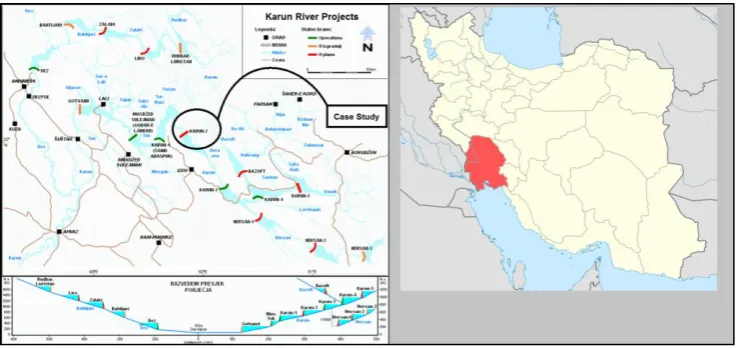
Figure 1. Location of Karun II in among all projects of Karun River
2.3. Invasive weeds optimization algorithm
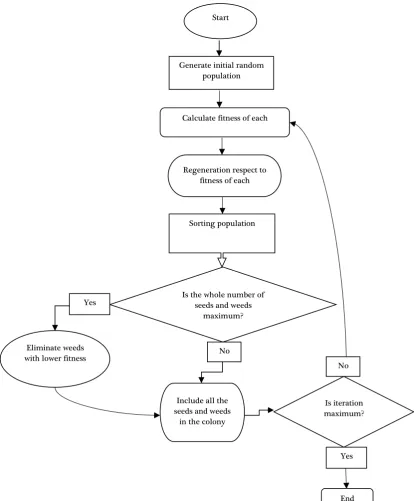
The weed optimization method has been introduced through inspiration by nature. This algorithm is very effective and fast in finding optimal locations in addition to being simple, and acts based on the basic and natural features of weeds such as seed generation, growth and struggle for survival in a colony. The procedure of this algorithm can briefly be stated as follows: (Figure 2)
Invasive weeds optimization model leads to optimization through reversing the unpleasant incident of weed growth on farms. Invasive weeds have two unique features of optimality and resistance. They act according to the popular theory of r/k selection over time (Mehrabian, et al., 2006).
2.3.1. Theory of r/k selection
SUMMER 2017, Vol 3, No 1, JOURNAL OF HYDRAULIC STRUCTURES Shahid Chamran University of Ahvaz
Figure 2. Invasive Weed Optimization Algorithm
Start
Generate initial random population
Calculate fitness of each
Regeneration respect to fitness of each
Sorting population
Is the whole number of seeds and weeds
maximum?
Include all the seeds and weeds
in the colony No Yes
Eliminate weeds with lower fitness
Is iteration maximum?
Yes
SUMMER 2017, Vol 3, No 1, JOURNAL OF HYDRAULIC STRUCTURES Shahid Chamran University of Ahvaz
Figure 3. the relation of fitness with number of seeds
2.3.2. Life stages of invasive weeds
The just purpose of a weed is survival and in order to achieve this goal, it seeks for the best livable environment. At first, the initial population is randomly dispersed throughout the space. The seeds grow and due to their fitness can produce zero to five seeds in the range of their capacity. Figure 3 shows the relation between fitness and number of seeds.
In case the problem is minimalist, the number of children follows the equation 1.
S = [Smin+ (Smax− Smin) ∗
F − Fworst
Fbest− Fworst] (1)
Seeds around the mother plant are distributed using a normal distribution with an average of zero and in the range of standard deviation that is obtained from equation 2.
σt= (T − tT ) n
∗ (σinitial− σfinal) + σinitial (2)
In equation 2, n is the speed control of the reduced dispersion, which reduces speed if it is between 0 and 1 and increases dispersion speed if it is more than one (Figure 4). Here, for the first and final standard deviation (σ) it were used a values of 1 and 0.001 respectively.
Figure4.Regeneration respect to fitness of each standard deviation (𝛔)
During time cycle, the number of plants in the colony have been considered as fixed and plants that have the least fitness in comparison to the rest of the colony will be eliminated to reduce calculations and limit the environment.
SUMMER 2017, Vol 3, No 1, JOURNAL OF HYDRAULIC STRUCTURES Shahid Chamran University of Ahvaz
2.4. The IWO - WEAP simulation - optimization model
To start the optimization module, first, for the primary plants have been produced random values. Then the WEAP model and the simulation module start under the command of the optimization module, and the simulation module is implemented only once for each particle. After that, hydro energy characteristics are calculated. At every step of the optimization algorithm, the best plant is selected as the most optimal response to the target function from among the produced plants. After running the algorithm to a certain number of iterations, the stop conditions of the algorithm will be controlled.
Figure5. The circle of thesimulation Hierarchy-Optimization
3. Results and discussion
In this section, the developed IWO-WEAP simulation-optimization model is utilized in the optimized design of Karun II power plant elements and then, the results are presented. Two different decision variables were used in this study which are normal water level (NWL) and minimum water level (MWL). Beside it, these variables were applied in two scenarios. The range of these levels in two different operation scenarios have been presented in Table 1. Due to determine of the storage of Karun II dam assumed that the Karun III dam’s (it is the upstream of Karun II) outflow during peak hours (6 hours) is equal 30 million cubic meter per second. The parameters used in the IWO algorithm in this study are shown in Table 2.
Table1.The scope of decision variables
Decision variable Minimum Maximum
Normal level of operation (masl) 664 672
minimum operating level (masl) 640 668
SUMMER 2017, Vol 3, No 1, JOURNAL OF HYDRAULIC STRUCTURES Shahid Chamran University of Ahvaz
Table 2. Parameters used in the IWO algorithm
Parameter value
Coefficient of dispersion 2
Minimum standard deviation 0.001
Maximum standard deviation 1
Minimum of seeds 0
Maximum of seeds 5
The initial population size 10
The maximum population size 20
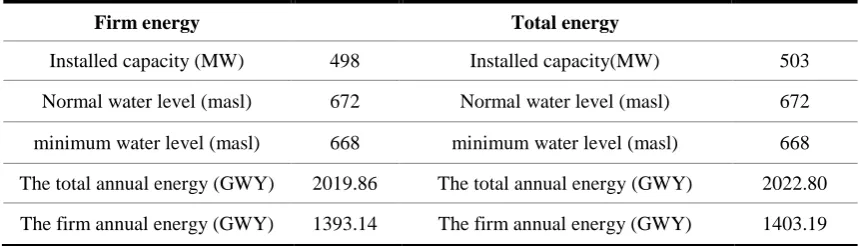
In order to end, the program was run once for the total energy and once for the firm energy and the results obtained as follows. In both cases, the normal level and the minimum operation level were obtained as 672 and 668 meters above sea level, respectively. It can be observed that when the model is run for maximalist of the firm energy, the firm energy and total energy are 1393.14 and 2019.86 MWY (Mega Watt per Year), respectively, and the installation capacity equals 498 MW. However, in maximalist mode of the total energy, the values obtained for the firm energy and total energy are 1403.19 and 2022.80 MWY (Mega Watt per Year), respectively, and the installation capacity equals 503 MW. This indicates that perhaps through maximizing the total energy, the firm energy has increased in comparison to the mode in which was run the model for maximizing the firm energy. However, the installation capacity has also increased. If the installation capacity was increased more than 498 MW when running the program in the firm energy mode, the amount of energy will be reduced, which indicates the proper function of the model. The results of using the developed model (IWO-WEAP) of the Karun II hydroelectric power plant are shown in Table 3.
Table 3. The results of the IWO-WEAP model
Firm energy Total energy
Installed capacity (MW) 498 Installed capacity(MW) 503
Normal water level (masl) 672 Normal water level (masl) 672
minimum water level (masl) 668 minimum water level (masl) 668
The total annual energy (GWY) 2019.86 The total annual energy (GWY) 2022.80
The firm annual energy (GWY) 1393.14 The firm annual energy (GWY) 1403.19
4. Conclusion
SUMMER 2017, Vol 3, No 1, JOURNAL OF HYDRAULIC STRUCTURES Shahid Chamran University of Ahvaz
increasing the value of the maximum (normal) and minimum operational water levels the values of the objective functions may improve, but due to the technical factors and the type and the working condition of Karun II power plant (including the flow of the power plant, the effects of Karun III, etc.) the normal values and the least operation cannot be increased over a specific value. In the case of total energy maximization, it is observed that the firm energy has obtained higher value.
Based on this study, it can be seen that the best possible condition regarding energy generation with the maximum (normal) and minimum operational water levels with designs conducted in reports of the dam by the consulting engineers of the project is a much lower obtained installation capacity than the amount of energy generation reduced in this mode. The abovementioned calculation is an evidence that increase in installation capacity cannot be a guarantee for maximization of benefits.
5. Refrences
1. Basak, D. Maity, and S. Das, “A differential invasive weed optimization algorithm for improved global numerical optimization,” Applied Mathematics and Computation, vol. 219, no. 12, pp. 6645–6668, 2013.
2. K. Barisal and R. C. Prusty, “Large scale economic dispatch of power systems using oppositional invasive weed optimization,” Applied Soft Computing, vol. 29, pp. 122–137, 2015.
3. Ouyang, Z. Tang, K. Li, A. Sallam, and E. Sha, “Estimating parameters of Muskingum model using an adaptive hybrid PSO algorithm,” International Journal of Pattern Recognition and Artificial Intelligence, vol. 28, no. 1, Article ID1459003, 29 pages,2014.
4. R. Mehrabian and C. Lucas, “A novel numerical optimization algorithm inspired from weed colonization,” Ecological Informatics, vol. 1, no. 4, pp. 355–366, 2006.
5. Saravanan, E. R. Vasudevan, and D. P. Kothari, “Unit commitment problem solution using invasive weed optimization algorithm,” International Journal of Electrical Power & Energy Systems, vol. 55, pp. 21–28, 2014.
6. Abu-Al-Nadi I., O. M. Alsmadi, Z. S. Abo-Hammour, M. F. Hawa, and J. S. Rahhal, “Invasive weed optimization for model order reduction of linear MIMO systems,” Applied Mathematical Modelling, vol. 37, no. 6, pp. 4570–4577, 2013.
7. Kundu, K. Suresh, S. Ghosh, S. Das, and B. K. Panigrahi, “Multi-objective optimization with artificial weed colonies,” Information Sciences, vol. 181, no. 12, pp. 2441–2454, 2011.
8. M. Xu, L. Qiu, and S.-Y. Chen, “Estimation of nonlinear Muskingum model parameter using differential evolution,” Journal of Hydrologic Engineering, vol. 17, no. 2, pp. 348–353, 2012.
9. Dezab Consulting Engineers Report on water and power resources planning of Karun II hydropower Project [Report]. - [s.l.] : Dezab, 2014.
10. Diaz G.E and Fontane D.G Hydropower Optimization via Sequential Quadratic Programming [Journal] // Water Resources Planning and Management, ASCE, 115(6). - 1989. - pp. 715-733.
11. Evenson, D. E; Moseley, J. C; Simulation/optimization techniques for multi-basin water resource planning [Journal] // JAWRA Journal of the American Water Resources Association. - 1970. - pp. 725–736.
SUMMER 2017, Vol 3, No 1, JOURNAL OF HYDRAULIC STRUCTURES Shahid Chamran University of Ahvaz
13. J. Chu and L.-C. Chang, “Applying particle swarm optimization to parameter estimation of the nonlinear Muskingum model,” Journal of Hydrologic Engineering, vol. 14, no. 9, pp. 1024–1027, 2009.
14. Luo and J. Xie, “Parameter estimation for nonlinear Muskingum model based on immune clonal selection algorithm,” Journal of Hydrologic Engineering, vol. 15, no. 10, Article ID 006010QHE, pp. 844–851, 2010.
15. Ahmadi and H. Mojallali, “Chaotic invasive weed optimization algorithm with application to parameter estimation of chaotic systems,” Chaos, Solitons & Fractals, vol. 45,no. 9-10,pp. 1108–1120, 2012.
16. M. Ghasemi, S. Ghavidel, E. Akbari, and A. A. Vahed, “Solving linear, smooth and non-convex optimal power flow problems using chaotic invasive weed optimization algorithms based on chaos,” Energy, vol. 73, pp. 340–353, 2014.
17. Mehrabian A.R and Lucasc C A novel numerical optimization algorithm inspired from weed colonization [Journal] // Ecological Informatics. - 2006. - pp. 355–366.
18. Najafpour, N., Emamgholizadeh, S., Torabi poudeh, H., Hamzeh Haghiabi, A., "Estimation of Sediment Transport Rate of Karun River (Iran)" Journal of Hydraulic Structures J. Hydraul. Struct., 2016; 2(2):74-84 DOI: 10.22055/jhs.2016.12874.
19. R. Barati, “Parameter estimation of nonlinear Muskingum models using nelder-mead simplex algorithm,” Journal of Hydrologic Engineering, vol. 16, no. 11, pp. 946–954, 2011.
20. Razi Khosroshahi M, Mousavi S j and Alizadeh H Upstream Effects on Aras Cascade Hydropower Plants System [Conference] // 10th International Congress on Civil Engineering. - University of Tabriz, Tabriz, Iran : [s.n.], 2015.
21. S. Mohan, “Parameter estimation of nonlinear Muskingum models using genetic algorithm,” Journal of Hydraulic Engineering, vol. 123, no. 2, pp. 137–142, 1997.
22. S. Peng, A. Ouyang, and J. J. Zhang, “An adaptive invasive weed optimization algorithm,” International Journal of Pattern Recognition and Artificial Intelligence, vol. 29, no. 2, Article ID 1559004, pp. 1–20, 2015.
23. Sieber J and Purkey D WEAP User Guide [Book]. - [s.l.] : Stockholm Environment Institute, U.S. Center, 2012.
24. Tsoukalas I and Makropoulos C Hydrosystem Optimization with the Use of Evolutionary Algorithms: The Case of Nestos River [Journal] // 13th International Conference on Environmental Science and Technology (CEST2013), Athens, Greece. - 2013.
25. S. Army Corps of Engineer Engineering and Design – Hydropower [Book]. - [s.l.] : Departmant of the Army, 1984.
26. Wardlaw R and Sharif M Evaluation of Genetic Algorithms for Optimal Reservoir System Operation [Journal] // Journal of Water Resources Planning and Management., 125. - 1999. - pp. 25–33.
27. Y. Zhou, H. Chen, and G. Zhou, “Invasive weed optimization algorithm for optimization no-idle flow shop scheduling problem,” Neurocomputing, vol. 137, pp. 285–292, 2014.
28. Y.Zhou, Q. Luo, H. Chen,A.He, and J.Wu, “Adiscrete invasive weed optimization algorithm for solving traveling salesman problem,” Neurocomputing, vol. 151, no. 3, pp. 1227–1236, 2015.
SUMMER 2017, Vol 3, No 1, JOURNAL OF HYDRAULIC STRUCTURES Shahid Chamran University of Ahvaz
30. D. Zaharis, P. I. Lazaridis, J. Cosmas, C. Skeberis, and T. D. Xenos, “Synthesis of a near-optimal high-gain antenna array with main lobe tilting and null filling using taguchi initialized invasive weed optimization,” IEEE Transactions on Broadcasting, vol. 60, no. 1, pp. 120–127, 2014.
31. W. Geem, “Parameter estimation for the nonlinear Muskingum model using the BFGS technique,” Journal of Irrigation and Drainage Engineering, vol. 132, no. 5, pp. 474–478, 2006.