Da Rosa ACM, Osowski LF, Tocchetto AG, Niederauer CE, Andrade Med Educ Online [serial online] 2003;8:13. Available from CMB, Scroferneker ML. An alternative teaching method for the http://www.med-ed-online.org
regulation of the Immune response
An Alternative Teaching Method for the Regulation of the Immune Response
Ana Cecília Michel da Rosa, Luiz Felipe Osowski, Andréa Goya Tocchetto, Carlos Eduardo Niederauer, Cristiane Maria Benvenuto Andrade and Maria Lúcia Scroferneker
Department of Mic robiology
Universidade Federal do Rio Grande do Sul Porto Alegre
Brazil
Abstract - Purpose: Our teaching experience has shown that dealing with the molecular aspects of the immune response regulation poses several difficulties. Therefore, we developed a panel board to verify whether or not this active-learning exercise could enhance students’ learning and arouse their interest in subjects that are basically theoretical and complex.
Methods: Twenty cardboard pieces labeled with the names of major regulators of the immune response and three panel boards with explanations on how major regulators work. Students had to match the cardboard pieces with the corresponding explanation.
Results: One hundred forty students participated in this study. The overall response of the stu-dents to the game was very positive: 95.71% considered the panel board interesting and 95% said the panel board facilitated the understanding of the subject matter. The students’ grades signifi-cantly improved (P<0.0001).
Conclusion: The results obtained show the importance of using the panel board when trying to approach a subject that is vast and complex not only for students but also for professors.
Key Words: Immune Response; Regulation; Learning; Game
Regulation of the immune response is a physiol-ogic process that takes place whenever the immune system encounters an antigen, involving both the humoral and the cell-mediated branch. Every time an antigen is introduced, important regulatory decisions determine the branch of the immune system to be activated, the intensity of the response, and its dura-tion.1
Our teaching experience has shown that dealing with molecular and biochemical aspects of the im-mune system poses several difficulties.At the School of Medicine of Universidade Federal do Rio Grande do Sul, Brazil, medical immunology is taught during the fourth semester, along with courses such as Pa-thology and Introduction to Clinical Practice, which emphasize the practice of Medicine. The comparison between medical immunology and these other sub-jects may discourage students from the study of more theoretical subjects. We previously developed teach-ing aids, for example, a poster for the study of the complement system,2 and a game for the study of cellular and humoral responses.3 In both cases, we had satisfactory results. Siqueira et al.4,5 developed
two methods for teaching biochemistry, which they called “The Krebs Cycle Game” and “The Dynamic Metabolic Diagrams”. Both were games that in-volved a logical sequence of thoughts, and proved valid as a tool for stimulating the learning process. Another game approach using case-based, small-group discussion format to teach ethics in medical school was described by Baldor et al. in Academic Medicine, in 2001.6 Finally, Moy et al.7 developed an educational game in pulmonary physiology for first-year medical students based on a popular television game show, evincing that the educational tool en-hanced students' learning process and their ability to understand and retain information.
Da Rosa ACM, Osowski LF, Tocchetto AG, Niederauer CE, Andrade Med Educ Online [serial online] 2003;8:13. Available from CMB, Scroferneker ML. An alternative teaching method for the http://www.med-ed-online.org
regulation of the Immune response
Materials and Methods
About the Game - The “Immune System Regulation game” was designed for fourth semester medical students taking the immunology course.
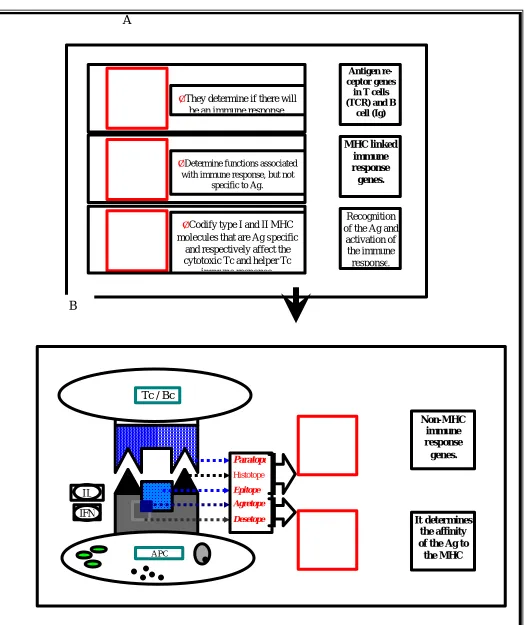
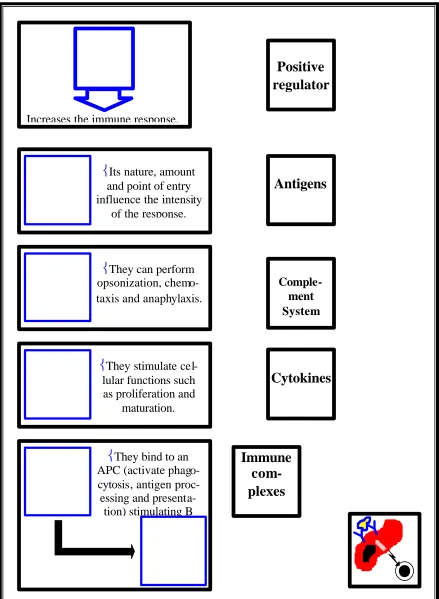
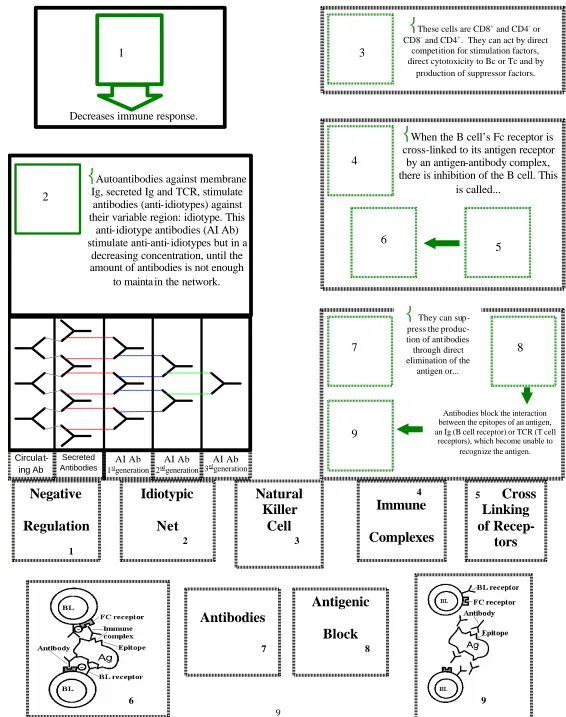
The game consisted of 20 cardboard pieces (5x5 cm) labeled with the names of major regulators of the immune response and three panel boards (50x 60 cm each). Each panel board presented a group of tors (genetic control, positive and negative regula-tors) and contained explanations on how major regu-lators work. Next to each explanation, there was a blank space so that students could fit the cardboard pieces into the corresponding space (Figures. 1-3 see Appendix).
Creating the Game - The panel boards and the cardboard pieces were created by one of the authors (Luiz Felipe Osowski) based on immunology books1,8 -10 and the illustrations were created by a second author (Andréa Goya Tocchetto) using Micro-soft PowerPoint®.
Monitors - We selected last-year undergraduate
medical students, who had volunteered to help de-velop and apply the game, by sitting them for a writ-ten test on Regulation of the Immune Response. A total of 28 students were selected and then trained by the head professor. The topic was brought up in every training session by the head professor and the game was played by the monitors until there were no ques-tions regarding its application. Four sessions were run, with a 7-day interval in between.
Suggestions for Play - One week before playing the game, students were asked to study about the regulation of the immune response and the bibliogra-phy was indicated.1,8 -10
On the day of the game, a review session about the regulatory mechanisms was conducted by the head professor.After that, all students were randomly split into two groups (A and B) and were asked to answer a test(Pretest), so that their previous knowl-edge could be checked. There were two different pretests – test A (Figure 4) and test B (Figure 5) -, both including 10 statements. Students in group A answered pretest A and students in group B, pretest B. Both groups had the same number of students. All students were asked to mark true or false to each one
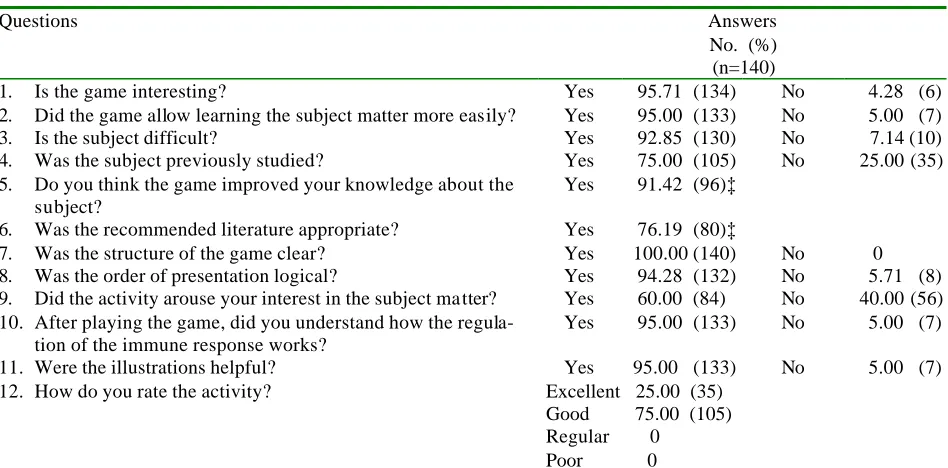
Table 1
Evaluation of instrumental materials for Regulation of the Immune Response
Questions Answers
No. (%) (n=140)
1. Is the game interesting? Yes 95.71 (134) No 4.28 (6)
2. Did the game allow learning the subject matter more easily? Yes 95.00 (133) No 5.00 (7)
3. Is the subject difficult? Yes 92.85 (130) No 7.14 (10)
4. Was the subject previously studied? Yes 75.00 (105) No 25.00 (35)
5. Do you think the game improved your knowledge about the subject?
Yes 91.42 (96)‡
6. Was the recommended literature appropriate? Yes 76.19 (80)‡
7. Was the structure of the game clear? Yes 100.00 (140) No 0
8. Was the order of presentation logical? Yes 94.28 (132) No 5.71 (8)
9. Did the activity arouse your interest in the subject matter? Yes 60.00 (84) No 40.00 (56) 10. After playing the game, did you understand how the
regula-tion of the immune response works?
Yes 95.00 (133) No 5.00 (7)
11. Were the illustrations helpful? Yes 95.00 (133) No 5.00 (7)
12. How do you rate the activity? Excellent 25.00 (35)
Good 75.00 (105) Regular 0
Poor 0
Evaluation instrument designed to assess the educational tool, including results expressed as rates. Students re-sponded to the following: the following statements evaluate general aspects of the materials. Mark yes or no and rate the activity considering the way you feel regarding each statement.
Da Rosa ACM, Osowski LF, Tocchetto AG, Niederauer CE, Andrade Med Educ Online [serial online] 2003;8:13. Available from CMB, Scroferneker ML. An alternative teaching method for the http://www.med-ed-online.org
regulation of the Immune response of the assertions.
Afterwards, students were once again split, but this time, they formed small groups (5 students per group) to enhance student’s engagement. Each group had a monitor of the Medical Immunology course to explain the rules and to conduct the game.
Before playing the game, 3 panels about the regulation of the immune response and the 20 card-board pieces were placed on a desk. The monitors began the game by explaining the regulatory mecha-nisms (written on the panels) and the students had to associate them with the corresponding cardboard pieces. Every time a student was able to correctly associate the name of the mechanism with the corre-sponding cardboard piece, he/she scored one point. After all mechanisms were shown, the student with the highest score won the game.
• Monitors completed the session discussing about the subject and clarifying additional doubts. • The overall time for playing the game and
an-swering the evaluation instruments was 2 hours.
Evaluation - To determine the effectiveness of the educational tool, students were asked to answer a questionnaire (Table 1) and a second test (posttest) after playing the game. Twelve statements were em-ployed on the questionnaire to evaluate four general aspects of the active-learning exercise (goals and objectives, content, motivation and participation, organization and structure). Students were asked to evaluate the extent to which they agreed with the statements by answering yes or no to each question (assertions 1 to 11)or rating the activity as excellent, good, regular or poor (assertion 12). The posttests were exactly the same tests used as pretest. Students who answered test A as pretest (group A) were asked to complete test B as posttest and vice-versa. Grades obtained on the pretest and posttests were compared in order to assess students’ improvement after play-ing the game.
Data anal ysis - The data were analyzed by means of Epi-Info version 6.04d (Center for disease Control and Prevention, Atlanta, GA). Statistical methods employed for this analysis included fre-quency, mean, variance and standard deviation. A paired t-test was used to analyze pre- and post- inter-vention change. Results are expressed as means +/ - standard deviation. For all analyses, a two-tailed p value of less than 0.05 was considered to indicate statistical significance.
Additionally, we checked whether there were
differences between the grades of students who had read about regulation of the immune response before playing the game and students who had not studied the recommended literature previously. Based on students’ reports when answering the questionnaire, we took the tests from these two subgroups and ana-lyzed them separately.
Results
One hundred forty students attending the fourth semester of Medical School participated in this study. The overall response of the students to the game was very positive. Of the 140 students, 134 (95.71%) considered the panel board interesting; 133 (95%) said the panel board facilitated the understanding of the subject matter; 130 (92.85%) considered the sub-ject matter difficult. 105 students (75%) reported studying the recommended literature previously to the class; of these 105 students, 96 (91.42%) have noticed learning improvement and 80 (76.19%) found that the recommended literature was appropriate; As for the presentation of the game, all of the 140 stu-dents (100%) found the structure clear; 132 (94.28%) said that the order of presentation was also logical; 84 (60%) increased their interest in the sub-ject matter; 133 (95%) affirmed they understood how regulation of the immune responses worked and said that the illustrations were helpful; 35 (25%) said the active learning exercise was excellent, and 105 (75%) said the panel board was good. The presentation of the panel board was not graded as regular or poor by any of the students (Table 1).
Da Rosa ACM, Osowski LF, Tocchetto AG, Niederauer CE, Andrade Med Educ Online [serial online] 2003;8:13. Available from CMB, Scroferneker ML. An alternative teaching method for the http://www.med-ed-online.org
regulation of the Immune response
Discussion
Immunology is taught in the fourth semester at the School of Medicine of Universidade Federal do Rio Grande do Sul (UFRGS). During this period, students begin to interact directly with patients and start their medical practice. As a consequence, their attention towards seminars dealing with the basic molecular and cellular mechanisms of immunology is diverted. Based on this experience, we have devel-oped different alternatives so as to improve learn ing.
Our data show that the panel board is a useful teaching aid, playing a significant role in the teach-ing-learning process, even on the medical students who had not read the recommended literature. Stu-dents are constantly exposed to a large amount of information in different fields or areas; therefore, a method that uses logical and active-learning material provides more consistent memorization, as shown in the results of our study.
The use of creative illustrations and the division of students into small groups enhances students’ engagement, thus promoting their participation , in-creasing their interest and making the elucidation of pertinent doubts more accessible.
We could verify that the game significantly im-proved students’ grades on the posttest as compared with the pretest. The good results obtained show the importance of using the panel board when trying to approach a subject that is vast and complex not only for students but also for professors. The panel was an interesting tool that certainly helped the monitors to get better prepared for the presentation of the semi-nar, making the activity more dynamic.
A limitation of our study is that there was no comparison with students’ grades from past sessions when we did not use this teaching method. Unfortu-nately, we did not keep register of students’ grades in past years to compare with grades after the introduc-tion of this activity. Other papers that describe the use of games as educational tools2-4,6,7 also found positive results despite no comparison with students’ per-formance in previous years. This assures that stu-dents’ opinion is a valuable evaluation parameter.
Another issue that could be considered a con-founding factor refers to the effect of the review session on the learning process. It is possible that this activity increased students’ learning, but as we did a pretest after the review session we assumed that stu-dents’ knowledge was evaluated up to that moment. After that activity, students were influenced only by
the game itself. So, results observed on the posttest reflect basically what students learned during the game.
Also, we would like to comment about possible differences in students’ performance that could be based on the performance of the monitor who taught them. Obviously, there are differences between peo-ple in terms of ability to explain and e xpose ideas and these variations can influence students’ learning.We tried to minimize these differences by running train-ing sessions for all the monitors. Anyway, we did not verify whether there was any significant variation between the small groups that could be attributed to themonitor’s performance.
Finally, we think that this game could perfectly be adapted to a CD-ROM version to be used by stu-dents as an additional learning tool at home. Given that only 25% of students rated the game as “excel-lent”, we believe that this computerized version would probably increase students’ enthusiasm about the game.
Despite these few limitations, the game proved to be an important teaching aid. Students were chal-lenged to learn immunology from a different pers pec-tive by interacting with monitors and working to-gether with other students.It required all individuals involved to listen actively, not interrupt, encourage others, be open-minded, provide active feedback, and show respect for others even during a comp etitive activity such as a game. This is an important comp o-nent because job opportunities in the future will re-quire employees to work cooperatively to solve prob-lems and develop solutions. As commented previ-ously in another paper7 “The best teaching tools are those which make you feel like they aren’t teaching tools”.
Conclusion
As previously described, most students endorsed the use of panel boards as an alternative teaching method. The panel boards enable global understand-ing of the subject matter, helpunderstand-ing to consolidate knowledge schematically and to elucidate complex concepts such as regulation of the immune response. In addition, the presentation of the panel boards was effective, and achieved the expected goals.
teach-Da Rosa ACM, Osowski LF, Tocchetto AG, Niederauer CE, Andrade Med Educ Online [serial online] 2003;8:13. Available from CMB, Scroferneker ML. An alternative teaching method for the http://www.med-ed-online.org
regulation of the Immune response
ing methods can be developed for easier learning of tedious medical topics.
We believe that the goals and objectives were accomplished. Moreover, we hope to incorporate other difficult topics in Immunology.
Acknowledgments
Thanks to the monitors (demonstrators) of the Medical Immunology Course, CBS 06624, from the Universidade Federal do Rio Grande do Sul for their help in conducting the Immune System Regulation game. Also, thanks to Gilson Mattos for revising the English translation of the manuscript.
References
1. Goldsby RA, Kindt TJ, Osborne BA. Immunology. 4th edition; chap-ter 11, pp 269-300. New York: W.H. Freeman and Company, 2000.
2. Scroferneker ML, Soria FHC, Shiba AS. An Alternative Teaching Method for the Complement Sys-tem. Biochemical Education 1995; 23: 67-68.
3. Colombo D, Fritsch A, Ordovás KG, Spode A, Scroferneker ML. Playing with Cellular and Humoral Immunity. Biochemical Education 1998; 26: 20-21.
4. Siqueira AJS, Remião JOR, Azevedo AM. Metabolograms to teach biochemistry. Biochemical Education 1988; 16:20-22.
5. Siqueira AJS, Remião JOR, Azevedo AM. Dynamic metabolic diagrams in biochemistry. Bio-chemical Education 1992; 20: 97-98.
6. Baldor RA, Field TS, Gurwitz JH. Using the "Question of Scruples" Game to Teach Managed Ethics to Students. Academic Medicine 2001; 76 (5): 510-511.
7. Moy JR, Rodenbaught DW, Collins HL, Dicarlo SE. Who wants to be a physician? An Educational Tool For Reviewing Pulmonary Physiology. Adv Physiol Educ 2000; 24 (1): 30-37.
8. Wraith D, Roitt I. Immunology. St. Louis: Mosby, 2001.
9. Scroferneker ML, Pohlmann PR. Imunologia Básica e Aplicada. Primeira edição, pp.218-237. Porto Alegre: Sagra Luzzatto, 1998.
10. Abbas A, Lichtman AH, Pober JS. Cellular and Molecular Immunol-ogy. 4th ed. pp. 208-231. Philadel-phia: Saunders, 2000.
Correspondence
Maria Lúcia Scroferneker, Rua Vasco da Gama 176/604 Porto Alegre - RS - Brazil. CEP 90420-111
Tc / Bc
APC
Paratope Histotope
Epitope
Agretope
Desetope IFN
IL
Non-MHC immune response genes.
It determines the affinity of the Ag to
the MHC
Antigen re-ceptor genes
in T cells (TCR) and B
cell (Ig)
They determine if there will be an immune response.
Determine functions associatedwith immune response, but not specific to Ag.
MHC linked immune response genes.
Recognition of the Ag and
activation of the immune
response.
Codify type I and II MHCmolecules that are Ag s pecific and respectively affect the cytotoxic Tc and helper Tc
immune response.
A
B
in-Increases the immune response.
Its nature, amount
and point of entry
influence the intensity
of the response.
They can perform
opsonization,
chemo-taxis and anaphylaxis.
They stimulate
cel-lular functions such
as proliferation and
maturation.
They bind to an
APC (activate
phago-cytosis, antigen
proc-essing and
presenta-tion) stimulating B
Antigens
Comple-ment
System
Cytokines
Immune
com-plexes
Positive
regulator
Decreases immune response.
Autoantibodies against membrane
Ig, secreted Ig and TCR, stimulate
antibodies (anti-idiotypes) against
their variable region: idiotype. This
anti-idiotype antibodies (AI Ab)
stimulate anti-anti-idiotypes but in a
decreasing concentration, until the
amount of antibodies is not enough
to mainta in the network.
Circulat-ing Ab
Secreted Antibodies
AI Ab 1stgeneration
AI Ab 2ndgeneration
AI Ab 3rdgeneration
These cells are CD8+ and CD4- orCD8- and CD4+. They can act by direct
competition for stimulation factors, direct cytotoxicity to Bc or Tc and by
production of suppressor factors.
When the B cell’s Fc receptor is
cross-linked to its antigen receptor
by an antigen-antibody complex,
there is inhibition of the B cell. This
is called...
Antibodies block the interaction between the epitopes of an antigen, an Ig (B cell receptor) or TCR (T cell
receptors), which become unable to recognize the antigen.
1
Negative
Regulation
12
3
Idiotypic
Net
24
5
6
7
8
9
Natural
Killer
Cell
3 4Immune
Complexes
5
Cross
Linking
of
Recep-tors
Antibodies
7Antigenic
Block
86 9
They cansup-press the produc-tion of antibodies through direct elimination of the