Know-how behavers 1 Running head: KNOW-HOW BEHAVERS
Know-how Behavers, and Negative Choice Value in Competitive Situation
Raimo J Laasonen Project researcher
Know-how behavers 2 Abstract1
The purpose of the research was to find out: How does know-how behavior link with a negative choice value of persons in a competitive situation, and which background factors are
responsible for behavioral dynamic. It was assumed that the joint background regulates the know-how of the behavers. When the know-how of the behavers gains in the process, then other behavers arouse a negative choice value toward the achievers, and oust them. The number of the subjects was 256 in groups of eight. Videotaped observation was the method of data gathering. The corrected coefficient of observer reliability was 0.920. χ2-test from a contingency table was applicable to position the observations in the right places. Accordingly, the coefficient of contingency was 0.145, and the correlation between classes was 0.151. Probabilities were used to
scrutinize dynamic of behavior. The causation of the joint background falsifies in the hypothesis. The dynamic
causalities corroborate: the perceivable gain of the know-how of the behaver motivates the arousal of the negative choice value in other behavers in a competitive situation. The
1 The paper is thank to Prof. Daniel Perlman at University of Calgary for his positive orientation to my research
Know-how behavers 3 Know-how Behavers, and Negative Choice Value in
Competitive Situation.
The incentive of the research initiated from discussions that concern shortage of skilled workers in some trades. It seems somewhat dubious to emphasize know-how because work places go through detours that do not prefer both theoretic and real know-how. Sometimes, know-how is contrasted with theoretic knowledge, which is a needless distinction. For example, a blacksmith shoes a horse. Thus, he has to have a process in the mind that bases on experience. The process is to be adequate with a series of operations both conceptually and practically to accomplish the optimal result. Therefore, extension of know-how is both theoretic and practical.
Intensions of know-how are real processes to be dealt with. A persons, matters, and things work. In the best case, there is a theory that organizes, explains, produces procedures for measurements and from which realistic hypotheses are deducible which match with real processes.
Know-how behavers 4 resolution level of behavior? As with the present research, there is no handy theory. Whence, one has to be satisfied with a conception. The premise of the research is: Know-how behavers are problematic for their immediate social environment, except when there are plain other know-how
behavers present. The immediate social environment aggregates to behavers who can see each other, and they have an
opportunity to direct contact. The behavers are reachable without any devices.
In a contest, the goal is to win. The problems begin with the know-how behaver, because he or she jeopardizes
chances of others to attain the goal to which others strive. In many cases, the behavers begin to use questionable means. In the present research, the means is dropping out a behaver who jeopardizes the attainment of the goal. Therefore, the behavers are able to block cumulative gain of others. A fact, that enables different tactics to apply. However, the behavers have their background variables; in this case, they are
points, and the standpoints the behavers use to examine reality.
So that, it is assumable the background regulates the know-how but the premise says problematic emerges.
Know-how behavers 5 As with the background it is probable that the joint background has a greater impact the know-how behavior than its individual variables. The premise, and the background
examinations warrant a derivation of a hypothesis. H1: The joint background regulates the know-how of the behavers. When the know-how of the behavers gains in the process, then other behavers arouse a negative choice value toward the achievers, and oust them. The negative choice value is definable through motivation to get rid of a behaver because she or he causes losses in the process. As known persons do not want to loose even a nickel. Accordingly, a behaver has a negative choice value if others want to exclude him or her.
Summarily: The variables of the research were: The gender, the age, the socio-economic group, and the quotient of the know-how and the negative choice value. The way of
obtaining data was observation from videotapes. A sort of random walk approach was usable to the analysis of the
the deeds of the behavers to verify ex-or to falsify the
hypothesis. Dynamic elaboration was the device to specify the causalities of likelihood.
Method Subjects and Context
The total number of the subjects was 256 from whom 165 were men and 91 were women.
Know-how behavers 6 The age range was from 19 years to 66 years.
The frequencies of the socio-economic group were: self-employed persons (14), upper level employees with
administrative, managerial, professional and related
occupations (90), lower-level employees with administrative and clerical occupations (51), manual workers (48), students (43), pensioners (3), unemployed (7), and unknown
socio-economic group (0). The classification originates from Statistics Finland.
There were 32-videotaped sessions in groups of 8 behavers. Each session included in 8 rounds, and in every round, one of the behavers was kicked out through other
Results
Reliability and Validity of Observation
The added, original frequency matrices of the knowledge, ignorance and negative choice value derived from the 32
session matrices was the starting point to asses the
coefficient of the observer reliability. The sum matrices are as transposes in Tables 1 and 2 for the sake of calculation directions. Simultaneously, a random observer matrix
Know-how behavers 7 was constructed. The random matrix formed from random number tables (Fisher & Yates, 1963, pp. 134-139). No two same numbers were allowed to occur in the matrix. The random matrix had the same form as the empirical matrix.
Table 1
Frequencies of Knowledge, Ignorance, and Negative Choice Value
T1 108 111 118 120 121 114 107 108
T2 110 101 103 99 105 104 85 104
T3 111 90 100 82 108 92 79 109
T4 98 90 88 73 107 82 86 99
T6 75 93 47 54 101 94 78 60
T7 64 48 29 17 54 62 66 48
T8 60 41 25 17 41 51 54 45
Know-how behavers 8
Table 2
Random Frequencies
T1 3 70 82 5 78 66 38 50
T2 97 56 94 71 29 6 4 43
T3 16 99 10 75 92 58 61 88
T4 12 15 86 53 85 5 39 24
T5 55 93 91 39 50 62 57 34
T7 42 25 45 44 20 80 91 46
T8 1 37 18 21 60 3 94 13
Know-how behavers 9 The rows in Tables 1, and 2 were normalized and the matrices were recomposed. Thereafter, the operation was A.A’
that resulted in rij-matrix. The rij-matrix was squared that gave an opportunity to calculate total variance (1.rij2.1’). However, the full variance without error is 64 because all the squared correlations are ones. Subtraction of the total
0.897 in the previous order. It appears that the ‘random’ observer has been quite reliable.
It is not so anyway. There is a need for a correction term to obtain the mere common variance. The coefficient of alienation served the purpose. The coefficients of alienation were obtainable from the squared correlation matrices,
directly. The same procedure was convenient as before to calculate the total sum of the matrices. Subtraction of both the specific variance and the total alienation gave the plain common variances. In the empirical observation the case is: (60.997 - 8 - 11.871) ≅ 41.126; in the random case the
subtraction is: 37.32 - 8 - 38.06 ≅ -8.739. Consequently, the correct
Know-how behavers 10 coefficient of reliability is 0.920, whereas the random coefficient has no meaning.
the observations. The χ2-test resulted in the value of 112.152
with v=49; the value flies beyond the significance table.
Therefore, the observations are there where they are to be. For the sake of check, the coefficient of contingency, and the correlation between classes were calculated. The former value is 0.145, and the latter value was 0.151. Comparison with the maximum coefficient of contingency 0.935 tells an evident
result.
Analysis with Causal Probabilities
The 32-matrices were sorted in the order of the ouster. The behavers were in the rows in a descending order, and time was in the columns. The frequency matrices formed for
knowledge, ignorance, and the ousters and the oustees. The knowledge matrix and the ignorance matrix were added. The sum matrix divided both of the matrices. The ignorance matrix was subtracted from the knowledge matrix. The outcome matrix was Know-how behavers 11 multiplied by the mean time of the answers. The matrix of the negative choice values divided the know-how-matrix. Consequently, the know-how is knowledge minus ignorance. The quotient of know-how and of the negative choice value as probabilities indicates the dual state of behavior.
Table 3
T1 T2 T3 T4 T5 T6 T7 T8
B1 70 77 80 95 114 137 127 99
B2 73 73 77 83 90 117 129 48
B3 66 73 89 89 102 116 0 0
B4 63 63 67 75 77 0 0 0
B5 59 59 58 54 0 0 0 0
B6 64 51 42 0 0 0 0 0
B7
555 32 0 0 0 0 0 0
B8 38 0 0 0 0 0 0 0
Know-how behavers 12 In Table 3, the first column includes in the ’sum‘
behavers (B1-B8), and time goes in the next columns.
Table 4
Sorted Sum Frequencies of Ignorance
B1 24 28 36 33 34 47 67 52
B2 23 25 36 46 51 66 65 103
B3 34 28 27 38 42 63 0 0
B4 30 32 42 47 69 0 0 0
B5 39 40 50 71 0 0 0 0
B6 35 48 68 0 0 0 0 0
B7 42 65 0 0 0 0 0 0
Know-how behavers 13 Table 4 is analogical with Table 3.
Table 5
Sorted Sum Frequencies of Negative Choice Value
T1 T2 T3 T4 T5 T6 T7 T8
B1 19 17 17 21 24 28 32 32
B2 22 22 21 25 28 30 32 0
B3 14 18 19 22 23 96 0 0
B4 22 16 23 24 128 0 0 0
B5 20 25 22 160 0 0 0 0
B6 22 21 192 0 0 0 0 0
B7 15 224 0 0 0 0 0 0
B8 256 0 0 0 0 0 0 0
Time 22.5s 24.2s 26.6s 30s 35s 43.3s 45s 30s
Know-how behavers 14 Construction of Dual State Space
The preliminary calculations gave the quotient matrix below.
Table 6
Quotient Matrix of Know-how and Negative Choice Value
T1 T2 T3 T4 T5 T6 T7 T8 B1 .579 .666 .594 .691 .788 .756 .434 .291
B2 .532 .540 .460 .344 .345 .402 .463 0
B3 .514 .601 .750 .547 .634 .133 0 0
B4 .362 .495 .265 .286 .014 0 0 0
B5 .229 .186 .089 -.025 0 0 0 0
B6 .299 .035 -.032 0 0 0 0 0
B7 .201 -.036 0 0 0 0 0 0
Know-how behavers 15
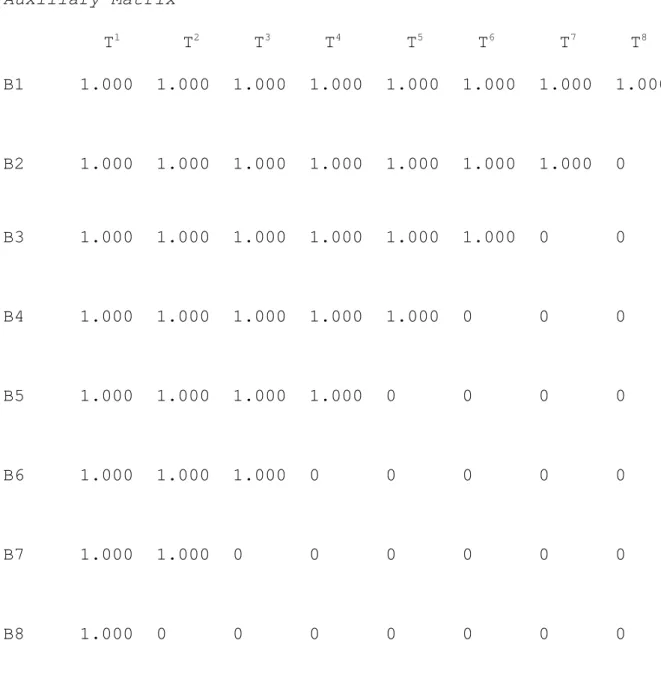
In the sequential calculations, an auxiliary matrix maintains the structure of the quotient matrix.
The auxiliary matrix is in Table 7.
Table 7
Auxiliary Matrix
T1 T2 T3 T4 T5 T6 T7 T8 B1 1.000 1.000 1.000 1.000 1.000 1.000 1.000 1.000
B2 1.000 1.000 1.000 1.000 1.000 1.000 1.000 0
B3 1.000 1.000 1.000 1.000 1.000 1.000 0 0
B4 1.000 1.000 1.000 1.000 1.000 0 0 0
B5 1.000 1.000 1.000 1.000 0 0 0 0
B6 1.000 1.000 1.000 0 0 0 0 0
B7 1.000 1.000 0 0 0 0 0 0
Know-how behavers 16 The maintenance of the matrix structure takes place by direct multiplication of the matrices that are results from calculations. The quotient matrix in Table 6 is of full rank with normal base, and the kernel is an empty set. In next phase, cumulative probabilities from the quotient matrix were calculated, at time.
Table 8
Cumulative Probability Matrix
T1 T2 T3 T4 T5 T6 T7 T8 B1 .025 .054 .080 .110 .144 .177 .196 .209
B2 .041 .082 .118 .144 .171 .202 .238 0
B3 .042 .091 .153 .198 .251 .262 0 0
B4 .070 .165 .216 .272 .275 0 0 0
B5 .140 .254 .309 .294 0 0 0 0
B6 .320 .357 .322 0 0 0 0 0
B8 1.00 0 0 0 0 0 0 0
Know-how behavers 17 The values in the Tables are not rounded because they may affect interpretations. Therefore, it is profitable to have the three decimal places such as they are.
There are ’pits for trapping wolves‘, especially to intermingle dependencies and causalities. The cumulative matrix in Table 8 is of full rank. It means lack of linear dependencies but to make certain that no dependencies exist the Gram-Schmidt process was applied to the cumulative matrix. There is also another program in Mathematica that finds the linear dependencies, and in spite of them gives an orthonormal base. The Gram-Schmidt process was good enough because of the full rank. Therefore, what are left are the independent
probable causalities. However, there is need to know the dual, causal state space until the proper causation analysis is possible. The outcome matrix of the Gram-Schmidt process is in Table 9.
in the rows. The Cartesian products were calculated between the vectors pair wise. Thereafter the row sums of the
resulted matrices (number of 7) were put to ones.
Know-how behavers 18
Table 9
Outcome Matrix of Gram-Schmidt Process
T1 T2 T3 T4 T5 T6 T7 T8 B1 .063 .136 .202 .278 .364 .448 .495 .528
B2 .085 .158 .216 .215 .199 .208 .294 0
B3 .021 .067 .182 .264 .373 .309 0 0
B4 .117 .304 .297 .361 .219 0 0 0
B5 .253 .337 .392 .186 0 0 0 0
B6 .538 .361 .130 0 0 0 0 0
B7 .497 .235 0 0 0 0 0 0
Know-how behavers 19
As a result, every row of the matrices corresponds with an outcome of branches in a Bayes tree. The absolute
probabilities were the column vectors. In a simple way, the multiplication is presentable such as p(Hi.)*p(A.j|Hi.).
Table 10
Dual Causal Probable State Space
T1 T2 T3 T4 T5 T6 T7 T8 B1 .020 .059 .072 .096 .131 .171 .193 .252
B2 .052 .134 .150 .145 .139 .154 .223 0
B3 .015 .066 .146 .205 .301 .265 0 0
B4 .077 .275 .222 .260 .164 0 0 0
B5 .186 .338 .325 .149 0 0 0 0
B7 .607 .392 0 0 0 0 0 0
Know-how behavers 20 The adding over the rows of the multiplied matrices gave the state space. The outcome matrix was transposed. The matrix modified into a stochastic one. The dual, causal state space matrix is in Table 10.
Dynamic elaboration
There were two options to implement the dynamic
elaboration or to eliminate a row and a column in the time order of the process. That is because in every round one behaver drops out. Therefore, the matrices in the elaboration form a descending order such as: 8 by 8, 7 by 7, 6 by 6, 5 by 5, 4 by 4, 3 by 3, 2 by 2, and 1 by 1 (scalar). The
elaboration was possible to start from the state space matrix in Table 10, directly. Another way was to modify the
auxiliary matrix in Table 7. It was more convenient to delete a row and a column from the auxiliary matrix in the time
order. Then the reduced auxiliary matrices multiplied the dual, causal state space matrix. The zero rows, and the
Correspondingly, the zeroes after each time vector were deleted with the result
Know-how behavers 21 that one column remained per every matrix as powered. The plain vector matrices were added. The operation gave a sum matrix of the dynamic elaboration.
Table 11
Sum Matrix of Dynamic Elaboration
P1 P2 P3 P4 P5 P6 P7 P8 B1 .020 .427 .179 .276 .315 .419 .581 1.000
B2 .052 .292 .226 .294 .374 .538 1.000 0
B3 .015 .250 .262 .342 .530 1.000 0 0
B4 .077 .192 .379 .489 1.000 0 0 0
B5 .186 .263 .570 1.000 0 0 0 0
B6 .456 .458 1.000 0 0 0 0 0
B8 1.000 0 0 0 0 0 0 0
Note. The P:s in the column headings are the matrixpowers.
Know-how behavers 22 How are the values in Table 11 to be read? The ones in the minor diagonal are absorbent, probable, causal effects borrowed from the Markov-chains. Other values are effects when the previous row(s) and column(s) are eliminated. For
example, the column values in P3 are the results of the
elimination of the 1st and 2nd rows and columns. Remarkable is the thing that both small and great causal probabilities have importance. The small probabilities indicate an inner stress of a behaver to assign negative choice value to another
behaver in the same occasion. The great values show a behaver to demonstrate know-how. The one in the last entry in the 1st row tells that the winners do not lose.
Background and Process
were sorted. The majority of the orders included in the calculation 16 behavers, at least. The orders scored
inversely. The the sums of the scores were added ,and divided by the mean of the different scores, one from every group. The obtained values were rounded into integers. The
Know-how behavers 23 background values turned into probabilities. The
probabilities were added, and the probability vector was done stochastic. The joint background vector, and the background matrix went trough the process. The reason for that, was to test the hypothesis, and to see which of the background
variables had importance in the process or was it the total background. The changes in the background probabilities are in Table 12.
Table 12
Changes of Background Variables in Process
Women .076 .349 .344 .377 .307 .232 .179 .154 .076
Mean Age
.131 .316 .359 .326 .289 .264 .241 .190 .131
Socio-Economic Group
.143 .292 .381 .320 .293 .280 .255 .191 .143
Know-how behavers 24
Table 13
Joint Background in Process
T0 T1 T2 T3 T4 T5 T6 T7 T8 .125 .308
.116 .363
.123 .330
.121 .296
.125 .269
.131 .239
.127 .189
Know-how behavers 25 As with the joint background the inner products with the powered matrices resulted in a matrix in Table 13.
Discussion
It was assumed in the hypothesis: the joint background regulates the know-how of the behavers. When the know-how of the behavers gains in the process, then other behavers arouse a negative choice value toward the achievers, and oust them.
The results in Tables 12, and 13 falsify the hypothesis about the joint background as a regulator of the know-how. The regulation is more varied than expected when the
background variables have revolved through the process. Second, one of the weaknesses of the present research is the narrow scope of the definition of the know-how. The definition does not include in behavior with many phases, and multitasks to accomplish what is to accomplish.
socio-economic group is decisive and being a male, too. In the 3rd session, the most prominent variable is
Know-how behavers 26 the female. The 3 other variables have weaker
causalities with behavior than the joint background. The next occasion shows that the female is most influential. The joint background, and the male have the same efficacy while the
average age, and the socio-economic group has minor
importance. In the next phase, changes occur. The male, and the socio-economic group have greater efficiency than the joint background but the female, and the average age has lesser influences in the process. Thereafter, the joint background looses its importance, except in relation with the female. The main cause is the male. The socio-economic group, and the average age follow up with efficiency. The same pattern
repeats until the end of the process, although the causalities weaken to some extent. On most occasions, the male, and the socio-economic group bring forth the winners. The joint
background, and its components act differently in the process. One of them functions as a Gestalt dominant in the rivalry.
Concerning the proper process in Table 11 the
the probable causes in the process. In the 1st column, the know-how of the oustee instigates arousal of the negative
Know-how behavers 27 choice value in the behavers 3, 1, 2, 4, and 5. The behavers 6, and 7 express their know-how in addition of the oustee but the know-how of the others does not matter. The removal of the know-how behaver causes changes in the next session.
The winner, and the 6th behaver disclose their know-how but other behavers arouse the negative choice value toward the 7th behaver in the order of 4, 3, 5, and 2 that abandons the behaver 7. In spite of the maintenance of the previous level of the know-how the behaver 6 stays. Second, the winner
demonstrates the know-how more than previously but the behaver 7 transfers in an absorbent state of absence. The second drop out again causes modifications. The winner, and the 1st runner up become prone to oust the 6th behaver because of the previous gain through the know-how. The behaver 3 join with the
considerable increase in the apparent know-how, previously. It means the arousal of the negative choice value because to win purports to prohibit the cumulative gain of others. Consequently, the winner, and the 1st runner up expel the
Know-how behavers 28 behaver 5. After the 4th throw out the behaver 4 becomes a nuisance to the winner, and the 1st runner up because the behaver 4 gains, repeatedly. A similar kind of improvement takes place with the 3rd competitor but the prohibition focuses on ruling out the behaver 4. In the 6th reduction, the
improvement of the 3rd competitor is a fact to be taken into consideration. The greatest know-how emerges in the 2nd
competitor. The winner points out the increased know-how but not in so high a quantity than the 2nd competitor. To that purpose, the winner takes care of the exclusion of the 3rd
competitor. In the next phase, that is the last chance of the gains the 2nd contestant gains more than the winner but then in the last decisive session, the winner takes the entire
cumulated gain in the process.
behaver motivates the arousal of the negative choice value in other behavers in a competitive situation.
There emerge a few theoretic implications from the
results. Know-how persons block attainment of other persons. Therefore, it is unlikely that the know-how persons are
greatly desired. How does a know-how person differentiate from other persons?
Know-how persons 29 Probably, he or she continues action to fill a purpose, and accomplishes a task when others have ceased it.
Examination of the theoretic aspects is workable through teamwork. Nowadays, competition is grafted in the team because of career pipes, often tubes, with individual
objectives. There are those false positives as true negatives in a form of promises. There are certain conditions to be fulfilled to speak about the teamwork. The members involve in the common objective, publicly. The condition of the task-based division of labor is vital, and above all insightful visions about implementation of the enterprise. Well, how about the graft of the implicit contest? At least, group dynamic does not realize because of friction between
creates more variety. More variety is less control, and more control is less variety. The consequence is those who are able to progress things are not the persons with the best of the knowledge because of obstacles put them out. That is the main theoretic result.
Know-how behavers 30 References
Fisher, R. A., & Yates, F. (1963). Statistical tables. London: Longman.