1013
An Improved 3d Playfair Cipher Key Matrix With
Dual Cipher Block Chaining Method
Ritchell S. Villafuerte, Ariel M. Sison, Ruji P. Medina
Abstract: One of the most concerned issues during data transmission is the security of information exchange. Cryptographic schemes are needed to protect the vital information from intruders or against illegal access and modifications. The 3D Playfair Cipher Algorithm is a symmetric encryption scheme that uses substitution technique. It originates due to the constraint of the classical 5x5 Playfair Cipher. The intended improvement emphasizes on proposing a more secure secret key generation and enhancing the encryption scheme of the 3D (4x4x4) Playfair cipher. The proposed study utilizes a 4x8x8 key matrix that holds 256 ASCII characters and implements a dual Cipher Block Chaining (CBC) method. Experimental results show a notable improvement in the security performance of the proposed study, wherein it achieved a strict avalanche criterion (SAC) of 54.17%. The proposed enhancement has a notable Avalanche Effect increase of 52.78% between the proposed improvement and the original 3D Playfair, indicating that the proposed algorithm is better compared to the original one. Furthermore, the proposed improvement also passed the randomness test.
Index Terms: 3D Playfair, trigraphs, encryption, symmetric cryptography, cipher block chaining.
—————————— ——————————
1.
INTRODUCTION
In this period, where one lives in an era flooded with information, secure exchange of information like text messaging is highly significant. Messages in the form of emails, SMS, or mobile messaging has become the primary ways of communication. These messages created and sent by the sender needs to be safeguarded to ensure confidentiality of the information to the receiver. And to protect the vital information from intruders or against illegal access and modifications, cryptographic schemes are needed. Playfair cipher is an example of a classical-symmetric encryption scheme and one of the best-known early block ciphers that use substitution technique. The Playfair cipher model is energy-efficient and straightforward compared to its counterparts with complex computational standards [1], [2], [3]. The 3D Playfair is an enhancement of the classical 5x5 Playfair cipher that encrypts trigraphs of three characters instead of digraphs and is proposed by Kaur, Verma, and Singh in the year 2012 [4]. 3D Playfair originates due to the limitations in the classical Playfair as it only supports 25 English alphabets and enhances its security in encrypting and decrypting plaintexts. It merely works on a 4x4x4 matrix with 64 characters which includes 26 alphabets, 10 numerals and 28 special characters in encrypting plaintext messages. The advantage of the cipher lies in the scheme of encrypting trigraphs or a set of three characters. It eliminates the issue of the digraph method in classical Playfair where the digraph and its reverse will encrypt similarly, making it more secure from cyphertext attacks [4],[5].And though the confusion rate of the 3D Playfair has increased, the cryptographic technique used still shows a low avalanche effect with respect to one-bit change in plain text [6],[7]. Transmission of the secret key is highly significant in cryptography. The key is selected by one of the
communicating parties (the sender) and shared to other authorized parties (the receiver) in encrypting and decrypting plaintext messages. As what Kerckhoffs‘s principle states: ―The security of a cipher should rely on the concealed key and not on the secrecy of the cipher.‖ [8] Thus, a key should be secure before sending it to the receiver for decryption. This concept is one of the security loophole in the 3D (4x4x4) Playfair Cipher, as it lacks to provide a secure key transmission to the receiver. Therefore, this paper focuses on improving the secrecy of the key in generating the key matrix and enhance the encryption scheme of the 3D (4x4x4) Playfair Cipher using CBC method to attain an improved avalanche effect.
2
THE
ORIGINAL
3D
(4X4X4)
PLAYFAIR
CIPHER
The 3D Playfair is a symmetric-multiple letter encryption cipher which encrypts a trigraph of plaintext into the corresponding ciphertext. It requires a 4x4x4 matrix and can only secure limited number of characters. The total size of the matrix in the original 3D Playfair is only 64 characters and considers uppercase letters of the English alphabets in encrypting plaintext messages. 3D Playfair originates due to the limitations in the classical Playfair as it only supports 25 English alphabets and enhances its security by increasing the complexity in encrypting and decrypting plaintexts. Different steps are involved in the encryption process. First, input data (secret key) is pre-processed to generate the key matrix formation. Then, encryption and decryption take place.
2.1 Key Matrix Formation
The 4x4x4 key matrix is used to store the secret key or the keywords in encrypting and decrypting plaintext message, to generate the matrix, the secret key is pre-processed using the following rules:
1. Enter the secret key (keyword) which may contain numerals, alphabets, and special symbols.
2. Drop the duplicate letters of the key. Make sure that no repeated characters exist.
3. Arrange it by floor, row (left to right) and column (top to bottom).
4. It will then be filled with the remaining alpha-numeric characters and special symbols.
FRIENDS4EVER@NITJ_2012.CSE, keyword will be FRIENDS4V@TJ_201.C. Table I shows the Key matrix formed from the keyword FRIENDS4V@TJ_201.C.
————————————————
Ritchell S. Villafuerte is currently pursuing Doctoral Degree program in Information Technology at Technological Institute of the Philippines, Quezon City, Philippines. E-mail: [email protected]
Ariel M. Sison, School of Computer Studies, Emilio Aguinaldo College, Manila, Philippines. E-mail: [email protected]
TABLE I
3D (4X4X4) KEY MATRIX
2.2 Message Encryption Process
Preparing the plaintext message takes the following rules. First, it will ignore all spaces. Second, the letters are divided into trigraphs or a set of three characters. Third, if any two letters are the same or only one letter is left, filler letters X and Z is added after the first letter in the trigraph. And lastly, if any two-letter is left, add a filler X after the second letter. Following the rules set in preparing the plaintext message, the word BALLOON in digraph will be {BAL}, {LOX}, {ONX} and the word MASTI_M.TECH @NITJ.2012 would be treated as {MAS}, {TI_}, {M.T}, {ECH}, {@NI}, {TJ.}, {201}, {2XZ}.Encrypting plaintext message in 3D Playfair is quite different from the traditional Playfair cipher. But still, the substitution technique is used for encryption. Here, the first letter is replaced in the trigraph by the first letter‘s row, second letter‘s column, and the third letter‘s floor. This method can be better understand in Table II.
TABLE II
ENCRYPTION PROCESS IN 3D (4X4X4) KEY MATRIX Plaintext
Trigraph Plaintext Trigraph Ciphertext Trigraph 1st Letter 2
nd etter 3
rd etter
1st Letter Row Column Floor 1st Letter 2nd Letter Floor Row Column 2nd Letter 3rd Letter Column Floor Row 3rd Letter
2.3 Message Decryption Process
Decryption is done using the substitution technique. A letter in the trigraph is replaced by the letter of the same row, the floor of the next letter and column of the next-to-next letter, following a circular fashion. This method can be better understood by referring to Table III.
TABLE II
DECRYPTION PROCESS IN 3D (4X4X4) KEY MATRIX Plaintext
Trigraph Plaintext Trigraph Ciphertext Trigraph 1st Letter 2
nd etter 3
rd etter
1st Letter Row Floor Column 1st Letter 2nd Letter Column Row Floor 2nd Letter 3rd Letter Floor Column Row 3rd Letter
3 CIPHER
BLOCK
CHAINING
METHOD
CBC mode is one mode of operation used in block ciphers. In CBC, plaintext block is exclusively-ored with the previous ciphertext block before being encrypted[10]. A single-bit error in the ciphertext block may create error in most bits in the plaintext block during decryption process [11]. This mode of operation has been implemented in an 8x8 Playfair Cipher [12]
but not yet implemented in 3D Playfair Cipher. Using this mode makes each cipher-text block dependent on the changes of plaintext blocks. The method is depicted in Figure 1.
Fig. 1. Cipher Block Chaining (CBC) Process
4 PROPOSED
METHOD
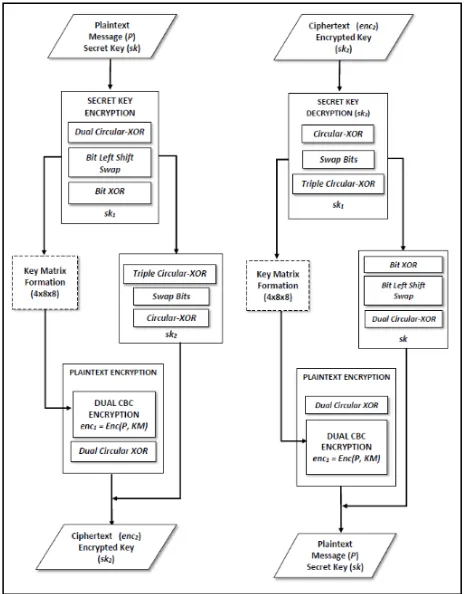
To include characters that are not included in the original 3D Playfair, the proposed method expanded the keyspace that will hold a total of 256 ASCII characters. It will utilize a 4x8x8 key matrix that consists of ASCII control characters, ASCII printable characters, and Extended ASCII characters. The process starts with plaintext message and secret key as inputs. The proposed enhancement involves three main techniques: secret key encryption, message encryption, and decryption. Figure 2 shows the flowchart of the proposed algorithm in encrypting and decrypting plaintext message.
Fig. 2. Proposed Encryption and Decryption Method
4.1 Secret Key encryption
1015 the key input is no longer needed. Key has two phases. The
result in the first phase of key encryption is used to form the key matrix. The result of the second phase is used to transmit the encrypted key to the receiver. Key encryption starts by converting key input to its binary format. Then, the following steps are executed to generate the key matrix.
1. Perform a dual circular XOR to each bit in the key. Circular-XOR is executed by first taking the XOR result of the first and the last bit of the key. Next, the result will be used to calculate the next XOR of the next bit. The operation is continued until the last bit and repeated twice.
2. Next, the result in step is shifted to the left by one bit. Then, it is shifted again to the left by three bits. Split the shifted bits into two and then swap the binary value.
3. Execute equation 1 where ki is the Fibonacci series to
ensure that no duplication of characters exists. The result in step 3 is the first encrypted key used in the key matrix formation.
(1)
4. A triple circular XOR is performed after getting the value for sk1. The result will then be split into two and
swapped. After swapping, execute another circular XOR. The final encrypted key (sk2) is then passed to
the receiver.
A step-by-step illustration is presented to understand the proposed method clearly. Table IV shows how to encrypt the key.
TABLE IV
KEY ENCRYPTION RESULT
Secret Key JAVA 123
Step 1: Dual Circular XOR TG«Õk– Step 2: Shift bit & Swap V¼)`…Dz½ Step 3: sk1 = (sk ⊕ ki) mod 256 W¾*e•oŸ Step 4: Dual Circular XOR(sk2 ) ^ ÝHïÃa
Key Matrix Formation
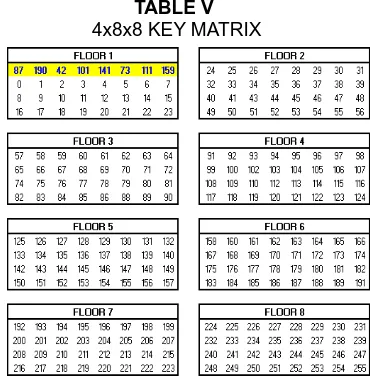
The proposed method makes use of a 4x8x8 key matrix. The key matrix is used to store the encrypted secret key that serves as a look-up table for the substitution technique in encrypting and decrypting messages. Content in the key matrix consists of 256 characters in decimal format and is based on some simple rules, as below:
1. Convert sk1 in decimal format.
2. Arrange the keyword in 4 X 8 X 8 matrix floor by floor, row-wise: left to right and then top-to-bottom.
3. Fill in the remaining spaces in the matrix with the rest of the decimal numbers from 0 – 255 that were not the part of the keyword.
To create the 4x8x8 key matrix, use the encrypted key result (sk1) in Table IV. To fill in the content of the matrix, sk1
is converted to decimal form. The decimal form of sk1 is:
87,190, 42, 101, 141, 73, 111, 159. The key is then arranged floor by floor, row-wise: left to right and then top-to-bottom. The remaining spaces in the matrix is filled with the rest of the decimal numbers from 0 – 255 that was not part of the keyword. Table V shows the 4x8x8 key matrix using the encrypted key sk1.
TABLE V
4x8x8 KEY MATRIX
4.2 Enhanced 3D Playfair Encryption Method
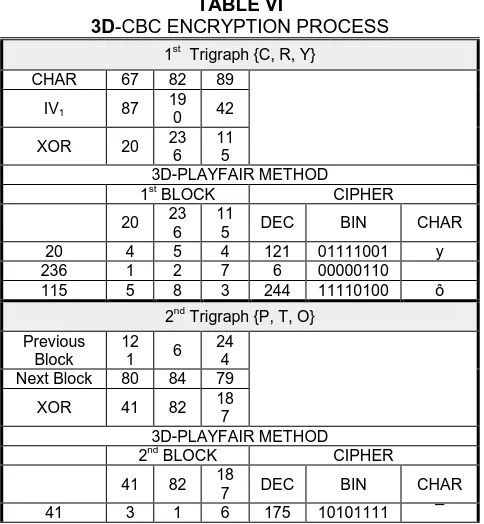
An improved Cipher Block Chaining (CBC) is implemented to enhance the 3D Playfair encryption method. The improved 3D-CBC process involves two stages. First, it will execute two rounds of CBC operation then the second stage works by performing a dual-circular XOR to the final ciphertext block generated in the first stage. The diagram in Figure 3 shows the proposed encryption method. Encrypting the plaintext message works by grouping it in trigraphs. Characters * and – is used as fillers. To start the encryption process, it will execute an XOR operation to the plaintext‘s first trigraph and the first initial vector (IV1). Then the result will then be used to
encrypt the plaintext block using the 3D Playfair algorithm. The encrypted block will then be XORed to the next trigraph. The process continues until the last block. The process continues after performing the first round of CBC operation. But this time, a second initial vector (IV2) will be used and will
start from the last encrypted block to the first. Then, a dual circular-XOR will be executed using the final ciphertext block generated in the previous stage. The initial vector used in encrypting the message is the key generated from the key encryption. The first trigraph in the generated key matrix is referred to as IV1. While the second trigraph in the key matrix
will be IV2. Table VI shows how the proposed method works.
In this illustration, the plaintext message CRYPTOGRAPHY A WORD WITH GREXEK ORIGIN MEANS SECRET WRITING. And the secret key JAVA 123 is used. It shows the initial encryption for the first until third trigraph. The same process is executed until the last trigraph. Table VII shows the final ciphertext result.
Fig. 3. 3D-CBC Encryption Method
4.3 Decryption Method
The decryption method is the reverse process of the enhanced 3D Playfair encryption method, as shown in Figure 2. To decrypt plaintext message, refer to Table III.
TABLE VI
3D-CBC ENCRYPTION PROCESS
1st Trigraph {C, R, Y} CHAR 67 82 89
IV1 87 19
0 42
XOR 20 23
6 11
5
3D-PLAYFAIR METHOD
1st BLOCK CIPHER
20 23 6
11
5 DEC BIN CHAR
20 4 5 4 121 01111001 y
236 1 2 7 6 00000110
115 5 8 3 244 11110100 ô
2nd Trigraph {P, T, O} Previous
Block 12
1 6 24
4 Next Block 80 84 79
XOR 41 82 18
7
3D-PLAYFAIR METHOD
2nd BLOCK CIPHER
41 82 18
7 DEC BIN CHAR
41 3 1 6 175 10101111 ¯
82 2 4 5 53 00110101 5
187 2 3 4 83 01010011 S
3rd Trigraph {G, R, A} Previous
Block 17
5 53 83 Next Block 71 82 65
XOR 23
2 10
3 18
3D-PLAYFAIR METHOD 3rd BLOCK CIPHER 23
2 10
3 18 DEC 00000011 CHAR 232 2 4 1 3 11101010
103 8 2 3 234 01110101 ê
18 1 4 4 117 00000011 u
TABLE VII
PLAINTEXT ENCRYPTION
Plaintext Message
CRYPTOGRAPHY A WORD WITH GREXEK ORIGIN MEANS SECRET WRITING.
Secret Key JAVA 123 Ciphertext
(stage 1) {xV°LWKÄû '}«ŸQW¼=!Ü ztïEº !O™¢@Ÿë=€ 먫7Ó„øMàq Ciphertext
(stage 2) Cœ`GjðFöPÉEy1]ܳ¾ìš›Ôå·:©\ÙêûbD+á ¤´‚ÿLÜ1ÿœÜŠ#ÆCPÊ´[ãòµ€kù
5 RESULTS
AND
DISCUSSIONS
In the proposed method, the pre-processing of the key is no longer needed. It means that even if the key contains repeated characters, it is retained and is used to generate a new key with no duplicate characters. Table VIII shows that even if duplicate characters exist in the key input, a new key is generated without repetition of characters.
TABLE VIII
KEY ENCRYPTION
NO Secret Key
CIPHERTEXT ASCII
Character Decimal 1 eeeeeeeeeee /Ó-Ô&Äæ A 47, 211, 45, 212, 38, 35,
196, 12, 230, 119, 65 2 Pass 1234 Àj{?·)KH 192, 106, 123, 63, 183,
140, 41, 75, 72 3 HELLO
WORLD "í[, D-‘Uº"
237, 91, 44, 160, 13, 173, 68, 45, 146, 85, 186
4 11345 ‗9+;ž 145, 57, 43, 59, 158 5 JAVA 123 W¾*e•oŸ 87, 190, 42, 101, 141, 73, 111, 159
5.1 Avalanche Effect
1017
Ž*£9!3šè´ÁÙ„S€ù–½ôúëƤ•Øn!/³[o0m×ɘ#Å9k§z‘öÑäúV9#)Ä\
Cœ`GjðFöPÉEy1]ܳ¾ìš›Ôå·:©\ÙêûbD+ᤴ‚ÿLÜ1ÿœÜŠ#ÆCPÊ´[ãòµ€kù
TABLE IX
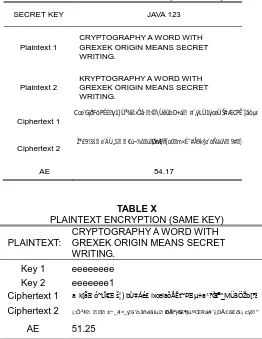
PLAINTEXT ENCRYPTION (SAME KEY)
SECRET KEY JAVA 123
Plaintext 1
CRYPTOGRAPHY A WORD WITH GREXEK ORIGIN MEANS SECRET WRITING.
Plaintext 2
KRYPTOGRAPHY A WORD WITH GREXEK ORIGIN MEANS SECRET WRITING.
Ciphertext 1
Ciphertext 2
AE 54.17
TABLE X
PLAINTEXT ENCRYPTION (SAME KEY)
PLAINTEXT:
CRYPTOGRAPHY A WORD WITH GREXEK ORIGIN MEANS SECRET WRITING.
Key 1 eeeeeeee Key 2 eeeeeee1
Ciphertext 1 a k[ãó~L΀š¦) bÙ¥Áé£ IxœIaôÅÊt~Þµ+a‘·?Ò®_' “MÜ3Ö •Žb[?
Ciphertext 2 ¡:Ô²‡±~_4=_ÿ¼’ò3ñéãîuÐÅ*j¾GI¶ùºŒRá#ˆ¿D¢6Eõì¡ cÿ“ØT
AE 51.25
Tables IX and X shows the AE ratio if there is a minimal change in the plaintext or the keyword. Using the same plaintext and key input in Table IX, the AE of the proposed algorithm is compared to the AE of the original 3D Playfair Cipher and the 2D Playfair Cipher that also implemented a simple CBC.
TABLE XI
COMPARISON OF AVALANCHE EFFECT
ALGORITHM
NO. OF BITS FLIPPED
AE
Original 3D Playfair Algorithm
(Kaur, et.al) 6 1.39%
Modified Playfair Using CBC
(Goyal, et..al) 201 49.51%
Proposed Algorithm
(Improved 3D-CBC) 260 54.17%
Table XI shows that the proposed algorithm contains the most number of bits flipped with respect to one-bit change in the plaintext. The original 3D Playfair by Kaur et al. has the least number of bits flipped with 1.39% AE, while the proposed algorithm contains the highest number of bits flipped with an AE of 54.17%.
5.2 Randomness Test
Randomness test determines if the output sequence generated is indistinguishable from each other, and the value of the next element in the sequence is unpredictable. The output was tested using frequency (monobit), frequency block test, and runs test. These tests are commonly used to determine if the output sequence is random or not. The result is said to be random if the p-value is > 0.01[8].
TABLE XII
RANDOMNESS TEST
Table XII shows that the result of the proposed algorithm passed the three randomness test with a p-value of 0.46521, 0.54358 and 0.56685, respectively. Likewise, the modified Playfair also pass the randomness test. However, the original 3D Playfair did not pass the frequency monobit test and runs test.
6 CONCLUSION
AND
FUTURE
WORKS
Based on the experimental result, it shows that there is a significant improvement in the performance of the proposed study. The proposed method outperforms the other algorithm with a strict avalanche criterion (SAC) of 54.17%. The proposed method has an increase of 4.66% compared to the AE of the modified Playfair. Moreover, a vast AE difference of 52.78% between the original 3D Playfair and the proposed algorithm is notable. Also, proposed method passed the randomness test. It only indicates that the proposed enhancement is better compared to the original one. For future works, it would be advantageous if time complexity will be evaluated to determine the speed of the proposed algorithm compared to other existing algorithms.
REFERENCES
[1] E. Elahi, H. Raza, and S. Ali, ―A new 3D Playfair based secure cipher generation model,‖ Proc. - 2017 13th Int. Conf. Emerg. Technol. ICET2017, vol. 2018-Janua, pp. 1–4, 2018.
[2] S. A. Khan, ―Design and Analysis of Playfair Ciphers with Different Matrix Sizes,‖ Int. J. Comput. Netw. Technol., vol. 3, no. 3, pp. 117–122, 2015.
[3] G. Shrivastava, M. Chouhan, and M. Dhawan, ―A Modified Version Of Extended Playfair Cipher ( 8x8 ),‖ Int. J. Eng. Comput. Sci., vol. 2, no. 4, pp. 956–961, 2013.
[4] A. Kaur, H. K. Verma, and R. K. Singh, ―3D (4X4X4) Playfair Cipher,‖ Int. J. Comput. Appl., vol. 51, no. August, pp. 36–38, 2012.
[5] V. Verma, D. Kaur, R. K. Singh, and A. Kaur, ―3D - Playfair cipher with additional bitwise operation,‖ 2013 Int. Conf. Control. Comput. Commun. Mater. ICCCCM 2013, no. Iccccm, 2013.
[6] K. Bhat, D. Mahto, and D. K. Yadav, ―Information ALGORITHM
Frequency (Monobit)
Test
Frequency
Block Test Runs Test Original 3D Playfair
Algorithm (Kaur, et.al) 1.7488E-4 0.40215 1.88931E-10 Modified Playfair Using
CBC (Goyal, et..al) 0.84264 0.63591 0.11178 Proposed Algorithm
Security using Adaptive Multidimensional Playfair Cipher,‖ Int. J. Adv. Res. Comput. Sci., vol. 8, no. 5, pp. 372–381, 2017.
[7] K. Bhat, D. Mahto, and D. K. Yadav, ―A Novel Approach to Information Security using Four Dimensional (4D) Playfair Cipher Fused with Linear Feedback Register,‖ Indian J. Comput. Sci. Eng., vol. 8, no. 1, pp. 15–32, 2017.
[8] A. Rukhin, J. Soto, and J. Nechvatal, ―A Statistical Test Suite for Random and Pseudorandom Number Generators for Cryptographic Applications,‖ no. April 2010.
[9] J. Aumasson, Serious Cryptography. No Starch Press, Inc., 2018.
[10] M. Dworkin, ―Recommendation for block cipher modes of operation: methods and techniques,‖ 2001.
[11] P. Goyal, G. Sharma, and S. S. Kushwah, ―A New Modified Playfair Algorithm Using CBC,‖ Proc. - 2015 Int. Conf. Comput. Intell. Commun. Networks, CICN, 2015, pp. 1008–1012, 2015.