247
International Journal in Management and Social Science http://ijmr.net.in, Email: [email protected] “THE IMPACT OF FAMILY TYPE ON THE EMOTIONAL INTELLIGENCE OF NETGENERATION STUDENTS”
Abhishek Venkteshwar1 and Dr Uma Warrier2 1
Assistant Professor and Research Scholar-Jain University, Bangalore
2
Professor and Chief Counselor-Jain University, Bangalore
ABSTRACT
Purpose: Research in the field of emotional intelligence have become a dynamic study area over the
past few decades and is likely to become even more so as the importance of emotional intelligence is
rapidly gaining momentum. Therefore understanding EI will be viewed as increasingly important.
India has been regarded as the youngest country in the world by the UN as it has the world’s second
largest population. Family bond is considered to be the strongest in India.
Family type is one of the most neglected components in the Indian society due to the complexity in its
computation. Family shapes an individual’s personality, measured by big 5 personality traits of an
individual (Openness to experience, Conscientiousness, Extraversion, Agreeableness and Neuroticism)
and controls the behavior of the person which has a strong relationship with the Emotional intelligence
of the individual. This article aims at examining the relationship between Emotional intelligence and
family type of net generation students.
KEYWORDS: Emotional intelligence, Family type and Net generation students
I. INTRODUCTION
EMOTIONAL INTELLIGENCE
Daniel Goleman's Definition: “Emotional Intelligence refers to the capacity for recognizing our own
feelings and those of others, for motivating ourselves, and for managing emotions well in ourselves and
our relationships.”(Goleman 2004)Salovey and Mayer's Definition: "Emotional Intelligence is the ability
to perceive emotions, to access and generate emotions so as to assist thought, to understand emotions
and emotional knowledge, and to reflectively regulate emotions so as to promote emotional and
intellectual growth."(Salovey and Mayer 2007) Salovey, Brackett and Mayer (2007) state that
“emotional intelligence (EI) refers to the processes involved in the recognition, use, understanding and management of one‟s own and other emotional states to solve emotion-laden problems and to regulate
248
International Journal in Management and Social Science http://ijmr.net.in, Email: [email protected] Emotional Intelligence (EQ or EI) is a term created by two researchers – Peter Salavoy and John Mayer– and popularized by Dan Goleman in his 1996 book of the same name. Emotional intelligence is the
ability to identify and manage your own emotions and the emotions of others.
There are 5 components of Emotional Intelligence (Goleman 2004), which has been discussed below.
1. Self-awareness: It is all about understanding one‟s own self. This involves a lot of Self-analysis and understanding themselves and knowing how one‟s own reaction at different situations.
2. Self-Regulation: This involves controlling the behavior of one‟s own self. It also focuses on how a
person should keep a tab on his or her emotions in public.
3. Motivation: Motivation is the driving force that makes a person behave in a certain manner. 4. Empathy: The ability to understand the emotions and feeling of others.
5. Social Skills: The ability to socialize and interact with others in the society
II. LITERATURE REVIEW
STUDIES ON EMOTIONAL INTELLIGENCE
Berrocal, Cabello, Castillo & Extremera (2012) investigated the role of gender differences in EI and
whether age acted as a mediator in the relationship between gender and EI among university students
and adults in the community. They observed that age completely mediated the relationship between
gender and EI. Therefore, the role of age is more pronounced.
Bii, Lucas, Mwengi et al. (2012) investigated the relationship between age and EI of managers and
whether the relationship is moderated by gender and managerial experience in educational institutions
including primary, secondary and tertiary institutions. They observed that age had a positive and
significant influence on EI and moderating effects of gender and managerial experience were mild and
non-significant.
Kumar & Muniandy (2012) studied the EI of lecturers in a polytechnic in Malaysia and examined the
impact of demographic factors like age, gender, occupational grade, work experience in the present as
well as in the past job in industry. They concluded that age, experience, occupational grade and
education had a significant positive influence on EI but gender and previous work experience had no
impact on level of EI of lecturers.
O’Boyle Jr., et al. (2011) conducted meta-analysis of empirical research concerning relation among EI,
Five Factor Model (FFM), cognitive ability and job performance. The study focused on identifying the
association of three streams of EI (ability based models adopting objective test items, self-report
measures based on four-branch model of EI and mixed models of emotional competencies) with FFM,
cognitive ability and job performance. The results confirmed a positive correlation (approximately same
249
International Journal in Management and Social Science http://ijmr.net.in, Email: [email protected] FFM were positively associated and neuroticism (one of the FFM factors) was negatively associatedwith EI.
Gryn (2010) studied the relationship between EI traits of 268 call center leaders and their job
performance in a medical aid administration organization in Johannesburg, South Africa. The study
found no significant association between overall EI and job performance of the call center leaders.
Mishra & Mohapatra (2010) researched the relationship between EI and job performance of 90 executives employed in different organizations in Delhi NCR. The results found a significant positive
relationship between EI and job performance. The study also confirmed the concurrent validity of EI
scale (EI test by Chadha and Singh, 2001). Also, out of various demographic variables, only work
experience was found to be positively correlated with EI.
STUDIES ON EMOTIONAL INTELLIGENCE AND FAMILY TYPEJoshi, Rajesh (2009) studied and concluded that emotional intelligence is influenced by the family.This 5 year longitudinal study
tested this hypothesis with 50 developing nuclear families. The dimensions of differentiation of self that
were examined were goal direction and effectiveness and emotional maturity. A qualitative analysis of
participant‟s goals demon staring nuclear families, when compared with couples with lower functioning
families, placed more emphasis on family goals had more balance between family and personal goals
and pursued more goals over the 5 years. The quantitative analysis supported the hypothesis that goal
effectiveness and emotional maturity were associated with nuclear family.
CONCLUSION DRAWN FROM LITERATURE
Family type has a direct impact on the emotional intelligence of students.
The studies conducted so far clearly state that Family type has a direct impact on Emotional intelligence.
The extent to which it impacts varies from situation to situation and all other factors involved.
III. RESEARCH GAP
There is hardly any information between Emotional intelligence and Family type of university students
in India.
This research aims at filling this gap by understanding how family type impacts Emotional intelligence
in Net generation students.
IV. RESEARCH METHODOLOGY
OBJECTIVES OF THE STUDY
To examine the differences in Emotional Intelligence of Net Generation students across, type of family.
HYPOTHESIS
H0= There is no significant difference in the emotional intelligence of net generation students across
250
International Journal in Management and Social Science http://ijmr.net.in, Email: [email protected] H1= There is a significant difference in the emotional intelligence of net generation students across
family type
SAMPLE DESIGN
There are 10 Universities in Bangalore, which is a combination of Central/State and Private Universities
offering Bachelors of Business Administration and Bachelors of Commerce. For the purpose of this
study 3 Universities have been considered , which is Bangalore University(State University), Christ
University (Private University) and Jain University (Private University).5 different colleges under these
universities have been considered .
1. CMR college
2. Mount Carmel College 3. St Anne‟s College
4. Christ Institute of Management 5. Centre for Management Studies
252 students sample was drawn from the above mentioned colleges as they seemed to be a perfect blend
of both state and private university .The questionnaire was administered for these students.
INCLUSION CRITERIA
Undergraduate- Management and Commerce students of 5 different colleges
SAMPLE PROFILE
Table 1: Indicating the percentage of respondents based on Family Type
Family Type Frequency Percentage
Nuclear 105 41.6%
Joint 147 58.4%
Figure 1: Bar Graph indicating percentage of respondents based on Family Type.
The table and chart show that 41.6% of students are from nuclear family, and 58.04% of students are
from joint family have answered the Emotional Intelligence questionnaire. 0.00%
10.00% 20.00% 30.00% 40.00% 50.00% 60.00% 70.00%
Nuclear Joint
251
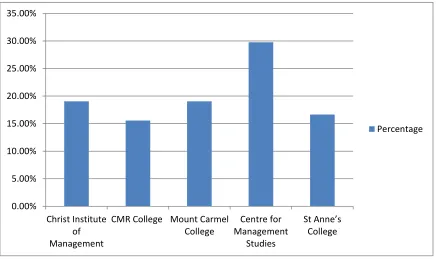
International Journal in Management and Social Science http://ijmr.net.in, Email: [email protected] Table 2 Indicating the College of the respondents in percentageCollege Frequency Percentage
Christ Institute of Management 48 19.04%
CMR College 39 15.57%
Mount Carmel College 48 19.04%
Centre for Management Studies 75 29.76%
St Anne‟s College 42 16.66%
Figure.2: Bar Graph indicating percentage of respondents based on the college
The table and chart show that there are 29.6% of students from CMS,19.04% of students from Mount
Carmel College and Christ institute of Management, 16.66% of students from St Anne‟s college and
15.5.57% of students from CMR college have answered the Emotional Intelligence questionnaire.
SAMPLING TECHNIQUE
Convenient sampling was used to administer the questionnaire for the sample.
TOOL ADOPTED FOR DATA COLLECTION
The tool used for this study is “Warrier‟s EI Questionnaire”. It consists of 14 demographic questions and
80 Emotional Intelligence Quotient Questions with 16 sub categories such as Self-awareness
,Self-esteem /confidence, Self-motivation, Self-management, Optimism , Resilience, Tolerance to ambiguity/ 0.00%
5.00% 10.00% 15.00% 20.00% 25.00% 30.00% 35.00%
Christ Institute of Management
CMR College Mount Carmel College
Centre for Management
Studies
St Anne’s College
252
International Journal in Management and Social Science http://ijmr.net.in, Email: [email protected] Intuition, Empathy, Stress coping skills, Relationship skills, Influencing others, Nurturing others,Networking skills, Values, Believes and Attitude, Assertiveness and Conflict management skills.
The tool was developed to measure the Emotional intelligence of a student.
The tools have been standardized and the cronbach alpha for the tool was reported at .89.The face
validity for the tool has also been conducted on 20 counselors and M.Sc Psychology students.
SCORING PROCEDURE
1. The EI Questionnaire –Warriers‟s EI tool consists of 2 sections.
a. Section 1 consists of the 14 demographic questions posted to the respondent. The response is recorded and analyzed as it is.
b. Section 2 consists of 80 EI questions across 16 factors. The scoring was on a five point scale from 1
to 5, Strongly Disagree (1), Disagree(2), Neutral(3), Agree(4) and Strongly Agree(5) .
2. The sum of the individual EI score of each respondent has been divided by 400 [Max score (5) *
Total number of EI questions (80)], which gives the Net EI score. The Net EI score is multiplied by
100 to give the final EI score
3. This Final EI score is considered for all other correlations with other variables.
Table 3 Indicating Norms for Measuring Emotional Intelligence
Score on 100 Interpretation
Above 90 Superior Emotional Intelligence
61-89 Good Emotional Intelligence
41-60 Average Emotional Intelligence
Below 40 Poor Emotional Intelligence
V. DATA ANALYSIS
NORMALITY TESTS
Skewness and Kurtosis
The skewness and kurtosis values were computed for the UG Performance of students to study the
normality of the sample .The values are tabulated in Table
Table 4 Skewness and Kurtosis values to test normality
Variable Statistic Std. Error Z value
Emotional Intelligence Skewness
Kurtosis
.199
.596
.153
.306
1.30
253
International Journal in Management and Social Science http://ijmr.net.in, Email: [email protected] AnalysisThe above table clearly indicates that the Z values of skewness and kurtosis of Emotional Intelligence is
< 1.96. Skewness and kurtosis values show that the sample is approximately normally distributed.
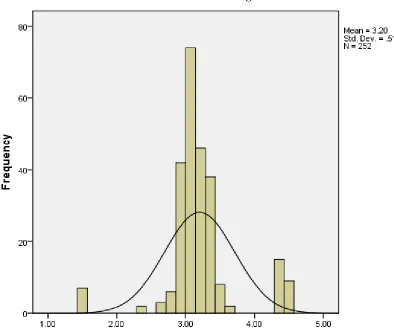
Histograms
Histogram is used to determine normality graphically; the histogram indicates that the data does not
deviate grossly from the bell-shaped normal distribution, confirming that the data is approximately
normal.
Emotional Intelligence
Figure 4 showing the normality of the Emotional Intelligence of students
Interpretation
In conclusion, regarding skewness and kurtosis, data are a little skewed and kurtotic for the sample. It
can be assumed that the data are approximately normally distributed in terms of skewness and kurtosis
and further parametric tests could be applied for analysis of data.
T-Test
254
International Journal in Management and Social Science http://ijmr.net.in, Email: [email protected] Table 5: Indicating the group statistics and independent samples Test for testing the relationshipbetween Family Type and Emotional Intelligence
Type of
family N Mean
Std.
Deviation d/f t value sig level
Emotional
Intelligence
Nuclear 105 3.1813 .42474 250 -.524 .601
Joint 147 3.2155 .56480 -.548 .584
Analysis
For Nuclear (M=3.1813, SD=.42474) and Joint (M=3.2155, SD=56480); conditions: t (250) = 0.601,
p=0.601 > 0.05(in other words the significance value is more than 0.05). There is no significant
difference in Emotional Intelligence across family type
The null hypothesis is accepted: There is no significant difference in the Emotional Intelligence of
net generation students across family types
Interpretation
The family type of an individual (whether nuclear or joint) does not affect the emotional intelligence.
This study contradicts with the study conducted by Joshi, Rajesh (2009) who states that family type does
affect emotional intelligence.
VI. FINDINGS OF THE STUDY
No significant differences were found between family type (Joint or Nuclear) and emotional
intelligence. It was found that the family type of a person whether joint or nuclear does not affect his/her
emotional intelligence.
VII. CONCLUSION
Emotional Intelligence has attracted the interest of researchers across the globe.This study confirms that
255
International Journal in Management and Social Science http://ijmr.net.in, Email: [email protected] Reference[1]. Abhishek Venkteshwar (2016). The Relationship between Emotional Intelligence and Academic performance of net generation students, M.Phil Dissertation –Jain University
[2]. Ahmad;, M, Pervaiz, , K & muhammad, A. (2010). Factors Affecting the Students' Academic Performance. Journal of Educational Research , 13(1), 252
[3]. Alexander B. Siegling, Adrian Furnham, and K. V. Petrides (2015). Trait Emotional Intelligence and Personality: Gender-Invariant Linkages Across Different Measures of the Big Five. Journal of
Psychoeducational Assessment 2015, Vol. 33(1) 57–67
[4]. Donald, et al.. (2007). Personality, Emotional Intelligence and Exercise. Journal of health Psychology, 12 (6 ), 937-948
[5]. Downey, L. (2014). Fluid Intelligence, Personality, and Emotional Intelligence. Canadian Journal of School Psychology, 29(1), 40-53.
[6]. Ferrando M., Prieto M. D., Almeida L. S. (2010). Trait emotional intelligence and academic performance: Controlling for the effects of IQ, personality, and self-concept. Journal of
Psychoeducational Assessment, 29, 150-159. 10.1177/0734282910374707
[7]. Furnham, A., L. Forde and T. Cotter (1998). Personality and intelligence. Personality and
Individual Differences 24:2, 187– 192.
[8]. Gallagher, S.A. (1990). Personality patterns of the gifted. Understanding our Gifted, 3, 11–3. [4].
Goldberg, Lewis R., (1990). Journal of Personality and Social Psychology, Vol 59(6), 1216-1229
[9]. Goleman, D. (2008). What makes a leader: Harvard Business Review.
[10]. Greenberg Jerald & Baron Robert A (2008). Behavior in Organizations. Ninth. ed. New Jersey: Pearson Education, Inc.
[11]. Hijazi, Syed Tahir and Naqvi, S.M.M. Raza. (January 2006). „Factors Affecting Students‟
Performance: A Case of Private Colleges‟. Bangladesh e-Journal of Sociology: Volume 3,
Number 1.
[12]. Higson, H. & Andrews, J. (2007) Education, Employment and Graduate Employability: Project Manual. Aston Centre for Research into Higher Education, Learning & Management, Aston
University.
[13]. Joyce G. Walsh-Portillo (2011), “The Role of Emotional Intelligence in College Students' Success”, 2011, Florida International University.
[14]. Martha, k. (2005). Factors affecting academic performance of undergraduate students at Uganda
256
International Journal in Management and Social Science http://ijmr.net.in, Email: [email protected] [15]. Michael Harris (1997). Human Resource Management: A Practical Approach. First. ed. Florida:Harcourt Brace & Company
[16]. Mushtaq, I & nawaz khan, S. (2012). Factors Affecting Students‟ Academic Performance. Global
Journal of Management and Business Research, 12(9),
[17]. McCrae, R. R., & Costa, P. T., Jr. (1999). A five-factor theory of personality. In L. A. Pervin & O.
P. Johns (Eds.), Handbook of personality theory and research (2nd ed., pp. 139-153). New York:
Guilford.
[18]. N Ryckman, R. (2004). Theories of Personality. Belmont, CA: Thomson/Wadsworth
[19]. Paul Kline (1966) Extraversion, Neuroticism and Academic Performance among Ghanaian university students. British Journal of educational psychology volume 36, issue 1, pages 92–94
[20]. Petrides K. V., Vernon P. A., Schermer J. A., Ligthart L., Boomsma D. I., Veselka L. (2010). Relationships between trait emotional intelligence and the Big Five in the
Netherlands. Personality and Individual Differences, 48, 906-910.10.1016/j.paid.2010.02.019
[21]. Petrides K. V., Pita R., Kokkinaki F (2007). The location of trait emotional intelligence in
personality factor space. British Journal of Psychology, 98(Pt. 2), 273-289
[22]. Salovey, P., Brackett, M., & Mayer, J. (Eds.) (2007). Emotional intelligence: Key readings on the
Mayer and Salovey model. New York: Dude.
[23]. Salovey, P., & Mayer, J. (1990). Emotional intelligence. Imagination, Cognition, and Personality,
9, 185-211.
[24]. Stephen P Robbins (2001) Organization Behavior, 9th edition, Pearson Education Asia
[25]. Shipley, L, Jackson, M & Segrest, S. (2010). The effects of emotional intelligence, age, work experience and academic performance. Research in Higher Education Journal ,9 1-18
[26]. Weinberger, L. (2002). Emotional Intelligence: Its connection to HRD theory and practice. Human