United Kingdom ISSN 2348 0386 Vol. VII, Issue 6, June 2019
Licensed under Creative Common Page 349
http://ijecm.co.uk/
THE EFFECT OF PRODUCT INNOVATIONS ON
CONSUMER DECISION MAKING PROCESS
Firuza ABILOVA
Department of Business Management, Institute of Social Sciences Istanbul Aydin University, Istanbul, Turkey
Ilkay KARADUMAN
Department of Business Management, Institute of Social Sciences Istanbul Aydin University, Istanbul, Turkey
Abstract
This study aims to evaluate the consumer decision-making process, especially while innovative
products are released to the market. Consumer always ponders a decision before a purchase. It
does not matter if he turns to a familiar company or chooses a new one. The decision to
purchase in any case involves the preliminary collection and analysis of information. Consumers
differ significantly from each other, including the willingness to try out a completely new product.
In each area there are both pioneers and early followers. The remaining consumers usually
perceive any new product much later. This make it possible for marketers to classify all
customers by the degree of their susceptibility. The beginning is usually slow. After that, more
and more people gradually begin to perceive the novelty. Further, their number will reach a peak
value, and then the percentage will decrease as the number of consumers who have not yet
accepted the product decreases. In the process of perception, personal influence plays an
important role, i.e. the effect that a statement about a product or service of one person has on
the attitude of another, on the likelihood of making a purchase. Regarding the novelty, the most
significant personal influence is at the evaluation stage. It makes a greater impression on the
"late followers" than on the "early" ones. In situations that involve risk, personal influence is
more effective than in situations of safety.
Keywords: Innovation, decision-making process, consumer behavior, innovative products,
Licensed under Creative Common Page 350 INTRODUCTION
Innovation is a novelty or innovation that is the final, previously never applicable, product of human creativity. It should be noted that the innovative product can affect any sectors of the economy, since its main purpose is to improve or improve the quality of life of the population. That is, the main requirement that applies to an innovative invention is the complete originality of the embodied idea, with its further realization in completely new products or technological processes.
Innovation is an innovation implemented with high efficiency. It is the end result of human intellectual activity, his imagination, the creative process, discoveries, inventions and rationalization in the form of new or different from previous objects. They are characterized by the introduction to the market of completely new (improved) products (services) of human intellectual activity, having a higher scientific and technical potential, new consumer qualities, which, in turn, in turn become the object of improvement.
The final product created with the use of one or another “innovative” solution, after
appearing on the market, as a result, represents a typical product with a set of value and consumer characteristics. The innovation built into it is automatically transformed into market competitive parameters and ceases to have any significance. Such a product will be evaluated according to the degree of satisfaction of consumer needs, advantages over peers and price-performance ratio.
An innovative product is the result of an innovative project, research and (or) experimental design, and it has the following properties: it is the realization (implementation) of an intellectual property object, it has state security documents (patents, certificates), the development of a product increases the domestic scientific, technical and technological level. The decision on the qualification of the product as an innovation is made based on the results of the examination.
Innovative invention is an invention in one or another field of activity. Some of the best inventions were simple innovations of previous works that existed. Many innovative inventions were discovered in response to the need for a society or business. For example, Eli Whitney invented the cotton-gin cotton ginner in order to improve its business and speed up production.
Licensed under Creative Common Page 351 The innovation process is the process of consistently transforming an idea into a commodity that goes through the stages of basic and applied research, design development, marketing, production and marketing.
However, innovation processes are often complex and difficult to manage. This model shows which stages in the life cycle of innovation are the most important and what managers need to pay attention to in it in the first place.
The choice of the best alternative is a comparison of the advantages and disadvantages of each alternative, as well as an analysis of the likelihood of their use. For comparison, it is advisable to have a set of standards or evaluation criteria. Often the result of choice becomes a compromise option, which includes the qualities of several alternatives. In the modern dynamic external environment in which organizations operate, the level of risk should be taken into account (for example, choosing not the most profitable option, but the one that will ensure the implementation of innovation with the highest probability of success).
According to analysts, one of the main reasons and at the same time a source of innovative ideas are market needs. So, T. Kono claims that 72% of all ideas that are successfully implemented on the market are stimulated by demand.
Picky consumers force the manufacturer not only to raise the quality standards of products and services, but also to change models, improve their design, create new ones. The results of a number of economic studies confirm that on average, out of 100 successfully implemented innovations, about 75 are a response to the needs of the consumer (market, order from the government, production needs of the manufacturer) and only 25 innovations are the result of the introduction of new technical ideas that have arisen in the process R & D.
Licensed under Creative Common Page 352 the consumer will get rid of the goods. If he sells it or exchanges it, it will reduce the sales of goods.
Consumer Decision Making Process
All the individuals need in the part that covers their entire life from birth to death, mostly for the help of others. A bunch of favors are available to help to meet one’s needs both financially and
spiritually. The concept of consumption was also appeared in this way. This means, the relevant concept is formed as a result of demand to meet consumers’ needs. A consumer is, by
definition, a person who purchases goods and services at a specified price to meet their needs (Mucuk, 2001, pp. 75-76).
Before discussing the concept of consumer, it is necessary to talk about the existence of two different consumer types. The first is the individual consumer and the other is the organizational consumer. The Individual Consumer consists of the consumer himself and the people who buy products and services for their immediate surroundings. The Organizational consumer is a community formed by the purchase of products and services with the aim of achieving the organizational purpose of certain profit-intentional enterprises, public institutions and other organizations within the scope of the organizational consumer (Okumuş, 2013, pp. 5-7).
The individuals must be able to meet their needs in order to survive. The fulfillment of these needs is realized through consumption action. Consumption is defined and used by people to meet the needs and desires of manufactured products and services (Karalar, 2007, p.18).
Consumption has emerged today in order to satisfy more psychological needs. Consumers are making purchases to benefit from the symbols and images, instead of meeting the needs of products and services carry. The fact that product image and symbols together with their level of satisfaction is a frequent action in the society in recent days. Famous sociologist and author Robert Bocock describes the modernized state of consumption; Consumption affects the ways in which individuals are now who they are, who they want to be, how they are interested and their sensitivity. Therefore, consumption should be considered not only as a single phenomenon but also as psychological, cultural and social phenomena (Bocock, 1997, pp.8-12).
Innovation
Licensed under Creative Common Page 353 method or a new organizational method that is improved in new or significantly improved in-house practices, workplace organization or external relations" (OECD European Union, 2005, p. 50).
Innovation according to the definition in the Turkish Language Association (TDK); "Innovation is to beginning using new methods in social, cultural and managerial environments to adapt to changing conditions”
(http://tdk.gov.tr/?option=com_karsilik&view=karsilik&kategori1=abecesel&kelime2=%C4%B0#u st, 2015, ¶ 29).
According to Schmookler, innovation, companies are making a fundamental difference for themselves when they create a new product, service or method. In order for this radical change to be regarded as innovation, the company must have done it before anyone does in marketplace (http://ifiriscisi.com/blog/inovasyon-tanimlari/, 2015, ¶ 4). According to Peter F. Drucker (1985), innovation is an important tool in many areas, especially as it is an important tool in entrepreneurship, and in particular is an action that provides resources to keep the prosperity level high and to be at an efficient level in the industry (Adıgüzel, 2012, p.3).
It is not clear yet what exactly the concept of innovation, defined as innovation, actually means and what it incorporates. Although "innovation" and "invention" are used in place of the word of innovation, they do not provide a multi-component understanding. First of all, innovation covers the economic processes of firms. This process can be a product or a service (Kabatepe & Üstel, 2006, pp. 1-2).
Although there is no clear definition of the concept of innovation, there is a consensus that this concept has great importance today (Kabatepe & Üstel, 2006, p.2).
CONCEPTUAL FRAMEWORK OF HYPOTHESES
Consumption used to satisfy the needs of individuals for the benefits of economic products and services is an act performed for each individual. Before the consumers can buy a product or a service, some emotions must occur. These feelings and situations are explained below under the headings. People get a product or service because they are in need of (Erdem, 2006, p.112-115).
Licensed under Creative Common Page 354 make the right choice. When an alternative is evaluated, it first looks for answers to the question of what advantage that product has in relation to other products and whether it can answer all of its needs. As a result of the evaluation, consumers will be able to complete this stage by choosing the product and the brand which provide the most suitable and the most satisfactory to them (Korkmaz, 2006, pp. 44-46). To evaluate all the alternatives, consumers come to the stage of making purchase decision to buy. If the result is negative when you evaluate the alternatives, the purchase of the service or the product is not realized at this stage. If positive, it determines when, how and where to buy the product, what the color of the product is, pattern, and quantity will look.
As a concept, strategy can have many meanings. Before businesses can innovate, they need to know the market well and take advantage of some disadvantages. It is possible to take the right step in the sectors where there is intense competition, or to make the right move to provide the current position in the market or to come to a better position. So some strategies have to be adopted by the company and act accordingly.
● Aggressive Strategy ● Defensive Strategy
● Imitator and Dependent Strategy ● Strategy to Follow Opportunities
Aggressive Strategy is, as it was mentioned above, when the Businesses develop some strategies to become the first company on the market with the newest products; most of them are being aggressive or pushy. In this strategy, businesses move before the other firms and drive the new product to the market alone.
Defensive strategy enterprises aim to protect their position instead of increasing their market share. Companies that are in this situation are not sensitive to the market like aggressive companies. Because they have assumed they will not be able to meet the risks of being first, they do not lead in driving new products to the market. They develop their products by trying to see the mistakes and deficiencies of the more leading companies.
Licensed under Creative Common Page 355 low operating expenses result in these types of businesses having significantly lower costs and cheaper rebates to the market.
Opportunity Tracking Strategy, in the opportunistic monitoring strategy, businesses are often the strategy that drives innovation in order to monitor the shortcomings and needs that are seen on the market and to provide products and services that have not been previously thought and can also generate demand. In such companies, creativity and entrepreneurship must be intense. Often these types of businesses include employees who constantly generate new ideas, follow dynamic and trends. In order to capture opportunities, more researchers are interested in providing products and services by seeing the shortcomings of the market (Gökçek, 2007, p.76).
Consumers complete all stages of the purchasing process and switch to the evaluation phase of the products they buy. At this stage, they evaluate whether the product purchased is satisfactory, whether it fully meets its needs, and whether the benefit offered by the product is provided. Accordingly, they will exhibit a positive or negative attitude towards the product. In case if the attitude is positive besides the consumer will continue to use that product also the product will be recommend to his or her environment. On the contrary, it will have a negative impact on the product, making no further purchases of the product, but having an impact on other consumers by making negative comments about the product.
The opinions and feelings of the appraisal stage that emerged at the end of the procurement process of the consumers are very important for marketing. The comments made by the consumers about the product are highly influential to the brand's image. Therefore, producers must be able to deal with any negativity that may occur.
Licensed under Creative Common Page 356 RESEARCH METHODOLOGY
In this study, one of the first hand data collection methods was used. The data were collected through questionnaires developed by using similar research and resources. The questionnaire consists of a questionnaire. Participants are expected to answer the questions in the questionnaire. The main mass of the research consists of people who consume cosmetic products. The universe of the research is composed of Student and people who mostly employed in corporate companies, using branded products known to everyone and having this experience.
Sampling & Data Collection
The questionnaires were shared with the persons for e-mail and hand delivery, and reply forms were collected by hand and by e-mail. The sample of the study consisted of cosmetic products consumers in İstanbul, Adana, Bursa, and İzmir. The questionnaire was applied to a total of 420
people, but 390 people (93%) received a return. 385 questionnaires were evaluated because of errors in the survey responses. The questionnaires included in the questionnaire used in the research consist of 2 parts. The scales and questions that constitute the research material are classified as follows: 1. Demographic questions, 2. Behavioral questions.
Demographic characteristics of the participants have been asked in the questionnaire. Behavioral questions have been also asked. All of these statements are based on the 5-point Likert-type rating scale (1 = Strongly Agree, 2 = Agree, 3 = Undecided, 4 = Disagree, 5 = Strongly Disagree).
Data Analysis
In the analysis of the data of the study, the 24th version of SPSS (Statistical Packages for Social Sciences) program has been used. First, the data of the demographic and behavioral questions were analyzed by conducting a frequency test. Then, descriptive factor analysis, validity and reliability analyses have been applied.
FINDINGS
Demographic Findings
Licensed under Creative Common Page 357 Table 1: Gender of Participants
Gender
Frequency Percent
Male 179 46% Female 206 54%
Total 385 100%
Table 2: Age of Participants
Age
Frequency Percent
56 and over 24 6% 24 and under 40 10%
46-55 69 18%
25-35 124 32%
36-45 128 33%
Total 385 100%
The survey consisted of 51% whom a single, 30% of whom were married and 19% were divorced (Table 3).
Table 3: Marital Status of Participants
Marital Status
Frequency Percent
Divorced or Others 73 19%
Married 115 30%
Single 197 51%
Total 385 100%
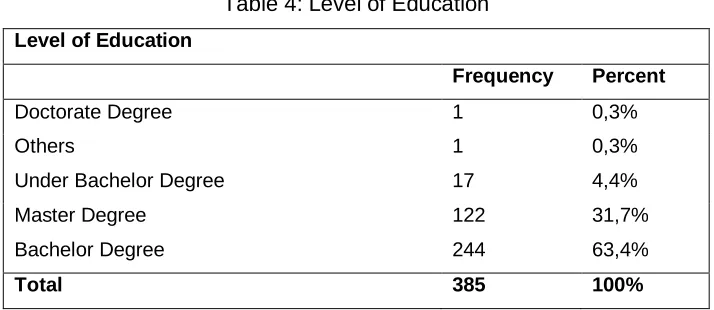
Licensed under Creative Common Page 358 Table 4: Level of Education
Level of Education
Frequency Percent
Doctorate Degree 1 0,3%
Others 1 0,3%
Under Bachelor Degree 17 4,4%
Master Degree 122 31,7%
Bachelor Degree 244 63,4%
Total 385 100%
As shown in Table 4.5, 58% of the survey participants stated that they had revenue between 5.501-7.000 TL, 16% of TL 10.001-above, 12% of the 7.501-10.000 TL, 12% of the 3.501-5.500 TL and 1% between 2.500-3.500 TL.
Table 5: Monthly Income of Participants
Monthly income
Frequency Percent
2.500 – 3.500 5 1%
3.501 – 5.500 45 12%
7.501 – 10.000 48 12%
10.001 – üstü 63 16%
5.501 – 7.500 224 58%
Total 385 100%
The survey consisted of 85% of the participants in the private employee, 8% Self-Employed, 6% state enterprise employee and 1% in the other occupational group (Table 6).
Table 6: Occupation of Participants
Occupation
Frequency Percent
Others 3 1%
State enterprise employee 24 6%
Self-Employed 31 8%
Private employee 327 85%
Licensed under Creative Common Page 359 Hypotheses Testing
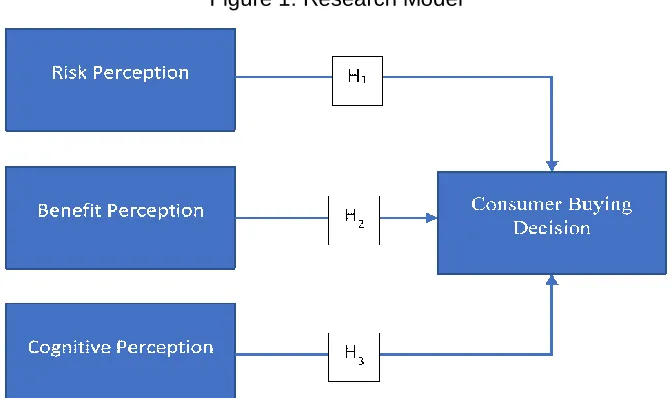
H1: There is a significant relationship between Risk perception of the consumer from innovative products and buying decision.
Table 7: Model Summary: Hypothesis 1
Table 8: ANOVA - Hypothesis 1
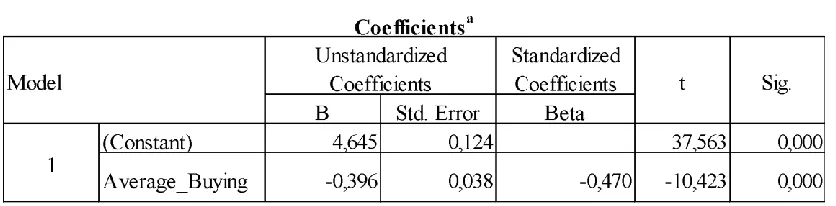
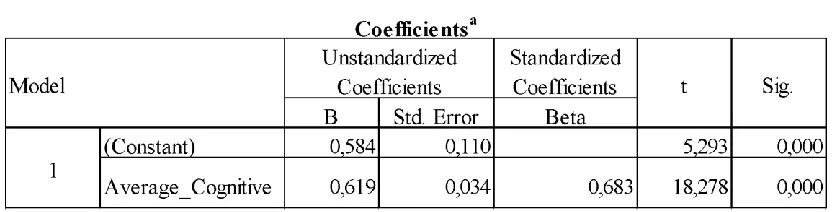
Table 9: Coefficients - Hypothesis 1
As can be seen that the sum of the squares is 32,999; the average of the squares is 32,999. The model is statistically significant (F384-1 = 108,637; p <.01).
Licensed under Creative Common Page 360 H2: There is a significant relationship between benefit perception of the consumer from innovative products and buying decision
Table 10: Model Summary: Hypothesis 2
Table 11: ANOVA - Hypothesis 2
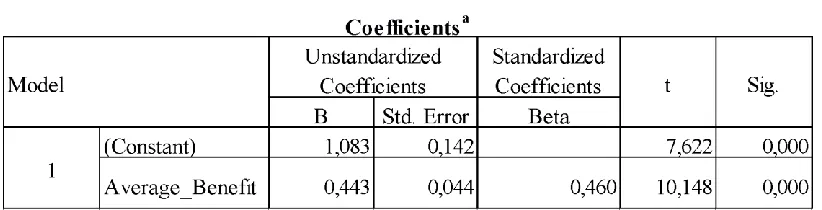
Table 12: Coefficients - Hypothesis 2
As can be seen that the sum of the squares is 41,341; the average of the squares is 41,341 The model is statistically significant (F384-1 = 102,985; p <.01).
Licensed under Creative Common Page 361 H3: There is a significant relationship between cognitive perception of the consumer from innovative products and buying decision.
Table 13: Model Summary: Hypothesis 3
Table 14: ANOVA - Hypothesis 3
Table 15: Coefficients - Hypothesis 3
As can be seen, the sum of the squares is 80,693; the average of the squares is 80,693 The model is statistically significant (F384-1 = 334,081; p <.01).
Cognitive Perception = ,584+ (.619 x Buying Decision Making of Innovation)
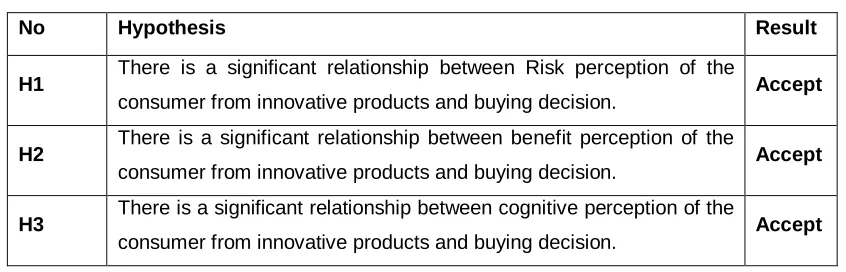
General Evaluation And Summary of Hypotheses Testing
Licensed under Creative Common Page 362 characteristics, and the fourth section contains the validity analyses of the scales and the findings of the factor structures.
In the first part of the study, demographic information of the 385 participants and the frequency distributions of the findings are examined. SPSS 24 was analyzed and studied with the help of the package program. Analyses were performed to determine the validity and reliability of the scales used in the measurement of each variable related to the model that constitutes the model of the research.
Demographic profile of participants was as followed:
● 54% of the female participants and 46% of the male participants
● 33% of the participants are between 36-45 and 32% are between the ages of 25-35.
● 51% of the participants are single and 30% married
● 85% were employed by private sector employees
● 63.4% of them have a bachelor degree and 31.7% of them have a master degree,
● It is seen that 58% of the income is between 5.501 – 7.500 TL.
According to the results of regression and ANOVA tests conducted to determine whether consumers have any effect on risk, benefit and cognitive perception while buying decision making of innovation;
● There was a statistically significant and negative effect on the risk dimension (p <.01).
When Buying Decision Making of Innovation 1 unit increases, Risk Perception is reduced by 396 units. Buying Decision Making of Innovation is thought to have a decreasing effect on Risk Perception.
● There was a statistically significant and positive effect on the benefit size (p <.01). When
Buying Decision Making of Innovation 1 unit increases, Benefit Perception is increasing 443 units. Buying Decision Making of Innovation is thought to have an increasing effect on Benefit Perception.
● There was a statistically significant and positive effect on the cognitive size (p <.01).
When Buying Decision Making of Innovation 1 unit increases, the Cognitive Perception is increasing 619 units. Buying Decision Making of Innovation is thought to have an increasing effect on Cognitive Perception.
Licensed under Creative Common Page 363 Table 16: Summary of Hypothesis
No Hypothesis Result
H1 There is a significant relationship between Risk perception of the
consumer from innovative products and buying decision. Accept
H2 There is a significant relationship between benefit perception of the
consumer from innovative products and buying decision. Accept
H3 There is a significant relationship between cognitive perception of the
consumer from innovative products and buying decision. Accept
CONCLUSION, LIMITATIONS AND RECOMMENDATIONS
At the end of this research and through our study it could be indicated that this conclusion includes a general summary of the two parts of the research, followed by the results of the applied study with research, analyse, survey and suggestions, and finally the horizons of research which can be an extension of it. The application part of the research consists of two main sections; the first section contains findings about demographic characteristics.
In the first part, it was tried to review the most important thing that consumers could hesitate up within the subject while making purchasing decisions. Therefore, it was dealt with the various theoretical concepts related to the subject. Innovative products are one of the most popular topics recently.
The second part includes the reliability analysis of the scales used in the research section in the findings section. According to the behavioral characteristics, and the fourth section contains the validity analyses of the scales and the findings of the factor structures.
In the first part of the study, demographic information of the 385 participants and the frequency distributions of the findings are examined. SPSS 24 was analyzed and studied with the help of the package program. Analyses were performed to determine the validity and reliability of the scales used in the measurement of each variable related to the model that constitutes the model of the research.
According to the results of regression and ANOVA tests conducted to determine whether consumers have any effect on risk, benefit and cognitive perception while buying decision making of innovation;
Licensed under Creative Common Page 364 There were also other limitations, such as confronting the researcher difficulties in the introduction, processing, and analysis of data, which forced her to resort to watching some educational videos and wasting time and effort, and this leads us to the last study limitation and the most important one that faced by the researcher is the lack of time as it required the researcher to finish the thesis in the period between a month February to May.
Finally, after reviewing the results, and reaching the recommendations part, the researcher reached some recommendations will be mentioned to benefit from them for future studies, including the need to review the design of offers offered by some cosmetic brands through some blogs to become more attractive because blogs are one of the most discussed platforms, also creating special applications for cosmetic brands to better communicate with customers, which helps build a good image of the them. The cosmetic brand should not only accept the temporary customer's satisfaction as an indicator of the quality of the product it sells but seeks to reach them to permanent satisfaction and then loyalty to ensure that they do not choose competitors. These were some recommendations for the theoretical side.
As for the recommendations for the practical side of the study, this study was limited to dependent variable and only one independent variable, so the researcher advises future researchers to place more than one independent variable and add a moderator variable to increase the accuracy and comprehensiveness of the study's results. The same study may also be used but in qualitative form rather than quantitative to find the results of the study from another perspective.
REFERENCES
Açıkgöz, A. (2012). Bilgi-teknoloji ve yenilik üretim stratejisi: (ulusal yenilik sistemleri), İstanbul: Literatür
Adıgüzel, B. (2012). İnovasyon ve İnovasyon Yönetimi: Steve Jobs Örneği, Yayımlanmamış Yüksek Lisans Tezi. Gazi Üniversitesi Sosyal Bilimler Enstitüsü
Akar, E. (2011). Sanal Toplulukların Bir Türü Olarak Sosyal Ağ Siteleri ve Bir Pazarlama İletişim Kanalı Olarak İşleyişi. Anadolu Üniveristesi Sosyal Bilimler Dergisi (1). 10, 107-122
Öztürk, M. & Soylu, A. (2010). Yönetim inovasyonu. Sosyoekonomi Dergisi, 6(11), 113-130
Öztürk, N. (2010) Marka Yönetimi, Yayınlanmamış Yüksek Lisans Tezi. Kadir Has Üniversitesi Sosyal Bilimler Enstitüsü
Sanrı, H. (2011). Yönetim fonksiyonları bağlamında inovasyon yönetimi: Türkiye mobilya endüstrisinde inovasyon yönetimi sürecinin incelenmesi ve bir model önerisi, Yayınlanmamış Yüksek Lisans Tezi. Atatürk Üniversitesi Sosyal Bilimler Enstitüsü
Taymaz, E. (2003), Ulusal yenilik sistemi, türkiye imalat sanayiinde teknolojik değişim ve yenilik süreçleri, Ankara: TUBİTAK
Torlak, Ö. & Uzturk, C. (2005). Kola Markası Kişiliklerinin Üniversite Öğrenciler Tarafından Algılanması. Eskişehir Osmangazi İşletme Fakültesi Dergisi 6(2), 15-31
Licensed under Creative Common Page 365 Uzkurt, C. (2010). İnovasyon Yönetimi: İnovasyon Nedir, Nasıl Yapılır ve Nasıl Pazarlanır?, Ankara Sanayi Odası Yayın Organı, 2, 36-51
Yıldırım, E. (2007). Bilgi çağında yaratıcılığın ve yaratıcılığı yönetmenin önemi, Selçuk Üniversitesi Karaman İ.İ.B.F. Dergisi 12(9), 109-120