Article
1
Secure IoT network structure based on distributed
2Fog computing, with SDN/Blockchain
3Ammar Muthanna 1,2,*, Abdelhamied A. Ateya 1,3 , Abdukodir Khakimov1, Irina Gudkova 2,4, 4
Abdelrahman Abuarqoub 5, Konstantin Samouylov 2,4 and Andrey Koucheryavy 1 5
1 Telecommunication Networks and Data Transmission, St. Petersburg State University of 6
Telecommunication, 193232 St. Petersburg, Russia; [email protected]; [email protected]; 7
2 Applied Probability and Informatics, Peoples’ Friendship University of Russia (RUDN University), 117198 9
Moscow, Russia; [email protected]; [email protected] 10
3 Electronics and Communications Engineering, Zagazig University, 44519 Sharqia, Egypt 11
4 Institute of Informatics Problems, Federal Research Center “Computer Science and Control” of Russian 12
Academy of Sciences, Moscow, Russia 13
5 Faculty of Information Technology Middle East University Amman, 383 Amman 11831, Jordan, 14
* Correspondence: [email protected]; Tel: +7-952-210-4486 16
17
Abstract: IoT is a new communication paradigm that gains a very high importance in the past few 18
years. This communication paradigm supports various heterogeneous applications in many fields 19
and with the dramatic increase of the number of sensor devices, it becomes a demand. Designing 20
IoT networks faces many challenges that include security, massive traffic, high availability, high 21
reliability and energy constraints. Thus, new communication technologies and paradigms should 22
be deployed for IoT networks to overcome these challenges and achieve high system performance. 23
Distributed computing techniques (e.g. fog and MEC), software defined networking (SDN), 24
network virtualization and blockchain are common recent paradigms that should be deployed for 25
IoT networks, either combined or individually, to achieve the main requirements of the IoT 26
networks at a high system performance. Fog computing is a form of edge computing that has been 27
developed to provide the computing capabilities (e.g. storage and processing) at the edge of the 28
access network. Employing Fog computing in IoT networks, as an intermediate layer between IoT 29
devices and the remote cloud, becomes a demand to make use of the edge computing benefits. In 30
this work, we provide a framework for the IoT system structure that employs an edge computing 31
layer of Fog nodes controlled and managed by SDN network with the blockchain technology to 32
achieve a high level of security for latency sensitive IoT applications. The proposed system 33
employs SDN network with distributed controllers and distributed OpenFlow switches; these 34
switches are enabled with limited computing and processing capabilities. Furthermore, a data 35
offloading algorithm is developed to allocate different processing and computing tasks to the 36
distributed OpenFlow switches with available resources. Moreover, a traffic model is proposed to 37
model and analyze the traffic among different parts of the network. The proposed work achieves 38
various benefits to the IoT network, such as the latency reduction, security improvement and high 39
efficiency of resources utilization. The proposed algorithm is simulated and also the proposed 40
system is experimentally tested over a developed testbed to validate the proposed structure. 41
Experimental results show that the proposed system achieves higher efficiency in terms of latency, 42
security and resource utilization. 43
Keywords: Internet of Things; Fog computing; Security; Blockchain; Traffic; latency; SDN; 44
OpenFlow 45
1. Introduction 46
With the dramatic increase of the number of physical objects (e.g. sensors) connected to the 47
Internet, Internet of Thing (IoT) become a high demand [1]. IoT is an adaptive self configuring 48
network that enables the communication and interaction between physical objects; this transforms 49
these objects from being blind to be smart [2]. Recently, IoT gains a very high significance because of 50
the great impact of all life fields [3]. IoT is expected to completely change our life by introducing 51
wide range of applications in various fields [4]. These applications include smart home, smart 52
cities, health care, smart vehicle and remote monitoring [5, 6]. The IoT technology has a high market 53
impact as it comes with big market opportunities for various sectors such as hardware 54
manufacturers, service providers and software developers [7]. 55
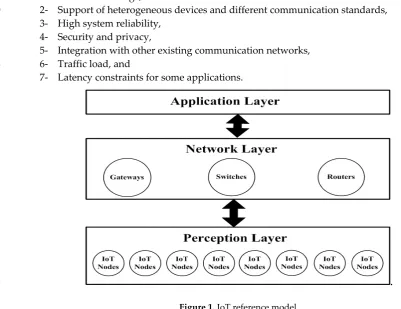
The IoT technology is always defined by the three-layer reference model as illustrated in figure 56
1. The IoT architecture may be viewed as a Perception layer, Network layer, and Application layer 57
[8]. Two more layers may be deployed around the application layer; Middleware layer and Business 58
layer [9]. The perception layer represents the bottom layer that contains the IoT nodes deployed for 59
perceiving data from the surrounding environment. Thus, this layer is mainly responsible for data 60
sensing and data collection. The network layer is the middle layer that connects the perception layer 61
and the application layer. This layer contains all network components and protocols that are 62
deployed for forwarding data perceived to the application layer. The top layer is application layer 63
that provides the overall management of the data perceived. This layer is responsible for presenting 64
data in a form of an application [10]. 65
IoT represents the third generation of the Internet that is expected to connect billions of 66
heterogeneous devices in a smart way [11]. This large number of connected devices puts high 67
constraints on the system structure and design [12]. These challenges include the following [13, 14]: 68
1- Network coverage, 69
2- Support of heterogeneous devices and different communication standards, 70
3- High system reliability, 71
4- Security and privacy, 72
5- Integration with other existing communication networks, 73
6- Traffic load, and 74
7- Latency constraints for some applications. 75
. 76
Figure 1. IoT reference model. 77
To overcome these challenges and achieve higher system efficiency, capable of connecting this 78
huge number of devices, new technologies and communication paradigms should be deployed to 79
serve for the IoT networks. These paradigms include the distributed edge computing (e.g. Fog 80
Edge computing is a new paradigm that aims to provide cloud services and computing 82
capabilities (e.g. storage and processing)at the edge of the access network; one or two hops away 83
from the end user [16]. This introduces a way of moving from the centralized huge data centers to 84
the distributed cloud units with limited capabilities [17]. Deploying the edge computing for the IoT 85
networks achieves various benefits that include the following [18, 19]: 86
1- Higher system bandwidth, 87
2- Reduced communication latency, 88
3- Providing a path for data offloading, and 89
4- Introduction of new services. 90
Fog computing is a form of edge computing that is suitable for IoT networks [20]. It introduces a 91
new computing paradigm that acts as an extension to the cloud computing paradigm able to provide 92
processing, computing and storage capabilities. It also introduces other cloud services to the 93
communication nodes in vicinity to the distributed Fog nodes. Fog computing supports various 94
types of heterogeneous devices that can connect and communicate with Fog nodes, these devices 95
include sensors, actuators and wireless gateways [21]. Fog node is a computing unit powered by 96
limited computational and storage resources that are deployed to serve for connected devices. Fog 97
computing IoT- based networks share various and significant advantages that include the following 98
[22, 23]: 99
1- Improving system privacy, 100
2- High system security, 101
3- High system reliability, 102
4- Achieving higher latency efficiency, 103
5- System lightness, and 104
6- Reduction of traffic overhead and congestion. 105
However, fog computing paradigm achieves various benefits to IoT networks; it introduces a 106
much complex scheme to be managed. Managing and controlling Fog distributed nodes, and 107
synchronizing their operation with the IoT cloud that is located remotely is a challenge [24]. 108
Deploying an orchestrator or a controller represents an efficient solution. This is the concept behind 109
SDN. 110
SDN is a new paradigm that physically separates the forwarding plane and the control plane to 111
provide a dynamic network structure [25]. Data plane represents the network part that is responsible 112
for forwarding traffic, while the control plane is the part that makes the decision of the traffic. SDN 113
networks generally consist of a centralized or distributed controller scheme and distributed 114
forwarding devices or switches. The controller connects and communicates with the network 115
devices via an open standard interface protocol such as OpenFlow protocol [26]. SDN achieves 116
higher system flexibility and scalability, which makes it considered as a part of all recently 117
developed communication systems. 118
Blockchain is another main paradigm that is recently deployed for the IoT networks to manage 119
the distributed edge cloud units and work against the heterogeneous cyber security attacks [27]. 120
Deploying blockchain paradigm for IoT networks enables the decentralization in a trustful manner. 121
The introduction of blockchain technology to the IoT networks achieves various vital benefits that 122
include the following [28, 29]: 123
1- Management of decentralized computing resources, 124
2- Increasing the overall flexibility of the system, 125
3- Achieving higher system security, by preventing various cyber security threats and 126
attacks, and 127
4- Reducing the cost of the system operation. 128
The blockchain technology can be defined as the peer-to-peer distributed ledger that is used to 129
record approved events and transactions. It can be represented by a distributed database or data 130
servers that contains all approved and shared data among all participants [30]. Participants in turn 131
interruption of the stored data without verifications. Recently, blockchain paradigm turned to 133
support applications and communication networks (e.g. IoT) beside the crypto-currency systems 134
[31]. 135
In this work, we provide a framework for an IoT-Fog based system with the enabling of 136
SDN/Blockchain paradigms. The system introduces a distributed edge computing layer of Fog nodes 137
deployed between the distributed heterogeneous IoT nodes and the IoT centralized cloud to make 138
use of various benefits of the fog computing. The network employs a distributed SDN controller 139
scheme with the blockchain technology. The SDN network consists of distributed OpenFlow 140
switches (OF) that are deployed with some limited computing capabilities and SDN controller that 141
can perform resource provisioning and orchestration in synchronization with Fog orchestration. The 142
SDN/blockchain network achieves higher system performance in terms of network management 143
and security. Moreover, a data offloading algorithm is introduced to organize and manage the 144
offloading scheme. The proposed algorithm makes use of the available resources of the OF switches 145
and thus, balance the load among core network switches. Furthermore, a traffic model for 146
modeling and managing IoT traffic among different network parts is introduced. 147
The main vision of the work is to provide an IoT network with high resource utilization 148
efficiency, high security and reduction of end-to-end latency. The system is simulated and tested 149
over a developed testbed to validate the work and check the system performance. In (Sec. 2) related 150
works to the proposed system are introduced. Sec.3 provides the proposed IoT system with the 151
deployment of distributed Fog computing, SDN and blockchain technologies. Also, the data 152
offloading algorithm and traffic model are presented in this section. In (Sec.4) the simulation and 153
testing is introduced and the experimental results are provided and analyzed. 154
2. Background and related works 155
There are many features associated with the IoT networks that put high constraints on the 156
designing of a secure IoT network. These features related to the topology and the nature of the IoT 157
networks and can be summarized in the following [32, 33]: 158
1- Scalability: 159
With the dramatic massive increase of wireless devices, the scalability of next generation 160
networks should be considered while designing these systems. By 2020, it is expected that 161
higher than 50 billion devices will be connected [34]. IoT networks will suffer from this 162
dramatic increase of network nodes and traffic. Thus, designing a secure IoT network 163
should consider the network scalability. Decentralized solutions represent a vital solution. 164
2- Heterogeneous technologies: 165
IoT networks comprise many heterogeneous communication technologies that have 166
different security requirements [35]. Thus, secure reliable IoT network should consider the 167
heterogeneity of these technologies and therefore, provide the security for all comprised 168
technologies. 169
3- Latency: 170
A part of IoT applications are latency sensitive applications that required a low end-to-end 171
latency. All introduced solutions and algorithms for such applications shouldn’t add extra 172
delays. 173
4- Availability: 174
IoT applications required a high system availability to support the massive traffic demand. 175
Developed algorithms and methods for IoT networks should support the availability 176
requirements for various IoT applications. 177
5- Mobility: 178
Mobility can be defined as the way of providing seamless service experience to users, while 179
they are moving. Various mobility demands may be required for various IoT applications; 180
some applications may require a very high mobility demands such as high speed systems 181
stationary devices or low speed and thus require a low mobility. Different mobility levels 183
put constraints on different solutions developed for IoT networks. 184
6- Battery operated nodes: 185
Energy conservation represents an important issue in designing IoT networks, this is 186
because heterogeneous IoT devices are battery operated and recharging may be hard in 187
many applications. Thus, conserving energy of IoT devices and prolong the life time of 188
distributed nodes become critical in many applications. Therefore, the comprised solutions 189
developed for IoT networks should be energy efficient. 190
7- Service discovery: 191
Service discovery is the process hold by the IoT network user to discover resources and get 192
much information about the endpoints of the application server. IoT networks should 193
deploy self configuring, reliable and scalable mechanisms to provide service discovery [59]. 194
8- Application level protection: 195
IoT is expected to support various applications in various fields. Thus, secure IoT ensures a 196
proper application level protection so that all heterogeneous applications are saved from 197
different cyber security attacks. 198
Cyber security attacks and threats put high constraints and demands on the design of the IoT 199
networks, as IoT networks should be able to work against these attacks [37]. This can be achieved by 200
introducing new communication paradigms to the IoT networks. SDN is one of the main paradigms 201
that are used to achieve higher security of the IoT networks beside many other benefits to the overall 202
network performance. Another main paradigm is the distributed computing techniques (e.g. Fog 203
computing and mobile edge computing (MEC)) [38]. 204
There is no doubt that cloud computing and edge computing represent the main base of the 205
fifth generation cellular network (5G), IoT networks and future smart systems [39]. There many 206
studies dedicated with development and deployment of edge computing units in communication 207
networks, especially for cellular networks and IoT. A part of researchers uses the term cloudlet to 208
refer to any secondary, small and limited capabilities cloud units [40]. There are many other forms of 209
the edge cloud units include Fog nodes and the micro-cloud units and other forms [18], [41]. 210
Fog computing is considered to be the most suitable edge computing platform for the IoT 211
networks and applications. The Fog computing paradigm was first announced by Cisco as a form of 212
edge computing and an extension of the cellular edge computing [42]. Then, researches and studies 213
have been developed to analysis, define, improve and integrate this new computing paradigm. 214
Many literatures that consider the Fog computing for IoT have been conducted; either without the 215
deployment of SDN technology or with SDN. Most of these works are literature reviews; in this part, 216
we consider the related works to our proposed work. 217
In [43], authors have developed a framework for IoT network with the fog computing 218
deployment. The work has mainly developed for considering IoT applications from the Fog 219
computing point of view. Authors have introduced a distributed data flow mechanism referred to as 220
DDF that is programmable. The dataflow programming model is used for building different IoT 221
applications and services. The data algorithm is validated over, the open-source flow based run time 222
and visual programming tool, Node-RED. The testing has been introduced just to validate that the 223
architecture and algorithm are suitable, however no performance metrics were considered. The 224
work mainly considered as a programming platform, however our work is validated over a 225
developed testbed. Furthermore, we consider more technologies (i.e. SDN and Blockchain) to 226
enhance the performance of Fog units and the overall system performance. 227
In [44], authors have developed a hierarchical computing structure for medical applications 228
over IoT networks. The hierarchical structure consists of the centralized cloud and distributed Fog 229
units. The proposed paradigm has mainly introduced to partition and accommodate the machine 230
learning methods used for health care applications over the IoT networks. The computation tasks 231
and medical data are distributed among two computing levels in a partitioning way that increases 232
the system availability. Furthermore, a closed loop management technique is developed that is 233
in terms of response time and availability. Our proposed work shares the similarity of using Fog 235
paradigm with this work. While, this work mainly considers medical applications over the IoT 236
networks and also it considers the availability only as the performance metric. 237
In [45], authors proposed an internet of vehicles (IoV) Fog based architecture, with SDN 238
deployed. The work is the first that considers such structure and gather IoV with the Fog computing 239
and SDN paradigms. The work mainly considers a specific problem, which is the SDN controller 240
placement. The SDN network consists of two levels of controllers; primary controller and secondary 241
controller. The primary controller is a centralized one that takes the control and management task of 242
the overall system. The secondary controller is a distributed controller dedicated with different 243
regions of covered area. The two controllers are physically connected. An optimization problem 244
has been solved to optimize the geographic placement of distributed controllers. The work shares 245
the similarity of deploying Fog computing and SDN with an IoT network with our proposed system, 246
while it considers only the IoV which is a high mobility application. One main issue of this algorithm 247
is that it hasn’t been validated and no performance has been checked. Authors have introduced a 248
system structure only. 249
In [46], authors have developed a secure IoT system that deploys Fog computing, SDN and 250
blockchain paradigms. The main objective of the work is to enhance the security of the IoT networks 251
through the deployment of these technologies (i.e. Fog computing, SDN and blockchain). The 252
system uses the SDN and blockchain technologies to secure and control the distributed fog 253
architecture. Fog services have been allowed at the edge of the access network by the distributed 254
fog nodes. The system achieves higher latency and security efficiency, since bringing computing 255
resources at the edge of the IoT network secure the core network traffic and minimize the end-to-end 256
latency between IoT devices and the computing unit. The system introduces a novel security method 257
that allows the system to adapt to the threat landscape automatically. This allows system 258
administrators to run as much as needed of recommendations at the network edge. The system has 259
been evaluated for different security scenarios and attacks. This system shares a similarity with our 260
proposed system, which is focused in the deployment of distributed Fog computing besides the 261
SDN and blockchain technologies. However, the main concern of this work is the security issues, 262
while our proposed structure mainly concerned with the end-to-end latency performance and the 263
resources utilization. Furthermore, our developed SDN network completely differs from the SDN 264
network used in this work, since we use a distributed controller scheme with distributed resource 265
powered OF switches. Feeding OF switches with ultra small computing capabilities achieves various 266
benefits to the IoT networks in terms of latency and reliability. Moreover, we consider the network 267
traffic management by introducing a traffic model to control the data traffic among network, which 268
is also novel. 269
In [47], we study the performance of IoT networks with the Fog computing deployment. We 270
have constructed a testbed of 50 IoT nodes, distributed Fog nodes and a controller. The testbed is 271
used to validate the benefits of Fog computing. This work can be considered as an extension to this 272
study, while in this work, we use powered OF switches with more capabilities and responsibilities. 273
Furthermore, we introduce a structure of the system with the deployment of blockchain. Also, we 274
introduce a data flow algorithm to manage the traffic among the proposed network. 275
3. IoT system structure with distributed Fog computing and SDN 276
In this part, we introduce the proposed IoT system that comprises the distributed Fog 277
computing with the SDN and blockchain paradigms. At first, the IoT system structure is introduced 278
and the comprised paradigms and system components are well defined. Then, a data offloading 279
algorithm is introduced for the proposed structure. Finally, a traffic model for analyzing traffic 280
among the proposed structure is introduced. 281
3.1. System structure:
282
The proposed system deploys the concept of Fog computing with the blockchain and SDN 283
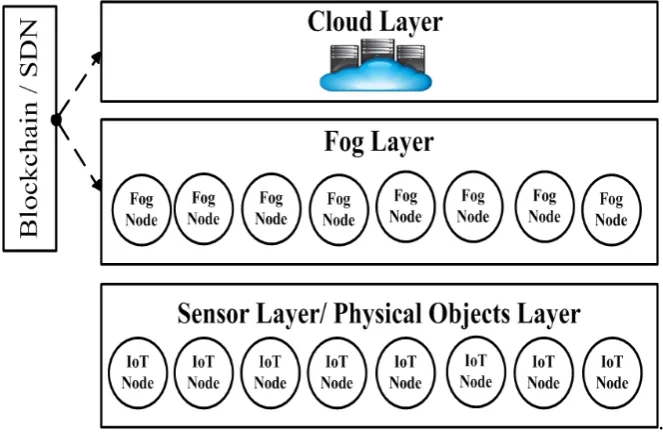
system as illustrated in figure 2. The first layer represents the device layer, which contains all IoT 285
devices and sensor devices. These devices are used to measure and capture physical and 286
environmental data. All devices deployed in this layer always have data to be transferred through 287
the network. IoT devices are heterogeneous in terms of computing capabilities (i.e. storage and 288
processing) and energy resources. These devices are battery operated and should be energy 289
efficiently managed. 290
The second layer represents the Fog layer, which deploys Fog nodes to provide an offloading 291
path for the captured data and enable other Fog computing benefits to the IoT network. This moves 292
from the centralized computing scheme to the distributed computing scheme. Fog nodes are 293
deployed at the edge of the access network and each Fog node can serve for a group of IoT devices 294
associated with a certain services and a dedicated location. The Fog node handles the data 295
forwarded from the dedicated IoT devices. Thus, fog layer enables data analyzing, classification and 296
monitoring at the edge of the network. Computing results are forwarded to the higher cloud layer 297
and a response is sent to the IoT devices, in cases that required such response. 298
Distributed fog nodes add various benefits to the proposed IoT network that include the 299
following: 300
1- Provide an offloading path for the collected data, 301
2- Provide computing capabilities near to IoT devices, 302
3- Increase the system security by detecting and blocking heterogeneous attacks, 303
4- Reduce the data traffic at the core network, and 304
5- Increase the overall network flexibility and availability. 305
The top layer is the cloud layer that is represented by the remote cloud unit. The IoT cloud 306
supports different IoT services and protocols. A service provider can integrate and connect the IoT 307
cloud with other networks. Using the cloud layer, network clients are empowered to use, search and 308
manage the computing resources and data. The cloud layer offers the network users an overall 309
controlling and monitoring of the application. 310
. 311
Figure 2. The main layers of the proposed IoT-Fog system. 312
The network also deploys two main communication paradigms, side by side with the three 313
introduced levels. These paradigms are the SDN technology and the blockchain that are deployed to 314
assist the system and provide control, management and security issues to the introduced system. 315
The end-to-end system structure of the proposed IoT system is presented in figure 3. 316
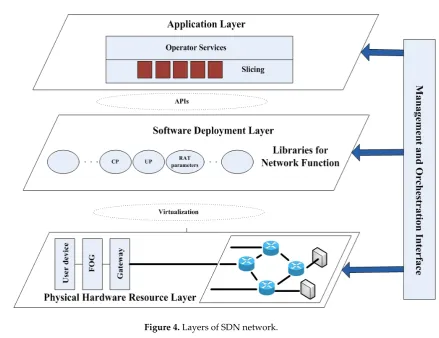
The system deploys a single centralized physical SDN controller that controls and manages 318
distributed fog nodes and hence IoT devices. Figure 4 illustrates the three main layers of the 319
deployed SDN model. The data plane of the SDN network contains all sensor nodes that could have 320
additional recourses from the Fog nodes, while the control plane scheme is represented by the 321
deployed SDN controller. 322
The SDN network also employs distributed OF switches that are powered by limited 323
computing capabilities. These switches can provide some limited services in addition to the 324
switching functions. The SDN controller is able to configure and manage all deployed OF switches 325
via a proper interface (i.e. any supported version of OpenFlow protocol) [48]. The SDN controller 326
employs a clustering algorithm introduced in [49], so that each fog node or a group of fog nodes are 327
associated with a distributed SDN controller. Distributed SDN controllers deploy packet migration 328
function to provide the security over the databases and work against saturation attacks [50]. 329
Distributed SDN network allows the network operator to program and manage fog nodes and IoT 330
devices via application programming interfaces (APIs). All distributed SDN controllers are 331
connected by the blockchain paradigm to provide a high security level to the proposed IoT network. 332
. 333
335
Figure 4. Layers of SDN network. 336
b- Blockchain paradigm 337
Distributed fog based SDN nodes are connected and managed via the blockchain technology 338
that is used for updating flow table in a secure manner. Furthermore, the cloud layer is split into 339
distributed clouds through the blockchain. 340
Introducing peer-to-peer paradigm (i.e. blockchain) to the distributed computing achieves 341
various benefits to the IoT network, these benefits includes the following: 342
1- Work against network heterogeneous attacks and thus, increases the overall system 343
security; 344
2- Increases the flexibility of the system; 345
3- Achieves the required scalability of the IoT networks; and 346
4- Increases the system availability. 347
In this work, the block chain is considered as a structural component, while further analysis of the 348
blockchain to the proposed structure need to be conducted in single work. This is because the main 349
objective of this work is the end-to-end latency not the analysis of security issues. 350
3.2-. Data offloading algorithm:
351
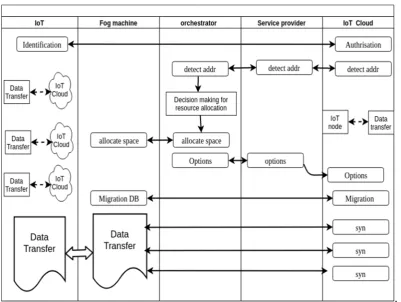
The proposed system works based on the data flow algorithm illustrated in figure 5. The 352
network operation goes through various steps; the first step is the authentication, as the IoT node 353
should be authorized. IoT node communicates directly with the IoT cloud to be authorized. Then, 354
IoT cloud performs the authentication process and mentioned the device to be authorized. 355
The next step is the address detection, in which the cloud calls the service provider to determine 356
the location of the IoT. For this purpose, the service provider refers to the SDN Orchestrator, which 357
makes an investment to locate the IoT. 358
Moreover, the SDN orchestrator estimates the routing table with different routing paths 359
. 361
Figure 5. Data flow algorithm. 362
The system mainly considers the resources utilization, and thus it makes use of all available 363
resources. Consequently, the SDN controller allows OF switches to handle some processing and 364
computing tasks for the IoT forwarded data after the Fog level. SDN controller estimates OF 365
switches with available resources upon checking certain parameters. These parameters are: 366
1- IoT traffic, 367
2- Transit traffic, 368
3- Traffic access type, 369
4- Time delay constraints, 370
5- Processing power for servicing the IoT data, and 371
6- Current state of the OF switches in terms of traffic and resources. 372
SDN controller decides the possibility of enabling the IoT data, passed to the core network 373
through the Fog layer, a part of available resources of the OF switches by optimizing the previous 374
parameters and thus, informs the selected switches. The orchestrator creates a virtual machine on 375
the selected OF switches, that is used for data processing. The next step is the database migration, as 376
the IoT Cloud through the service provider migrates the database for servicing IoT group over 377
certain OF switches. The network continues working and OF switches aggregate and synchronize 378
the IoT data with the cloud. 379
Handling computing tasks to OF switches achieves various benefits to our proposed IoT system 380
structure, these benefits include the following: 381
1- Reduction of the communication latency, 382
2- Channel load reduction, 383
3- Useful for anti-persistence traffic in the core network, and 384
4- Efficient resource utilization. 385
3.3-. Traffic model:
386
It is clear that, reducing a part of subscriber traffic in the local cloud reduces the total traffic 387
Introducing Fog nodes (i.e. Fog computing) with the SDN paradigm to the IoT networks, has a great 389
impact on the network traffic performance and efficiency. To enhance this performance, a fog 390
computing-based traffic model is introduced. This traffic model reflects the impact of introducing 391
Fog computing on the traffic services over the network. 392
In order to estimate the efficiency of introducing Fog nodes (i.e. Fog computing) on the traffic 393
performance and efficiency, the delivery time of data offloaded is considered as the main metric, 394
which reflects impact of the Fog computing on the traffic service in the network. 395
The proposed traffic model considers the operation of the access network, the core network and 396
the application server as queuing processes. The traffic model assumes a G/G/1 queuing system and 397
also assumes that the main characteristic of the access network, core network and an application 398
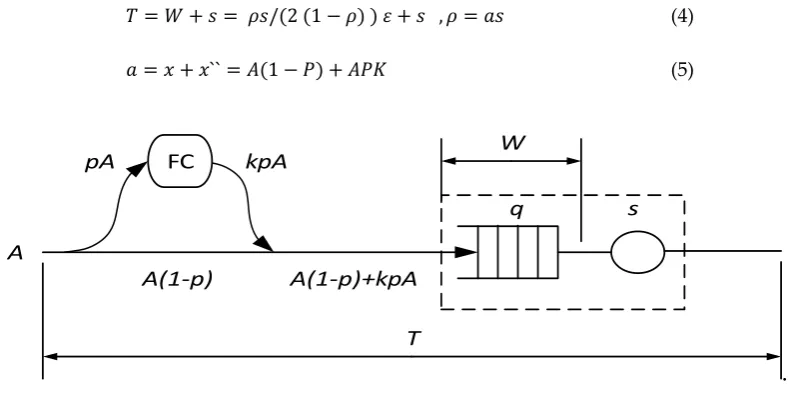
server is the delivery time T [51]. Figure 6 illustrates the proposed traffic model based on the G/G/1 399
queuing model. 400
The total traffic originated by a group of users (e.g. IoT nodes) in a cell or a base station has the 401
intensity A. The user traffic may be forwarded to a nearby Fog node; the probability that this event 402
happens is assumed to be P. This reduces the amount of traffic handled to the access network. Thus, 403
the traffic served by the access network is equal to x, where x is calculated as following: 404
405
𝑥 = 𝐴 (1 − 𝑃) (1)
406 407
The intensity of the traffic handled by the Fog node is x` where, x` can be calculated as the 408
following: 409
𝑥` = 𝐴𝑃 (2)
410 411
As a result, the traffic service of Fog computing node originates traffic that is forwarded to the 412
core network with intensity of x``, where x`` is calculated as following: 413
414
𝑥`` = 𝐴𝑃𝐾 , 0 < 𝐾 ≤ 1 (3) 415
416
Where, K is the probability constant with a value between zero and one. For K with any value 417
below one, the amount of traffic forwarded to the core network is reduced and thus, the Fog unit 418
achieves traffic reduction and reduces the network congestion. The zero value of the constant K is 419
corresponding to the removal of the Fog computing layer. 420
The total delivery time T can be calculated as following [52]: 421
422
𝑇 = 𝑊 + 𝑠 = 𝜌𝑠/(2 (1 − 𝜌) ) 𝜀 + 𝑠 , 𝜌 = 𝑎𝑠 (4) 423
424
𝑎 = 𝑥 + 𝑥`` = 𝐴(1 − 𝑃) + 𝐴𝑃𝐾 (5)
425 426
. 427
Figure 6. Traffic service model. 428
FC
A
pA
A(1-p)
kpA
A(1-p)+kpA T
q s
Where, s is the service time and ε is the form factor [52].The efficiency of introducing Fog 429
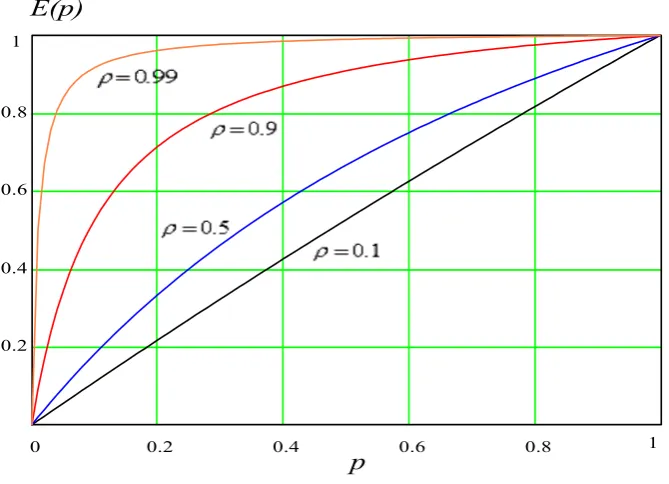
computing nodes on the traffic is E and can be calculated as the percentage decrease in the queuing 430
delay of the ordinary IoT network (i.e. without the introduction of Fog computing nodes) and due to 431
the existence of the Fog computing layer. 432
433
𝐸 = 1 − 𝐸 /𝐸 = 1 − (1 − 𝜌)/(1 − 𝜌(1 − 𝑃) ) (1 − 𝑃) (6) 434
435
Where, EF is the efficiency in the existence of Fog computing layer and Eo is the efficiency of the
436
ordinary IoT system with no Fog layer. The maximum value of E is corresponding to the maximal 437
efficiency of using Fog computing nodes. Figure 7 shows the impact of the change of the probability 438
of traffic forwarding to the fog cloud layer on the efficiency E, for different values of ρ. As the 439
probability increases, the Fog nodes can handle much traffic and thus, the efficiency increases. 440
Furthermore, the dependence shows that the efficiency grows rapidly in case of high traffic value 441
and grows slowly in case of small traffic value. Also, efficiency varies from 0, when no traffic is 442
directed to fog cloud, to 1 when all traffic is directed to fog cloud. 443
Performance evaluation 444
In this part, the performance of the proposed IoT system and all comprised algorithms is 445
evaluated. The proposed IoT-Fog system is experimentally tested over our proposed testbed. 446
Various parameters are considered as performance metrics. Moreover, the proposed offloading and 447
traffic algorithms are simulated and the obtained results are analyzed. 448
4.1. Experiment setup:
449
In order to evaluate the performance of the proposed system structure and the data offloading 450
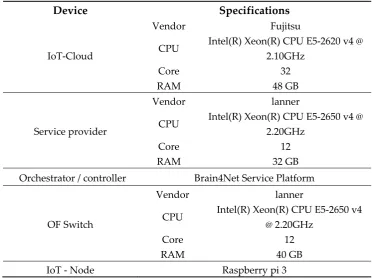
algorithm, the following experiment is conducted. We construct the system shown in figure 3, while 451
the considered network components are presented in Table 1, with the introduction of the 452
specifications of each component. The x86 architecture is deployed to act as an OF switch, which is 453
able to support processing and computing tasks [53]. We employ 48 Raspberry nodes; each of them 454
represents an IoT node. The 48 Raspberry nodes act as traffic generators that generate data traffic 455
with average of 6 per each node. The application layer supports MQTT and CoAP protocols [54]. 456
. 457
Figure 7. Traffic efficiency for IoT based Fog system. 458
0 0.2 0.4 0.6 0.8
0.2 0.4 0.6 0.8 1
1
Table 1. Experimental parameters and device specifications. 459
Device Specifications
IoT-Cloud
Vendor Fujitsu
CPU Intel(R) Xeon(R) CPU E5-2620 v4 @ 2.10GHz
Core 32
RAM 48 GB
Service provider
Vendor lanner
CPU Intel(R) Xeon(R) CPU E5-2650 v4 @ 2.20GHz
Core 12
RAM 32 GB
Orchestrator / controller Brain4Net Service Platform
OF Switch
Vendor lanner
CPU Intel(R) Xeon(R) CPU E5-2650 v4 @ 2.20GHz
Core 12
RAM 40 GB
IoT - Node Raspberry pi 3
The system is also simulated over iFogSim simulator, which is a reliable java based simulation 460
environment for simulating IoT networks with distributed Fog computing structure [55]. The 461
iFogSim is built over the CloudSim environment and for simulation process of our proposed system; 462
CloudSim SDN is also involved for the SDN network [56]. CloudSim SDN is also a reliable java 463
based environment; built over the CloudSim [57]. 464
The system is simulated over a machine with an Intel core i5 processor, with a speed of 3.07 465
GHz and memory of 16 GB. The considered simulation parameters are introduced in Table 2. 466
For the performance evaluation of the proposed system, the following performance metrics are 467
considered for both simulation and experimental works; resources utilization (e.g. storage, 468
processing and energy) and the end-to-end latency. 469
4.2. Experimental results:
470
In order to evaluate the performance of deploying distributed fog computing and SDN 471
paradigm, the system is simulated for three considered cases. In the first case, the system is 472
simulated without the deployment of distributed Fog computing and SDN network. In this case, 473
distributed IoT devices had to communicate with the remote cloud and no nearby computing 474
capabilities are provided. The second case represents the system with the distributed Fog computing 475
layer and without the deployment of SDN network. In this case, distributed IoT devices can use the 476
nearby Fog computing capabilities. The final case represents the proposed IoT network with the 477
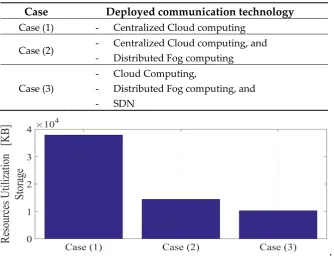
deployment of distributed Fog computing controlled by SDN network. Table 3 summarized the 478
considered cases specifications. 479
Figures 8, 9 and 10 illustrate the simulation results in terms of resources utilization. Figure 8 480
illustrates the amount of storage used by the system in the three considered cases. As the results 481
indicate, the deployment of Fog computing achieves higher utilization performance of storage 482
resources, than the IoT system with only centralized cloud computing. Moreover, the proposed IoT 483
system with distributed Fog computing and SDN network achieves higher performance in terms of 484
storage resources utilization than the previous considered cases. 485
Table 2. Simulation parameters. 487
Parameter Description Value
Fog node
Upstream bandwidth BWUP 500 Mbps
Downstream bandwidth BWDown 10000 Mbps
Storage capabilities RAM 6144 MB
Processing capabilities CPU 30000 MIPS
Communication latency to the ISP gateway dFog-Gateway 4 ms
Communication latency to IoT device dFog-Node 1ms
Cloud
Upstream bandwidth BWUP 10000 Mbps
Downstream bandwidth BWDown 10000 Mbps
Storage capabilities RAM 40960 MB
Processing capabilities CPU 30000 MIPS
Communication latency to the ISP gateway dCloud-Gateway 100 ms
ISP Gateway
Upstream bandwidth BWUP 10000 Mbps
Downstream bandwidth BWDown 10000 Mbps
Storage capabilities RAM 8192 MB
Processing capabilities CPU 5000 MIPS
IoT Node
Upstream bandwidth BWUP 200 Mbps
Downstream bandwidth BWDown 250 Mbps
Storage capabilities RAM 2048 MB
Processing capabilities CPU 1500 MIPS
Table 3. Considered simulation cases 488
Case Deployed communication technology
Case (1) - Centralized Cloud computing
Case (2) - Centralized Cloud computing, and - Distributed Fog computing
Case (3)
- Cloud Computing,
- Distributed Fog computing, and
- SDN
. 489
. 491
Figure 9. Average resources utilization in terms of processing, for the considered simulation cases. 492
493
Figure 10. Average resources utilization in terms of energy, for the considered simulation cases. 494
Figure 9 illustrates the utilization performances of the processing resources for each considered 495
case. The proposed system utilizes the processing resources in an efficient way with higher 496
performance than other considered systems. Figure 10 provides the total energy consumed for 497
computing tasks by all network elements in each considered case, based on the energy model 498
introduced in [58]. The deployment of SDN with distributed Fog computing achieves higher energy 499
efficiency of the IoT network and thus, utilize the energy resources more efficiently. 500
Figure 11 provides the end-to-end system latency for each considered case. Results indicate that 501
the proposed system achieves higher latency efficiency. Thus, the proposed IoT system achieves 502
higher efficiency in terms of computing resources utilization (e.g. processing, storage and energy) 503
and latency. This is because of the deployment of distributed edge computing paradigm that brings 504
the computing resources near to IoT devices. Also, deploying SDN for controlling and managing IoT 505
-Fog network is the key solution for the performance enhancement, this is because of the previous 506
mentioned benefits of SDN based networks. 507
4.3. Experimental results:
508
Figure 12 illustrates the percentage of the average CPU load of the OF switchs in two 509
considered cases. In the first case, the network is operated without the Fog layer, this puts great load 510
on OF switches. In the second case, the Fog nodes are deployed. Results indicate the high 511
performance achieved in case of Fog deployment. 512
Figure 13 illustrates the total latency of IoT traffic, in case of the network is operated without the 513
Fog and SDN. In this case, the IoT nodes directly communicate with the IoT cloud. Figure 14 514
illustrates the latency for the proposed system where Fog nodes and SDN network are deployed. 515
Comparing the two figures, we can get the vast variations in the latency in both cases. Employing 516
high reduction in communication latency of IoT data and also better utilization of computing 518
resources, which can be considered as the main benefit of the proposed system structure. 519
520
Figure 11. Average end-to-end Latency, for the considered simulation cases. 521
522
Figure 12. Percentage CPU-load for IoT traffic and processing for OF switches. 523
. 524
Figure 13. Communication latency in case of direct access to the IoT cloud. 525
0 2 4 6 8 10 12
1 4 7 10 13 16 19 22 25 28 31 34 37 40 43 46 49 52 55 58
%
CPU
Load
Time (min)
cpu_load_sw cpu_load_fog
00 20 40 60 80 100 120 140
1 40 79
118 157 196 235 274 313 352 391 430 469 508 547 586 625 664 703 742 781 820 859 898 937 976
latency
526
Figure 14. Communication latency for the IoT-Fog system. 527
5. Conclusions 528
Employing distributed Fog computing for IoT networks achieves various benefits, since it 529
brings the cloud computing capabilities (e.g. computing, storage and processing) near to IoT 530
nodes. This work has introduced a framework of the IoT system that deploys distributed Fog 531
computing with the SDN and blockchain paradigms. The SDN employs a physical centralized / 532
logical distributed controller with a distributed OF switches to manage and control the distributed 533
Fog computing. The distributed OF switches have been empowered with limited resources that can 534
be used for assist forwarded traffic. The introduction of SDN achieves higher flexibility and higher 535
performance in utilizing computing resources. The work provides a novel offloading mechanism 536
that handles certain processing and computing tasks to OF switches to reduce the data latency and 537
achieve other benefits. The data offloading algorithm for controlling and managing data offloading 538
over the proposed system is developed, with the traffic model. The proposed system has been 539
simulated over a reliable environment and also experimentally evaluated via a developed testbed. 540
Simulation and experimental results validate the system and ensure the efficiency claims. 541
Acknowledgments: The publication was supported by the Ministry of Education and Science of the Russian 542
Federation (project No. 2.882.2017/4.6). 543
Conflicts of Interest: The authors declare no conflict of interest 544
References 545
1. Iannacci, J. Internet of things (IoT); internet of everything (IoE); tactile internet; 5G–A (not so evanescent) 546
unifying vision empowered by EH-MEMS (energy harvesting MEMS) and RF-MEMS (radio frequency 547
MEMS). Sensors and Actuators A: Physical, 2018. 548
2. Stojkoska, B.L.R.; Trivodaliev, K.V. A review of Internet of Things for smart home: Challenges and 549
solutions. Journal of Cleaner Production, 2017, 140, pp.1454-1464. 550
3. Abuarqoub, A.; Abusaimeh, H.; Hammoudeh, M.; Uliyan, D.; Abu-Hashem, M.A.; Murad, S.; Al-Jarrah, 551
M.;Al-Fayez, F. A survey on internet of things enabled smart campus applications. In Proceedings of the 552
International Conference on Future Networks and Distributed Systems, Cambridge, UK, 19–20 July 2017. 553
4. Sethi, P.; Sarangi, S.R. Internet of things: architectures, protocols, and applications. Journal of Electrical and 554
Computer Engineering, 2017. 555
5. Al-Fuqaha, A.; Guizani, M.; Mohammadi, M.; Aledhari, M.; Ayyash, M. Internet of things: A survey on 556
enabling technologies, protocols, and applications. IEEE Communications Surveys & Tutorials, 2015, 17(4), 557
pp.2347-2376. 558
0 5 10 15 20 25 30 35 40
1 47 93
139 185 231 277 323 369 415 461 507 553 599 645 691 737 783 829 875 921 967
Latency
6. Farhan, L.; Kharel, R.; Kaiwartya, O.; Hammoudeh, M.; Adebisi, B. Towards green computing for Internet 559
of things: Energy oriented path and message scheduling approach. Sustainable Cities and Society, 2018, 38, 560
pp.195-204. 561
7. Lund, D.; MacGillivray, C.; Turner, V.; Morales, M. Worldwide and regional internet of things (iot) 562
2014–2020 forecast: A virtuous circle of proven value and demand. International Data Corporation (IDC), 563
Tech. Rep, 1, 2014. 564
8. Manogaran, G.; Varatharajan, R.; Lopez, D.; Kumar, P.M.; Sundarasekar, R.; Thota, C. A new architecture 565
of Internet of Things and big data ecosystem for secured smart healthcare monitoring and alerting system. 566
Future Generation Computer Systems, 2018, 82, pp.375-387. 567
9. Aazam, M.; Huh, E.N. Fog computing and smart gateway based communication for cloud of things. In 568
Proceedings of the 2014 IEEE International Conference on Future Internet of Things and Cloud (FiCloud), 569
Aug. 2014, pp. 464-470. 570
10. Muruganandam, M.K.; Balamurugan, B.; Khara, S. Design Of Wireless Sensor Networks For IOT 571
Application: A Challenges and survey. International Journal of Engineering and Computer Science, 2018, 7(03), 572
pp.23790-23795. 573
11. Li, S.; Da Xu, L.; Zhao, S. 5G internet of things: A survey. Journal of Industrial Information Integration, 2018. 574
12. Mihovska, A.; Sarkar, M. Smart Connectivity for Internet of Things (IoT) Applications. In Proceedings of 575
the New Advances in the Internet of Things, Springer International Publishing: Cham, 2018, pp. 105-118. 576
13. Lin, J.; Yu, W.; Zhang, N.; Yang, X.; Zhang, H.; Zhao, W. A survey on internet of things: Architecture, 577
enabling technologies, security and privacy, and applications. IEEE Internet of Things Journal, 2017, 4(5), 578
pp.1125-1142. 579
14. Ray, P.P. A survey on Internet of Things architectures. Journal of King Saud University-Computer and 580
Information Sciences, 2018, 30(3), pp.291-319. 581
15. Muhizi, S.; Shamshin, G.; Muthanna, A.; Kirichek, R.; Vladyko, A.; Koucheryavy, A. Analysis and 582
performance evaluation of SDN queue model. In Proceedings of the International Conference on 583
Wired/Wireless Internet Communication, Springer International Publishing: Cham, June 2017, pp. 26-37. 584
16. Roman, R.; Lopez, J.; Mambo, M. Mobile edge computing, fog et al.: A survey and analysis of security 585
threats and challenges. Future Generation Computer Systems, 2018, 78, pp.680-698. 586
17. Satyanarayanan, M. The Emergence of Edge Computing. Computer, 2017, 50(1), pp.30-39. 587
18. Ateya, A.A.; Vybornova, A.; Kirichek, R.; Koucheryavy, A. Multilevel cloud based Tactile Internet system. 588
In Proceedings of theIEEE2017 19th International Conference on Advanced Communication Technology 589
(ICACT),Feb. 2017, pp. 105-110. 590
19. Ansari, N.; Sun, X. Mobile edge computing empowers Internet of Things. IEICE Transactions on 591
Communications, 2018, 101(3), pp.604-619. 592
20. Negash, B.; Rahmani, A.M.; Liljeberg, P.; Jantsch, A. Fog Computing Fundamentals in the 593
Internet-of-Things. In Fog Computing in the Internet of Things, Springer International Publishing: Cham, 594
2018, pp. 3-13. 595
21. Botta, A.; De Donato, W.; Persico, V.; Pescapé, A. Integration of cloud computing and internet of things: a 596
survey. Future Generation Computer Systems, 2016, 56, pp.684-700. 597
22. Naranjo, P.G.; Pooranian, Z.; Shamshirband, S.; Abawajy, J.H.; Conti, M. Fog over Virtualized IoT: New 598
Opportunity for Context-Aware Networked Applications and a Case Study. Applied Sciences, 2017, 7(12), 599
p.1325. 600
23. Byers, C.C. Architectural imperatives for fog computing: Use cases, requirements, and architectural 601
techniques for FOG-enabled IoT networks. IEEE Communications Magazine, 2017, 55(8), pp.14-20. 602
24. Hosseinian-Far, A.; Ramachandran, M.; Slack, C.L. Emerging Trends in Cloud Computing, Big Data, Fog 603
Computing, IoT and Smart Living. In Technology for Smart Futures, Springer International Publishing: 604
Cham, 2018, pp. 29-40. 605
25. Cui, L.; Yu, F.R.; Yan, Q. When big data meets software-defined networking: SDN for big data and big 606
data for SDN. IEEE network, 2016, 30(1), pp.58-65. 607
26. Ateya, A.A.; Muthanna, A.; Gudkova, I.; Abuarqoub, A.; Vybornova, A.; Koucheryavy, A. Development of 608
Intelligent Core Network for Tactile Internet and Future Smart Systems. Journal of Sensor and Actuator 609
Networks, 2018, 7(1), p.1. 610
27. Panarello, A.; Tapas, N.; Merlino, G.; Longo, F.; Puliafito, A. Blockchain and IoT Integration: A Systematic 611
28. Dorri, A.; Kanhere, S.S.; Jurdak, R.; Gauravaram, P. Blockchain for IoT security and privacy: The case 613
study of a smart home. In Proceedings of the2017 IEEE International Conference on Pervasive Computing 614
and Communications Workshops (PerCom Workshops),March 2017, pp. 618-623. 615
29. Banafa, A. IoT and Blockchain Convergence: Benefits and Challenges. IEEE Internet of Things, 2017. 616
30. Huh, S.; Cho, S.; Kim, S. Managing IoT devices using blockchain platform. In Proceedings of theIEEE2017 617
19th International Conference on Advanced Communication Technology (ICACT), Feb. 2017, pp. 464-467. 618
31. Peter, H.; Moser, A. Blockchain-Applications in Banking & Payment Transactions: Results of a Survey. 619
European Financial Systems 2017, p.141, 2017. 620
32. Dabbagh, M.; Rayes, A. Internet of things security and privacy. In Internet of Things From Hype to Reality, 621
Springer International Publishing: Cham, 2019, pp. 211-238. 622
33. Atwady, Y.; Hammoudeh, M. A survey on authentication techniques for the internet of things. In 623
Proceedings of the ACM International Conference on Future Networks and Distributed Systems, July 624
2017, p. 8. 625
34. ATEYA, A.; AL-BAHRI, M.; MUTHANNA, A.; KOUCHERYAVY, A. End-to-end system structure for 626
latency sensitive applications of 5G. Электросвязь, 2018, (6), pp.56-61. 627
35. Ghafir, I.; Prenosil, V.; Alhejailan, A.; Hammoudeh, M. Social engineering attack strategies and defence 628
approaches. In Proceedings of the 2016 IEEE 4th International Conference on Future Internet of Things 629
and Cloud (FiCloud), August 2016, pp. 145-149. 630
36. 3GPP TR 38.913, “Study on Scenarios and Requirements for Next Generation Access Technologies,” Ver. 631
14.3.0, June. 2017. 632
37. Choo, K.K.R.; Bishop, M.; Glisson, W.; Nance, K. Internet-and cloud-of-things cybersecurity research 633
challenges and advances, 2018. 634
38. Uddin, M.; Mukherjee, S.; Chang, H.; Lakshman, T.V. SDN-based Multi-Protocol Edge Switching for IoT 635
Service Automation. IEEE Journal on Selected Areas in Communications, 2018. 636
39. Alliance, N.G.M.N. 5G white paper. Next generation mobile networks, white paper, 2017. 637
40. Ateya, A.A.; Muthanna, A.; Koucheryavy, A. 5G framework based on multi-level edge computing with 638
D2D enabled communication. In Proceedings of the2018 IEEE 20th International Conference on Advanced 639
Communication Technology (ICACT),Feb. 2018, pp. 507-512. 640
41. Wang, S.; Tu, G.H.; Ganti, R.; He, T.; Leung, K.; Tripp, H.; Warr, K.; Zafer, M. Mobile micro-cloud: 641
Application classification, mapping, and deployment. In Proceedings of theAnnual Fall Meeting of ITA 642
(AMITA), Oct 2013. 643
42. Computing, F. the Internet of Things: Extend the Cloud to Where the Things Are. White paper. CISCO, 644
2015. 645
43. Giang, N.K.; Blackstock, M.; Lea, R.; Leung, V.C. Developing IoT applications in the fog: a distributed 646
dataflow approach. In Proceedings of the 2015 IEEE 5th International Conference on the Internet of Things 647
(IOT), Oct. 2015, pp. 155-162. 648
44. Azimi, I.; Anzanpour, A.; Rahmani, A.M.; Pahikkala, T.; Levorato, M.; Liljeberg, P.; Dutt, N. HiCH: 649
Hierarchical fog-assisted computing architecture for healthcare IoT. ACM Transactions on Embedded 650
Computing Systems (TECS), 2017, 16(5s), p.174. 651
45. Borcoci, E.; Ambarus, T.; Vochin, M. Distributed Control Plane Optimization in SDN-Fog VANET. ICN 652
2017, p.135. 653
46. Sharma, P.K.; Chen, M.Y.; Park, J.H. A software defined fog node based distributed blockchain cloud 654
architecture for IoT. IEEE Access, 2018, 6, pp.115-124. 655
47. Khakimov, A.; Muthanna, A.; Muthanna, M.S.A. Study of fog computing structure. In Proceedings of the 656
2018 IEEE Conference of Russian Young Researchers in Electrical and Electronic Engineering (EIConRus), 657
Jan. 2018, pp. 51-54. 658
48. Rofie, S.A.; Ramli, I.; Redzwan, K.N.; Hassan, S.M.; Ibrahim, M.S. OpenFlow Based Load Balancing for 659
Software-Defined Network Applications. Advanced Science Letters, 2018, 24(2), pp.1210-1213. 660
49. Kirichek, R.; Vladyko, A.; Zakharov, M.; Koucheryavy, A. Model networks for internet of things and SDN. 661
In Proceedings of the2016 IEEE 18th International Conference on Advanced Communication Technology 662
(ICACT),Jan. 2016, pp. 76-79. 663
50. Sharma, P.K.; Chen, M.Y.; Park, J.H. A software defined fog node based distributed blockchain cloud 664
architecture for IoT. IEEE Access, 2018, 6, pp.115-124. 665
52. Iversen, V.B. Teletraffic engineering handbook. ITU-D SG, 2005, 2, p.16. 667
53. Vogl, S.; Eckert, C. Using hardware performance events for instruction-level monitoring on the x86 668
architecture. In Proceedings of the 2012 European workshop on system security EuroSec, April 2012, Vol. 669
12. 670
54. Karagiannis, V.; Chatzimisios, P.; Vazquez-Gallego, F.; Alonso-Zarate, J. A survey on application layer 671
protocols for the internet of things. Transaction on IoT and Cloud Computing, 2015, 3(1), pp.11-17. 672
55. Gupta, H.; Vahid Dastjerdi, A.; Ghosh, S.K.; Buyya, R. iFogSim: A toolkit for modeling and simulation of 673
resource management techniques in the Internet of Things, Edge and Fog computing environments. 674
Software: Practice and Experience, 2017, 47(9), pp.1275-1296. 675
56. Kumar, R.; Sahoo, G. Cloud computing simulation using CloudSim. arXiv, 2014. 676
57. CloudSimSDN Project. Available online: https://github.com/jayjmin/cloudsimsdn (accessed on 10 677
September 2018). 678
58. Taneja, M.; Davy, A. Resource aware placement of IoT application modules in Fog-Cloud Computing 679
Paradigm. In Proceedings of the 2017 IFIP/IEEE Symposium on Integrated Network and Service 680
Management (IM),May 2017, pp. 1222-1228. 681
59. Cirani, S.; Davoli, L.; Ferrari, G.; Léone, R.; Medagliani, P.; Picone, M.; Veltri, L. A scalable and 682
self-configuring architecture for service discovery in the internet of things. IEEE Internet of Things Journal, 683