2216
Computational Thinking: Students On Proving
Geometry Theorem
Titin Masfingatin, Swasti MaharaniAbstract—Theorem is a statement whose truth value still has to be proven. Especially in proving the geometry theorem students must be able to reason or think logically deductively in order to prove / solve problems. One of the thinking skills that influences the process of proving the geometry theorem is Computational Thinking (CT). The purpose of this study is to describe CT students in the process of proving the geometry theorem. This type of research is descriptive research with a qualitative approach that is explorative in nature. The subjects of the study consisted of 2 prospective mathematics teacher students consisting of 1 male and 1 female who had the ability to prove geometry theorems. Data collection techniques use geometry theorem verification tests in writing and interviews. The results of the study are (1) male respondents proving the geometry theorem with the sequence of CT steps: decomposition, abstraction, generalization (with scaffolding), algorithmic and debugging, (2) female respondents doing CT sequences: decomposition, abstraction, debugging, generalization (through scaffolding), algorithmic (through scaffolding). The results of this study indicate that between men and women have differences in computational thinking in the process of proving the geometry theorem.
Index Terms— Computational thinking, education, mathematics, geometry, learning, proof, theorem
—————————— ——————————
1 I
NTRODUCTIONToday, computers play a central role in human life. Almost all work is done digitally. The skill needed to balance the development in the digitalization era is Computational Thinking (CT). Some countries have included CT in the school curriculum to teach CT early [1]–[4]. Computational thinking concepts should be available to enrich daily life in modern society [5]. Computational thinking is started to be integrated in educational environments by 21st century [6], [7]. CT will enable students to learn abstract, algorithmic, and logical thinking, also ready to solve complex and open problems [8]. One of the subjects in the school curriculum is mathematics; mathematics requires learning activities that provide direct experience to encourage problem-solving skills [9] so that applying computational thinking in mathematics can improve students' conceptual in mathematics. Besides that, mathematics is closely related to daily life; therefore it is vital to introduce CT practice into mathematics classrooms [10].
Based on the results of previous studies, CT can improve mastery of material number sense and arithmetic abilities [11], [12] that are influenced by thinking style, academic success, and attitudes towards mathematics [13]. Cognitive habits that can help in the development of CT are spatial reasoning and intelligence [14], [15]. Mathematical material related to spatial reasoning is geometry. Good learning about geometry can make students successful in mathematics [16].
Geometry is a compulsory subject in a mathematics study program where there is a proof, for example, proof of a theorem. Proof is essential in mathematics [17] and must be integrated into mathematics classes at all levels [18], [19].
In addition, the proof of mathematics and deductive
reasoning of students is important for the practice in classrooms that adopt a reformed curriculum approach or harmonized with the Common Core State Standards for Mathematics [19], [20]. The idea of proof of mathematics refers to various aspects related to broader evidence, such as validating written evidence and strategic knowledge to prove, from the usual presuppositions for the construction of written evidence [21]–[25].
Proof in geometry is based on deductive logical reasoning. Geometry as a deductive system is compiled from the meaning of the base, namely primitive elements that are not defined. From the meaning of the base, definitions are derived from reducing the more complex properties of geometry. In addition to the definition also the postulate that is accepted and agreed upon as truth without having to be proven. In geometry, also known as a theorem. The theorem is a statement derived from previous postulates, definitions, or theorems. The truth of a theorem must be proven first. Theorems are usually presented in the form of implications, i.e., statements if, then is a part of the hypothesis or a part that is known from the theorem, while is a conclusion that is the thing that will be proven. Proving the truth of a theorem means verifying the conclusions for a hypothesis.
In the process of proof, students must be able to sort out important information in the theorem, especially the hypotheses and conclusions. After that, students must represent it mathematically. In addition, students must be able to generalize in proving. Suppose a student will prove a triangular character, then that property also applies to all triangles.This shows that in the process of proving students also do CT. Until now there has been no research on CT in geometry, so there is a need for research on CT especially in the process of proving the geometry theorem.
CT is closely related to computer calculations. The use of computers has an effect on gender, especially students. Male students have better abilities than female students in terms of computer use [26]. At present, there is no research on CT that is associated with gender [27], so it needs to be studied further ————————————————
Titin Masfingatin, Universitas PGRI Madiun, E-mail: [email protected]
2217 on how CT is seen from gender and in the context of geometry
especially proof. The difference between this research and the others is that in this study analyzing CT from the geometry side in the proof section. This has never been studied by other researchers.
2
R
ESEARCHM
ETHODSThis research is a qualitative descriptive. The subjects were students of the mathematics education study program at the Universitas PGRI Madiun in the first semester who were taking geometry courses. The investigation began by giving test questions to 68 students. The written work results of students were analyzed to determine the subject of the study. The research subject was chosen based on the ability to prove the theorem (students who did the complete proof). This subject selection technique is called purposive sampling.
The next step is to interview each subject separately. Interviews are carried out based on the task of proving theorems that have been carried out by each subject. From the results of the subject work and interviews, the data analysis was then carried out by data reduction, data presentation, and conclusion (miles and Huberman, 1984). The instruments used in this study are a matter of proving theorems in the following geometry.
Proof this theorem! Theorem
Perpendicular bisectors of a triangle that concurrent and equidistance from all vertices of triangle.
Buktikan teorema berikut! Teorema
Bisektor-bisektor tegak lurus dari suatu segitiga berpotongan di satu titik dan berjarak sama dari semua titik sudut segitiga.
3 R
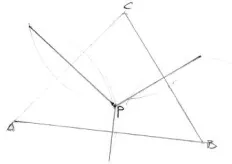
ESULTSThe first subject with the initial NS was to read the theorem and understood it. Furthermore, NS constructs the ABC triangle with any size, both angle and side. After that, NS constructs the bisector perpendicular to each side and uses the term and ruler. NS understands well the definition of a triangle bisector and is able to construct it. The constructors constructed intersect at one point, i.e., The results of the construction are presented in Figure 1. below.
Figure 1. The construction of perpendicular bisectors of ABC triangle
NS then makes a second triangle, which is also called the ABC triangle. Through the same process, NS constructs the bisectors perpendicular to each side of the ABC triangle and
intersects at P exactly as done in the first triangle, but in the second ABC triangle, point P is outside the triangle. The results of construction are presented in Figure 2. below.
Figure 2. Perpendicular Bisectors of any Obtuse Triangles
Construction of the triangles in Figures 1 and 2 shows that NS writes important information in the theorems in different forms, namely in the form of visualization of the hypothesis section. After constructing two ABC triangles along with the bisector perpendicular to each triangle, then NS starts to prove that the bisector-bisector intersection points are perpendicular to the triangle points. NS writes information that is known in a different language than the theorem. Also, write down what will be proven in the theorem. Figure 3. is a written result that shows that NS writes important information in the theorem.
Figure 3. Important Information
2218 Figure 4. Results of Proof by NS
Based on Figure 4. NS can generalize that for all bisector-bisector intersection triangles perpendicular to the vertices of the triangle. Furthermore, based on the results of written work, interviews were conducted to know exactly about the verification process carried out by NS. The results of the interview show that NS starts the proof by describing the theorem based on its parts, namely the hypothetical part and the conclusion of the theorem. When NS explains the parts of the theorem, there are differences between the results of written work and the results of interviews there are differences. Following are the results of interviews with NS.
Researcher: "Can you explain the meaning of the theorem, what is known?"
NS : "what is known is: triangular bisector intersects at one point, while what will be proven is the intersection point of the bisector equal to the vertex triangle "[NS_1]
Researcher:" Are you sure? "
NS : (repeating the theorem)" oh, what is known is the bisector perpendicular to a triangle, while what will be proven is the bisector intersects at one point and distance point [NS_2]
Researcher: "so what will you prove?"
NS : "perpendicular bisector of triangles intersect at one point and equidistant to the vertices of triangles" [NS_3 ]
NS describes the theorem based on its important components, namely things that are known (hypotheses) [NS_1] and [NS_2] and things to prove (conclusions) [NS_3]. In addition, NS realized that he had made a mistake when writing what was known from the theorem, but NS could mention a correct answer [NS_2]. Next, when NS was asked to explain how to prove that the bisector of the triangle is intersecting at one point, NS shows the construction of the ABC triangle that has been made (Figures 1. and Figure 2.).
Researcher: "Can you makethe two triangular constructs prove that for all types of triangles, the perpendicular bisectors intersect at exactly 1 point?"
NS : "I think yes, because the first triangle represents acute triangles, including equilateral triangles, equal, any,
while the second triangle represents an arbitrary triangle of any size. " [NS_4]
Researcher: "What about right triangles?" [P_5 (1)]
NS : "... (constructing right triangles and perpendicular bisectors").
Figure 5. Perpendicular Bisectors of any Right Triangle
2219
Figure 6. FR writes important information
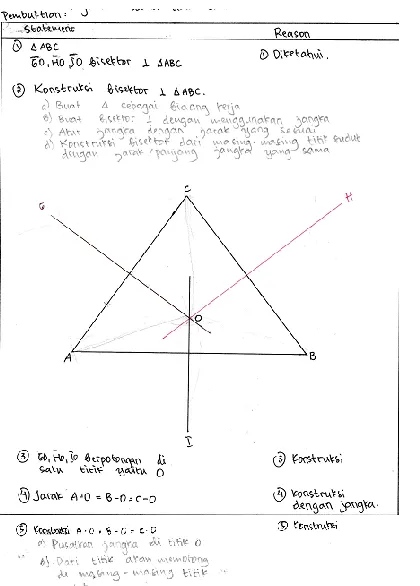
FR starts the proof by writing down the known thing and constructing the triangle ABC using a ruler and the term and writing the steps for constructing a triangle. The results of the construction show that the perpendicular bisector of the triangle intersects at one point, namely point O as shown in Figure 7. below.
Figure 7. Proofs’ Result of FR
Regarding the written results by FR, interviews are then conducted. FR describes the theorem into simpler parts, namely the known part (hypothesis) and which will be proven (conclusion).
Researcher: "Which clause shows what is known from the theorem?" FR : "perpendicular bisector of the triangle" [FR_1] Researcher: "what will be proven?"
FR : "triangle bisector intersects at one point and equidistant from triangle points "[FR_2]
Researcher:" how do you prove it? "
FR :" first I make an ABC triangle, then construct the perpendicular bisector of triangles and it turns out the
bisector perpendicular to the triangle that I made intersects at one point, namely point O ". [FR_3]
Researcher: "how is the distance of point O to the points of the ABC triangle?"
FR : "the distance is the same ... (FR uses the run and makes the radius according to distance O with point A, then with center O turning clockwise right through points C and B). so, the distance of point O is the same as point A, B, and C ". [FR_4]
Researcher: "does this apply to all types of triangles or only triangles that you make?"
FR : "The ABC triangle I made earlier is an arbitrary triangle, I also constructed for any triangle, the result is the same. [FR_5]
Figure 8. Construction of any ABC triangle by FR
Researcher: "What about other types of triangles?"
FR : "Hmm ... try construction again for another type of triangle". (FR constructs the other two triangles, any blunt triangle and any right triangle). [FR_6]
(a) (b)
(b)Figure 9. Construction of the bisector of any obtuse triangle (a) and any right triangle (b)
Researcher: "is each triangle constructed, the distance of the bisectors points perpendicular to the angular points of each triangle? "
FR :" yes ma'am, same ... "(FR confirms by repeating thesteps used to check the first triangle (in Figure 7.). [FR_7]
Researcher:" Are you sure that this applies to all triangles of any kind? "
2220 7) [FR_8]
Researcher:" maybe you can prove it in another way
? "
FR : (FR looks at the image again and tries to make a link ... then draw a triangle sketch ABC with bisector perpendicular intersecting in O.
FR writes all important information related to bisector properties perpendicular to the image, which is to make point M a or the midpoint of the AB side and give congruent marks in the AM and MB segments. On the BC side, FR makes point L the midpoint of the BC side and gives congruent marks on the BL and LC segments, as well as point K on the AC side so that AK is congruent with KC. FR connects points O with A, O with B and O with C with dashed lines. In addition, FR also writes it is known based on the sketch that was made and which will prove as in the following picture. [FR_9]
Figure 10. Sketch of ABC triangle with perpendicular bisectors and important information.
Figure 11. Proofs’ Result of FR
Researcher: "how do you prove this new way?"
FR : "I use triangular congruence, that is, the AKO triangle is congruent with the CKO triangle based on side-angle sides, so BLO triangles are congruent with CLO triangles also because of side-corners. As a result, the corresponding parts are also congruent so. [FR_10]
Researcher: "Are you sure of the answer" FR : "It's already maam ..."
Briefly, the process carried out by FR is as follows. FR writes things that are known and which will be proven based
on theorems with mathematical languages that are different from the theorems. This shows that FR is able to decipher the parts of the theorem, namely the hypothetical part (what is known from the theorem) [FR_1] and the conclusion section (which will be proven) [FR_2] (Decomposition). In addition, FR writes important information in the mathematical language (in mathematical/geometric terms) (Figure 6.) (Abstraction). FR constructs the triangle ABC (equal) and constructs the bisectors in its straight line. FR constructs the bisector perpendicular by writing step by step in detail (Figure 7.) (Algorithmic). FR doubts the proof that the results of construction (Figure 7.) prove that the perpendicular bisector of the triangle intersects at one point [FR_3] and equidistant to the vertices of the triangle [FR_4] (Debugging). Through FR scaffolding makes another construction, namely any arbitrary triangle (Figure 8.), any blunt triangle (Figure 9 (a)) and any right triangle (Figure 9 (b)) and proves that the perpendicular bisector of the triangle intersects at one point and equidistant to the vertices of the triangle [FR_5] (Decomposition, Generalization). FR doubts the correctness of the answer [FR_6], so it tries to find a relationship and describes the information it knows [FR_7] and presents it in the form of a sketch (Figure 10.) (Debugging, Decomposition). FR writes important information based on the sketch (Figure 10.) and arranges formal proof, namely direct verification with two columns (Figure 11.) and explains the process [FR_8] (Abstraction, Algorithmic).
4 D
ISCUSSIONSAnalysis of Computational Thinking (CT) identified from the results of research on NS and FR is as follows.
Decomposition
2221 deciphering the theorem into simpler parts, namely the known
part (hypothesis) [FR_1] and which will be proven (conclusion) [FR_2]. This is the first step to prove and make it easier for FR to identify important information in the theorem, which is known and will be proven. FR also breaks down triangles into triangles equal, arbitrary, obtuse and right. This means that FR describes a triangle based on the types of triangles (Figure 8., Figures 9 (a) and (b)) all of which are of any size (not determined by the length of the side with a certain number). In this case, FR describes a triangle based on the type of angle to prove that for each kind of triangle, there is a property that perpendicular bisector intersects at one point. When FR proves that the distance of the bisector's intersection points is perpendicular to the triangle (point O) to the vertices of the ABC triangle equidistant, FR describes the ABC triangle into three parts, each in the form of a simpler triangle. Furthermore, FR uses the concept of congruence to prove that segments that connect point O with A (segment OA) are congruent with the OB segment and OC segment ([FR-7] and Figure 10.).
Abstraction
NS sorts important information in the theorem, which is known information (hypothesis) from the theorem, namely bisector perpendicular to the triangle. Besides what is also known the thing that will be proven (conclusion) the theorem. Furthermore, based on this important information, NS presents in the form of visualization (Figures 1. and 2.). In the second proof, namely when NS proves that the intersection of the triangle bisector is equidistant from the vertices of the triangle, based on the image that was made before (Figure 2.) NS rewrites important information in the theorem with mathematical language (Figure 3). FR writes down the important parts of the theorem, namely information that is known and which will be proven by mathematical language that is different from the sentence in the theorem (Figure 6.). In the second proof, when FR proves that the intersection of the bisector is perpendicular to the triangle equidistant from the vertices of the triangle, FR sketches a triangle and writes all important information relating to the bisector's nature straight in its sketch. FR writes important information in the form of "known" and "proved" based on the sketch made (Figure 10.)
Algorithmic
NS constructs any ABC triangle and constructs perpendicular bisector using a ruler and term skillfully. NS constructs the bisector perpendicular to each side of the triangle according to the steps that it has known skillfully even though it does not write in detail the construction steps. The results of the construction are Figure 1. and Figure 2. When carrying out the verification, NS begins the verification by writing down things that are known and will be proven, also in the steps of proof starting from the thing that is known and the last is the thing that will be proven. This has been algorithmically learned when doing proof. NS is very skilled at composing algorithms, although at first NS could not determine where the process of verification / not yet know the concept to be used, after deciphering the triangle into small parts the NS triangle easily
compiled proof. NS uses triangular congruence to prove that triangles containing PA, PB, and PC segments are congruent. As a result, the corresponding sides are congruent (Figure 4). Thus NS has shown algorithmic capabilities. FR constructs the triangle ABC (equal) and constructs the bisectors in its straight line. FR constructs the bisector perpendicular by writing step by step in detail (Figure 7.). FR is able to make construction based on the algorithms that have been studied. In addition, FR compiles formal proof, which is direct verification with two columns (Figure 11.) and explains the process [FR_8]. FR has mastered the algorithm in formulating proof formally, that is by direct verification and presenting it in two columns, namely the statement column and reason. This shows that FR has algorithmic capabilities.
Generalization
Generalization is a skill to formulate a solution into a general form so that it can be applied to different problems (Angeli et al., 2016). The process of generalization can be seen when NS shows the construction of various triangles (Figures 1. ,Figure
2., and Figure 5.) based on known important information. In
2222 the bisector perpendicular to the triangle to one of the vertices
of the triangle then rotating it so that it forms a full circle and through the other two triangle points. This means that the distance of OA, OB, and OC is the radius of a circle centered on O so that the distance/length is the same. This applies to any equal triangle (Figure 7) or any arbitrary triangle (Figure 8) and obtuse or arbitrary right triangles (Figures 9 (a) and (b)) based on the statement [FR_ 7]. Another generalization is found when FR sketches triangles (Figure 10), FR does not write a number that shows the length of the side of the triangle. FR only mentions symbols or variables to specify the sides of a triangle. This means that the inferred nature of FR applies to any size triangle.
Debugging
Debugging is analyzed when NS realizes an error that is made, namely when NS identifies the hypothetical part and conclusions of the given theorem [NS_2]. Also, when NS fixes an error that has been made by mentioning the correct answer [NS_3]. Also, when NS realizes that for any right triangle, it has not been shown by construction that the bisector of the triangle is intersected at one point (Figure 5.). FR doubts the proof that the results of the construction (Figure 7.) prove that the perpendicular bisector of the triangle intersects at one point [FR_3] and equidistant to the vertices of the triangle [FR_4]. In addition, FR doubts the correctness of the answer [FR_6], so it tries to find a relationship and describe the information it knows [FR_7] and present it in the form of a sketch (Figure 10.). FR realized that the mistake was made based on doubts about the answer, but was also able to correct the mistakes made. This means FR is debugging. Based on field notes, FR realizes the mistakes that have been made, namely in writing the FR lines write one capital letter (i.e., G, H, and O) which is a symbol for the point. So FR justifies the error and replaces it with and. On the second proof, FR made several corrections because he realized his mistake. FR writes a statement that should be the reason. FR several times to prove and require a relatively longer time than NS.
5
C
ONCLUSIONWhen the abstraction of the two subjects sort out and write down important information from the theorem, the female subject also sketched a triangle. Generalization carried out by the male subject by taking any taper triangle and making bisector on the triangle, while the female subject performs an arbitrary triangle construction to conclude that for each perpendicular bisector triangle intersect at exactly one point. Both male and female subjects do the same decomposition by deciphering the theorem into several parts, namely hypotheses and conclusions. Likewise in the algorithmic stage, the two subjects both use existing workmanship algorithms, namely procedural verification processes (identifying important information, namely things that are known and to be proven, making sketches / construction based on important information that is owned and compiled direct verification with two columns, namely the statement and reason column. Debugging on a male subject occurs when he realizes that he has not shown proof for any right triangle and
then he does proof on opaque paper, whereas on a female subject occurs when he makes a mistake when writing a triangle symbol and then justifying it. Both subjects tend to be lacking in making generalizations in proof. They are more visual constructive. There needs to be a scaffolding to bring up generalization ideas on the subject. In addition, the processing time carried out by female subjects is longer than the male subject. The findings of this study are the sequence of steps taken by each subject differently and the CT component is repeated several times in solving a problem. Suggestions for further research are more in-depth research on each component of CT.
ACKNOWLEDGMENT
The authors wish to thank all of parties who have helped and supported this research.
R
EFERENCES[1] M. Bower, L. N. Wood, C. Howe, and R. Lister, ―Improving the Computational Thinking Pedagogical Capabilities of School Teachers,‖ Aust. J. Teach. Educ., vol. 42, no. 3, pp. 53–72, 2017.
[2] D. C. Geary, S. J. Saults, F. Liu, and M. K. Hoard, ―Sex Differences in Spatial Cognition , Computational Fluency , and Arithmetical Reasoning,‖ J. Exp. Child Psychol., vol. 77, pp. 337–353, 2000.
[3] J. Voogt, P. Fisser, J. Good, P. Mishra, and A. Yadav, ―Computational thinking in compulsory education : Towards an agenda for research and practice,‖ Educ. Inf. Technol., vol. 20, no. 4, pp. 715–728, 2015.
[4] D. Weintrop et al., ―Defining Computational Thinking for Mathematics and Science Classrooms,‖ J. Sci. Educ. Technol., vol. 25, no. 1, pp. 127–147, 2016.
[5] J. F. Sanford and J. T. Naidu, ―Computational Thinking Concepts for Grade School,‖ Contemp. Issues Educ. Res., vol. 9, no. 1, pp. 23–32, 2016.
[6] A. T. Korucu, ―Examination of the Computational Thinking Skills of Students,‖ J. Learn. Teach. Digit. Age, vol. 2, no. 1, pp. 11–19, 2017.
[7] P. Morreale, C. Goski, and L. Jimenez, ―Measuring the Impact of Computational Thinking Workshops in High School Teachers,‖ J. Comput. Sci. Coll., vol. 27, no. 6, pp. 151–157, 2012.
[8] J. M. Wing, ―Computational Thinking,‖ Commun. ACM, vol. 49, no. 3, pp. 33–35, 2006.
[9] W. Sung, J. Ahn, and J. Black, ―The Design of Embodied Activities Promoting Computational Thinking and Mathematics Learning in Early-childhood ...,‖ in The annual conference of the American Educational Research Association, 2017, no. April.
[10] K. Prasad Acharya, ―Fostering Critical Thinking Practices At Primary Science Classrooms in Nepal,‖ Res. Pedagog., vol. 6, no. 2, pp. 1–7, 2016.
2223
Mathematics Education Research Group of
Australasia, 2015, pp. 285–292.
[12] W. Sung, J. Ahn, and J. B. Black, ―Introducing Computational Thinking to Young Learners: Practicing Computational Perspectives Through Embodiment in Mathematics Education,‖ Technol. Knowl. Learn., vol. 22, no. 3, pp. 1–21, 2017.
[13] H. Y. Durak and M. Saritepeci, ―Analysis of the relation between computational thinking skills and various variables with the structural equation model,‖ Comput. Educ., vol. 116, pp. 191–202, 2017.
[14] A. P. Ambrosio, L. da S. Almeida, J. Macedo, and A. Franco, ―Keywords: POP-II.A. novices, POP-V.A. cognitive theories, POP-VI.F. exploratory,‖ in PPIG, 2014, pp. 1–10.
[15] O. Yasar, J. Maliekal, P. Veronesi, and L. Little, ―The essence of computational thinking and tools to promote it,‖ in American Society for Engineering Education, 2017, no. September.
[16] M. G. Jones, G. Gardner, A. R. Taylor, E. Wiebe, and J. Forrester, ―Conceptualizing Magnification and Scale: The Roles of Spatial Visualization and Logical Thinking,‖ Res. Sci. Educ., vol. 41, no. 3, pp. 357–368, 2011.
[17] G. Hanna, ―Proof , Explanation and Exploration : An Overview,‖ Educ. Stud. Math., vol. 44, no. 1–3, pp. 5– 23, 2000.
[18] K. Maria Reiss, A. Heinze, R. Alexander, and C. Groß, ―Reasoning and proof in geometry : Effects of a learning environment based on heuristic worked-out examples,‖ ZDM - Int. J. Math. Educ., vol. 40, no. 3, pp. 455–467, 2008.
[19] NCTM, Principles And Standards For School Mathematics. Reston, VA: The National Council of Teachers of Mathematics Inc, 2010.
[20] K. Lee, ―The Journal of Mathematical Behavior Students ’ proof schemes for mathematical proving and disproving of propositions,‖ J. Math. Behav., vol. 41, pp. 26–44, 2016.
[21] L. Alcock and K. Weber, ―Proof validation in real analysis: Inferring and checking warrants,‖ J. Math. Behav., vol. 24, no. 2, pp. 125–134, 2005.
[22] A. Selden and J. Selden, ―Validations of Proofs Considered as Texts: Can Undergraduates Tell Whether an Argument Proves a Theorem?,‖ J. Res. Math. Educ., vol. 34, no. 1, p. 4, 2010.
[23] A. J. Stylianides and G. J. Stylianides, ―Proof constructions and evaluations,‖ Educ. Stud. Math., vol. 72, no. 2, pp. 237–253, 2009.
[24] A. J. Stylianides, G. J. Stylianides, and G. N. Philippou, ―Prospective Teachers’ Understanding of Proof: What If the Truth Set of an Open Sentence Is Broader Than That Covered By the Proof?,‖ Proc. 29th Conf. Int. Gr. Psychol. Math. Educ., vol. 4, pp. 241–248, 2005.
[25] M. Weber, A. Blake, and R. Cipolla, ―Towards a complete dense geometric and photometric reconstruction under varying pose and illumination,‖ Image Vis. Comput., vol. 22, no. 10 SPEC. ISS., pp.
787–793, 2004.
[26] E. E. E. Espino and C. S. G. G. González, ―Influence of Gender on Computational Thinking,‖ pp. 9–10, 2015. [27] E. Eva, E. Espino, and C. G. González, ―Gender and