Volume 4, No. 3, March 2013 (Special Issue)
International Journal of Advanced Research in Computer Science
REVIEW ARTICLE
Available Online at www.ijarcs.info
Comparison of different Radio Propagation Models with and without Black Hole
Attack on AODV routing protocol in MANET
Abhinav Mehta*, Rohit Jain, PG Scholar and Vinay Somani
PG Scholar Dept. of Electronics & Communication Mandsaur Institute of Technology Mandsaur, India
[email protected]*, [email protected] , [email protected]
Abstract - A Mobile ad-hoc network (MANET) is a temporary network set up by wireless mobile computers (or nodes) moving
arbitrary in the places that have no network infrastructure. In this paper we will discuss the AODV routing protocol in MANET. We will also discuss various security threats with our major concern on the Black Hole attack. In the later part of this paper we will describe different radio propagation models and then compare their performance on AODV, with and without Black Hole attack.
Keywords - AODV, MANET, Black Hole, Propagation,
I. INTRODUCTION
Mobile ad-hoc networks are composed of autonomous nodes that are self- managed without any infrastructure. In this way, Ad-Hoc networks have a dynamic topology such that nodes can easily join or leave the network at any time. Ad-hoc networks are suitable for areas where it is not possible to set up a fixed infrastructure [1]. In MANETs nodes offer connections by using different routing protocols including Ad-hoc on demand distance vector (AODV), Dynamic source routing (DSR), Destination sequenced distance vector (DSDV) etc. The AODV is one of the widely used routing protocols in MANETs. However, due to various security issues of the routing protocols, wireless ad-hoc networks are unprotected to attacks of the malicious nodes. One of these attacks is the Black Hole Attack. We will highlight different types of attacks and describe the black hole attack in later section in this paper.
A. Ad-hoc on demand distance vector (AODV):
The AODV routing protocol is a reactive routing protocol therefore, routes are determined only when needed. When a source node desires to send a message to some destination node and does not already have a valid route to that destination, it initiates a route discoveryprocess to locate the other node. It broadcasts a route request (RREQ) packet to its neighbors, which then forward the request to their neighbors, and so on, until either the destination or an intermediate node with a “fresh enough” route to the destination is located. When the RREQ message packet either reaches the destination node or encounters a node with a route to the destination a response is transmitted. That response occurs via the transmission of a route reply (RREP) message. In case if a node realizes that the route is damaged or broken it transmits a route error (RERR) message to the source [2].
II. SECURITY ISSUES FOR MANETS
Ad-hoc networks are more vulnerable than wired networks therefore security is much more difficult to maintain in mobile ad hoc networks. Following are the various vulnerabilities that exist in wireless ad-hoc networks: [3]
a. Open Medium - Eavesdropping is easier than in
wired network as there is no centralized medium.
b. Dynamically Changing Network Topology –
Mobile Nodes comes and goes from the network. They dynamically change their topology. This allows any malicious node to join the network without being detected.
c. Cooperative Algorithms - The routing algorithm
of MANETs requires mutual trust between the neighbor nodes which violates the principles of Network Security.
d. Lack of Centralized Monitoring – There is
absence of any centralized infrastructure that prohibits any monitoring agent in the system.
e. Lack of Clear Line of Defense - In addition to
prevention, we need two line of defense i.e. detection and response. Realizing security in ad hoc environments is exceedingly difficult since many different types of ad hoc networks exist. Any variation is possible ranging from predominantly static sensor networks to highly mobile vehicular network scenarios. So, it is necessary to design specialized security solutions adapted to the underlying ad hoc network. Not only the network architecture has to face security threats, also the services and protocols used within the network have to withstand many different attacks.
Following are the different types of attack:- a) Black hole attack
b) Passive Eavesdropping
c) Selective existence (Selfish Nodes) d) Gray hole attack (Routing Misbehavior) e) Impersonation
Abhinav Mehtaet al, International Journal of Advanced Research in Computer Science, 4 (3) Special Issue, March 2013,97-101 g) Wormhole attack
III. BLACK HOLE ATTACK
A black hole is a malicious node that incorrectly replies the route requests that it has a fresh route to destination and then it drops all the receiving packets. The damage will be serious if malicious nodes work together as a group. This type of attack is called cooperative black hole attack. The difference of Black Hole Attacks compared to Gray Hole Attacks is that malicious nodes never send true control messages initially. To carry out a black hole attack, malicious node waits for neighboring nodes to send RREQ messages. When the malicious node receives an RREQ message, without checking its routing table, it immediately sends a false RREP message giving a route to destination over itself, assigning a high sequence number to settle in the routing table of the victim node, before other nodes send a true one. Therefore requesting nodes assume that route discovery process is completed and ignore other RREP messages and begin to send packets over malicious node.[1]
Figure 1: Illustration of Black Hole Attack
Figure-1 shows the black hole attack. When a malicious node M enters the network it advertises that it has the shortest path to the destination node D when it receives the Route Request packets sent by node S. The attacker may not be able to succeed if node A, which also receives the Route Request packet from node S, replies earlier than node M. But a major advantage for the malicious node is that it does not have to search its routing table for a route to the destination.
Also, the Route Reply packets originate directly from the malicious node and not from the destination node. Hence, the malicious node would be able to reply faster than node A, which would have to search its routing table for a route to the destination node M, allowing node M to listen all packets meant for destination node.
IV. RADIO PROPAGATION MODELS
Radio channels are much more complicated to analyze than wired channels. Their characteristics may change rapidly and randomly [8]. There are large differences between simple paths with line of sight (LOS) and those which have obstacles like buildings or elevations between the sender and the receiver (Non Line of Sight (NLOS)). To implement a channel model generally two
cases are considered: large-scale and small-scale propagation models. Large scale propagation models account for the fact that a radio wave has to cover a growing area when the distance to the sender is increasing. Small scale models (fading models) calculate the signal strength depending on small movements or small time frames. In this paper, three frequently used models for the ns-2 (network simulator-2) are described in more detail.
A. Free Space Model:
This is a large scale model. The received power is only dependent on the transmitted power, the antenna’s gains and on the distance between the sender and the receiver. It accounts mainly for the fact that a radio wave which moves away from the sender has to cover a larger area. So the received power decreases with the square of the distance. The free space propagation model assumes the ideal propagation condition that there is only one clear line-of-sight path between the transmitter and receiver. H. T. Friss presented the following equation to calculate the received signal power in free space at distance d from the transmitter. [4][5][6][7]
Pr(d) = (PtGtGrλ2)/((4π)2d2L) …………(i)
Where Pt is the transmitted signal power, Gt and Gr are
the antenna gains of the transmitter and the receiver respectively. L (L 1) is the system loss, and λ is the
wavelength. It is common to select Gt=Gr=1and L=1 in
ns simulations.
B. Two Ray Ground Model:
The Two Ray Ground model is also a large scale model. It is assumed that the received energy is the sum of the direct line of sight path and the path including one reflection on the ground between the sender and the receiver. A limitation in ns-2 is that sender and receiver have to be on the same height. It is shown that this model gives more accurate prediction at a long distance than the free space model. [4][5][6][7] The received power at distance d is predicted by:
Pr(d) = (PtGtGrht2hr2)/(d4L) …………(ii)
Where ht and hr are the heights of transmit and receive
antennas respectively. To be consistent with the free space model L is added here. The above equation shows
a faster power loss than Eqn. (i) as distance increases. However, the two-ray model does not give a good result for a short distance due to the oscillation caused by the constructive and destructive combination of the two rays. Instead, the free space model is still used when d is small.
C. Shadowing Model:
reference. Pr(d) is computed relative to Pr(d0) as
follows.
Pr(d0) / Pr(d) =(d/d0)β ………..(iii)
β is called the path loss exponent, and is usually empirically determined by field measurement. From Eqn. (1) we know that β=2 for free space propagation. Table 1 gives some typical values for β. Larger values correspond to more obstructions and hence faster decrease in average received power as distance becomes larger. Pr(d0) can be computed from eqn.(i). The path
loss os usually measured in dB.
[Pr(d) / Pr(d0)] = -10β log (d/d0) ………. (iv)
The second part of the shadowing model reflects the variation of the received power at certain distance. It is a log-normal random variable that is; it is of Gaussian distribution if measured in dB. The overall shadowing model is represented by
[Pr(d) / Pr(d0)] = -10β log (d/d0) +XdB ……… (v)
Where XdB is a Gaussian random variable with zero mean and standard deviation σdB. σdB is called the
shadowing deviation, and is also obtained by measurement. Table.2 shows some typical values of σdB.
Eqn. (v) is also known as a log-normal shadowing model.[4][5][6][7]
Table 1: Some Typical Values Of Β.
Environment Β
Outdoor
Free Space 2
Shadowed urban area 2.7-5
In Building
Line of sight 1.6-1.8
Obstructed 4-6
Table 2: Some Typical Values Of Standard Deviation σdB.
Environment σdB
Outdoor 4-12
Office, hard partition 7
Office, soft partition 9.6
Factory, line of sight 3-6
Factory, obstructed 6.8
V. SIMULATION ENVIRONMENT
A. Simulation Parameters:
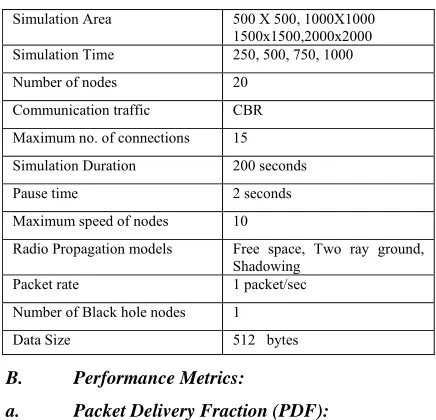
The simulation has been performed on Network Simulator version 2.35 (NS-2.35). We have simulated AODV routing protocol considering both cases i.e. with Black hole attack and without Black hole attack. Also we have taken three different radio propagation models whose performance have been compared in both the cases to get the most suitable model for the simulation parameters and scenarios which we have taken. Table 3 shows our simulation environment.
Table 3: Simulation Parameters
Simulation Area 500 X 500, 1000X1000 1500x1500,2000x2000 Simulation Time 250, 500, 750, 1000
Number of nodes 20
Communication traffic CBR Maximum no. of connections 15
Simulation Duration 200 seconds
Pause time 2 seconds
Maximum speed of nodes 10
Radio Propagation models Free space, Two ray ground, Shadowing
Packet rate 1 packet/sec
Number of Black hole nodes 1
Data Size 512 bytes
B. Performance Metrics:
a. Packet Delivery Fraction (PDF):
The packet delivery ratio in this simulation is defined as the ratio between the numbers of packets received by the CBR sink at destination to the number of packets sent by sources.
b. End-to-end delay:
The average time taken by the packets to pass through the network is called end-to-end delay. This is the time when a sender generates the packet and it is received by the application layer of destination, it is represented in seconds. This is the whole time that includes all delay of network such as transmission time, buffer queues, MAC control exchanges and delay produced by routing activities.
VI. SIMULATION RESULTS
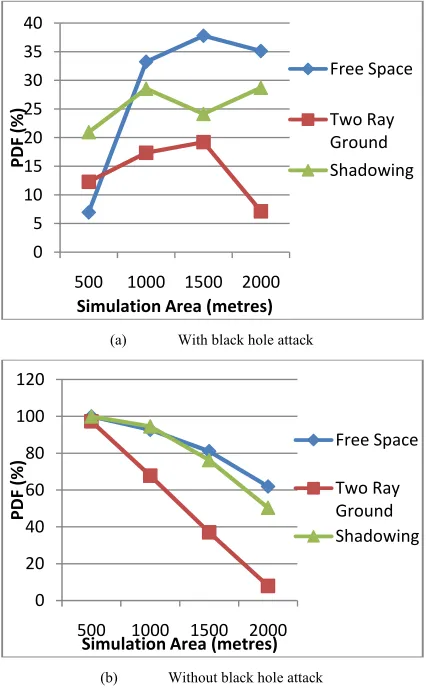
The analysis of simulation results is performed based on the standard metrics of Packet delivery fraction (PDF) and End to end (E2E) delay over different radio propagation models. We conducted our simulations varying simulation area and simulation time for simulation. Also our simulation results have been divided into two different subsections i.e. with black hole attack and without black hole attack.
Abhinav Mehtaet al, International Journal of Advanced Research in Computer Science, 4 (3) Special Issue, March 2013,97-101 path without any obstacles between the transmitter and
receiver.
(a) With black hole attack
(b) Without black hole attack
Figure 2- Comparison of various Radio Propagation models on the basis of PDF varying simulation area.
Figure 3 shows the End to End delay of the three models varying simulation area. By analyzing figure 3(a) & 3(b) we can conclude that the average end to end delay in two ray ground is very high as compared to both the free space and shadowing models of radio propagation. These high delay leads to the small PDF of the two ray ground as shown in figure-2. We can also see that the free space and shadowing models go neck to neck as far as end to end delay is concerned with free space offering a more delay at 1000 and 2000 m distance.
(a) With black hole attack
(b) Without black hole attack
Figure 3- Comparison of various Radio Propagation models on the basis of End to End Delay varying simulation area.
Figure 4(a) shows that when we vary simulation time, two ray ground has a better PDF under black hole attack and free space offers least performance. Figure 4(b) shows that when malicious attack is not present performance two ray ground is less as compared to the other two models. Here free space offers best packet delivery rate.
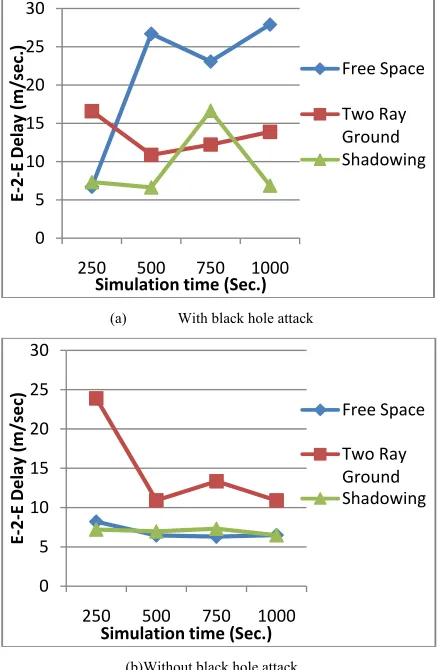
Figure 5(a) shows that in free space end to end delay is quite high compared to the other two models. This is the main reason behind the low PDF of free space in figure 4(a). Shadowing models offers less delay and proves to be better models that the other two in case of black hole attack. Figure 5(b) shows delay of the models without black hole attack. Here two ray ground offer a higher end to end delay the free space and shadowing model.
(a) With black hole attack
(b) Without black hole attack
Figure 4- Comparison of various Radio Propagation models on the basis of Packet delivery fraction (PDF) varying simulation time.
0
500 1000 1500 2000
(%)
Simulation Area (metres)
Free Space
500 1000 1500 2000
(%)
Simulation Area (metres)
Free Space
500 1000 1500 2000
E
Simulation Area (metres)
Free Space
500 1000 1500 2000
E
Simulation Area (Metres)
Free Space
250 500 750 1000
(%)
Simulation Time (Sec.)
Free Space
250 500 750 1000
(%)
Simulation Time (Sec.)
Free Space
(a) With black hole attack
(b)Without black hole attack
Figure 5- Comparison of various Radio Propagation models on the basis of Average end to end (E-2-E) delay varying simulation time.
VII. CONCLUSION
In this paper we have tried to analyze the performance of three major radio propagation models. The MANET protocol considered here is AODV and we have also considered a malicious attack known as black hole attack. We have performed our simulations considering both the cases i.e. with black hole and without black hole attack. We demonstrated that the usage of more
accurate radio propagation model changes simulated topologies considerably between commonly used propagation models. Consequently, we obtain different performance evaluation results. We have compared radio propagation models performance on the basis of Packet delivery fraction and End to end delay. The results may vary in the realistic simulation environment where the obstacles such as buildings will lead to the signal fading which will also affect the performance of the different propagation models.
VIII. REFERENCES
[1]. A. Vani ECE Department CBIT-Hyderabad D. Sreenivasa Rao Professor ECE. Department, JNTU Hyderabad, Andhra Pradesh, India “Removal of Black Hole Attack in Ad Hoc Wireless Networks to provide confidentiality security service”.
[2]. C. E. Perkins and E. M. Royer, “Ad-hoc On-Demand Distance Vector Routing,” Proc. 2nd IEEE Wksp. Mobile Comp. Sys. and Apps., Feb. 1999, pp. 90–100.
[3]. Akanksha Saini, Harish Kumar Department of Computer Science & Engineering, UIET, Punjab University Chandigarh, “Effect Of Black Hole Attack On AODV Routing Protocol In MANET”. [4]. Ingo Gruber, Oliver Knauf and Hui Li,”
Performance of Ad Hoc Routing Protocols in Urban Environments”, In Proceedings of European Wireless 2004 (EW'2004, Barcelona, Spain, February 24 - 27, 2004, Barcelona, Spain
[5]. http://www.cubinlab.ee.unimelb.edu.au/~jrid/Docs / Manuel-NS2/node196.html.
[6]. www.isi.edu/~weiye/pub/propagation_ns.pdf. [7]. Arne Schmitz, Martin Wenig ,”The Effect of the
Radio Wave Propagation Model in Mobile Ad Hoc Networks”, Torremolinos, Malga, Spain, MSWiM’ 06, October 2-6,2006
[8]. www.isi.edu/nsnam/ns/tutorial Marc Greis tutorial on ns2.
0 5 10 15 20 25 30
250 500 750 1000
E
‐
2
‐
E
Delay
(m/sec.)
Simulation time (Sec.)
Free Space
Two Ray Ground Shadowing
0 5 10 15 20 25 30
250 500 750 1000
E
‐
2
‐
E
Delay
(m/sec)
Simulation time (Sec.)
Free Space