Citation:
García, AM and De Bra, P and Stash, N and Fletcher, GHL and Fabri, M and Pechenizkiy, M (2016)
Adaptive web-based educational application for autistic students. CEUR Workshop Proceedings,
1628. ISSN 1613-0073
Link to Leeds Beckett Repository record:
http://eprints.leedsbeckett.ac.uk/3291/
Document Version:
Article
The aim of the Leeds Beckett Repository is to provide open access to our research, as required by
funder policies and permitted by publishers and copyright law.
The Leeds Beckett repository holds a wide range of publications, each of which has been
checked for copyright and the relevant embargo period has been applied by the Research Services
team.
We operate on a standard take-down policy.
If you are the author or publisher of an output
and you would like it removed from the repository, please
contact us
and we will investigate on a
case-by-case basis.
Adaptive web-based educational application for autistic
students
Alejandro Montes García
Eindhoven University of Technology
Eindhoven, the Netherlands
[email protected]
Natalia Stash
Eindhoven University of Technology
Eindhoven, the Netherlands
Marc Fabri
Leeds Beckett University Leeds, United Kingdom
Paul De Bra
Eindhoven University of Technology
Eindhoven, the Netherlands
George H. L. Fletcher
Eindhoven University of Technology
Eindhoven, the Netherlands
[email protected]
Mykola Pechenizkiy
Eindhoven University of Technology
Eindhoven, the Netherlands
ABSTRACT
Adaptive web-based applications have proven successful in reduc-ing navigation and comprehension problems in hypermedia docu-ments. In this paper, we describe a toolkit that is offered as an adap-tive web-based application to help autistic students incorporate to high education. The toolkit has been developed using a popular CMS in which we have integrated a client-side adaptation library.
The toolkit described here was tried out during workshops with autistic students at Leeds Becketts University to gather (mostly qualitative) feedback on the adaptation and privacy aspects of the Autism&Uni platform, that feedback was later used to improve the toolkit.
CCS Concepts
•Information systems→Web applications;•Social and profes-sional topics→People with disabilities;•Security and privacy →Privacy protections;
Keywords
adaptation, autism, learning styles, privacy
1.
INTRODUCTION
In this paper, we will demonstrate an adaptive web based appli-cation developed for the Autism&Uni project. This has been devel-oped with a tool that combines a popular CMS, namely Wordpress, and a library that enables client-side adaptation that is being devel-oped at the TU/e called WiBAF [12].
The application demonstrated is the one used in the Autism&Uni1 project, however, the WiBAF + Wordpress integration used for de-veloping it is generic. In fact, first year students have developed
1
http://autism-uni.org/
Permission to make digital or hard copies of all or part of this work for personal or classroom use is granted without fee provided that copies are not made or distributed for profit or commercial advantage and that copies bear this notice and the full cita-tion on the first page. Copyrights for components of this work owned by others than ACM must be honored. Abstracting with credit is permitted. To copy otherwise, or re-publish, to post on servers or to redistribute to lists, requires prior specific permission and/or a fee. Request permissions from [email protected].
HT ’16 July 10–13, 2016, Halifax, NS, Canada
c
2016 ACM. ISBN 978-1-4503-2138-9.
DOI:10.1145/1235
different examples of adaptive applications using it. Autism&Uni is aimed at widening access to higher education for autistic students by providing a toolkit that can help them overcome the challenges they may face when going to university. The goal is to give stu-dents a taste of how higher education works and how to cope with the physical university environment before they start their study. This toolkit2is offered as an Adaptive Web-Based Application to
autistic students, but also to non-autistic students that might find it useful.
The adaptive functionality differentiates inhowthe information site presents itself to autistic and non-autistic students, but in the end the toolkit provides the same information to everyone. The adaptive functionality offered in the toolkit presented here is based on learning styles and user history.
Adaptive Hypermedia is a research field that can be traced back to the nineties [3, 4]. It has become more complex since then and several frameworks have been developed. They aim to ease the development of this kind of applications. Some good examples of those frameworks are AHA! [6] or GALE [16].
Learning styles refer to the different ways a person can learn. There is previous research on adaptation to cognitive/learning styles and how can these be incorporated to Adaptive Hypermedia Sys-tems and e-learning platforms [15, 17]. While adaptation to learn-ing styles is useful in every e-learnlearn-ing platform, this is specially im-portant in our use case scenario with autistic students as we shown in our previous work [5, 13]. Autistic students show problems link-ing concepts and therefore, adaptlink-ing the content to their specific needs can be of great help.
In this demonstration we will showcase the integration of WiBAF and Wordpress in several ways. We will show the how we ap-ply adaptive hypermedia and learning styles to a toolkit targeted at helping autistic students succeding in their transition from high school to university. However during the demo session we will also showcase some parts described in a different paper, like the author-ing of adaptive applications with the WiBAF and Wordpress tool.
The remainder of this paper is structured as follows: We describe what autism is and why adaptation is important for them in Sec-tion 2 and then we describe the specific acSec-tions taken in our toolkit in Section 3. Section 4 measures the overhead that this integra-tion causes compared to a CMS without any adaptaintegra-tion. Finally we conclude and propose future work in Section 5.
2
2.
ADAPTATION FOR AUTISTIC STUDENTS
Adaptation for autistic students is first and foremost concerned with adapting to the differences in cognitive abilities, within this project in particular comprehension, between autistic and non-autis-tic people. Autism is often described as a “spectrum disorder” be-cause the condition affects people in many different ways and to varying degrees. In our previous work [5] we discussed the “spec-trum” and indicated that within the project we are mainly consider-ing students who are of average or advanced intellectual abilities, academically capable and able to communicate effectively in most situations. Traditionally this group would have been referred to as being “high-functioning” or having Asperger syndrome [2, 10], al-though these labels are both imprecise and considered offensive by many autistic people and other stakeholders [9]. Therefore, in the remainder of this paper we will refer to “autistic students”.
Autism is often called a “hidden disability”, with few physical signs of the student having difficulties until a crisis is reached. This can make it difficult for autistic students to have their needs fully met, as they experience doubts about their condition, demands to justify their requirements from staff as well as from student peers [1]. And this is in addition to the social and communication difficulties common to autism.
With the right support and encouragement, however, autistic stu-dents can develop their full potential at university and lead full and independent lives. One of the most accomplished and well-known adults with autism in the world is Temple Grandin, an American professor of animal science at Colorado State University (see her TED talk3), but this is just one of many more examples.
Comprehension disturbance makes it difficult for autistic people to make semantic connections between the topics that they study while generally speaking non-autistic people do not have this prob-lem. Autistic people are good at “seeing trees in the forest”, they can spot details but may have difficulties “seeing the whole forest” and developing critical thinking skills [2]. On the other hand, many autistic people have specific strengths such as an ability to maintain intense focus, to think rationally and logically, to adopt unconven-tional angles in problem-solving or to spot errors that others may overlook [7, 11]. All these are valuable attributes in higher edu-cation students, and the strengths of autistic people as profession-als with a high work ethic are increasingly recognized by business world-wide, e. g. in technical and scientific areas and also in the humanities and the arts4.
In order to provide effective adaptation, we utilize the specific characteristics and preferences of the user in three different learn-ing styles [8], i. e. where is the user located in the: visual vs. verbal axis, global vs. analytical axis and active vs. reflective axis. We make use of the user history as well. These variables together with the adaptation effects provided by the toolkit, have been described in our previous work [5].
A secondary but also important aspect of performing adaptation in the presence of autistic users is the heightened awareness of (and anxiety for) the user modelling involved. Autistic students do not only experience anxiety when entering an unknown environment but also when they realize that their personal and possibly sensi-tive data are stored on a external computer that they cannot access, when they do not feel their data is kept private or they cannot con-trol it. Fortunately WiBAF stores all user data on the client side (using browser storage) by default. Autistic users may choose to
3
http://www.ted.com/talks/temple_grandin_the_world_needs_all_ kinds_of_minds
4see http://goo.gl/71YG14 accessed last time on Tue 16thFebruary,
2016
keep this setting, thus guarding their privacy, while other users may opt to share their data in order to enable the server side to perform group adaptation. (We currently do not offer group adaptation but we do offer the user model sharing option.)
For this specific use-case, we also consider some factors related to the context namely,wherethe student is andwhat timeit is. The reason for this is that autistic students feel lost often, they need re-minders that tell them where they have to go. We are implementing a feature so that they can import events from their Google Calen-dar. The tool will show a reminder when the student needs to go to a lecture and a link with the instructions to get to the room where she needs to be. This is still under development and not yet part of the generic platform, therefore we will not describe it further. We mention the notification feature because it needs to be developed in order to really help autistic students.
In order to effectively display the content from our learning ob-jects, we have broken it down into small pieces or fragments with some semantic meaning, from which the student can learn some-thing. In our case, we show an introduction first, we show also a comic strip or an image that shows quotes of students about the topic of the learning object, establishing a context for it. Then some background information is provided to justify the learning object. After that we talk about how the learning object being described is important for the reader and what she should do. We close the article with some additional tips, questions to think about and some follow-on reading. Each learning object can also have an alterna-tive video version as well as pre and post-requisites.
3.
ADAPTATION EFFECTS
After running workshops with autistic students at the Leeds Beck-ett University, and trying different alternatives like stretchtext, or reordering of parts that call users to do an immediate action, we have concluded that the following are the most valuable adaptation effects.
• If the user is more visual than verbal, the video version of the content will be shown at the top of the learning object. Otherwise it will be moved to the last (bottom) section of the learning object.
• If the user is more global than analytical, all the sections of the learning object will be displayed on a single page. On the other hand, if the user is more analytical than global, each section will be shown sequentially in one page, in a similar way as in a slide-show.
• Some learning objects have pre-requisites, they require knowl-edge of some items to be completely understood. These pre-requisites are shown when the user starts to read a new learn-ing object, unless she already fulfilled those pre-requisites. In that case, the pre-requisites block is not displayed in the learning object.
• The learning objects from which the user has already got knowledge are marked as visited. This is done in order to help users remember which items they have already read and which ones they still have to read.
Some of these effects are hard-coded in our adaptation and mod-elling files, as they refer to the general structure of the content and it are independent of the number of learning objects and their content. Other effects are created dynamically by our framework, when new learning objects are created.
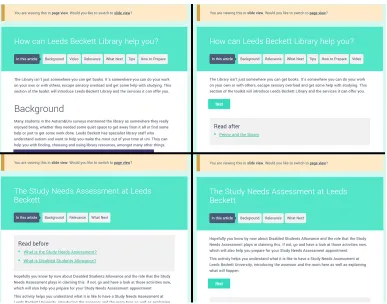
Figure 1: Versions of two different learning objects for different types of students (top images), or with different prior knowledge (bottom images).
the version for a global-visual student is depicted and the same LO for an analytic-verbal student is shown on its right. On the bottom part of the image, a learning object with pre-requisites is shown. On the left part, the student has not read the pre-requisites yet, on the right version, the student has fulfilled these pre-requisites, and therefore they are not shown again.
4.
TECHNICAL PERFORMANCE
Technical performance (speed) is often a problem with adaptive hypermedia systems, which (understandably) is rarely reported. Some initiatives, including the general-purpose adaptation engine GALE developed at the Eindhoven University of Technology [16] pay spe-cial attention to efficiency and can withstand a stress test using hundreds of simultaneous users. Most of the performance prob-lems stem from the adaptation that needs to be computed in the split second between the user clicking on a link and the browser presenting the “next” page. Since WiBAF performs user mod-elling and adaptation inside the browser it does not face a perfor-mance problem because of large numbers of simultaneous users. However there is still a bit of overhead in the server because in the WiBAF+WordPress combination WordPress has to serve (and sometimes generate) code for the browser to execute. We are inter-ested in seeing how both tasks affect the overall performance of the modified WordPress.
We ran a performance test on a MacBook Air laptop together with an Apache Server and a MySQL database. The server was running WordPress version 4.4.2. We have measured the time it takes for our modified WordPress to load several pages of differ-ent types (learning objects, the home page, etc. ). We did so by
using a plugin called P35. Then we compared it to an unmodified WordPress with the default theme, without any plugins (except P3). The adaptive version of WordPress takes 176 ms to load the site, while the not adaptive version takes 167 ms, that is an over-head of just 9 ms. In the detailed analysis we see that indeed the WiBAF plugin is executed in 9.1 ms while the theme is handled slightly more efficiently in our WordPress than the default Word-Press theme.
We also measured the time the client code uses (for user mod-elling and adaptation). We used the Google Chrome profiler to measure the total JavaScript execution time with our custom Word-Press. In this measurements we include not only WiBAF but also JQuery6, a popular JavaScript library that is used to manipulate the DOM structures and it is required by WiBAF. and compared that to the default WordPress (not performing any user modelling or adap-tation). The execution time of the JavaScript code in our WordPress was 487 ms, against 304 ms for the non-adaptive version. There-fore the overhead we introduce in the client is 183 ms. More than one half of that time (69 ms) is caused by the use of the Indexed DB to store and retrieve data from the user model.
In total, we quantify that making a WordPress adaptive costs 192 ms per request. The page will be served with a delay of 9 ms and adapted in 183 ms. In total the page is served and adapted in 663 ms. According to an study in 2004 [14], users consider a wait-ing time of around 2 seconds acceptable. Since then people may have grown more impatient. But when considering these perfor-mance numbers you should consider that we ran an unlikely
sce-5
https://wordpress.org/plugins/p3-profiler/
6
nario where the web server with WordPress, the mySQL database and the (Chrome) browser with adaptation code were all running on the same (relatively slow) computer.
5.
DEMONSTRATION SCENARIO AND
FU-TURE OUTLOOKS
In this demo we will showcase an adaptive web-based appli-cation developed with a framework consisting on a CMS and an adaptation library. This application is aimed at supporting autis-tic student in higher education, but it is offered to everyone. The application takes advantage of the use of learning styles and user history, but extra functionality can be added, such as notifications or a progress bar e. g. “you have studied only 5% of the material and there are only 2 days left before the exam”, etc. . . Extra adap-tive features can include adapadap-tive testing or selection of navigation tools - more independent students (with field-independent learning style) can be provided with a search option while less independent students (with field-dependent style) can be provided with a “Next” button that at each step will be bringing them to the most suitable material.
It is important that concepts of privacy, information sharing and storage locations are communicated in a clear, non-technical and unambiguous way. Initial usability tests of the settings screen were carried with autistic students. Trial participants did not understand the control these settings offered them. Inadequately implemented privacy settings, are likely to increase anxiety rather than alleviate it for the students that participated in our trials. Therefore we need to find a way to improve the scrutability of our user profile.
6.
ACKNOWLEDGMENTS
This research is supported by the project WiBAF and the Life-long Learning Programme (project no. 10018300 Authew 539031-LLP-2013-1-UK). This publication reflects the views only of the authors, and the Commission cannot be held responsible for any user, which may be made of the information contained therein. The authors thank the Autism&Uni project team, TU/e psychologists specialising in autism, TU/e students with autism who participated in interviews with us, Stichting Handicap+Studie7 and Autastic!8 for their valuable input.
7.
REFERENCES
[1] K. S. Adams and B. E. Proctor. Adaptation to college for students with and without disabilities: Group differences and predictors.Journal of Postsecondary Education and Disability, 22(3):166–184, 2010.
[2] T. Attwood.The Complete Guide to Asperger’s Syndrome. Jessica Kingsley Pub., 2014.
[3] P. Brusilovsky. Methods and techniques of adaptive hypermedia. InAdaptive hypertext and hypermedia. 1998. [4] L. Calvi and P. De Bra. Improving the usability of hypertext
courseware through adaptive linking. InProceedings of the eighth ACM conference on Hypertext. ACM, 1997. [5] P. De Bra, A. Montes García, and N. Stash. Novel adaptive
features of the Autism&Uni toolkit for students on the autism spectrum. InProceedings of the INTED 2016 Conference. IATED, 2016.
[6] P. De Bra, D. Smits, and N. Stash. The design of aha! In
Proceedings of the seventeenth conference on Hypertext and hypermedia, pages 133–134. ACM, 2006.
7
http://www.handicap-studie.nl/
8
http://royhoutkamp.nl/
[7] K. P. Grant and G. Davis. Perception and apperception in autism: rejecting the inverse assumption.Philosophical Transactions of the Royal Society of London B: Biological Sciences, 364(1522):1393–1398, 2009.
[8] J. W. Keefe. Learning style: An overview.Student learning styles: Diagnosing and prescribing programs, 1:1–17, 1979. [9] L. Kenny, C. Hattersley, B. Molins, C. Buckley, C. Povey,
and E. Pellicano. Which terms should be used to describe autism? perspectives from the uk autism community.Autism, page 1362361315588200, 2015.
[10] A. Klin, D. Pauls, R. Schultz, and F. Volkmar. Three diagnostic approaches to asperger syndrome: Implications for research.Journal of Autism and Developmental Disorders, 35(2):221–234, 2005.
[11] T. Lorenz and K. Heinitz. Aspergers–different, not less: Occupational strengths and job interests of individuals with asperger’s syndrome.PloS one, 9(6):e100358, 2014. [12] A. Montes García. WiBAF: Within Browser Adaptation
Framework. InExtended Proceedings of the 22nd Conference on User Modeling, Adaptation, and Personalization. CEUR-WS, 2014.
[13] A. Montes García, N. Stash, and P. De Bra. Adaptive applications to assist students with autism in succeeding in higher education. InUser Modeling, Adaptation and Personalization, number 23, 2015.
[14] F. F.-H. Nah. A study on tolerable waiting time: how long are web users willing to wait?Behaviour & Information Technology, 23(3):153–163, 2004.
[15] M. d. P. Paule Ruiz, M. J. Díaz Fernández, F. O. Soler, and J. R. Pérez Pérez. Adaptation in current e-learning systems.
Computer Standards & Interfaces, 30(1):62–70, 2008. [16] D. Smits.Towards a Generic Distributed Adaptive
Hypermedia Environment. PhD thesis, Eindhoven University of Technology, adaptive version:
http://gale.win.tue.nl/thesis/, ISBN 978-90-386-3115-8, 2012.
[17] N. Stash.Incorporating Cognitive/Learning Styles in a General-Purpose Adaptive Hypermedia System. PhD thesis, Eindhoven University of Technology, ISBN