Capturing Consistency between Intra-clause and Inter-clause Relations
in Knowledge-rich Dependency and Case Structure Analysis
Daisuke Kawahara
National Institute of Information and Communications Technology, 3-5 Hikaridai Seika-cho, Soraku-gun,
Kyoto, 619-0289, Japan
Sadao Kurohashi
Graduate School of Informatics, Kyoto University,
Yoshida-Honmachi, Sakyo-ku, Kyoto, 606-8501, Japan
Abstract
We present a method for dependency and case structure analysis that captures the consistency between intra-clause relations (i.e., case structures or predicate-argument structures) and inter-clause relations. We assess intra-clause relations on the basis of case frames and inter-clause relations on the basis of transition knowledge be-tween case frames. Both knowledge bases are automatically acquired from a mas-sive amount of parses of a Web corpus. The significance of this study is that the proposed method selects the best depen-dency and case structure that are con-sistent within each clause and between clauses. We confirm that this method con-tributes to the improvement of dependency parsing of Japanese.
1 Introduction
The approaches of dependency parsing basically assess the likelihood of a dependency relation be-tween two words or phrases and subsequently collect all the assessments for these pairs as the dependency parse of the sentence. To improve dependency parsing, it is important to consider as broad a context as possible, rather than a word/phrase pair.
In the recent evaluation workshops (shared tasks) of multilingual dependency parsing (Buch-holz and Marsi, 2006; Nivre et al., 2007), transition-based and graph-based methods achieved good performance by incorporating rich context. Transition-based dependency parsers consider the words following the word under consideration as features of machine learning (Kudo and Matsumoto, 2002; Nivre and Scholz, 2004; Sassano, 2004). Graph-based dependency parsers consider sibling and grandparent nodes,
i.e., second-order and higher-order features (McDonald and Pereira, 2006; Carreras, 2007; Nakagawa, 2007).
It is desirable to consider a wider-range phrase, clause, or a whole sentence, but it is difficult to judge whether the structure of such a wide-range expression is linguistically correct. One of the rea-sons for this is the scarcity of the knowledge re-quired to make such a judgment. When we use the Penn Treebank (Marcus et al., 1993), which is one of the largest corpora among the available ana-lyzed corpora, as training data, even bi-lexical de-pendencies cannot be learned sufficiently (Bikel, 2004). To circumvent such scarcity, for instance, Koo et al. (2008) proposed the use of word classes induced by clustering words in a large raw cor-pus. They succeeded in improving the accuracy of a higher-order dependency parser.
On the other hand, some researchers have pro-posed other approaches where linguistic units such as predicate-argument structures (also known as case structures and logical forms) are considered instead of arbitrary nodes such as sibling nodes. To solve the problem of knowledge scarcity, they learned knowledge of such predicate-argument structures from a very large number of automat-ically analyzed corpora (Abekawa and Okumura, 2006; Kawahara and Kurohashi, 2006b). While Abekawa and Okumura (2006) used only co-occurrence statistics of verbal arguments, Kawa-hara and Kurohashi (2006b) assessed predicate-argument structures by checking case frames, which are semantic frames that are automatically compiled for each predicate sense from a large raw corpus. These methods outperformed the accuracy of supervised dependency parsers.
In such linguistically-motivated approaches, well-formedness within a clause was considered, but coherence between clauses was not con-sidered. Even if intra-clause relations (i.e., a predicate-argument structure within a clause) are
p o in to w a , p o in t
T O P
h
ito ts u n i o n e D A T
m a to m e te o rg a n iz e ta k u
h
a ib in d e c o u rie rC M I
o k ur u se n d
k o to d es u
b
e th a t
(b 1 )
(c 1 )
( b 2 )
( c 2 )
( b 3 )
( c 3 )
333
333
333 p o in to w a ,
p o in tT O P
h
ito ts u n i o n e D A T
m a to m e te p a c k ta k u
h
a ib in d e c o u rie r
C M I o k ur u
se n d k o to d es u
b
e th a t
p o in to w a , p o in tT O P
h
ito ts u n i o n e D A T
m a to m e te o rg a n iz e ta k u
h
a ib in d e c o u rie r
C M I o k ur u s e n d
k o to d es u
b
e th a t
p o in to w a , p o in t
T O P
h
ito ts u n i o n e
D A T m a to m e te p a c k ta k u
h
a ib in d e c o u rie rC M I
o k ur u se n d
k o to d es u
b
e th a t
p o in to w a , p o in t
T O P
h
ito ts u n i o n e
D A T m a to m e te o rg a n iz e ta k u
h
a ib in d e c o u rie rC M I
o k ur u s e n d
k o to d es u
b
e th a t
p o in to w a , p o in t
T O P
h
ito ts u n i o n e
D A T m a to m e te
p a c k ta k u
h
a ib in d e c o u rie rC M I
o k ur u se n d
k o to d es u
b
e th a t
p o in to w a , p o in t
T O P
h
ito ts u n i o n e D A T
m a to m e te p a c k ta k u
h
a ib in d e c o u rie rC M I
o k ur u se n d
k o to d es u
b
e th a t
p o in to w a , p o in t
T O P
h
ito ts u n i o n e D A T
m a to m e te o rg a n iz e ta k u
h
a ib in d e c o u rie rC M I
o k ur u s e n d
k o to d es u
b
e th a t
p o in to w a , p o in t
T O P
h
ito ts u n i o n e D A T
m a to m e te p a c k ta k u
h
a ib in d e c o u rie rC M I
o k ur u se n d
k o to d es u
b
[image:2.595.73.529.59.527.2]e th a t
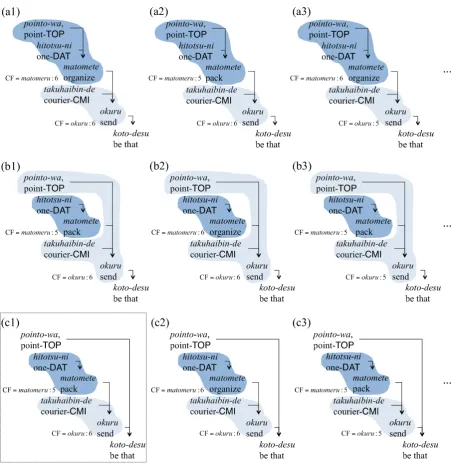
Figure 1: Possible dependency and case structures of sentence (1).
optimized, they might not be optimum when look-ing at clause pairs or sequences. To improve the accuracy of dependency parsing, we propose a method for dependency and case structure analy-sis that considers the conanaly-sistency between intra-clause and inter-intra-clause relations. This method an-alyzes intra-clause relations on the basis of case frames and inter-clause relations on the basis of transition knowledgebetween case frames. These two knowledge sources are automatically acquired from a massive amount of parses of a Web corpus. The contributions of this paper are two-fold. First, we acquire transition knowledge not be-tween verbs or verb phrases but bebe-tween case
frames, which are semantically disambiguated representations. Second, we incorporate the tran-sition knowledge into dependency and case struc-ture analysis to capstruc-ture the consistency between intra-clause and inter-clause relations.
2 Idea of Capturing Consistency between Intra-clause and Inter-clause Relations
We propose a method for generative dependency parsing that captures the consistency between intra-clause and inter-clause relations.
Figure 1 shows the ambiguities of dependency and case structure ofpointo-wa(point-TOP) in the following sentence:
(1) pointo-wa,
point-TOPhitotsu-nione-DAT matometepack takuhaibin-de
courier-CMI okurusend koto-desube that
(The point is that (we) pack (one’s bag-gage) and send (it) using courier service.)
The correct structure is (c1), which is surrounded by the dotted rectangle. Structures (c2), (c3) and so on have the same dependency structure as (c1), but have incorrect case structures, in which incorrect case frames are selected. Note that matomeru:5, okuru:6 and so on in the figure rep-resent the IDs of the case frames.
The parser of Kawahara and Kurohashi (2006b) (and also conventional Japanese parsers) erro-neously analyzes the head of pointo-wa
(point-TOP)1 asmatomete(organize), whereas the cor-rect head iskoto-desu(be that), as shown in struc-ture (a1) in Figure 1.
This error is caused by the incorrect selection of the case framematomeru:6 (organize), which is shown in Table 1. This case frame locally matches the input predicate-argument structure “pointo-wa hitotsu-ni matomeru” (organize points). Thefore, this method considers only intra-clause re-lations, and falls into local optimum.
If we consider the wide range of two clauses, this error can be corrected. In structure (a1) in Figure 1, the generative probability of case frame transition,P(matomeru:6|okuru:6), is
con-sidered. This probability value is very low, be-cause there are few relations between the case frame matomeru:6 (organize) and the case frame okuru:6 (send baggage) in corpora.
Consequently, structure (c1) is chosen as the correct one, where both intra-clause and inter-clause relations can be interpreted by the case
1In this paper, we use the following abbreviations:
NOM (nominative), ACC (accusative), ABL (ablative),
[image:3.595.308.526.120.353.2]CMI(comitative) andTOP(topic marker).
Table 1: Case frame examples formatomeru and okuru. “CS” represents case slot. Argument words are written only in English. “<num>” represents
the class of numerals.
case frame ID CS example words ..
. ... ...
matomeru:5 (pack)
ga I, person, ...
wo baggage, luggage, variables, ... ni <num>, pieces, compact, ... matomeru:6
(organize)
ga doctor, ...
wo point, singularity, ... ni <num>, pieces, below, ... ..
. ... ...
okuru:1 (send)
ga person, I, ...
wo mail, message, information, ... ni friend, address, direction, ... de mail, post, postage, ... ..
. ... ...
okuru:6 (send)
ga woman, ...
wo baggage, supply, goods, ... ni person, Japan, parental house, ... de mail, post, courier, ...
..
. ... ...
framesand thetransition knowledgebetween case frames.
3 Acquiring Transition Knowledge between Case Frames
We automatically acquire large-scale transition knowledge of inter-clause relations from a raw corpus. The following two points are different from previous studies on the acquisition of inter-clause knowledge such as entailment/synonym knowledge (Lin and Pantel, 2001; Torisawa, 2006; Pekar, 2006; Zanzotto et al., 2006), verb relation knowledge (Chklovski and Pantel, 2004), causal knowledge (Inui et al., 2005) and event relation knowledge (Abe et al., 2008):
• the unit of knowledge is disambiguated and generalized
The unit in previous studies was a verb or a verb phrase, in which verb sense ambiguities still remain. Our unit is case frames that are semantically disambiguated.
• the variation of relations is not limited
In this section, we first describe our unit of transition knowledge, case frames, briefly. We then detail the acquisition method of the transition knowledge, and report experimental results. Fi-nally, we refer to related work to the acquisition of such knowledge.
3.1 The Unit of Transition Knowledge: Case Frames
In this paper, we regard case frames as the unit of transition knowledge. Case frames are constructed from unambiguous structures and are semantically clustered according to their meanings and usages. Therefore, case frames can be a less ambiguous and more generalized unit than a verb and a verb phrase. Due to these characteristics, case frames are a suitable unit for acquiring transition knowl-edge and weaken the influence of data sparseness. 3.1.1 Automatic Construction of Case
Frames
We employ the method of Kawahara and Kuro-hashi (2006a) to automatically construct case frames. In this section, we outline the method for constructing the case frames.
In this method, a large raw corpus is auto-matically parsed, and the case frames are con-structed from argument-head examples in the re-sulting parses. The problems in automatic case frame construction are syntactic and semantic am-biguities. In other words, the parsing results in-evitably contain errors, and verb senses are intrin-sically ambiguous. To cope with these problems, case frames are gradually constructed from reli-able argument-head examples.
First, argument-head examples that have no syntactic ambiguity are extracted, and they are dis-ambiguated by a pair comprising a verb and its closest case component. Such pairs are explic-itly expressed on the surface of the text and can be considered to play an important role in conveying the meaning of a sentence. For instance, exam-ples are distinguished not by verbs (e.g., “tsumu” (load/accumulate)), but by pairs (e.g., “nimotsu-wo tsumu” (load baggage) and “keiken-“nimotsu-wo tsumu” (accumulate experience)). argument-head exam-ples are aggregated in this manner, and they yield basic case frames.
Thereafter, the basic case frames are clustered in order to merge similar case frames, including similar case frames that are made from scram-bled sentences. For example, since
“nimotsu-wo tsumu” (load baggage) and “busshi-“nimotsu-wo tsumu” (load supply) are similar, they are clustered to-gether. The similarity is measured by using a dis-tributional thesaurus based on the study described in Lin (1998).
3.2 Acquisition of Transition Knowledge from Large Corpus
To acquire the transition knowledge, we collect the clause pairs in a large raw corpus that have a de-pendency relation and represent them as pairs of case frames. For example, from the following sen-tence, a case frame pair, (matomeru:5,okuru:6), is extracted.
(2) nimotsu-wo
baggage-ACCmatomete,pack takuhaibin-decourier-CMI
okutta sent
(packed one’s baggage and sent (it) using courier service)
These case frames are determined by applying a conventional case structure analyzer (Kawa-hara and Kurohashi, 2006b), which selects the case frames most similar to the input expres-sions “nimotu-wo matomeru” (pack baggage) and “takuhaibin-de okuru” (send with courier service) from among the case frames of matomeru (or-ganize/settle/pack/...) and okuru (send/remit/see off/...); some of the case frames ofmatomeruand okuruare listed in Table 1.
We adopt the following steps to acquire the tran-sition knowledge between case frames:
1. Apply dependency and case structure analy-sis to assign case frame IDs to each clause in a large raw corpus.
2. Collect clause pairs that have a dependency relation, and represent them as pairs of case frame IDs.
3. Count the frequency of each pair of case frame IDs; these statistics are used in the analysis described in Section 4.
Table 2: Examples of automatically acquired transition knowledge between case frames. pairs of case frame IDs meaning freq.
(okuru:1,okuru:6) (send mails, send baggage) 186 (aru:1,okuru:6) (have, send baggage) 150 (suru:1,okuru:6) (do, send baggage) 134 (issyoda:10,okuru:6) (get together, send baggage) 118 (kaku:1,okuru:6) (write, send baggage) 115
... ... ...
(matomeru:5,okuru:6) (pack, send baggage) 12 (dasu:3,okuru:6) (indicate, send baggage) 12
... ... ...
3.3 Experiments of Acquiring Transition Knowledge between Case Frames
To obtain the case frames and the transition knowl-edge between case frames, we first built a Japanese Web corpus by using the method of Kawahara and Kurohashi (2006a). We first crawled 100 million Japanese Web pages, and then, we extracted and unduplicated Japanese sentences from the Web pages. Consequently, we developed a Web corpus consisting of 1.6 billion Japanese sentences.
Using the procedure of case frame construction presented in Section 3.1.1, we constructed case frames from the whole Web corpus. They con-sisted of 43,000 predicates, and the average num-ber of case frames for a predicate was 22.2.
Then, we acquired the transition knowledge be-tween case frames using 500 million sentences of the Web corpus. The resulting knowledge con-sisted of 108 million unique case frame pairs. Ta-ble 2 lists some examples of the acquired transition knowledge. In the acquired transition knowledge, we can find various kinds of relation such as en-tailment, cause-effect and temporal relations.
Let us compare this result with the results of previous studies. For example, Chklovski and Pantel (2004) obtained 29,165 verb pairs for sev-eral semantic relations in VerbOcean. The tran-sition knowledge acquired in this study is several thousand times larger than that in VerbOcean. It is very difficult to make a meaningful compari-son, but it can be seen that we have succeeded in acquiring generic transition knowledge on a large scale.
3.4 Related Work
In order to realize practical natural language pro-cessing (NLP) systems such as intelligent dialog
systems, a lot of effort has been made to develop world knowledge or inference knowledge. For ex-ample, in the CYC (Lenat, 1995) and Open Mind (Stork, 1999) projects, such knowledge has been obtained manually, but it is difficult to manually develop broad-coverage knowledge that is suffi-cient for practical use in NLP applications.
On the other hand, the automatic acquisition of such inference knowledge from corpora has at-tracted much attention in recent years. First, se-mantic knowledge between entities has been au-tomatically obtained (Girju and Moldovan, 2002; Ravichandran and Hovy, 2002; Pantel and chiotti, 2006). For example, Pantel and Pennac-chiotti (2006) proposed the Espresso algorithm, which iteratively acquires entity pairs and extrac-tion patterns using reciprocal relaextrac-tionship between entities and patterns.
As for the acquisition of the knowledge be-tween events or clauses, which is most relevant to this study, many approaches have been adopted to acquire entailment knowledge. Lin and Pan-tel (2001) and Szpektor and Dagan (2008) learned entailment rules based on distributional similar-ity between instances that have a relation to a rule. Torisawa (2006) extracted entailment knowl-edge using coordinated verb pairs and noun-verb co-occurrences. Pekar (2006) also collected en-tailment knowledge with discourse structure con-straints. Zanzotto et al. (2006) obtained entailment knowledge using nominalized verbs.
(2008) learned event relation knowledge for two semantic relations. They first gave seed pairs of verbs or verb phrases and extracted the patterns that matched these seed pairs. Subsequently, by using the Espresso algorithm (Pantel and Pennac-chiotti, 2006), this process was iterated to augment both instances and patterns. The acquisition unit in these studies was a verb or a verb phrase.
In contrast to these studies, we obtained generic transition knowledge between case frames without limiting target semantic relations.
4 Incorporating Transition Knowledge into Dependency and Case Structure Analysis
We employ the probabilistic generative model of dependency and case structure analysis (Kawahara and Kurohashi, 2006b) as a base model. We incor-porate the obtained transition knowledge into this base parser.
Our model assigns a probability to each possi-ble dependency structure, T, and case structure,
L, of the input sentence, S, and outputs the
de-pendency and case structure that have the highest probability. In other words, the model selects the dependency structureTbestand the case structure
Lbestthat maximize the probability P(T, L|S)or
its equivalent,P(T, L, S), as follows:
(Tbest, Lbest) = argmax(T,L)P(T, L|S)
= argmax(T,L)
P(T, L, S) P(S)
= argmax(T,L)P(T, L, S). (1)
The last equation follows from the fact thatP(S)
is constant.
In the model, a clause (or predicate-argument structure) is considered as a generation unit and the input sentence is generated from the end of the sentence. The probability P(T, L, S) is defined as the product of the probabilities of generating clausesCias follows:
P(T, L, S) = ∏Ci∈SP(Ci|Ch), (2)
whereChis the modifying clause ofCi. Since the
Japanese language is head final, the main clause at the end of a sentence does not have a modifying head; we account for this by assumingCh=EOS
(End Of Sentence).
The probabilityP(Ci|Ch)is defined in a
man-ner similar to that in Kawahara and Kurohashi
(2006b). However, the difference between the probability in the above-mentioned study and that in our study is the generative probability of the case frames, i.e., the probability of generating a case frame CFi from its modifying case frame
CFh. The base model approximated this
proba-bility as the product of the probaproba-bility of gener-ating a predicatevi from its modifying predicate
vh and the probability of generating a case frame
CFifrom the predicatevias follows:
P(CFi|CFh)≈
P(vi|vh)×P(CFi|vi). (3)
Our proposed model directly estimates the proba-bility P(CFi|CFh) and considers the transition
likelihood between case frames. This probabil-ity is calculated from the transition knowledge be-tween case frames using maximum likelihood.
In practice, to avoid the data sparseness prob-lem, we interpolate the probabilityP(CFi|CFh)
with the probability of generating predicates,
P(vi|vh), as follows:
P′(CFi|CFh)≈
λP(CFi|CFh) + (1−λ)P(vi|vh), (4)
whereλis determined using the frequencies of the
case frame pairs,(CFi, CFh), in the same
man-ner as in Collins (1999).
5 Experiments
We evaluated the dependency structures that were output by our new dependency parser. The case frames used in these experiments are the same as those described in Section 3.3, which were au-tomatically constructed from 1.6 billion Japanese sentences obtained from the Web.
In this study, the parameters related to unlexi-cal types were unlexi-calculated from the Kyoto Univer-sity Text Corpus, which is a small tagged corpus of newspaper articles, and lexical parameters were obtained from a large Web corpus. To evaluate the effectiveness of our model, our experiments were conducted using sentences obtained from the Web. As a test corpus, we used 759 Web sentences2, which were manually annotated using the same criteria as those in the case of the Kyoto sity Text Corpus. We also used the Kyoto Univer-sity Text Corpus as a development corpus to op-timize some smoothing parameters. The system
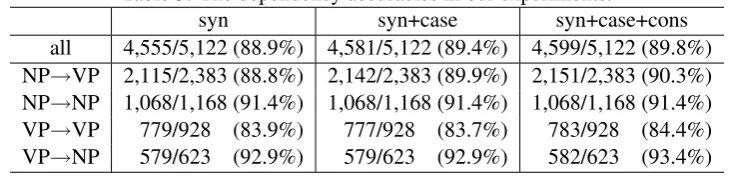
Table 3: The dependency accuracies in our experiments.
syn syn+case syn+case+cons
all 4,555/5,122 (88.9%) 4,581/5,122 (89.4%) 4,599/5,122 (89.8%) NP→VP 2,115/2,383 (88.8%) 2,142/2,383 (89.9%) 2,151/2,383 (90.3%)
NP→NP 1,068/1,168 (91.4%) 1,068/1,168 (91.4%) 1,068/1,168 (91.4%) VP→VP 779/928 (83.9%) 777/928 (83.7%) 783/928 (84.4%) VP→NP 579/623 (92.9%) 579/623 (92.9%) 582/623 (93.4%)
input was automatically tagged using the JUMAN morphological analyzer3.
We used two baseline systems for the purposes of comparison: a rule-based dependency parser (Kurohashi and Nagao, 1994) and the probabilistic generative model of dependency and case struc-ture analysis (Kawahara and Kurohashi, 2006b)4. We use the above-mentioned case frames also in the latter baseline parser, which also requires au-tomatically constructed case frames.
5.1 Evaluation of Dependency Structures We evaluated the obtained dependency structures in terms of phrase-based dependency accuracy — the proportion of correct dependencies out of all dependencies5.
Table 3 lists the dependency accuracies. In this table, “syn” represents the rule-based dependency parser, “syn+case” represents the probabilistic parser of syntactic and case structure (Kawahara and Kurohashi, 2006b)6, and “syn+case+cons” represents our proposed model. In the table, the dependency accuracies are classified into four cat-egories on the basis of the phrase classes (VP: verb phrase7and NP: noun phrase) of a dependent and its head. The parser “syn+case+cons” signif-icantly outperformed the two baselines for “all” (McNemar’s test;p <0.05). In particular, the
ac-curacy of the intra-clause (predicate-argument) re-lations (“NP→VP”) was improved by 1.5% from “syn” and by 0.4% from “syn+case.” These
im-3http://nlp.kuee.kyoto-u.ac.jp/ nl-resource/juman-e.html
4http://nlp.kuee.kyoto-u.ac.jp/ nl-resource/knp-e.html
5Since Japanese is head-final, the second to last phrase unambiguously depends on the last phrase. However, we in-clude such dependencies into our evaluation as in most of previous studies.
6The accuracy described in Kawahara and Kurohashi (2006b) is different from that of this paper due to the different evaluation measure excluding the unambiguous dependencies of the second last phrases.
7VP includes not only verbs but also adjectives and nouns with copula.
provements are due to the incorporation of the transition knowledge into syntactic/case structure analysis.
In order to compare our results with a state-of-the-art discriminative dependency parser, we in-put the test corpus into an SVM-based Japanese dependency parser, CaboCha8(Kudo and Mat-sumoto, 2002), which was trained using the Kyoto University Text Corpus. Its dependency accuracy was 88.6% (4,540/5,122), which is close to that of “syn.” This low accuracy is attributed to the lack of knowledge of both intra-clause and inter-clause relations. Another cause of the low accuracy is the out-of-domain training corpus. In other words, the parser was trained on a newspaper corpus, while the test corpus was obtained from the Web because a tagged Web corpus that is large enough to train a supervised parser is not available.
5.2 Discussions
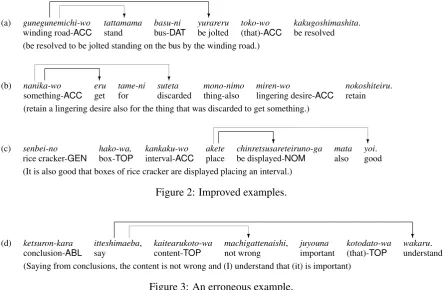
Figure 2 shows some improved analyses; here, the dotted lines represent the results of the analysis performed using the baseline “syn + case,” and the solid lines represent the analysis performed using the proposed method, “syn+case+cons.” These sentences are incorrectly analyzed by the baseline but correctly analyzed by the proposed method. For example, in sentence (a), the head of gunegunemichi-wo(winding road-ACC) was cor-rectly analyzed as yurareru (be jolted). This is because the case frame of “basu-ni yurareru” (be jolted by bus) is likely to generate tatsu (stand) that does not take thewo(ACC) slot. In this man-ner, by considering the transition knowledge be-tween case frames, the selection of case frames became accurate, and thus, the accuracy of the dependencies within clauses (predicate-argument structures) was improved.
In the case of the dependencies between pred-icates (VP→VP), however, only small
? ?
(a) gunegunemichi-wo tattamama basu-ni yurareru toko-wo kakugoshimashita. winding road-ACC stand bus-DAT be jolted (that)-ACC be resolved (be resolved to be jolted standing on the bus by the winding road.)
? ?
(b) nanika-wo eru tame-ni suteta mono-nimo miren-wo nokoshiteiru. something-ACC get for discarded thing-also lingering desire-ACC retain (retain a lingering desire also for the thing that was discarded to get something.)
? ?
[image:8.595.77.523.68.358.2](c) senbei-no hako-wa, kankaku-wo akete chinretsusareteiruno-ga mata yoi. rice cracker-GEN box-TOP interval-ACC place be displayed-NOM also good (It is also good that boxes of rice cracker are displayed placing an interval.)
Figure 2: Improved examples.
? ?
(d) ketsuron-kara itteshimaeba, kaitearukoto-wa machigattenaishi, juyouna kotodato-wa wakaru. conclusion-ABL say content-TOP not wrong important (that)-TOP understand (Saying from conclusions, the content is not wrong and (I) understand that (it) is important)
Figure 3: An erroneous example.
ments were achieved by using the transition knowledge between case frames. This is mainly because the heads of the predicates are intrinsi-cally ambiguous in many cases.
For example, in sentence (d) in Figure 3, the correct head ofitteshimaeba(say) iswakaru (un-derstand) as designated by the solid line, but our model incorrectly judged the head to be machigat-teinaishi,(not wrong) as designated by the dotted line. However, in this case, both the phrases that are being modified are semantically related to the modifier. To solve this problem, it is necessary to re-consider the evaluation metrics of dependency parsing.
6 Conclusion
In this paper, we have described a method for ac-quiring the transition knowledge of inter-clause re-lations and a method for incorporating this knowl-edge into dependency and case structure analy-sis. The significance of this study is that the pro-posed parsing method selects the best dependency and case structures that are consistent within each clause and between clauses. We confirmed that this method contributed to the improvement of the dependency parsing of Japanese.
The case frames that are acquired from 1.6 bil-lion Japanese sentences have been made freely
available to the public9. In addition, we are prepar-ing to make the acquired transition knowledge ac-cessible on the Web.
In future, we will investigate the iteration of knowledge acquisition and parsing based on the acquired knowledge. Since our parser is a gener-ative model, we are expecting a performance gain by the iteration. Furthermore, we would like to ex-plore the use of the transition knowledge between case frames to improve NLP applications such as recognizing textual entailment (RTE) and sentence generation.
References
Shuya Abe, Kentaro Inui, and Yuji Matsumoto. 2008. Acquiring event relation knowledge by learning cooccurrence patterns and fertilizing cooccurrence samples with verbal nouns. InProceedings of IJC-NLP2008, pages 497–504.
Takeshi Abekawa and Manabu Okumura. 2006. Japanese dependency parsing using co-occurrence information and a combination of case elements. In
Proceedings of COLING-ACL2006, pages 833–840.
Daniel M. Bikel. 2004. Intricacies of Collins’ parsing model. Computational Linguistics, 30(4):479–511.
Sabine Buchholz and Erwin Marsi. 2006. CoNLL-X shared task on multilingual dependency parsing. In
Proceedings of CoNLL-X, pages 149–164.
Xavier Carreras. 2007. Experiments with a higher-order projective dependency parser. InProceedings of EMNLP-CoNLL2007 Shared Task, pages 957– 961.
Timothy Chklovski and Patrick Pantel. 2004. VerbO-cean: Mining the web for fine-grained semantic verb relations. In Proceedings of EMNLP2004, pages 33–40.
Michael Collins. 1999. Head-Driven Statistical Mod-els for Natural Language Parsing. Ph.D. thesis, University of Pennsylvania.
Roxana Girju and Dan Moldovan. 2002. Mining an-swers for causation questions. In Proceedings of AAAI Spring Symposium.
Takashi Inui, Kentaro Inui, and Yuji Matsumoto. 2005. Acquiring causal knowledge from text us-ing the connective marker tame. ACM Transactions on Asian Language Information Processing (ACM-TALIP), 4(4):435–474.
Daisuke Kawahara and Sadao Kurohashi. 2006a. Case frame compilation from the web using high-performance computing. In Proceedings of LREC2006.
Daisuke Kawahara and Sadao Kurohashi. 2006b. A fully-lexicalized probabilistic model for Japanese syntactic and case structure analysis. In Proceed-ings of HLT-NAACL2006, pages 176–183.
Terry Koo, Xavier Carreras, and Michael Collins. 2008. Simple semi-supervised dependency parsing. InProceedings of ACL-08:HLT, pages 595–603. Taku Kudo and Yuji Matsumoto. 2002. Japanese
de-pendency analysis using cascaded chunking. In Pro-ceedings of CoNLL2002, pages 29–35.
Sadao Kurohashi and Makoto Nagao. 1994. A syn-tactic analysis method of long Japanese sentences based on the detection of conjunctive structures.
Computational Linguistics, 20(4):507–534.
Douglas B. Lenat. 1995. CYC: A large-scale invest-ment in knowledge infrastructure. Communications of the ACM, 38(11):32–38.
Dekang Lin and Patrick Pantel. 2001. DIRT - discov-ery of inference rules from text. InProceedings of ACM SIGKDD Conference on Knowledge Discovery and Data Mining, pages 323–328.
Dekang Lin. 1998. Automatic retrieval and cluster-ing of similar words. In Proceedings of COLING-ACL98, pages 768–774.
Mitchell Marcus, Beatrice Santorini, and Mary Marcinkiewicz. 1993. Building a large annotated corpus of English: the Penn Treebank. Computa-tional Linguistics, 19(2):313–330.
Ryan McDonald and Fernando Pereira. 2006. Online learning of approximate dependency parsing algo-rithms. InProceedings of EACL2006, pages 81–88.
Tetsuji Nakagawa. 2007. Multilingual dependency parsing using global features. In Proceedings of EMNLP-CoNLL2007 Shared Task, pages 952–956.
Joakim Nivre and Mario Scholz. 2004. Deterministic dependency parsing of English text. InProceedings of COLING2004, pages 64–70.
Joakim Nivre, Johan Hall, Sandra K¨ubler, Ryan Mc-Donald, Jens Nilsson, Sebastian Riedel, and Deniz Yuret. 2007. The CoNLL 2007 shared task on dependency parsing. In Proceedings of EMNLP-CoNLL2007, pages 915–932.
Patrick Pantel and Marco Pennacchiotti. 2006. Espresso: Leveraging generic patterns for automati-cally harvesting semantic relations. InProceedings of COLING-ACL2006, pages 113–120.
Viktor Pekar. 2006. Acquisition of verb entailment from text. In Proceedings of HLT-NAACL2006, pages 49–56.
Deepak Ravichandran and Eduard Hovy. 2002. Learn-ing surface text patterns for a question answerLearn-ing system. InProceedings of ACL2002, pages 41–47.
Manabu Sassano. 2004. Linear-time dependency anal-ysis for Japanese. InProceedings of COLING2004, pages 8–14.
David G. Stork. 1999. Character and document re-search in the open mind initiative. InProceedings of International Conference on Document Analysis and Recognition, pages 1–12.
Idan Szpektor and Ido Dagan. 2008. Learning entail-ment rules for unary templates. InProceedings of COLING2008, pages 849–856.
Kentaro Torisawa. 2006. Acquiring inference rules with temporal constraints by using Japanese coordi-nated sentences and noun-verb co-occurrences. In
Proceedings of HLT-NAACL2006, pages 57–64.