Performance Analysis of PAPR in STBC
MIMO-OFDM System under Different
Modulation Schemes
P. Vidyullatha
1, R. Chandrasekhar
2, K. Rushendra Babu
3, B. Ajay Kumar
4PG Student [DECS], Dept. of ECE, Gudlavalleru Engineering College, Gudlavalleru, India1
Assistant Professor, Dept. of ECE, Gudlavalleru Engineering College, Gudlavalleru, India2, 3, 4
ABSTRACT: Orthogonal frequency division multiplexing (OFDM) is a best method for encoding digital data on multiple carriers. The carriers are different frequencies and are orthogonal to each other. Orthogonality in OFDM reduces bandwidth usage and frequency selective fading due to multipath. The motivation behind MIMO is its data rate. MIMO provides enormous data rate and improves bit error rate. Data rate is provided by spatial multiplexing technique and bit error rate is improved by space diversity technique. Space time block coding (STBC) is a technique in MIMO which provides space diversity. The combination of both MIMO and OFDM namely Multiple-input multiple-output orthogonal frequency division multiplexing (MIMO-OFDM) is a hopeful technology for high data rate transmission in wireless communication. Peak to average power ratio (PAPR) is the main problem which occurs in MIMO-OFDM system and causes signal distortions and increases complexity in A-D and D-A. In this paper PAPR and BER values are calculated and analysis is done for MIMO-OFDM under Binary phase shift keying (BPSK), Quadrature phase shift keying (QPSK), and Quadrature amplitude modulation (16-QAM) schemes.
KEYWORDS: MIMO, OFDM, STBC.
I. INTRODUCTION
New technologies are emerged in wireless systems. The next generation mobile systems are expected to provide a high data rate to meet the requirements of future high performance multimedia applications. Initially in a system, generally the total information is send through single carrier. A single carrier system modulates information onto one carrier
using frequency, phase or amplitude [1]. This system faces information lossfrom signal reflections, impulse noise and
other impairments. Frequency division multiplexing (FDM) is an extension of single carrier modulation by using multiple sub carriers in the same single channel. Frequency division multiplexing is a form of multiplexing where non overlapping frequency channels are assigned to different signals. A guard band is left between the signals to prevent the signals from overlapping with the adjacent signal. By leaving this guard band the band width is consumed and it also decreases the systems information rate when compared to a single carrier modulation system. To use the bandwidth efficiently orthogonal frequency division multiplexing is used (OFDM) [2,3 4]. In OFDM a large number of closely spaced sub carriers which are orthogonal to each other are used to carry data. Orthogonality here says that orthogonal sub carriers are used that is the spectrum of the sub carriers are overlapped, it increases the spectral efficiency. The signals are said to be orthogonal to each other when the dot product of two signals is equal to zero. Here the signals are independent with each other. The total data sent into the channel is divided between sub carriers. Each sub-carrier is modulated with a modulation scheme (BPSK, QPSK, and QAM) where the data rates are similar to the single carrier modulation scheme in the same bandwidth [5].
II. OFDM
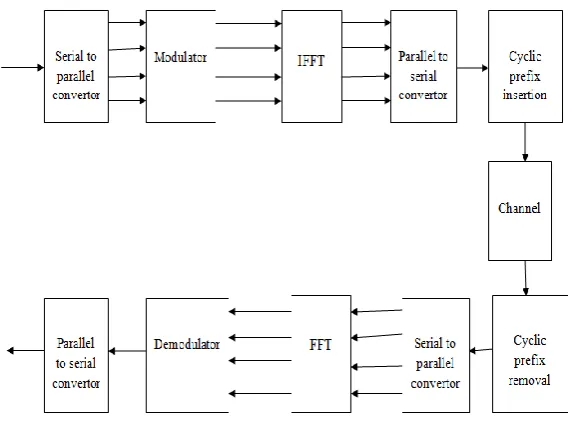
(ISI) caused by the multipath channel. The Cyclic Prefix or Guard Interval is a periodic extension of the last part of an OFDM symbol that is added to the front of the symbol in the transmitter, and is removed at the receiver before demodulation. At the receiver side, removal of the cyclic prefix is performed and then signals are given to serial to parallel converter block where the signals are converted to parallel data and the output of the S/P block is given to FFT block. The FFT block converts the time domain signal to frequency domain signal. The output bit stream is obtained by converting the output of the FFT block into a serial bit stream [7, 8].
Fig. 1 Block diagram of OFDM system.
III. MIMO
Multiple inputs multiple output (MIMO) is one of the advancements regarding digital communications. To improve bit error rate performance and provide high data rate MIMO is used. There are two techniques in MIMO with respect to how data is transmitted across the given channel. They are spatial diversity and spatial multiplexing.
Spatial Diversity: It is a type of Diversity in which two (or) more number of signals sent over different paths by using multiple antennas at transmitting and receiving sides.
Fig. 2 Block Diagram of Spatial Diversity
receivers and in the same way MISO means having multiple transmitters and single receiver. To get better results both
OFDM and MIMO techniques are combined therefore MIMO-OFDM system is introduced
.
Fig.3. Block Diagram of Spatial Multiplexing
IV. MIMO-OFDM SYSTEM MODEL
MIMO-OFDM block diagram is shown in the figure 4. In that information source generates the random data, the data is given to the modulator and the modulation schemes followed here are BPSK, QPSK, and QAM. The modulated data is given to the space time block coding (STBC) encoder. Space time block coding is a method used in the spatial diversity which increases reliability. As said above here multiple copies of same data is sent across independent fading channels, if each channel is suffered by fading, each channel has different fading effect. So among all channels any one channel may suffer with less fading compared to others. So the chance of receiving the proper transmitted data is more and improves the reliability of the system. The encoded data is given to the Inverse Fast Fourier Transform (IFFT) block, where the time domain signal is converted into frequency domain. At the end of the transmitter peak to average power ratio (PAPR) value is calculated and finally the data is sent to the receiving antennas by using transmitting antennas. At the receiver side first FFT operation is performed this scheme; this processed data is decoded using STBC decoder. Decoder gives the appropriate signal from all receiving signals after that demodulation operation is performed finally original information is received at destination [11, 12, 13].
Fig.4 Block diagram of MIMO-OFDM
V. PEAK TO AVERAGE POWER RATIO
are usually undesirable for it usually strains the analog circuitry. High PAPR signals would require a large range of dynamic linearity from the analog circuits which usually results in expensive devices and high power consumption with lower efficiency (for e.g. power amplifier has to operate with larger back-off to maintain linearity). In OFDM system, some input sequences would result in higher PAPR than others. For example, an input sequence that requires all such carriers to transmit their maximum amplitudes would certainly result in a high output PAPR. Thus by limiting the possible input sequences to a smallest sub set, it should be possible to obtain output signals with a guaranteed low output PAPR. The ratio of peak to average power value is termed as PAPR. This is the problem which occurs in MIMO-OFDM system. Because of multiple subcarriers power output increases greatly and become higher than the mean power of the system. To transmit the signals with high PAPR requires power amplifiers with high power. These are very expensive. PAPR reduces the performance increases the complexity in A-D and D-A convertors and reduces the efficiency of RF amplifiers.
)
(
)
(
2 2 maxt
x
t
x
EPAPR Where,
(
)
2
max
x
t
=Peak Signal Power
(
)
2t
x
E =Average Signal Power.
VI. RESULTS AND DISCUSSION
The evaluation of PAPR is examined by MATLAB simulation. To evaluate the performance, the complementary cumulative distribution (CCDF) is used. The CCDF of PAPR for OFDM signal x is,
ccdf (papr(x)) = PT (papr(x) > papr 0
The CCDF of the PAPR denotes the probability that the PAPR of a data block exceeds a given threshold. The PAPR and BER are calculated under different modulation schemes for a MIMO-OFDM system.
A. PAPR Performance :
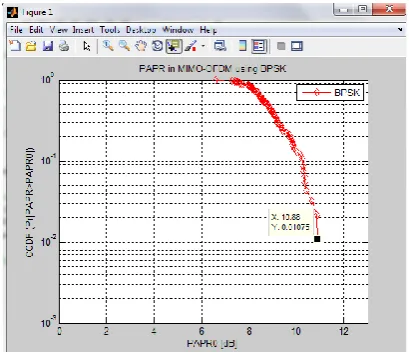
Fig. 5 CCDF plot for a MIMO-OFDM system for BPSK
Fig. 6 CCDF plot for a MIMO-OFDM system for QPSK
Figure 6 shows the CCDF plot for a MIMO-OFDM system under QPSK modulation scheme where PAPR value is 8.642 db at CCDF 0.021.
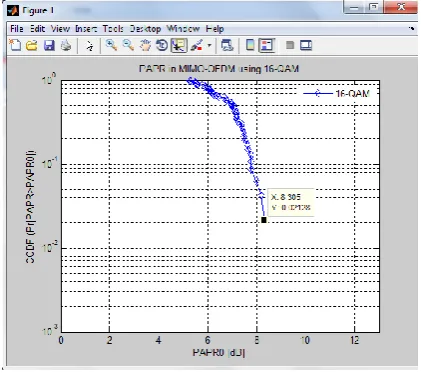
Fig. 7 CCDF plot for a MIMO-OFDM system for QAM
Figure 7 shows the CCDF plot for MIMO-OFDM system under QAM modulation scheme where PAPR value is 8.305db at CCDF 0.021. Compared to BPSK modulation, QAM modulation has degradation in PAPR value from 10.88db to 8.305db. Therefore QAM modulation has less PAPR.
VII. BIT ERROR RATE
If the signal to noise ratio is high and medium between the transmitter and receiver is good then the bit error rate will be very small-possibly insignificant and having no noticeable effect on the overall system However if noise can be detected, then there is chance that the bit error rate will need to be considered
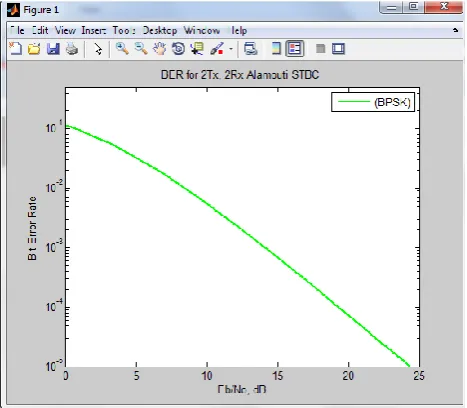
Fig.8 Simulation result for MIMO-OFDM system for BPSK modulation
Figure 8 shows the plot for bit error rate of 2*2 MIMO-OFDM systems for BPSK modulation and bit error rate is 24
Fig.9 Simulation result for MIMO-OFDM system for QPSK modulation
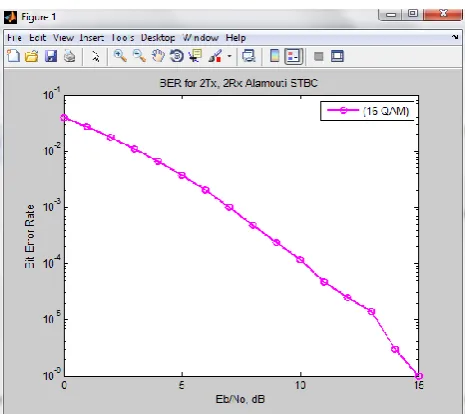
Fig.10 Simulation result for MIMO-OFDM system for QAM modulation
Figure 10 shows the plot for bit error rate of 2*2 MIMO-OFDM systems for QAM modulation and the value is 15. Comparing these modulation techniques, QAM modulation has better results with less bit error rate.
VIII. CONCLUSION
In this paper the performance of MIMO OFDM system by using different modulation schemes (BPSK, QPSK) under various fading channels (RAYLEIGH CHANNEL and AWGN CHANNEL) is analysed. The bit error rate for the OFDM and also for the MIMO-OFDM systems is calculated and compared for the different SNR values. After analysing the results, BPSK and QPSK in OFDM has greater bit error rates when compared to the BPSK and QPSK in MIMO-OFDM. This is because of the STBC coding. In STBC we are sending the same symbol two times in the orthogonal passion. So it can reduce the fading effect and also if at all a receiver is failed to receive the symbol in one time slot it can receive the symbol in another time slot so the information may not be lost.
REFERENCES
[1] Sen-Hung Wang ,Chih-Peng Li, Kuan-Chou Lee and Hsuan-Jung Su, “A Novel Low- Complexity Precoded OFDM System With Reduced PAPR”, IEEE Transactions On Signal Processing, VOL. 63, No. 6, on MARCH 15, 2015.
[2] Yong Wang, Chao Yang, and Bo Ai, “Iterative Companding Transform and Filtering for Reducing PAPR of OFDM Signal”, IEEE Transactions on Consumer Electronics, Vol. 61, No. 2, May 2015.
[3] Ying-Che Hung and Shang-Ho (Lawrence) Tsai, “PAPR Analysis and Mitigation Algorithms for Beamforming MIMO OFDM Systems”, IEEE Transactions on Wireless Communications, VOL. 13, No. 5, MAY 2014.
[4] Seyran Khademi and Alle-Jan van der Veen, “Constant Modulus Algorithm for Peak-to-Average Power Ratio (PAPR) Reduction in MIMO OFDM/A” IEEE Signal Processing Letters, Vol. 20, No. 5, MAY 2013.
[5] Yasir Rahmatallah, Seshadri Mohan, “Peak-To-Average Power Ratio Reduction in OFDM Systems: A Survey And Taxonomy” IEEE Communications Surveys & Tutorials, Vol. 15, No. 4, Fourth Quarter 2013.
[6] Tao Jiang, Chunxing Ni, and Lili Guan, “A Novel Phase Offset SLM Scheme for PAPR Reduction in Alamouti MIMO-OFDM Systems Without Side Information” IEEE Signal Processing Letters, Vol. 20, NO. 4, APRIL 2013.
[7] Kitaek Bae, Changyong Shin and Edward J. Powers, “Performance Analysis of OFDM Systems with Selected Mapping in the Presence of Nonlinearity” IEEE Transactions On Wireless Communications, Vol. 12, NO. 5, MAY 2013.
[8] T. Jiang and Y.Wu, “An overview: Peak-to-average power ratio reduction techniques for OFDM signals,” IEEE Trans. Broadcast., vol. 54, no. 2,pp. 257–268, Jun. 2008.
[9] Seung Hee Han, Stanford University Jae Hong Lee, Seoul National University, MIMO-OFDM, “An Overview of Peak-To-Average Power Ratio Reduction Techniques For Multicarrier Transmission” IEEE Wireless Communications, April 2005.
[10] D. Wulich, “Reduction of peak to mean ratio of multicarrier modulation using cyclic coding,” IEE Electronics Letters, vol. 32, no. 29, pp.432– 433, Feb. 1996.
[12] T. Jiang and G. X. Zhu, “OFDM peak-to-average power ratio reduction by complement block coding scheme and its modified version,” in The 60th IEEE Vehicular Technology Conference 2004 Fall, Los Angeles, USA, Sept. 2004, pp. 448–451.
[13] T. Jiang, W. D. Xiang, P. C. Richardson, J. H. Guo, and G. X. Zhu, “PAPR reduction of OFDM signals using partial transmit sequences with low computational complexity,” IEEE Trans. Broadcasting, vol. 53, no. 3, pp. 719–724, Sept. 2007.
[14] S. Litsyn and G.Wunder, “Generalized bounds on the crest-Factor distribution of OFDM signals with applications to code design,” IEEE Trans. Information Theory, vol. 52, no. 3, pp. 992–1006, Mar. 2006.