Evaluate the Effectiveness and Progress of the Bluetooth Wireless
Sensor Network Contains Low Energy (BLE) To Monitor Wireless
Network Ordnance Survey
1 M.MAHESHWARI
, 2 P.POORNIMA,3 Dr.K.SHIVA KUMARA SWAMY 1
PG Scholar, Department of ECE,Sphoorthy Engineering College. Nadergul,R.R.Dist.Telangana 2
PHD SCHOLAR, Associate Professor, Department of ECE,Sphoorthy Engineering College.
Nadergul,R.R.Dist.Telangana.
3.PHD,HOD, Department of ECE,Sphoorthy Engineering College. Nadergul,R.R.Dist.Telangana
ABSTRACT:
WBAN nodes which have blocked RF links because of body shadowing forward their data with
the BCC connect to a node that functions like a relay and it has an energetic RF connection. With
this architecture we design a network layer protocol that manages the 2 communication
technologies and accounts for relay selection and knowledge forwarding. To resolve this issue
we present a brand new WBAN architecture that utilizes two communication technologies. One
network is created between on-body nodes, and it is recognized with capacitive body-combined
communication (BCC), while an IEEE 802.15.4 RF (RF) network can be used for forwarding
data towards the gateway. Within this paper we're worried about the issue of information
forwarding from the wireless body area network (WBAN) to some gateway when body
shadowing affects ale WBAN nodes to talk with the gateway. Next, we develop analytical
performance types of the medium access control (MAC) methods of these two independent
communication links to become employed for driving the choices from the previous calculations.
Finally, the analytical models can be used for further optimizing energy and delay efficiency. We
test our bodies under different designs first by carrying out simulations and then by utilizing real
RF traces.
Keywords: Wireless body area network (WBAN), body sensor network (BSN), body
shadowing, capacitive body-coupled communication, optimization
I. INTRODUCTION
Energy consumption may also be key for
your prolonged operation in the items
attached to the body. For communication
needs these WBANs usually employ RF
commercial, scientific and medical (ISM)
radio band? In many programs where
wireless body area systems (WBAN) are
deployed round the body, reliable and
periodic delay communication is critical
because of the critical nature in the collected
data. However, it is also easy to utilize the
broadly popular wireless LAN (WLAN)
standard IEEE 802.11because in the readily
available doorway (AP) infrastructure.
Regardless of the specific wireless
communication technology, when multiple
sensors are deployed inside you, a WBAN in
the star topology is usually created to make
sure that all the on-body nodes speak with a
gateway for forwarding the collected data.
Although RF could be the only practical
mechanism to forward data in this particular
scenario, still several significant problems
remain. RF signals suffer considerably from
body shadowing in the highly variable way
regarding body. This makes communication
between on-body nodes, in addition to
off-body, very difficult to depend on. This
natural unreliability of RF communication
round the body can be a critical problem for
a lot of real-existence programs. We discuss
two emerging application situations here to
motivate our physiques design [1]. As one
example of vital sign monitoring where
multiple nodes need to be deployed in many
different places from the body. Readers are
usually flowing inside the uplink direction,
i.e., within the WBAN nodes for the
gateway. Consider say for example a human
with a node round the torso then one round
the wrist for monitoring the middle rate.
When the human can be a patient lounging
during intercourse, your RF link in the
sensor round the torso might be completely
blocked. Besides health monitoring, another
essential application is real-time media
entertainment [2]. While using rising
recognition of wearable items, it's even
feasible that high data rate video streams
need to be posted in the body (uplink). In
this particular paper we advise manuscript
WBAN architecture, a network layer
(NWK) protocol that exploits the
recommended architecture, plus an
optimization framework according to an
analytical performance kind of the device.
When the RF link from the node is difficult
to depend around the node uses the BCC
link for forwarding its data with the body
with a node getting a much better RF link.
The reason from the design choice is
founded on the power-efficient BCC
technology you should use instead of RF
communication. Prototype BCC transceivers
use simple baseband communication this
a completely new cooperative WBAN
architecture that employs two
communication technologies namely BCC
and RF. This architecture is orchestrated
having a novel NWK relay selection
protocol that identifies the right relay for
forwarding the data in the body. The
recommended plan's unlike any existing
relay selection techniques since two
different communication technologies are
used. Second, for each medium access
control (MAC) protocol in the RF and BCC
sub systems we develop accurate
expressions in the delay and consumption
just like a reason for specific protocol
parameters [3]. Our novel contributions here
include first the performance modeling from
the NWK that concurrently uses two
wireless MAC/PHY technologies. Second,
our model can be a mix-technology model.
We advise while using analytical
performance models for additional
optimization in the duty cycling in the BCC
transceivers as well as the retransmission
manner of the RF transceivers to make sure
that energy consumption and delay are
minimized. Benefits. The initial advantage is
always that items getting a blocked RF link
may use the relaxation from the nodes for
forwarding their data with a gateway and
improve thus the durability from the
information delivery. Second, RF
transmissions are reduced to minimum since
WBAN nodes don't speak with each other
using the RF link. The benefit is the RF link
is moving a lesser load as well as the
interference to surrounding RF items may
also be minimized. The Next advantage is
always that a node by getting an RF link that
is not completely blocked, but works
inefficiently, can speak with other nodes
through BCC and select another node for
data forwarding. Performance is evaluated
both through simulations in addition to by
utilizing real RF traces.
II. PREVIOUS WORK
Within this paper we cope with the issue of
optimizing data delivery from the WBAN to
some gateway. The issue is challenging
because communication between on-body
and off body nodes is extremely hard to rely
on. Probably the most promising method to
attack the issue is through cooperation
between WBAN nodes. With cooperation
the nodes that help with forwarding the
information of other nodes would be the
relays. There's an array of works that
concentrate on choosing the perfect relay
within the general situation of wireless
sensor systems (WSN) by thinking about
works have focused in WBANs. Nearly all
research works investigated cooperation in
WSNs/WBANs with the aim to reduce
power consumption. Our solution includes a
new WBAN architecture along with a novel
cooperative protocol design that's based on
an analytical performance model. With this
system even if a minimum of one node
comes with an active RF link the
information of the entire WBAN node will
achieve the gateway [4]. A communication
protocol that utilizes two technologies was
presented our approach is considerably
different.
Fig.1 Block Diagram of the system
III. SYSTEM COMPONENTS
ARM:
The ARM (Acorn RISC Machine)
architecture is developed at Acorn Computer
Limited of Cambridge, England between
1983-1985. ARM Limited founded in 1990.
ARM became as the Advanced RISC
Machine is a 32-bit RISC processor
architecture that is widely used in embedded
designs. ARM cores licensed to
semiconductor partners who fabricate and
sell to their customers. ARM does not
fabricate silicon itself Because of their
power saving features, ARM CPUs are
dominant in the mobile electronics market,
where low power consumption is a critical
design goal. As of 2007, about 98 percent of
the more than a billion mobile phones sold
each year use at least one ARM CPU.
Today, the ARM family accounts for
approximately 75% of all embedded 32-bit
RISC CPUs, making it the most widely used
32-bit architecture. ARM CPUs are found in
most corners of consumer electronics, from
portable devices (PDAs, mobile phones,
iPods and other digital media and music
players, handheld gaming units, and
calculators) to computer peripherals (hard
drives, desktop routers). ARM does not
manufacture the CPU itself, but licenses it to
other manufacturers to integrate them into
their own system
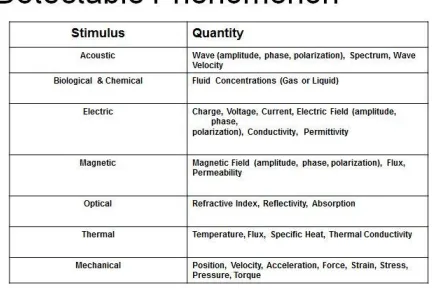
Sensors:
American National Standards Institute
A device which provides a usable
output in response to a specified
measure and
A sensor acquires a physical
parameter and converts it into a
signal suitable for processing (e.g.
optical, electrical, mechanical)
A transducer Microphone, Loud Speaker,
Biological Senses (e.g. touch, sight,…ect)
Temperature Sensor:
The LM35 series are precision
integrated-circuit temperature sensors, whose output
voltage is linearly proportional to the
Celsius (Centigrade) temperature. The
LM35 thus has an advantage over linear
temperature sensors calibrated in Kelvin, as
the user is not required to subtract a large
constant voltage from its output to obtain
convenient centigrade scaling. The LM35
does not require any external calibration or
trimming to provide typical accuracies of
±1/4°C at room temperature and ±3/4°C
over a full -55 to +150°C temperature range.
Low cost is assured by trimming and
calibration at the wafer level. The LM35’s
low output impedance, linear output, and
precise inherent calibration make interfacing
to readout or control circuitry especially
easy. It can be used with single power
supplies, or with plus and minus supplies.
As it draws only 60 µA from its supply, it
has very low self-heating, less than 0.1°C in
still air. The LM35 is rated to operate over a
-55° to +150°C temperature range, while the
LM35C is rated for a -40° to +110°C range
(-10° with improved accuracy). The LM35
series is available packaged plastic TO-92
transistor package. The LM35D is also
available in an 8-lead surface mount small
outline package and a plastic TO-220
package.
Fig : Temperature Sensor
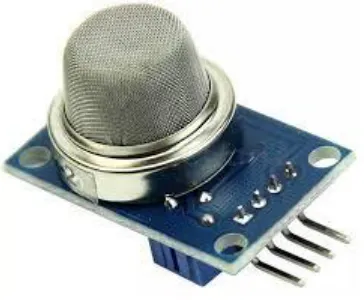
Fig: Smoke Sensor
A mechanical device that is sensitive to
smoke or particular material in the air that
transmits a signal to the measuring
instrument. Smoke detector consists of two
parts:
A sensor to sense the smoke .
Electronic horn to horn the people
Humidity Sensor
Fig : Humidity Sensor
Humidity is the presence of water in air. The
amount of water vapor in air can impact
human comfort as good as many
manufacturing processes in industries. The
presence of water vapor also influences
more than a few bodily, chemical, and
biological methods. Humidity dimension in
industries is vital due to the fact that it's
going to impact the trade fee of the product
and the well being and safeguard of the
personnel. Consequently, humidity sensing
is very principal, specifically within the
control programs for industrial techniques
and human alleviation.
Heart beat Sensor:
Fig : Heart Beat Sensor
This heart beat sensor is designed to give
digital output of heart beat when a finger is
placed on it. When the heartbeat detector is
working, the top-most LED flashes with
each heart beat. This digital output can be
measure the Beats Per Minute (BPM) rate. It
works on the principle of light modulation
by blood flow through finger at each
pulse. Module dual output mode, digital
output is simple, serial output with exact
readings.
IV. METHODOLOGY
All of the nodes that are members of the RF
network can connect with a gateway for
forwarding the collected data. Each wireless
link has different delay/energy qualities
because of funnel versions. We think about a
WBAN that includes N nodes where each
node is outfitted by having an RF
transceiver along with a BCC transceiver.
Both of these hardware components use
different MAC/PHY methods and therefore
are both controlled from the specialized
NWK protocol. While only Nr nodes are
members of the RF network, all of the N
nodes have fun playing the BCC network.
Non-relay nodes transmit their packets with
the BCC connect to among the relays, as the
selected relay transmits wirelessly towards
the gateway the in your area produced and
submitted data packets. Nodes that don't
have a relay responsibility are permitted to
place into sleep mode the RF transceiver for
lowering the energy consumption. However,
as it is entirely possible that later on they
assume the function of the RF relay, they
awaken periodically, they transmit an RF
packet, and after they get a response they
update the received signal strength
indication (RSSI) worth of their RF link. A
no beacon-enabled and united
nations-slotted carrier sense multiple accesses with
collision avoidance (CSMA/CA) formula
are assumed for funnel access. All of the
nodes sense the funnel status throughout the
obvious funnel assessment (CCA) slots. The
fundamental concept of the united
nations-slotted CSMA/CA formula is the fact that
back off and packet transmissions aren't
aligned to a particular slot limitations. BCC
without needing skin contact could be
recognized with two electrode
transmitter/receiver products capacitive
combined to the body Concerning the MAC
layer it's a protocol that utilizes the
well-known idea of low power listening. The
foremost and primary task in our distributed
WBAN product is to calculate the perfect
subset of Nr RF relays all the accessible
nodes, as the second task would be to
forward the information with the optimal
relay as needed. When an RF node isn't a
relay, the RF transceiver is deactivated
simply by entering an idle condition so it
needs to enter an energetic condition to
estimation is a nearby task each and every
RF node that's performed automatically in
IEEE 802.15.4 for each received packet and
thus no extra overhead is created by our plan
while collecting the data and broadcasting
it's an important task, it's also critical to
make sure that the incoming information in
a node is correctly processed.
RESULTS:
FIG:
IV. CONCLUSIONS
The performance gains are materialized not
just using the novel WBAN architecture, but
additionally having a NWK protocol that
utilizes an formula for RF relay selection
and packet forwarding driven with a
performance model. In addition, the
mix-technology performance models are used for
local optimization from the MAC
parameters from the methods that be
employed in the BCC and RF sub systems.
In traditional RF-based WBANs when
confronted with body shadowing there's a
simple compromise: Either consumes more
energy for retransmissions or funnels coding
to be able to increase reliability and suffer
also greater delay, or reduces delay and at
the expense of reduced reliability. However,
we shown the above doesn't have is the
delay/energy-efficient secondary link
(within this situation BCC) to be able to
select the best RF link for forwarding
WBAN data to some gateway. The
performance results indicate the suggested
product is more effective than the usual
condition-of-the-art plan when it comes to
energy and delay under different realistic
funnel conditions, application loads, and
gratification constraints. The possibility
concern concerning the suggested product is
the requirement for two different
technologies. However, existing IC
technology already enables the combination
of multiple transceivers in one nick. Our
future work is going to be focused first
around the optimal configuration of other
system parameters like the amount of used
relays and also the content from the sent
packets. Next, we plan to investigate
potential together with your suggested
system.
REFERENCES
[1] A. Fazzi, S. Ouzounov, and J. van den
Homberg, “A 2.75mw wideband
correlation-based transceiver for body-coupled
communication,” in Proc. IEEE Int.
Solid-State Circuits Conf.-Dig.Tech. Papers, 2009,
pp. 204–205.
[2] T. Kim, J. Park, H. Chong, K. Kim, and
B. Choi, “Performance analysis of IEEE
802.15.4 non-beacon mode with the
unslotted CSMA/CA,” IEEE Comm. Lett.,
vol. 12, no. 4, pp. 238–240 Apr. 2008.
[3] D. Cavalcanti, R. Schmitt, and A.
Soomro, “Performance analysis of 802.15.4
and 802.11e for body sensor network
applications,” in Proc. 4th Int. Workshop
[4] A. G. Ruzzelli, R. Jurdak, G. M. O’Hare,
and P. Van Der Stok, “Energy-efficient
multi-hop medical sensor networking,” in
Proc. ACM 1st SIGMOBILE Int. Workshop
Syst. Netw. Support Healthcare Assisted
Living Environ. 2007, pp. 37–42.
[5] J. Elias and A. Mehaoua, “Energy-aware
topology design for wireless body area
networks,” in Proc. IEEE Int. Conf.