Lee Young Cheol. Biomed J Sci & Tech Res
Short Communication
Open Access
The Potential Usefulness of Several Insects and Fatty
Acids in Allergic Disorders
Young Cheol Lee*
Department of Herbology, Sangji University, Republic of Korea
Received: January 18, 2019; Published: January 25, 2019
*Corresponding author:Lee Young Cheol, Department of Herbology, Sangji University, Wonju 220-702, Republic of Korea
Introduction
Insect medicine is an old ancient medicinal concept that is still used in Asia. It can be understood as the traditional animal species medicines, including the dried animal bodies, secretions and processing natural products of medicinal insects. Entomotherapy is the use of insects as medicines and is an important complementary and alternative to modern therapy in many parts of the world [1]. One of the most considerable differences in the drug materials in East Asian traditional and modern scientific medicines is the use of insects [2,3]. Nutritionally, insects are high in protein and fat compared with typical dietary items like fruit and vegetation. In small quantities, they may serve to provide important fatty acids. It is well known that insects are not only selected based on their environmental availability, but also their nutrient composition. Insects can play a key role (in anti-inflammatory responses by inhibiting (secreting) inflammatory mediators) in the diet of many nations. Their high nutritive value is mainly determined by a high content of protein, essential fatty acids, vitamins, minerals and other bioactive substances [4].
Potential Usefulness of Fatty Acids
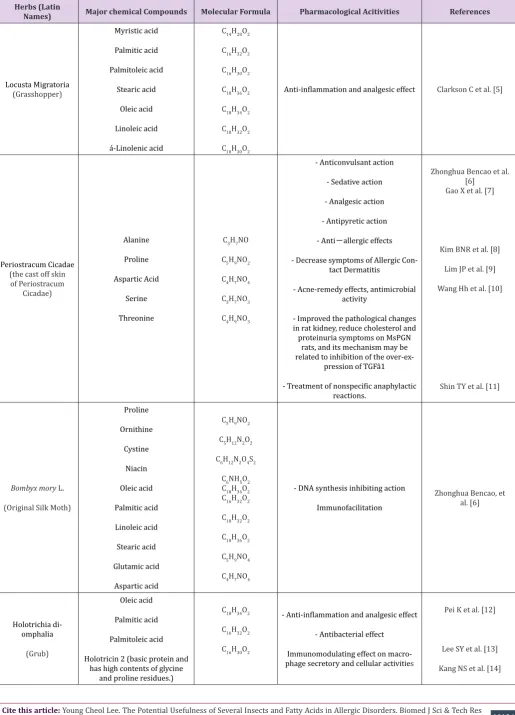
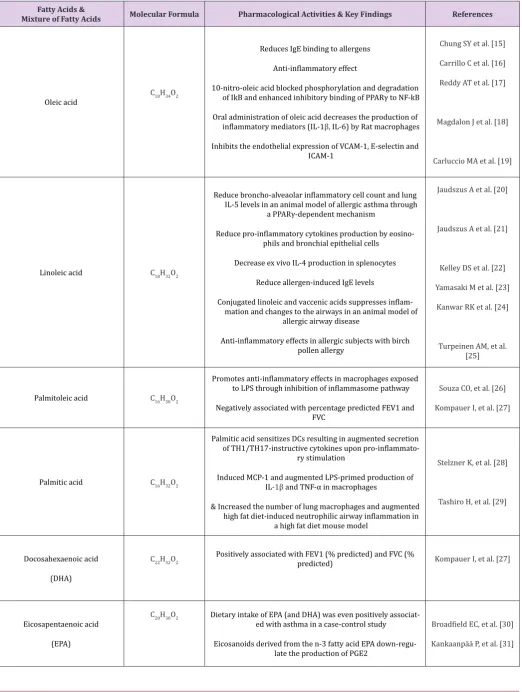
As shown Table 1 [5-14], the major components of medicinal insects were myristic acid, oleic acid, palmitic acid and palmitoleic acid. There are many kinds of necessary amino acids and inorganic elements for mankind in insects. As shown Table 2 [15-33], oleic acid reduces IgE binding to allergens and decreases the production of inflammatory mediators by inhibition the endothelial expression of VCAM-1, E-selectin and ICAM-1. Linoleic acid reduces broncho-alveolar inflammatory cell count and lung IL-5 levels in an animal model. Also, it reduces proinflammatory cytokines production by eosinophils and bronchial epithelial cells. Palmitoleic acid promotes anti-inflammatory effects in macrophages exposed to LPS. Howev-er, palmitic acid sensitizes dendritic cells resulting in augmented secretion of Th1/Th17 cytokines upon proinflammatory stimu-lation. n-3 PUFA may directly regulate the function of the effector cells that mediate the allergic inflammatory response. Increased n-3 PUFA preferentially modulate the Th2-cell response, there was a marked down-regulation of IL-5, IL-9, IL-13 and RANTES n-3 PUFA suppress FcεRI-mediated activation of mast cells.
Abstract
Insects are the largest and widely distributed group of animals and contain high quality essential fatty acids, proteins and minerals. Insects,
which relieves pain, can play a key role in anti-inflammatory responses by inhibiting inflammatory mediators and are used as a medicine for the treatment of inflammatory diseases. We hypothesized that potential insects and their main ingredients regulates airway inflammation and asthma
and can be developed as therapeutic drugs for the treatment of asthma. In our review we try to show the potential usefulness of insects and fatty acids in searching for new therapeutic solutions for allergic diseases. We summaries the knowledge about properties of insect fatty acids to indicate
usefulness of knowledge about insect fatty acids in drug design. The field of possible using of insect and their fatty acids delivered to therapy of various human allergic diseases is still not sufficiently investigated. Undoubtedly, more attention should be paid to insects and their fatty acids due
Herbs (Latin
Names) Major chemical Compounds Molecular Formula Pharmacological Acitivities References
Locusta Migratoria (Grasshopper)
Myristic acid
Palmitic acid
Palmitoleic acid
Stearic acid
Oleic acid
Linoleic acid
á-Linolenic acid
C14H28O2
C16H32O2
C16H30O2
C18H36O2
C18H34O2
C18H32O2
C18H30O2
Anti-inflammation and analgesic effect Clarkson C et al. [5]
Periostracum Cicadae (the cast off skin of Periostracum
Cicadae)
Alanine
Proline
Aspartic Acid
Serine
Threonine
C3H7NO
C5H9NO2
C4H7NO4
C3H7NO3
C4H9NO3
- Anticonvulsant action
- Sedative action
- Analgesic action
- Antipyretic action
- Anti-allergic effects
- Decrease symptoms of Allergic Con-tact Dermatitis
- Acne-remedy effects, antimicrobial activity
- Improved the pathological changes in rat kidney, reduce cholesterol and proteinuria symptoms on MsPGN
rats, and its mechanism may be
related to inhibition of the over-ex -pression of TGFâ1
- Treatment of nonspecific anaphylactic
reactions.
Zhonghua Bencao et al. [6]
Gao X et al. [7]
Kim BNR et al. [8]
Lim JP et al. [9]
Wang Hh et al. [10]
Shin TY et al. [11]
Bombyx mory L.
(Original Silk Moth)
Proline
Ornithine
Cystine
Niacin
Oleic acid
Palmitic acid
Linoleic acid
Stearic acid
Glutamic acid
Aspartic acid
C5H9NO2
C5H12N2O2
C6H12N2O4S2
C6NH5O2 C18H34O2 C16H32O2
C18H32O2
C18H36O2
C5H9NO4
C4H7NO4
- DNA synthesis inhibiting action
Immunofacilitation
Zhonghua Bencao, et al. [6]
Holotrichia di-omphalia
(Grub)
Oleic acid
Palmitic acid
Palmitoleic acid
Holotricin 2 (basic protein and has high contents of glycine
and proline residues.)
C18H34O2
C16H32O2
C16H30O2
- Anti-inflammation and analgesic effect
- Antibacterial effect
Immunomodulating effect on macro-phage secretory and cellular activities
Pei K et al. [12]
Lee SY et al. [13]
Table 2: Summary of major fatty acids and their biological activities in the development of lung diseases like asthma or COPD. Fatty Acids &
Mixture of Fatty Acids Molecular Formula Pharmacological Activities & Key Findings References
Oleic acid C18H34O2
Reduces IgE binding to allergens
Anti-inflammatory effect
10-nitro-oleic acid blocked phosphorylation and degradation of IkB and enhanced inhibitory binding of PPARγ to NF-kB Oral administration of oleic acid decreases the production of
inflammatory mediators (IL-1β, IL-6) by Rat macrophages
Inhibits the endothelial expression of VCAM-1, E-selectin and
ICAM-1
Chung SY et al. [15]
Carrillo C et al. [16]
Reddy AT et al. [17]
Magdalon J et al. [18]
Carluccio MA et al. [19]
Linoleic acid C18H32O2
Reduce broncho-alveaolar inflammatory cell count and lung
IL-5 levels in an animal model of allergic asthma through a PPARγ-dependent mechanism
Reduce pro-inflammatory cytokines production by eosino -phils and bronchial epithelial cells
Decrease ex vivo IL-4 production in splenocytes
Reduce allergen-induced IgE levels
Conjugated linoleic and vaccenic acids suppresses inflam -mation and changes to the airways in an animal model of
allergic airway disease
Anti-inflammatory effects in allergic subjects with birch
pollen allergy
Jaudszus A et al. [20]
Jaudszus A et al. [21]
Kelley DS et al. [22]
Yamasaki M et al. [23]
Kanwar RK et al. [24]
Turpeinen AM, et al. [25]
Palmitoleic acid C16H30O2
Promotes anti-inflammatory effects in macrophages exposed to LPS through inhibition of inflammasome pathway
Negatively associated with percentage predicted FEV1 and FVC
Souza CO, et al. [26]
Kompauer I, et al. [27]
Palmitic acid C16H32O2
Palmitic acid sensitizes DCs resulting in augmented secretion
of TH1/TH17-instructive cytokines upon pro-inflammato -ry stimulation
Induced MCP-1 and augmented LPS-primed production of IL-1β and TNF-α in macrophages
& Increased the number of lung macrophages and augmented
high fat diet-induced neutrophilic airway inflammation in
a high fat diet mouse model
Stelzner K, et al. [28]
Tashiro H, et al. [29]
Docosahexaenoic acid
(DHA)
C22H32O2 Positively associated with FEV1 (% predicted) and FVC (% predicted) Kompauer I, et al. [27]
Eicosapentaenoic acid
(EPA)
C20H30O2 Dietary intake of EPA (and DHA) was even positively associat-ed with asthma in a case-control study
Eicosanoids derived from the n-3 fatty acid EPA down-regu-late the production of PGE2
Broadfield EC, et al. [30]
Mixture of fatty acids (1)
n-3 PUFA
(EPA, DHA are the main active forms of n-3 PUFA)
C20H30O2 (EPA)
C22H32O2
(DHA)
n-3 PUFA may directly regulate the function of the effector
cells that mediate the allergic inflammatory response
Increased n-3 PUFA preferentially modulate the Th2-cell response, there was a marked down-regulation of IL-5, IL-9,
IL-13 and RANTES
n-3 PUFA suppress FcεRI-mediated activation of mast cells
Bilal S, et al. [32]
Wang X, et al. [33]
Conclusion
Therefore, above results provide evidence about the potential usefulness of the mixture of fatty acids from medicinal insects in allergic disorders. Overall, fatty acids have various roles in the way they affect the immune system and allergic responses and no single dietary fatty acid is suitable for treating allergic disorders. It is necessary to conduct more large scale studies with relevant animal models to arrive at meaningful recommendations for various fatty acid interventions for clinical usefulness. Further scientific research will be accomplished. This issue is and will be subject of work of many researchers from different areas.
Acknowledgment
This work was supported by the National Research Foundation of Korea (NRF) grant funded by the Korea government (MSIT) (grant number 2016R1A2B4006269).
References
1. Seabrooks L, Hu L (2017) Insects: an underrepresented resource for the discovery of biologically active natural products. Acta Pharm Sin B 7(4): 409-426.
2. Pemberton RW (1999) Insects and other arthropods used as drugs in Korean traditional medicine. J Ethnopharmacol 65(3): 207-216. 3. Namba T, Ma YH, Inagaki K (1988) Insect-derived crude drugs in Chinese
Song Dynasty. Journal of Ethnopharmacology 24(2-3): 247-285. 4. Mlcek J, Rop O, Borkovcova M, Bednarova M (2014) A Comprehensive
Look at the Possibilities of Edible Insects as Food in Europe Europe-a Review. Pol J Food Nutr Sci 64(3): 147-157.
5. Clarkson C, Mirosa M, Birch J (2018) Potential of Extracted Locusta
Migratoria Protein Fractions as Value-Added Ingredients. Insects 9(1): 1-12.
6. Zhonghua Bencao (1999) Editorial Committee of National Administrative Bureau on Chinese Medicine Chinese Herbal Medicine. Shanghai Science and Technology Pub Co, Shanghai 9: 129-231.
7. Gao X, Hong L, Jia H, Li Wd, Xu Lp (2015) Study on anti-allergic effects
and primary mechanism of ultrafine powder of Periostracum cicadae.
Heilongjiang Animal Science and Veterinary Medicine 12: 22-25. 8. Kim BNR, Chae JW (2015) Effects of Cicadae Periostracum (CP) in
Allergic Contact Dermatitis (ACD) Induced by DNCB in Mice. J Pediatr Korean Med 29: 1-15.
9. Lim JP (2010) Acne-remedy Effects of Extract Mixture of Pulsatillae Radix and Cicadidae Periostracum. Korean J Oriental Physiology &
Pathology 24(4): 653-660.
10. Wang Hh, Bao H, Yu Js, Lu H, Zhao Zq (2012) Experimental Study of Periostracum Cicadae and Bombyx Batryticatusin the Treatment of
Mesangial Proliferative Glomerulonephritis of Rats. Progress in Modern Biomedicine 12: 2814-2818.
11. Shin TY, Park JH, Kim HM (1999) Effect of Cryptotympana atrata extract
on compound 48/80-induced anaphylactic reactions. J Ethnopharmacol 66(3): 319-325.
12. Pei K, Cao W, Guo QQ, Xie YH, He ZM, et al. (2012) Analysis of liposoluble constituents in Holotrichia diomphalia by GC-MS and investigation their
anti-inflammatory and analgesic activities. Journal of Chinese medicinal
materials 35(3): 357-360.
13. Lee SY, Moon HJ, Kurata S, Kurama T, Natori S, et al. (1994) Purification
and molecular cloning of cDNA for an inducible antibacterial protein of larvae of a coleopteran insect, Holotrichia diomphalia. J Biochem 115(1): 82-86.
14. Kang NS, Park SY, Lee KR, Lee SM, Lee BG, et al. (2002) Modulation of
macrophage function activity by ethanolic extract of larvae of Holotrichia
diomphalia. Ethnopharmacol 79(1): 89-94.
15. Chung SY, Mattison CP, Reed S, Wasserman RL, Desormeaux WA (2015)
Treatment with oleic acid reduces IgE binding to peanut and cashew allergens. Food Chem 180: 295-300.
16. Carrillo C, Cavia Mdel M, Alonso Torre S (2012) Role of oleic acid in immune system; mechanism of action; a review. Nutr Hosp 27(4): 978-990.
17. Reddy AT, Lakshmi SP, DornadulaS, PinniS, Rampa DR, et al. (2013) The nitrated fatty acid 10-nitro oleate attenuates allergic airway disease. J Immunol 191(5): 2053-2063.
18. Magdalon J, Vinolo MA, Rodrigues HG, Paschoal VA, Torres RP, et al. (2012) Oral administration of oleic or linoleic acids modulates the
production of inflammatorymediators by rat macrophages. Lipids
47(8): 803-812.
19. Carluccio MA, Massaro M, Bonfrate C, Siculella L, Maffia M, et al.
(1999) Oleic acid inhibits endothelial activation: A direct vascular antiatherogenic mechanism of a nutritional component in the mediterranean diet. Arterioscler Thromb Vasc Biol 19(2): 220-228. 20. Jaudszus A, Krokowski M, Möckel P, Darcan Y, Avagyan A, et al. (2008)
HamelmannE.Cis-9, trans-11 conjugated linoleic acid inhibits allergic
sensitization and airway inflammation via a PPARgamma-related
mechanism in mice. J Nutr 138(7): 1336-1342.
21. Jaudszus A, Foerster M, Kroegel C, Wolf I, Jahreis G (2005) Cis-9,
trans-11-CLA exerts anti-inflammatory effects in human bronchial epithelial
cells and eosinophils: comparison to trans-10, cis-12-CLA and to linoleic acid. Biochim Biophys Acta 1737(2-3): 111-118.
22. Kelley DS, Warren JM, Simon VA, Bartolini G, Mackey BE, et al. (2002) Similar effects of c9, t11-CLA and t10, c12-CLA on immune cell functions in mice. Lipids 37(7): 725-728.
Submission Link: https://biomedres.us/submit-manuscript.php
Assets of Publishing with us
• Global archiving of articles• Immediate, unrestricted online access • Rigorous Peer Review Process • Authors Retain Copyrights • Unique DOI for all articles
https://biomedres.us/ This work is licensed under Creative
Commons Attribution 4.0 License
ISSN: 2574-1241
DOI: 10.26717/BJSTR.2019.13.002434 Lee Young Cheol. Biomed J Sci & Tech Res
24. Kanwar RK, Macgibbon AK, Black PN, Kanwar JR, Rowan A, et al. (2008) Bovine milk fat enriched in conjugated linoleic and vaccenic acids
attenuates allergic airwaydisease in mice. Clin Exp Allergy 38(1):
208-218.
25. Turpeinen AM, Ylönen N, von Willebrand E, BasuS, Aro A (2008) Immunological and metabolic effects of cis-9, trans-11-conjugated linoleic acid in subjects with birch pollen allergy. Br J Nutr 100(1): 112-119.
26. Souza CO, Teixeira AA, BiondoLA, SilveiraLS, Calder PC, et al. (2017) Palmitoleic acid reduces the inflammation in LPS-stimulated macrophages by inhibition of NFκB, independently of PPARs. Clin Exp
Pharmacol Physiol 44(5): 566-575.
27. Kompauer I, Demmelmair H, Koletzko B, Bolte G, Linseisen J, et al. (2008) Association of fatty acids in serum phospholipids with lung function and bronchial hyperresponsiveness in adults. Eur J Epidemiol 23(3): 175-190.
28. Stelzner K, Herbert D, Popkova Y, Lorz A, Schiller J, et al. (2016) Free fatty acids sensitize dendritic cells to amplify TH1/TH17-immune responses. Eur J Immunol 46(8): 2043-2053.
29. Tashiro H, Takahashi K, SadamatsuH, Kato G, KurataK, et al. (2017) Saturated Fatty Acid Increases Lung Macrophages and Augments House
Dust Mite-Induced Airway Inflammation in Mice Fed with High-Fat Diet. Inflammation 40(3): 1072-1086.
30. Broadfield EC, McKeever TM, Whitehurst A, Lewis SA, Lawson N, et al.
(2004) A casecontrol study of dietary and erythrocyte membrane fatty
acids in asthma. Clin Exp Allergy 34(8): 1232-1236.
31. Kankaanpää P, Sütas Y, Salminen S, Lichtenstein A, Isolauri E (1999) Dietary fatty acids and allergy. Ann Med 31(4): 282-287.
32. Bilal S, Haworth O, Wu L, Weylandt KH, Levy BD, et al. (2011) Fat-1 transgenic mice with elevated omega-3 fatty acids are protected from allergic airway responses. Biochim Biophys Acta 1812(9): 1164-1169. 33. Wang X, Ma DW, Kang JX, Kulka M (2015) n-3 Polyunsaturated fatty acids
inhibit Fc ε receptor I-mediated mast cell activation. J Nutr Biochem