Palm Print Recognition Using Geometrical
and Texture Features
Er.Ranpreet Kaur1, Maninder Kaur2
Assistant Professor, Dept. of CSE, RIMT-IET Engineering College, M.Gobindgarh, Punjab, India1
M.Tech Student, Dept. of CSE, RIMT-IET Engineering College, M.Gobindgarh, Punjab India2
ABSTRACT: Palmprint recognition being one of the important aspects of biometric technology is one of the most reliable and successful identification methods. The approach based on biometric system involves the use of biological features of person. In many surveys the human biometric identification achieved the higher rate of acceptance. The palm is considered an ideal part of the human body for this technology; it normally does not have hair which can be an obstacle for photographing the palm pattern, and it is less susceptible to a change in skin colour, unlike a finger or the back of a hand.
Human palm print has the capabilities to differentiate a person from another. In this paper various geometrical and textures features of human palm have been discussed. The database is taken from www.coep.org.in for processing. To extract features image is pre-processed in order to remove noise, dust, etc. Then that pre-processed image is used for extraction and then dataset is prepared and used for further identification. The purpose of the identification is that whether the features belong to the same person or not.
KEYWORDS: Geometrical features, biometrics, palmprint recognition, texture features, pre-processing.
I.INTRODUCTION
Recognition based on the palmprint is most accepted biometric now-a-days. Biometric involves physical and behavioural characteristics of human beings.Palmprint are considered as a physical trait of human. Today, the physical identity of person is proved with the help of fingerprints, iris, retina, facial recognition.Whereas signature, voice, typing speed, vocal are included in behavioural characteristics. The acquired image of human hand is known as palmprint which is used for the purpose of identity verification in various fields. The key point about an identification that is non-transferable means it can’t be given or lent to another individual so nobody can get around the system they personally have to go through the control point. When the image is captured it might contain some dirt, noise or any other unwanted material that has to be removed for extraction of various features. That’s why the image acquired cannot be directly used for feature extraction it needs to be pre-processed firstly. Palm recognition is gaining a wide acceptance now days in this automatic world. Every person is more concerned for the security purposes. Many systems have been launched in the market for security purpose but they all have chances for getting misused by dishonest persons. But in case of biometrics it has a least chances of getting attacked because every person has its own hand geometry moreover it is unique.
Palm print recognition is being discussed as a research topic from many years due to increase in the need of personal security. It is almost used at every place now for eg.in offices for employ record, in solving criminal cases, in banks for security purposes and various other commercial applications. The image of the palm can be captured through various devices such as digital cameras, scanners, low resolution cameras, etc. The captured can be offline or online depending upon the type of security system. High resolution and low resolution images comprises different features so image must should be captured accordingly. It has coarse lines which can be easily detected using a low resolution camera.
WHY HAND GEOMETRY IS PREFFERED?
It has coarse lines which can be easily detected using a low resolution camera.
Reliability in the personal authentication is key to the security in the networked society.
It also satisfies the requirements of universality, distinctiveness, permanence and acceptability.
Palm prints can be used for criminal, forensic, or commercial applications.
II. PREVIOUS WORK DONE
Biometrics guarantees the identification of individuals based on measuring the personal unique features with a high degree of assurance while cryptography assures a high degree of trust in the transactions of information through the communication networks. It is very interesting research topic since many years.
Amit Taneja and Sonika [1] “Pattern recognization using neural network of hand biometrics” July 2011 explores the features of a human hand, extracted from a colour photograph.
Aravind Nalamothu, Hemantha Kumar Kalluri [2] “Texture based Palm print Recognition using Simple Methods”, July 2012, proposed a palmprint recognition algorithm and results are compared with FFT, DCT and DWT.
Jobin J., Jiji Joseph, et.al, [3] “Palm Biometrics Recognition and Verification System”, August 2012, shows how to utilize the shape of the palm to extract features using very simple algorithms.
R.Vivekanandam , M. Madheswaran [4] “Principal Component Analysis based Palmprint Recognition with Centre of Mass Moments” October 2012 , introduces two steps centre of mass moment method for ROI segmentation and Principal Component Analysis (PCA) for obtaining palmprint feature vector and matching.
Eryun Liu, Anil K. Jain, and Jie Tian [5] “A Coarse to Fine Minutiae-Based Latent Palmprint Matching” October 2013, proposed palmprint matching algorithm on a latent-to-full palmprint database consisting of 446 latents and 12,489 background full prints.
Mansi Manocha, Parminder Kaur [6] “Palm Vein Recognition for Human Identification Using NN”, December 2013, presents a complete and fully automated palm image matching framework by simultaneously utilizing the palm surface and palm subsurface features, i.e., from palm-vein images.
Rashmi Shrivas, Nilmani Verma, Vikas Singh [7] “Palm print Biometrics using Feed Forward Back Propagation Neural Network”, July 2013, proposed a new method for human identification using palm print based biometrics.
Sumalatha K.A, Harsha [8] “Palmprint Recognition System: A Review”, January 2014, states new methods to reduce the error rates and to improve the accuracy and speed of the system.
Priyanka A. Mane, A. S. Gaikwad [9] “3D Palm Print Classification using Global Features”, July 2014, overcome the shortcomings of 2D images and three dimensional (3D) palm print identification system has been developed.
Mr.Lokhande S.K., Prof. Mrs. Dhongde V.S. [10], “Fingerprint Identification System Based on Neural Network”, April 2014, proposed global features for 3-D palm print images.
Rohit Khokher, Ram Chandra Singh, and Rahul Kumar [11]“Palmprint Recognition Using Geometrical and Texture Features” March 2014, aims to design and develop a pattern recognition system with using Artificial Neural Network (ANN) that can recognize the type of image based on the features extracted from the chosen image.
Vijayta Chowdhary, Kamini Verma, et.al. [13] “Human Identification Using Palm-Vein Images Using Gabor Filter”, July 2014, presents two new approaches to improve the performance of palm-vein-based identification systems using the Gabor filter.
Ukirde Archana, Momale Shraddha, et.al. [14] “Palm Vein Authentication” March 2015, represents the contact less palm vein authentication device that takes blood vessel pattern as a personal identification.
III. PROPOSED SYSTEM
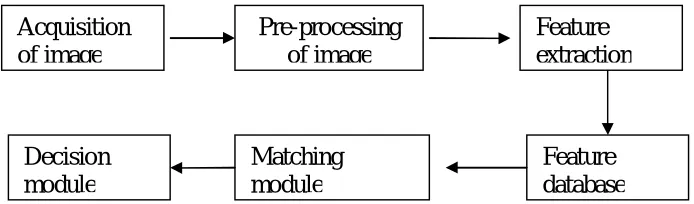
The proposed system consists of following steps:
Image Acquisition
In first phase the acquisition of image is to be conducted. The image acquisition involves capturing and storing digital image from sensors like color digital cameras, video cameras, scanners, etc. In this system an offline image will be considered.
Image Preprocessing
In second phase is image processing module. In this module we prepare the image for feature extraction. In this stage colour image transform into gray level image then we reduce the noise pixels from the gray image this relates to the preparation of an image which includes conversion to gray scale; because image captured by camera are not necessarily in the form that can be used for image analysis.
Feature Extraction
The feature extraction module extracts the features of hand geometry. Transforming the input data into set of features is called feature extraction. In this system we will work on the basis of geometrical and texture features. Geometrical features include centroid, area, mean, solidity, extent, major axis, minor axis, etc.
Matching
This is the last module of the biometric system is matching. In this the features extracted in the previous section are matched up with the features of that individual previously stored in the database. The match score represents the closeness of the current image to the one present in the database. The threshold is a value which lies in the range of match score.
Fig 1: Flow Diagram of System
IV. FEATURE EXTRACTION
(A) Geometrical Features
The physical hand geometry of hand is denoted as a geometrical feature. Geometric feature of the palm includes length, width, perimeter, area, etc. All these features are extracted with the help of image processing toolbox of Matlab. Various features that have been used in this system are as follows:
Acquisition
of image
Pre-processing
of image
Feature
extraction
Feature
database
Matching
module
Decision
Area: Returns a scalar that specifies the actual number of pixels in the region. (This value might differ slightly from the value returned by bwarea, which weights different patterns of pixels differently.)
Minor axis: This feature gives the length of minor axis of ellipse which has same normalized central moments of region of palm. The length is specified in pixels.
Major axis: This feature gives the length of major axis of ellipse which has same normalized central moments of region of palm. The length is specified in pixels.
Centroid: Returns a 1-by-Q vector that specifies the centre of mass of the region. The first element of Centroid is the horizontal coordinate (or x-coordinate) of the centre of mass, and the second element is the vertical coordinate (or y-coordinate). All other elements of Centroid are in order of dimension. This feature is defined as arithmetic mean ("average") of a two- dimensional region is the position of all the points in the shape.
EquivDiameter: This feature calculates the diameter of circle with same area as of the region. It is calculated with formula: sqrt (4*Area/pi).
Extent: The feature is calculated as a ratio of number of pixels in bounded region to the number pixels in the region. Also we can say the area of region divided by the area of bounded region.
Mean: The feature gives the mean of all the orientations in region.
Object area: This feature estimates the area of the objects in binary image .It is a scalar whose value corresponds roughly to the total number of on pixels in the image, but might not be exactly the same because different patterns of pixels are weighted differently.
Perimeter: Returns a scalar that specifies the distance around the boundary of the region. Regionprops computes the perimeter by calculating the distance between each adjoining pair of pixels around the border of the region. If the image contains discontiguous regions, regionprops returns unexpected results.
Solidity: This feature is calculated as Area/Convex Area. It is used to specify the ratio of pixels in region to the convex hull.
Euler number: This feature gives the count of number of objects minus number of holes present in the region (O-H).
(B) Texture features
V. RESULTS
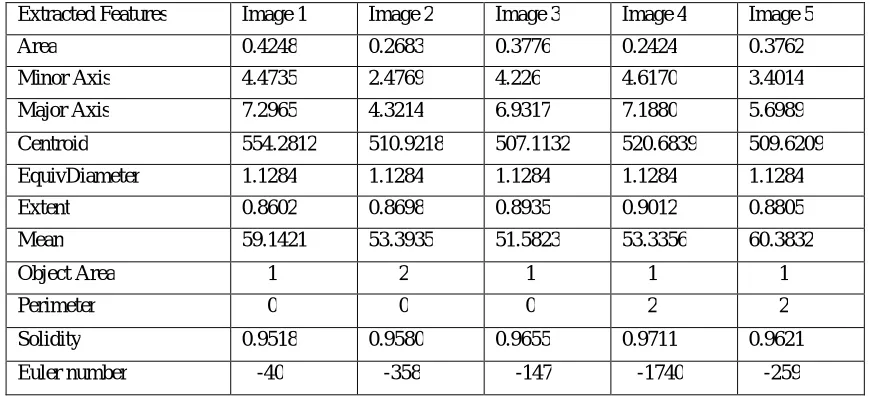
There are five images used in this system for the purpose of feature extraction. The database is taken from www.coep.org.in for processing. To extract features image is pre-processed as stated before. The colour image is transformed into gray level image then we reduce the noise pixels from the gray image this relates to the preparation of an image which includes conversion to gray scale; because image captured by camera are not necessarily in the form that can be used for image analysis. The image obtained cannot be used for feature extraction as it contains dirt, noise then that pre-processed image is used for extraction and then dataset is prepared and used for further identification. So the results obtained after feature extraction can be shown as:
Extracted Features Image 1 Image 2 Image 3 Image 4 Image 5 Area 0.4248 0.2683 0.3776 0.2424 0.3762 Minor Axis 4.4735 2.4769 4.226 4.6170 3.4014 Major Axis 7.2965 4.3214 6.9317 7.1880 5.6989
Centroid 554.2812 510.9218 507.1132 520.6839 509.6209 EquivDiameter 1.1284 1.1284 1.1284 1.1284 1.1284 Extent 0.8602 0.8698 0.8935 0.9012 0.8805 Mean 59.1421 53.3935 51.5823 53.3356 60.3832
Object Area 1 2 1 1 1 Perimeter 0 0 0 2 2
Solidity 0.9518 0.9580 0.9655 0.9711 0.9621
Euler number -40 -358 -147 -1740 -259
Fig 2: Results obtained after feature extraction
V. CONCLUSION AND FUTURE WORK
The method used for recognition of person is the most reliable method because human biometric is different for each individual moreover it is universal. Palm print consists of many features which are enough capable to verify the person with more assurance. In future feature extraction techniques can be more enhanced to obtain more accurate results. Various other biometric traits can also be used in future.
REFERENCES
[1] T.Amit and Sonika, “Pattern Recognition Using Neural Network Of Hand Biometrics” Journal of Global Research in Computer Science Volume 2, No. 7, July 2011.
[2]N.Aravind, K.Hemantha, “Texture based Palm print Recognition using Simple Methods” International Journal of Computer Applications (0975 – 8887) Volume 50 – No.4, July 2012.
[3]J.Jobin, J.Jiji,et.al, “Palm Biometrics Recognition and Verification System”, International Journal of Advanced Research in Electrical, Electronics and Instrumentation Engineering Vol. 1, Issue 2, August 2012.
[4] R.Vivekanandam, M. Madheswaran “Principal Component Analysis based Palmprint Recognition with Centre of Mass Moments” International Journal of Scientific & Engineering Research Volume 3, Issue 10, October-2012.
[5]L.Eryun, J.Anil, et al “A Coarse to Fine Minutiae-Based Latent Palmprint Matching” IEEE, Vol. 35, No. 10, October 2013.
[6]M.Mansi, K.Parminder, “Palm Vein Recognition for Human Identification Using NN”, International Journal of Innovative Technology and Exploring Engineering (IJITEE) ISSN: 2278-3075, Volume-3, Issue-7, December 2013.
[7]S.Rashmi,V.Nilmani,S.Vikas, “Palm print Biometrics using Feed Forward Back Propagation Neural Network”,International Journal of Computer Applications (0975 – 8887) Volume 74– No.3, July 2013.
[8]A.Sumalatha, Harsha, “Palmprint Recognition System: A Review ”, International Journal of Advanced Research in Computer Science and Software Engineering Biometric, Volume 4, Issue 1, January 2014 .
[10]S.K.Lokhande, M.S Dhongde, “Fingerprint Identification System Based On Neural Network” International Journal of Innovative Research in Science, Engineering and Technology, Volume 3, Special Issue 4, April 2014.
[11]K.Rohit, S.Ram Chandra, “Palm print Recognition Using Geometrical and Texture Features” (ICRSET’2014) Dubai (UAE), March 21-22, 2014. [12] Jinyu Guo, Haibin Chen and Yuan Li, “Palmprint Recognition Based on Local Fisher Discriminant Analysis”, Journal of Software, Vol. 9, no. 2, February 2014.
[13] Vijayta Chowdhary, Kamini Verma and Himanshu Monga, “Human Identification Using Palm-Vein Images Using Gabor Filter” Journal of Advanced Research in Computer Science and Software Engineering Volume 4, Issue 7, July 2014.