ISSN (Print) : 2320 – 3765 ISSN (Online): 2278 – 8875
I
nternational
J
ournal of
A
dvanced
R
esearch in
E
lectrical,
E
lectronics and
I
nstrumentation
E
ngineering
(An ISO 3297: 2007 Certified Organization)
Vol. 5, Issue 11, November 2016
Comparative Analysis of Speed Control of
Induction Motor by DTC over Scalar Control
Technique
S.Anuradha1, N.Amarnadh Reddy2
M.Tech (PE), Dept. of EEE, VNRVJIET, T.S, India1 Assistant Professor, Dept. of EEE, VNRVJIET, T.S, India2
ABSTRACT: This paper presents comparative analysis of induction motor speed control by DTC and Scalar control technique. The both Scalar control and direct torque control techniques are proposed. Speed control of induction motor under No-Load and Load conditions by both scalar and DTC control techniques. The basic two-level voltage source inverter is fed to three phase induction motor. SVPWM technique is used to generate switching signals for reference speed signal. The sensor-less speed controlling technique is used in the DTC control technique for speed estimation. The test simulation results are proposed in details verified MATLAB/Simulink.
KEYWORDS: speed control, I.M, scalar, DTC, SVPWM.
I.INTRODUCTION
Three-Phase induction motor had the wide range of applications like as industrial drives, Automotive etc. I.M drive requires variable speed operations based on applications, using of traditional speed controlling techniques will affect the efficiency of operating system. There are number of speed controlling techniques based on applications area [8]. The speed error of the induction motor will depends on the type of speed controlling and PWM techniques using in the system [4].
The Scalar controlling technique is depends on the variation of magnitudes of parameters for speed controlling. The frequently used scalar controlling is v/f control technique. The value of flux can be controlled by varying the voltage magnitude and the torque can be controlled by frequency or slip parameters [2-3]. The speed of induction motor can be controlled using v/f control, which is so simple and easy to control in industrial applications, here the ratio of voltage magnitude to frequency was maintained constant, in order to get the constant flux for producing the required torque over an entire operating range [1].
The scalar control technique has poor performance because of stator impedance drop leads to unstable due to variation in speed (torque) by variation in load conditions. To overcome the disadvantages of scalar control, vector control technique is proposed.
The vector control overcome these problems, here the torque and flux producing current components are decoupled, and the system will adapt to any load disturbances with good dynamic performance [5-6]. In this method, direct torque control is achieved by direct and independent control of the flux linkages and the electromagnetic torque through the selection of optimal inverter switching which gives fast torque response with constant flux.
ISSN (Print) : 2320 – 3765 ISSN (Online): 2278 – 8875
I
nternational
J
ournal of
A
dvanced
R
esearch in
E
lectrical,
E
lectronics and
I
nstrumentation
E
ngineering
(An ISO 3297: 2007 Certified Organization)
Vol. 5, Issue 11, November 2016
II.DYNAMIC MODELLING OF INDUCTION MOTOR
Motor dynamic model in stationary frame
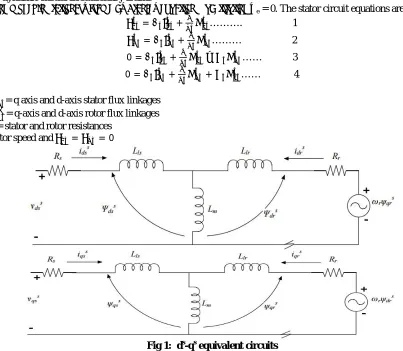
Machine model in stationary frame by Stanley equations substituting ωe = 0. The stator circuit equations are written as:
= + ………. 1
= + ……… 2
0 = + − …… 3
0 = + + …… 4
Where , = q axis and d-axis stator flux linkages φ ,φ = q-axis and d-axis rotor flux linkages , = stator and rotor resistances = rotor speed and = = 0 Fig 1: ds-qs equivalent circuits The electromagnetic torque is developed by the interaction of air gap flux and rotor mmf which can be expressed in general vector form as = . . ………. 5
ISSN (Print) : 2320 – 3765 ISSN (Online): 2278 – 8875
I
nternational
J
ournal of
A
dvanced
R
esearch in
E
lectrical,
E
lectronics and
I
nstrumentation
E
ngineering
(An ISO 3297: 2007 Certified Organization)
Vol. 5, Issue 11, November 2016
III.SVPWM
Theory of Space vector pulse width modulation
When three phase supply is given to the stator of the induction machine, a three phase rotating magnetic field is produced [12]. Due to this field flux, a three phase rotating voltage vector is generated which lags the flux by 90º. This field can also be realized by a logical combination of the inverter switching which is the basic concept of SVPWM [7].
Realization of voltage space phasor
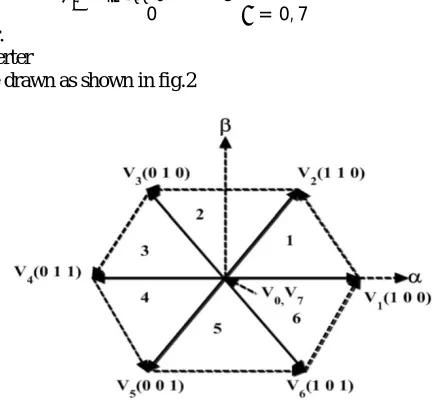
The three phase bridge inverter has eight possible switching states: six active and two zero states. The six switches have a well-defined state ON or OFF in each configurations. At a particular instant, only one switch in each of the three legs is ON. Corresponding to each state of the inverter, there is one voltage space vector. For example for state zero it is V0, for state 1 it is V1 and so on. These switching state vectors have equal magnitude but 60º apart from each other. These vectors can be written in generalized form as follows:
= = 1, 2, … , 6 0 = 0, 7 Where k = inverter state number.
Vdc = dc link voltage of the inverter
The inverter state vectors can be drawn as shown in fig.2
Fig 2: Inverter switching state vectors
The space bounded by two inverter space vectors is called a sector. So the plane is divided into six sectors each spanning 60º. In a balanced three phase system the voltage vectors are 120º apart in space and are represented by rotating vectors, whose projections on the fixed three phase axes are, sinusoidal waves. So they can be represented as three sinusoidal references by a voltage reference space vector Vref*or Vs*. The reference vector is assumed to be rotating in counter-clockwise direction with respect to ds-axis (α-axis) as shown in fig .2 through six sectors.
The reference space vector can be synthesized by a combination of eight state vectors and is constant in magnitude at switching instant ts in case the switching frequency much higher than the output frequency. In a time average sense
thereference vector at that instant can be approximated by two active voltage states of the inverter. For only certain amount of time these states are valid.
∗= + = 0, 1, 2, … … … , 7
In SVPWM, it is assumed that the space phasor of stator voltage ∗, is moving in α-β plane with constant angular
ISSN (Print) : 2320 – 3765 ISSN (Online): 2278 – 8875
I
nternational
J
ournal of
A
dvanced
R
esearch in
E
lectrical,
E
lectronics and
I
nstrumentation
E
ngineering
(An ISO 3297: 2007 Certified Organization)
Vol. 5, Issue 11, November 2016
Fig 3: Reference vector in sector 1
In sector 1, the space voltage vector V1 is along α-axis, V2 makes an angle 60º to V1 and at a particular instant Vs* is
making an angle γ w.r.t V1. To generate the reference space vector in sector 1, the switching state vector V1 is applied
for an interval t1, V2 for t2 and the two zero vectors V0, V7 for interval t0, t7 respectively. So the total sampling interval
ts can be written as:
= + + + ……….. 7
Resolving Vs* and V1, V2along the α-β axis, and by equating voltage-time integrals we get:
| ∗| = | | + | | cos
3… … … . 8
| ∗| = | | sin ………. 9
By the knowledge of t0, t1, t2, t7, the switching pattern can be determined if the vector is in sector 1. The four time
intervals change simultaneously when Vs* goes from one sector to another for a particular modulation index a. The full cycle is completed by six similar sectors with label 1, 2,….6. As Vs* move over to sector 2, the inverter remains in switching state vector V2 for time interval t1 and in V3 for time t2. For sector 3: V3 for t1 and V4 for t2 and so on.
Pulse pattern generation
The PWM pattern generation means the generation of gating pulses for the six switches of the inverter, for correct interval so that appropriate switching state vectors are active for the appropriate time intervals as the reference space vector moves over a full cycle.
In order to obtain minimum switching frequency, it is desired that only one phase of the inverter changes state from + /2 to – /2 while changing the switching vectors. So the arrangement of the switching sequence should be such that the transition from one state to the next state is performed by switching only one inverter phase. This is done by switching the inverter legs in a sequence starting from one zero state and ending at another zero state.
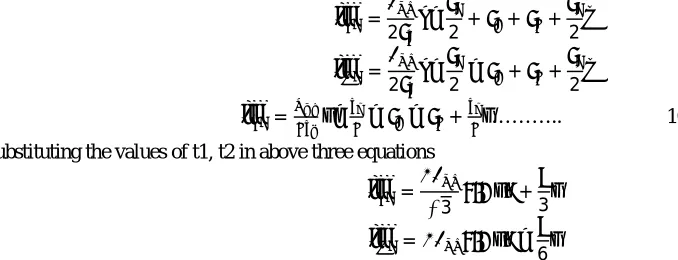
The mean values of the phase to center tap voltages (VA0, VB0, and VC0) can be evaluated, averaging over one sampling
period ts as follows:
=
2 −2 + + + 2
=
2 −2 − + +2
= − − − + ……….. 10
Substituting the values of t1, t2 in above three equations
=
ISSN (Print) : 2320 – 3765 ISSN (Online): 2278 – 8875
I
nternational
J
ournal of
A
dvanced
R
esearch in
E
lectrical,
E
lectronics and
I
nstrumentation
E
ngineering
(An ISO 3297: 2007 Certified Organization)
Vol. 5, Issue 11, November 2016
=− ………….. 11
The mean value of the phase voltages obtained by SVPWM technique has triple harmonics which is eliminated in line voltage. The peak value of the line voltage is 15% more than that in sine PWM at maximum modulation index, so this method of PWM generation gives better utilization of dc bus voltage for inverter.
IV. SCALAR CONTROL
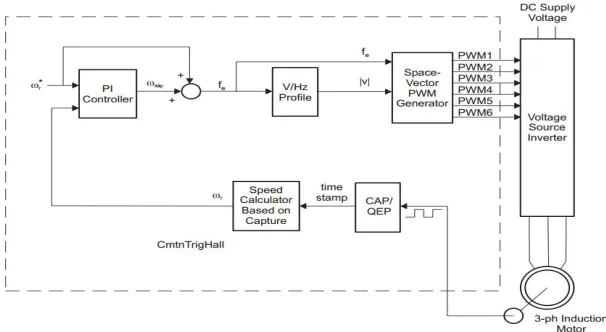
The block diagram for closed loop v/f control by controlling SVPWM technique is shown in Fig. 4. The relation between induced voltage and the flux is
v=k*ϕ ϕ=v/f≈k=constant Where ϕ is the flux
From the block diagram, the reference speed compared to the actual speed then the PI-control generates the slip command i.e.
∫ = ………….12
Fig 4: Block diagram for scalar control
From the last equation, it follows that if the ratio V/ƒ remains constant for any change in ƒ, then flux remains constant
and the torque becomes independent of the supply frequency. In order to keep ΛM constant, the ratio of Vs/ƒ would
also be constant at the different speed. As the speed increases, the stator voltages must, therefore, be proportionally increased in order to keep the constant ratio of Vs/f. However, the frequency (or synchronous speed) is not the real speed because of a slip as a function of the motor load. At no-load torque, the slip is very small, and the speed is nearly the synchronous speed. Thus, the simple open-loop Vs/f (or V/Hz) system cannot precisely control the speed with a presence of load torque. The slip compensation can be simply added in the system with the speed measurement.
Simulation Performance of SCALAR Control
ISSN (Print) : 2320 – 3765 ISSN (Online): 2278 – 8875
I
nternational
J
ournal of
A
dvanced
R
esearch in
E
lectrical,
E
lectronics and
I
nstrumentation
E
ngineering
(An ISO 3297: 2007 Certified Organization)
Vol. 5, Issue 11, November 2016
Fig 5: simulation design of speed control of I.M with scalar control
The performance characteristics of the speed control of three-phase induction motor using scalar (v/f) control technique are given in following figures.
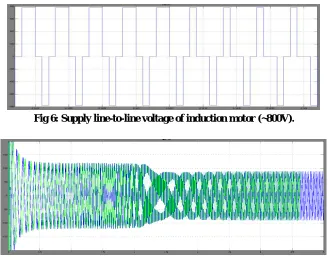
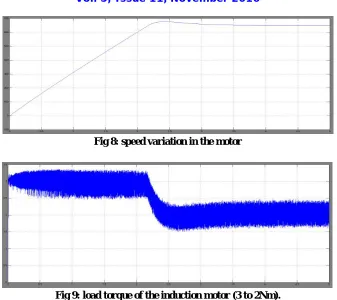
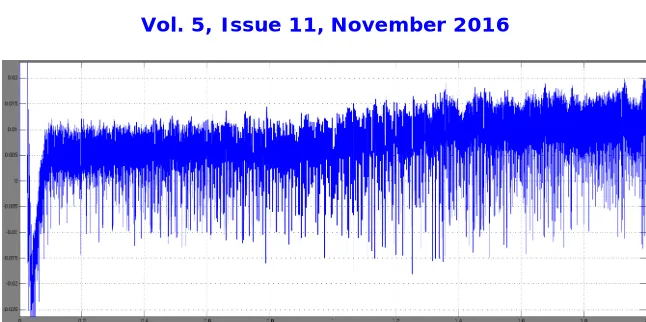
Fig 6 shows the line-to-line supply voltage of the induction motor of ab-phase. According to result it shows that operating voltage is near to 800 volts. Fig 7 shows the supplied line current of induction motor. The supply current shows that current is higher during the higher load, the load has been decreased after 2.2s which results decrement in the current value. Fig 8 displays the speed of induction motor under variable load conditions. The estimated speed of 650rpm is getting after 2.2s of settling time. Fig 9 shows the load torque supplied by motor, from wave form it observed that torque is getting decreasing from 3Nm to 2Nm after 2.2s as represented in load torque.
Fig 6: Supply line-to-line voltage of induction motor (~800V).
ISSN (Print) : 2320 – 3765 ISSN (Online): 2278 – 8875
I
nternational
J
ournal of
A
dvanced
R
esearch in
E
lectrical,
E
lectronics and
I
nstrumentation
E
ngineering
(An ISO 3297: 2007 Certified Organization)
Vol. 5, Issue 11, November 2016
Fig 8: speed variation in the motor
Fig 9: load torque of the induction motor (3 to 2Nm).
V. DIRECT TORQUE CONTROL (DTC)
The block diagram of DTC-SVPWM is shown in Fig. 10. Whereas the speed controller decides the mode of operation either in clockwise or counter clock wise direction. The electromagnetic torque for four-pole induction motor [9-11] is written as.
= 3(ψ i − ψ i )…………13
ψ = ψ +ψ ………..14
Where ψ and ψ are the stator flux in d-q axis Stator flux in d-axis is ψ =∫( −i )
Stator flux in q-axis is ψ =∫ −i
The Reference voltage vector ‘Vref’ can be found from the stator flux of the induction motor as given below
v = + ………15
Where
= ψ − i
= ψ − i
ISSN (Print) : 2320 – 3765 ISSN (Online): 2278 – 8875
I
nternational
J
ournal of
A
dvanced
R
esearch in
E
lectrical,
E
lectronics and
I
nstrumentation
E
ngineering
(An ISO 3297: 2007 Certified Organization)
Vol. 5, Issue 11, November 2016
Fig 10: Direct torque control
Direct Torque Control Technique is verified for speed control of induction motor with sensor-less speed measurement technique.
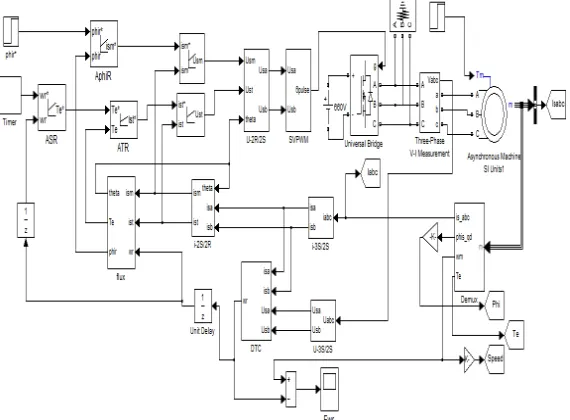
Fig 11 shows the simulation circuit of block diagram of scalar control technique shown in fig10.
Fig 11: Direct Torque Control Scheme
ISSN (Print) : 2320 – 3765 ISSN (Online): 2278 – 8875
I
nternational
J
ournal of
A
dvanced
R
esearch in
E
lectrical,
E
lectronics and
I
nstrumentation
E
ngineering
(An ISO 3297: 2007 Certified Organization)
Vol. 5, Issue 11, November 2016
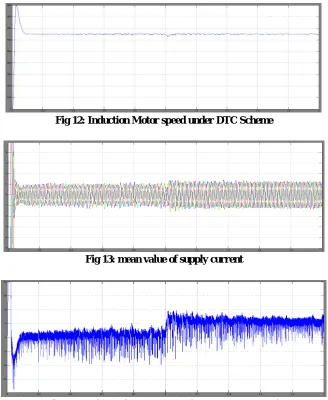
Fig 12: Induction Motor speed under DTC Scheme
Fig 13: mean value of supply current
Fig 14: Electro mechanical torque varies from 0Nm to 5Nm after 1Sec.
ISSN (Print) : 2320 – 3765 ISSN (Online): 2278 – 8875
I
nternational
J
ournal of
A
dvanced
R
esearch in
E
lectrical,
E
lectronics and
I
nstrumentation
E
ngineering
(An ISO 3297: 2007 Certified Organization)
Vol. 5, Issue 11, November 2016
Fig 16: Speed error signal of induction motor (increased when load increased)
VI. CONCLUSION
In this paper analysis of speed controlling techniques scalar and DTC are performed. It is concluded that scalar controlling technique is having the poor performance over DTC scheme. Speed controlling in scalar control is less when compared with the DTC for high rating induction motors like industrial applications. Both control schemes are designed with SVPWM techniques. The DTC scheme is having the linear distribution in stator flux while scalar is nonlinear manner. It’s observed that DTC is having advantage in speed control of induction motors compared with Scalar control technique.
REFERENNCES
[1] Alfredo, Thomas A. Lipo and Donald W. Novotny, “A New Induction Motor V/f Control Method Capable of High-Performance Regulation at Low Speeds,” IEEE Trans. on Ind. Appl., vol. 34, no. 4, pp. 813-819, July. 1998.
[2] Rashid, “Power electronic; Circuit Devices and Applications,” Third Edition Pearson Education, Inc., 2007.
[3] B. K. Bose, “Power Electronics and Motor Drives Advances and Trends,” Academic Press is an imprint of Elsevier, Jan. 2006.
[4] Allan B. Plunkett, “Direct Flux and Torque Regulation in a PWM Inverter-Induction Motor Drive,” IEEE Trans. Ind. Appl., vol. ia-13, no. 2, pp. 139-146, Mar. 1977.
[5] M. Depenbrock “Direct Self-Control (DSC) of Inverter-Fed Induction Machine,” IEEE Trans. on Power Electron, vol. 3, no. 4, pp. 420-429, Oct. 1988.
[6] DomenicoCasadei, Francesco Profumo, Giovanni Serra and Angelo Tani, “FOC and DTC: Two Viable Schemes for Induction Motors Torque Control,” IEEE Trans. on Power Electron., vol. 17, no. 5, pp. 779-787, Sept. 2002.
[7] G. Narayanan, Di Zhao and Harish K. Krishnamurthy, “Space Vector Based Hybrid PWM Techniques for Reduced Current Ripple,” IEEE Trans. on Ind. Electron., vol. 55, no. 4, pp. 1614-1627, April. 2008.
[8] H. Abhu-Rubu, AtifIqbal, and J. Guzinski, “High performance control of AC Drives with Matlab/Simulink Models,” A Jhon Willey & Sons, Ltd, Publications, 2012.
[9] M. NasirUddin and M. Hafeez, “FLC Based DTC Scheme to Improve Dynamic Performance IM Drive,” IEEE Trans. on Ind. Applications., vol. 48, no. 2, pp. 823-831, Mar. 2012.
[10] Isao Takahashi and YouichiOhmori “High-Performance Direct Torque Control of an Induction Motor,” IEEE Trans. on Ind. Appl., vol. 25, no. 2, pp. 257-264, Mar. 1989.
[11] DomenicoCasadei, Francesco Profumo, Giovanni Serra and Angelo Tani, “FOC and DTC: Two Viable Schemes for Induction Motors Torque Control,” IEEE Trans. on Power Electron., vol. 17, no. 5, pp.
779-787, Sept. 2002.