International Journal of Research (IJR)
e-ISSN: 2348-6848, p- ISSN: 2348-795X Volume 2, Issue 09, September 2015Available at http://internationaljournalofresearch.org
Image in painting and Compression Using DCT Algorithm
1
Seema Devi &
2Varun sanduja
1M.tech student,Deptt of ECE;Chandigarh Group of Colleges Technical Campus, Jhanjeri
2Assistent Professor,Chandigarh Group of Colleges Technical Campus, Jhanjeri
1email:[email protected];2 email:[email protected]
Abstract-
This research work has major focus on images which have cracks and minor distortions in them. This prevents any compression technique to give the best output. Hence there is a need to first eliminate those distortions from the images before applying compression. A system is proposed, in which K-Nearest Neighbor Algorithm is implemented after the DCT Step, to remove the distortions before compressing it. The neighboring color of the distorted part can be used to merge with the damaged part. So basically, we have to store less color intensities to save the same image without the distorted piece which will result in more optimized compression ratio. It will be greatly valuable for observer perspective.
Keywords: Image processing; KNN algorithm; in painting
I.INTRODUCTION
In this Digital age where bulk of data is getting transferred each and every second, different compression methods is a necessity. By being able to compress images to a small fraction of their original size, we can save a significant amount of disk space. Likewise transportation of images starting from one computer then onto the next gets to be simpler and quick [1].
1.1 Compression algorithm:
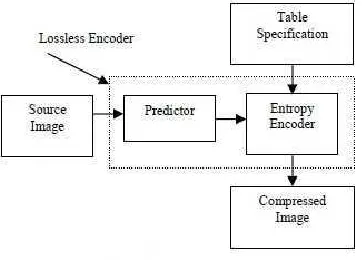
As stated above, Image compression Algorithms can be partitioned into: Lossy and Lossless. Decompression after lossless compression yields
the same input image. Lossy compression brings about loss of information and the decompressed picture is not exactly the equal as the first.
1.1.1 Lossy Algorithm
This data compression technique is finished with loss of value and originality (Fig. 1). The original in sequence is never recovered over after compression. A pair of normal case of lossy compression is establishing in streaming features in the web, additionally the VOIP utilizes lossy compression strategy. The algorithm may pick a more modest extent of pixels whose color value contrasts fall inside the limits of our discrimination, and replacement those for the
others.[1]
Fig .1: Lossy Algorithm
1.1.2 Lossless Algorithm:
International Journal of Research (IJR)
e-ISSN: 2348-6848, p- ISSN: 2348-795X Volume 2, Issue 09, September 2015Available at http://internationaljournalofresearch.org
Fig. 2: Lossless Algorithm
1.2 Joint Photographic Experts Group (JPEG):
JPEG is an abbreviation for ''Joint Photographic Experts Group'' [3]. For its standard coding method the Discrete Cosine Transform (DCT) is utilized. The authors in [4] first confirmed that DCT in a general sense is the same to the KLH (Karhunen–loeve–hotelling) alter that performs a de-correlation course In light of the fact that each coefficient can be dealt separately without losing compression proficiency, de-correlation is essential for compression. Basically, the nxn 2-D version of DCT disintegrates a nxn block of an image into a set, each with a specific spatial frequency. Because of this, we can reduce the information not visible to the human eyes. The redundancies existing, are of the following types, 1.Coding Redundancy: Present when a smaller amount than optimal code words are used.
2.Interpixel Redundancy: results from
correlations between the pixels of an picture 3.Psychovisual Redundancy: is due to data that is ignored by the human visual system (i.e. visually non essential information).
1.3 8X8 FDCT and DCT
At the input to the encoder, source image samples are assembled into 8x8 blocks [14],
stimulated from unsigned integers to signed integers, and input to the Forward DCT (FDCT). At the output from the decoder, the Inverse DCT (IDCT) yields 8x8 sample blocks to construction the reconstructed image
1.4 Quantization
The 8x8 blocks are set for quantization. The coefficients Fu,v, are real numbers, which will be stored as integers, hence we require to round them off. It is done in a manner that encourages more famous compression. as a substitute of fundamentally rounding the coefficients, Fu,v is primary partition by a quantizing factor and after
that confirmation round(Fu,v / Qu,v).
1.5 Encoder
International Journal of Research (IJR)
e-ISSN: 2348-6848, p- ISSN: 2348-795X Volume 2, Issue 09, September 2015Available at http://internationaljournalofresearch.org
II. FLOW CHART OF IMAGE INPAINTING ALGORITHUM:
Fig. 3: Flow chart of purposed algorithum.
III. RESULTS ANALYSIS:
1. Running the file inpainting.m which is
used to implement the standard jpeg algorithm, we have achieved these outputs.
2. Import the distorted uncompressed image.
3. The message box shows that the jpeg file is created and stored in the hard drive.
4. Now import the same distorted uncompressed image for our inpainting algorithm.
Obtain image ( having cracks and minor distortions)
Divide it into 8*8 matrix components.
Convert to greyscale
Convert to black and white(logical class) and save position of luminanace from the matrix.
Apply DCT to the matrix obtained from step 3.
Apply KNN algorithum to the positions obtained from step 4, in the DCT coefficient.
Apply quantization to compress the data.
International Journal of Research (IJR)
e-ISSN: 2348-6848, p- ISSN: 2348-795X Volume 2, Issue 09, September 2015Available at http://internationaljournalofresearch.org
5. GUI of restore algorithm.
6. Importing the image.
6. Enlarge the image and show each bl.ock of 64 pixels
International Journal of Research (IJR)
e-ISSN: 2348-6848, p- ISSN: 2348-795X Volume 2, Issue 09, September 2015Available at http://internationaljournalofresearch.org
8. Showing the cracked parts
9. Restored image is stored in the hard drive.
10.Now we will follow the same compression algorithm and the compressed image is stored in the hard drive.
IV. CONCLUSION
International Journal of Research (IJR)
e-ISSN: 2348-6848, p- ISSN: 2348-795X Volume 2, Issue 09, September 2015Available at http://internationaljournalofresearch.org
REFERENCES
[1] Vahid Bastani, M. S. (2014). Image compression based on spatial redundancy
removal and image inpainting. Journal of
Zhejiang University SCIENCE C, Volume 11, Issue 2 , , 92-100 .
[2]Li, Q., Han, Y., & Dang, J. (2013). Image decomposing for inpainting using compressed
sensing in DCT domain. Frontiers of Computer
Science , Volume 8, Issue 6 , pp 905-915 , 905-915.
[3]Christine Guillemot, Mehmet Turkan, Olivier Le Meur, Mounira Ebdelli (2013).Image Inpainting Using LLE-LDNR And Linear
Subspace Mappings. Acoustics, Speech and
Signal Processing (ICASSP), 2013 IEEE
International Conference,(pp- 1558 - 1562) Vancouver.IEEE.
[4] Awate, S., & Whitaker,
Unsupervised,Information-Theoretic,adaptive image filtering for image restoration (2008).
[5] Yang, E.-h., & Wang, L. (2007). Joint Optimization of Run-Length Coding, Huffman Coding and Quantization Table with Complete
Baseline JPEG Compatibility. Image
Processing,2007.
[6] En-hui Yang,Fusion algorithm for remote
sensing image based on nonsubsampled contourlettransform,(2007)
[7] Timothy K. Shih forensic technique for detecting tamper in digital image compression (2004).