20th International Conference on Structural Mechanics in Reactor Technology (SMiRT 20) Espoo, Finland, August 9-14, 2009 SMiRT 20-Division I, Paper 1891
Experimental Study of the Effect of Radiation Exposure to Concrete
Kazushige Fujiwaraa
,
Masanobu Itoa,
Miwa Sasanumab,
Hideo Tanakac,
Kiyoshi Hirotanid, Kunio Onizawae, Masahide Suzukie and Hiroo Amezawafa
Projects Development Department, The Japan Atomic Power Company, JAPAN, e-mail:[email protected]
b
Civil Engineering & Architecture Technology Group R&D Center, Tokyo Electric Power Company, JAPAN
c
Nuclear Asset Management Department, Tokyo Electric Power Company, JAPAN
d
Civil & Architectural Engineering Department, Tohoku Electric Power Company, JAPAN
e
Nuclear Safety Research Center, Japan Atomic Energy Agency, JAPAN
f
Oarai Research and Development Center, Japan Atomic Energy Agency, JAPAN (currently Department of Emergency Preparedness Operations, Nuclear Safety Technology Center, JAPAN)
Keywords: Structural Concrete, Aging, Radiation Expose, Temperature, Compressive Strength.
1
ABSTRACT
Concerns over aged nuclear power stations are mounting in Japan today. However, to date, there exists only a small number of experimental studies regarding the effect of radiation exposure to concrete. We have consequently conducted an irradiation test on concrete specimens to confirm the effect of long-term radiation exposure on the basic material properties of concrete.
As a result of the irradiation tests, irradiation temperature was kept lower than 65deg. C, which is the limiting value stipulated in the design standard for nuclear power stations in Japan. The maximum fast neutron fluence reached 12.0×10¹⁸n/cm2 (E>0.1MeV), which is sufficiently exceeding total fast neutron fluence to be exposed to the concrete located at the exterior of a reactor pressure vessel for a typical BWR by 60-year operation.
Compressive strength of the irradiated concrete specimens was roughly equivalent to that of concrete specimens cured for the same duration under the basic environment (20deg. C, 60%RH). Furthermore, by measuring water content of irradiated specimens, no changes after irradiation were observed as for the chemically bound water content.
As shown above, it was confirmed that radiation exposure did not significantly affect the basic material characteristics of concrete within the range of radiation doses adopted in this study.
2
INTRODUCTION
Tokai Power Station, which started operation in 1966 as the first commercial nuclear power station in Japan, discontinued its operation in 1998 and is now undergoing decommissioning. The nation’s initial nuclear power plants -- including Tsuruga Power Station Unit 1 that commenced operation after 1970 following Tokai Power Station -- will mark four decades in service in the near future. In Japan, nuclear power plants are obligated to undergo national safety authority’s inspection to continue long-term service at their 30th year since operation start and every 10 years thereafter. Concern over aging degradation of nuclear power plants is mounting as a number of nuclear power plants will be subjected to national authority’s inspection almost every year from now on and early nuclear power plants such as Tsuruga Power Station Unit 1 face their 40th year inspection in the-not-distant future.
2
3
OBJECTIVE
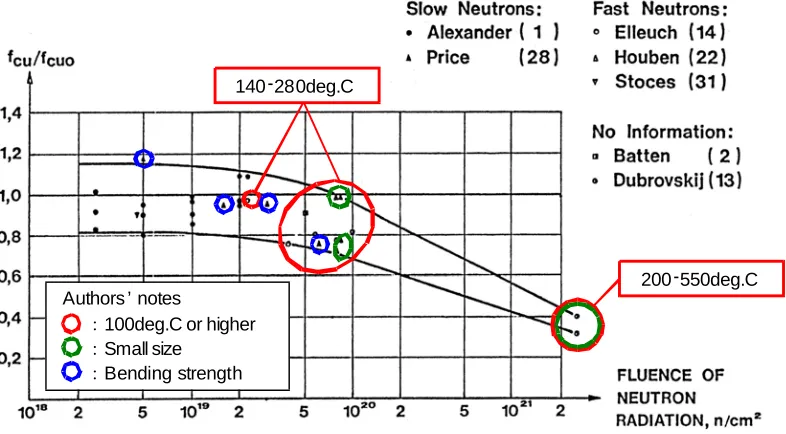
To date, there exists only a small number of experimental studies regarding the effect of radiation exposure to concrete. Still in Japan, a document by Hilsdorf et al. (1978) compiled the results of several researches is cited as a representative literature that describes the effect of radiation exposure to concrete. The document contains a figure that illustrates the relation between neutron fluence and compressive strength. However, our investigation reveals that this figure contains many data with improper testing condition which is not appropriate to evaluate the actual condition of components and structures in the light water reactor.
We have consequently conducted an irradiation test using concrete specimens to confirm the effect of long-term radiation exposure on the basic material properties such as the compressive strength of concrete, under clearly defined conditions and the appropriate control of test conditions.
The objective of this study is to evaluate the effect of radiation exposure on the concrete material properties such as the compressive strength and water content which are important to the safety functions in nuclear power plants.
4
EXPERIMENTS
4.1 Concrete specimens
The mix proportion of concrete specimens is shown in Table 1. The materials used for the manufacture of specimens were selected from those generally used at nuclear power plants in Japan. The concrete specimens were shaped in a cylindrical form of φ50mm×100mm in accordance with the capsule size.
The cast concrete was cured in a sealed environment of 20deg.C and 60%RH for three months, and subjected to atmospheric curing in the same environment until the start of the irradiation test.
For the purpose of confirming the effect of radiation exposure to the concrete specimens, another test was conducted by exposing non-irradiated specimens to a 20deg.C, 60%RH environment during irradiation.
4.2 Irradiation facility
The irradiation test was conducted using the Japan Materials Testing Reactor (JMTR) of Japan Atomic Energy Agency’s Oarai Research and Development Center (Fig. 1).
JMTR is a light-water moderator/light-water coolant tank reactor with rated thermal output of 50MW. Various types of irradiation equipment, including the capsule used to irradiate loaded samples, is
Table 1. The Mix Proportion of Concrete Specimens
Mass per Unit Volume (kg/m3) W/C
Ratio*
(%) Water Cement Sand Gravel
Chemical Admixture**
(cc/m3)
55 176 320 959 953 800
*Ratio of Water to Cement
**Air-Entraining and Water-Reducing Agent
Main stack
Reactor building Water tower
Pressure vessel Core
Canal Cells
Hot laboratory
placed inside the JMTR for the purpose of conducting neutron irradiation and other tests on reactor fuel and various types of material samples. Also, the hot laboratory facility is directly connected to the reactor enables post-irradiation tests by simply transporting irradiated samples through the canal between the hot cell and the reactor without carrying them out of the facility. Annual operation at JMTR is conducted in around 6 cycles, with each cycle lasting around 31 days.
4.3 Irradiation capsule
A stainless steel capsule measuring 60mm in diameter and approx. 1m in height was used for this test. This capsule was loaded with 4 concrete specimens (φ50mm×100mm), 4 concrete specimens (φ50mm×25mm) embedded with thermocouples to measure temperature, a fluence monitor to measure neutron fluence.
4.4 Irradiation conditions
4.4.1 Temperature
Regarding the temperature of concrete specimens during irradiation, the target condition was to keep temperatures below 65deg.C. This upper limiting temperature is stipulated in the design code for nuclear power plants in Japan, the Rules on Concrete Containment Vessels for Nuclear Power Plants (JSME, 2003). This temperature limiting value of 65deg.C has originally been defined according to the corresponding value (150°F) indicated in the Code for Concrete Containments (ASME, 2007) as indicated in Table 2.
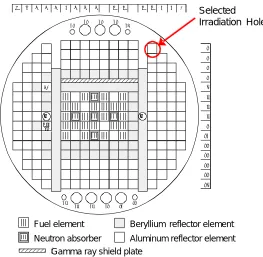
The JMTR core houses fuel elements, neutron absorber, reflector and other components in an appropriate arrangement. To keep the temperature rise of concrete specimens by gamma-ray at low levels, an irradiation hole with the lowest gamma heating rate located on the core outermost position was selected for this irradiation study (Fig. 2).
4.4.2 Neutron fluence
Target neutron fluence was set in three levels based on the irradiation conditions of the selected irradiation holes as shown in Table 3. Table 4 shows the target neutron fluence for each step in the three levels. The
Table 2. Temperature limiting values in the ASME Code
Concrete Temperature State
General Part Local Areas
Normal Operation 150°F (65deg.C) 200°F (95deg.C) 1) Accident 350°F (175deg.C) 650°F (345deg.C) 2) 1) For example, around a penetration
2) Steam or water jets in the event of a pipe failure
!"# $ % &'()*+,-.
/01234
56789:,12;<=>?.
@AABCDE:34
>FGHBCDE:34 I J K L M W N O P " Q R # S T U V %
XY X Z X [ X \ X ]
]X X^ X_ X`
X a ]]
] \ [ Z Y
` _ ^ ] X ] ] ] \ ] [ ] Z ] Y a
T b W ! c ]
defghi O %
j
j klmnopqrjst
j
uvwxyz O %
T b W !
c ] J T K I {T b W c]sv|}~•€•
Fuel element
Neutron absorber
Gamma ray shield plate
Beryllium reflector element
Aluminum reflector element Selected Irradiation Hole
4
ultimate target for neutron fluence was set at values that exceed the total fast neutron fluence to be exposed to the reactor pressure vessel exterior of a typical BWR over a 60-year period (3.0×10¹⁸n/cm2 (E>0.1MeV)). The target values are set at levels equivalent to the total projected neutron fluence during a 10-year period for Step-1, 60-year period for Step-2 and 40-year period for Step-3.
4.4.3 Concentration of generated Gas
When concrete is exposed to radiation, the water content inside concrete decomposes and generates hydrogen and other gases. For this reason, a constant flow of carrier gas was poured into the capsule to release the generated gas. Periodic measurements were made to check the concentration of generated gas.
4.5 Measurement items
Measurement items using concrete specimens during and after irradiation are shown below:
(1) During irradiation: temperature and concentration of generated gas (Hydrogen gas, Oxygen gas, Nitrogen gas)
(2) After irradiation: neutron fluence, compressive strength, modulus of static elasticity, the amount of chemically bound water, dimensions, appearance, and observation using scanning electron microscope (SEM)
5
TEST RESULTS
5.1 Irradiation Conditions
Irradiation conditions are summarized in Table 5.
5.1.1 Temperature
In all steps, the temperature of concrete specimens during irradiation did not exceed the limiting temperature value (65deg.C) as shown in Table 5, thus satisfying the requirements. Temperature differences among steps
Table 5. Summary of irradiation conditions
Specimen
Concrete Age (week)
Irradiation Time
(h)
Fast Neutron Fluence
(x1018n/cm2,E>0.1MeV)
Thermal Neutron Fluence
(x1018n/cm2,E<0.4eV)
Gamma Fluence*
(x107Gy)
Average Temperature
(Deg.C)
1 0.7 3.2 1.6
2 1.1 4.1 2.0
3 1.5 5.0 2.6
Step-1
4
42 541.4
1.2 4.5 2.3
56.2
1 6.1 14.3 8.1
2 8.8 17.8 10.4
3 12.0 22.8 13.1
Step-2
4
87 4093.9
11.0 20.7 11.9
50.9
1 4.1 8.0 5.4
2 5.8 11.3 6.6
3 8.1 14.4 8.7
Step-3
4
142 2770.7
7.1 12.9 8.0
50.1
*Calculation result
Table 3. Irradiation conditions of the selected irradiation hole
Fast Neutron Flux (n/cm2/s) [E>0.1MeV]
Thermal Neutron Flux (n/cm2/s)
Fast Neutron Fluence (n/cm2/cycle)
[E>0.1MeV]
Gamma Heating Rate (W/g)
Specimen Center Temperature
(deg.C)
1.9x10¹¹ 5.3x10¹² 0.5x10¹⁸ 0.05 <65
Table 4. Target neutron fluence for each step
Fast neutron fluence Irradiation cycles Step-1 0.5x10¹⁸ n/cm2 (E>0.1MeV) 1
5
are attributed to variations in in-core layout around the irradiation holes and difference in the temperature of reactor cooling water.
5.1.2 Concentration of generated Gas
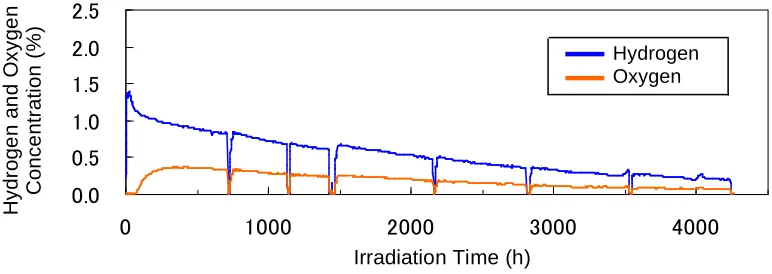
An example of the results of gas concentration measurement for hydrogen gas and oxygen gas generated during irradiation is shown in Fig. 3. Hydrogen gas concentration had a peak immediately after the start of irradiation and fell gradually as irradiation time increased. Oxygen gas concentration was increased from approx. 100 hours after the start of irradiation and fell gradually from approx. 400 hours. These tendencies were observed in all steps.
In addition to the above gases, measurement was also conducted on nitrogen gas, which was detected in negligible amount at the start of irradiation.
5.2 Results of Measurement after Irradiation
5.2.1 Neutron fluence
Neutron fluence was calculated by analysis using a three-dimensional model of JMTR core. The analysis results were then corrected using neutron fluence values obtained from radioactivation measurements on the fluence monitor.
As listed in Table 5, fast neutron fluence successfully exceeded the target values in all steps. Even in Step 3, which was based on the 40-year operation assumption, the fluence values exceeded the fast neutron fluence expected on the exterior of reactor pressure vessel in a typical BWR over a 60-year period (3.0×10¹⁸n/cm2 (E>0.1MeV)). The maximum value for fast neutron fluence was 12.0×10¹⁸n/cm2 (E>0.1MeV).
5.2.2 Compressive strength
The relation between fast neutron fluence and compressive strength of concrete specimens is shown in Fig. 4. The vertical axis in the figure indicates the compressive strength ratio of irradiated specimens in relation to the compressive strength of non-irradiated specimens (mean of 4 specimens).
As illustrated by this figure, the compressive strength of irradiated specimens was equivalent to that of non-irradiated specimens regardless of neutron fluence. Furthermore, it was found that specimens are free from the effect of neutron fluence, exhibiting a constant level, more or less, of compressive strength up to the maximum fluence of 12.0×10¹⁸n/cm2 (E>0.1MeV).
!"! !"# $"! $"# %"! %"#
! $!!! %!!! &!!! '!!!
Hydrogen Oxygen
Irradiation Time (h)
H y d ro g e n a n d O x y g e n C o n c e n tr a ti o n ( % )
Figure 3. Example of measured concentration of generated gases (Step-2)
6
5.2.3 Modulus of static elasticity
The relation between fast neutron fluence and modulus of static elasticity of concrete specimens is shown in Fig. 5. The vertical axis in this figure indicates the modulus of static elasticity ratio of irradiated specimens in relation to the modulus of static elasticity of non-irradiated specimens (mean of 4 specimens).
The modulus of static elasticity of irradiated specimens was not different from that of non-irradiated specimens at levels of fast neutron fluence (3.0×10¹⁸n/cm2 (E>0.1MeV)) expected on the reactor pressure vessel exterior of a typical BWR over a 60-year period. There was a tendency for the values to decrease slightly at levels above 6.0×10¹⁸n/cm2 but the decrease was not significant as to have any impact on the concrete structures.
5.2.4 Amount of chemically bound water
The concrete specimens were heated up to 600deg.C by referring to the Concrete Test and Analysis Manual (JCI, 2000) to measure the amount of chemically bound water based on the difference in mass values after heating at temperatures of 105deg.C and 600deg.C, which serves as an indicator of shielding performance. The results revealed no changes in the amount of chemically bound water before and after irradiation. In addition, the amount of chemically bound water of irradiated specimens was equivalent to that of non-irradiated specimens.
5.2.5 Dimensions
The diameter and height of concrete specimens were measured before and after irradiation. For all specimens, the degree of dimensional changes fell within the range of ±0.1%, equivalent to the margin of error of the measuring instrument, which showed that dimensional changes caused by irradiation are negligible.
5.2.6 Appearance and SEM observation
Deformations or cracks were not observed in the appearance of post-irradiation concrete specimens.
For more microscopic observation of the concrete, the specimens were crushed to check the fractured surface using SEM, which showed no identifiable differences in comparison with non-irradiated specimens.
6
COMPARISON WITH LITERATURE DATA
7
Figure 6 indicates a tendency for compressive strength to decrease with increase in neutron fluence. However, as a result of our investigation of the plotted individual data, it was revealed to contain the following data:
(a) The temperature of specimens during irradiation reached 100deg.C or higher (approx. 140-550deg.C).
(b) The size of the specimens was extremely small (with one side measuring 8-15mm).
(c) Evaluation was based not on compressive strength but on the bending strength.
There are many documents that point to the decrease in compressive strength when concrete is exposed to a high-temperature environment above 100deg.C. For instance, the Concrete Manual (JCI, 1996) describes an example of a test result on heat resistance of concrete that “There is a tendency for residual compressive strength ratio to decrease in inverse proportion to the heating temperature at temperatures of 100deg.C or higher, while the fall of the compressive strength is comparatively small to around 100deg.C.”
Generally, the specimen temperature is assumed to rise with higher flux, with the effect of temperature being larger. The temperature during irradiation, in addition to neutron fluence, therefore, has a significant influence on the decrease in compressive strength.
Consequently, the data that fall under (a)-(c) above, among the data in Fig. 6, were screened and reorganized as shown in Fig. 7. By plotting the present test results on the figure, a tendency resembling that found in previous literature agreed with the present results within the range of fluence adopted in this study. According to the results, a tendency for concrete compressive strength to decrease in response to rise in neutron fluence was not detected, although the range of neutron fluence was limited.
200-550deg.C 140-280deg.C
1 00deg.C or higher S mall size
B ending strength Authors ’ notes
Figure 6. Relation between fast neutron fluence and compressive strength of concrete specimens by Hilsdorf et al. (1978) with authors’ notes.
!"# !"$ !"% !"& '"! '"# '"$
Present data
Data screened from Hilsdorf
C
o
m
p
re
s
s
iv
e
S
tr
e
n
g
th
R
a
ti
o
(I
rr
a
d
ia
te
d
/N
o
n
-I
rr
a
d
ia
te
d
)
8
7
CONCLUSION
Based on the above results, it was confirmed that radiation exposure does not significantly affect the compressive strength of concrete, and does not has a major impact on shielding performance, with no change of the amount of chemically bound water, within the range of fluence adopted in this study. Other findings obtained in this research include those pertaining to gas generation behaviour, etc. due to radiation decomposition and indication that radiation causes little or no changes in dimensions or texture. These findings are believed to be valuable in evaluating the long-term integrity not only in relation to concrete structures of nuclear power plants but also for nuclear fuel cycle facilities subjected to radiation exposure.
Acknowledgements.
In this research, a study group comprising people of experience or academic standing in concrete and radiation fields was organized to reliably conduct the unprecedented experiments with high accuracy. The research was advanced through periodic discussions among the people concerned. We wish to express our deep appreciation to Prof. Fuminori Tomosawa of Nihon University, Emeritus Prof. Kenkichi Ishigure of the University of Tokyo, Prof. Yoshihiro Masuda of Utsunomiya University, Prof. Takayuki Terai and Associate Prof. Takafumi Noguchi of the University of Tokyo and Associate Prof. Shunsuke Hanehara of Iwate University for their sincere and close guidance spanning over long periods of time.
REFERENCES
Hilsdorf, H. K., Kropp, J. and Koch, H. J. 1978. The Effects of Nuclear Radiation on the Mechanical Properties of Concrete. American Concrete Institute Publication. SP 55-10. p. 223-251.
The Japan Society of Mechanical Engineers. 2003. Codes for Nuclear Power Generation Facilities - Rules on Concrete Containment Vessels for Nuclear Power Plants -. (in Japanese)
American Society of Mechanical Engineers. 2007. Boiler and Pressure Vessel Code Section III - Rules for Construction of Nuclear Facility Components Division 2
- Code for Concrete Containments
.Japan Concrete Institute. 2000. Concrete Test and Analysis Manual. (in Japanese)