DIRECTIVITY OPTIMIZATION IN PLANAR SUB-ARRAYED MONOPULSE ANTENNA
P. Rocca, L. Manica, and A. Massa
ELEDIA
Department of Information Engineering and Computer Science University of Trento
Via Sommarive 14, Trento 38050, Italy
Abstract—In this paper, the Contiguous Partition Method (CPM) is applied to the optimization of the directivity of difference patterns in monopulse planar array antennas. Since the excitations providing maximum directivity of planar arrays can be analytically computed and because of the excitation matching nature of the CPM, the problem at hand is recast as the synthesis of the difference compromise solution close as much as possible to the reference pattern with maximum directivity. Selected results are shown to point out the potentialities of the CPM-based approach.
1. INTRODUCTION
concerned with linear arrays have also considered the maximization of the directivity [11]. As regards to the difference modes, the slope at boresight is the most critical feature to be carefully optimized, since it is strongly related to the ability to track a target. On the other hand, the gain values in correspondence with the peaks of the difference patterns are also significant indexes of the radar efficiency in achieving angle lock on of a distant target [12].
In such a framework, this letter considers a CPM-based strategy [13] for the optimization of the directivity of compromise difference patterns in monopulse planar array antenna. Since the CPM is an effective and computationally-efficient excitation matching procedure and the optimal coefficients providing the maximum directivity can be easily computed through well known analytical procedures [14, 15], the synthesis problem at hand is recast as the definition of the compromise solution that better matches the optimal directivity pattern.
2. MATHEMATICAL FORMULATION
Let us consider a planar array of N radiating elements lying on the
xy-plane and located on a uniform rectangular grid,dx =dy =dbeing the inter-element spacing. The corresponding array factor is given by
E(u, v) = N
n=1
Inej
2π
λ(uxn+vyn) (1)
where u = sinθcosφ, v = sinθsinφ (θ ∈ [0, π/2], φ ∈ [0,2π]). Moreover,xn,ynand In are the coordinates and the real excitation of then-th element, respectively.
(a) the optimal excitation coefficients affording a difference pattern with maximum directivity are computed according to the guidelines in [14, 15];
(b) the CPM is used to match the optimal pattern, thus defining the “best compromise” solution.
More in detail, the directivity along the angular direction (u, v) is given by
D(u, v) = I
TA(u, v)I
ITBI (2)
where I = [I1, . . . , IN]T, A(u, v) = F F∗, F = [ejk(ux1+vy1), . . . ,
ejk(uxN+vyN)]T, and the generic entry of the matrixBis equal tob
mn = sin(kρmn)
kρmn if m = n and bnn = 1 otherwise, ρmn being the Euclidean
distance between the m-th and the n-th element positions [15]. Moreover, T and ∗ denote the transpose and the adjoint operation, respectively.
Since the direction (umax, vmax) of maximum directivity, Dmax, of a difference pattern is nota-priori known, the maximization ofD(u, v) is obtained by applying the excitation adjustment method [14, 15]. In particular:
(i) Starting from a trial directionu(tk), v(tk),k= 0, (e.g., the angular direction of maximum directivity of a uniformly-excited array), the excitation setIt(k)is computed by solving the matrix equation
It(k)=B−1F(k);
(ii) The direction u(tk+1), vt(k+1) of the array excited with It(k) is
determined by identifying the maximum ofE
u(tk), vt(k)
;
(iii) The vectorF is updated,F =Fut(k+1), vt(k+1);
(iv) The process is then iterated (k = 1, . . . , K) until negligible differences between successive estimates of the angular direction occur [14].
Once the set of optimal directivity excitations Imax = It(K) is computed, the cost function
Ψ(C, W) = N
n=1
|Inmax−In(C, W)|2 (3)
is minimized by means of the CPM approach [13]. The coefficients
In = δqcnwqI
sum
and Insum indicates the n-th optimal sum excitation, δqcn being the
Kronecher delta function.
3. NUMERICAL ASSESSMENT
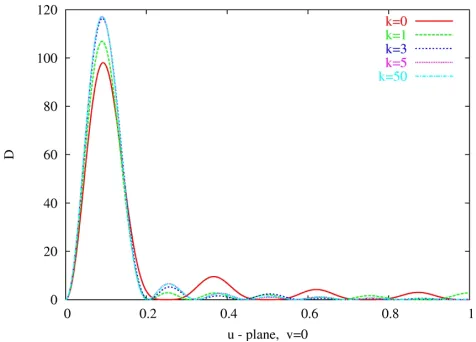
Let us consider a rectangular array of N = 128 elements disposed on a 16 × 8 regular lattice with d = λ/2. The sum excitations are fixed to those of a pattern multiplication Dolph-Chebyshev array with SLL = −20 dB [16] and, for the sake of space, the analysis is limited to the synthesis of the E-mode difference pattern. The optimal excitations Imax(E) have been determined at the end of the first stage after K = 50 iterations. The synthesized optimal pattern is shown in Fig. 1 where the maximum value of directivity, Dmax = 117.3 , is located at (umax, vmax) =
9.1×10−2,0.0. As far as the compromise synthesis is concerned, the values of the maximum directivity obtained with the CPM versus the number of sub-arrays are shown in Fig. 2, where the plot of Ψopt function is also reported. It is worth noting that the directivity values of the compromise solutions are generally close to the optimum one. In particular, the index ξD = D
max−DCP M
Dmax turns
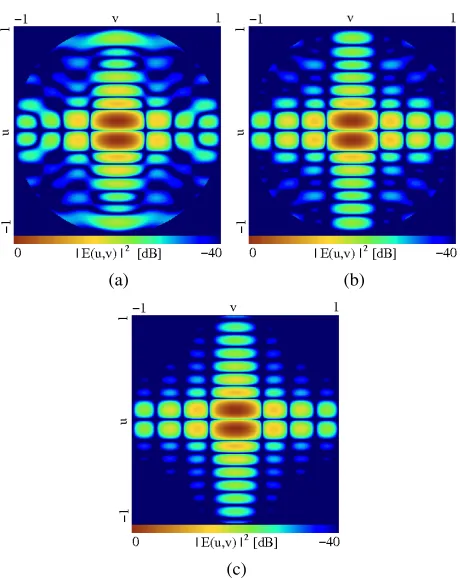
out to beξD ≤4% whenQ≥4 andξD ≤1% whenQ≥8 (Fig. 2). For illustrative purposes, Fig. 3shows the synthesized compromise patterns when Q = 4 [Fig. 3(a)] and Q = 8 [Fig. 3(b)]. The reference pattern [Fig. 3(c)] is reported, as well.
Figure 2. Behaviors of the synthesized value of D and of the cost function Ψ versusQ.
(a) (b)
(c)
4. CONCLUSIONS
In this paper, a two-stage procedure for the optimization of the directivity of compromise difference patterns in monopulse planar sub-arrayed antennas has been considered. The CPM has been used to define the “best compromise” solution that better matches the optimum with maximum directivity for a given array geometry. Selected results have been reported to assess the effectiveness of the proposed approach.
REFERENCES
1. Skolnik, M. I., Radar Handbook, McGraw-Hill, New York, 1990. 2. Song, M. Z. and T. Hong, “Sum and difference multiple beam
modulation transmitted by multimode horn antenna for inverse monopulse direction-finding,” Progress In Electromagnetics Re-search, PIER 82, 367–380, 2008.
3. Singh, A. K., P. Kumar, T. Chakravarty, G. Singh, and S. Bhooshan, “A novel digital beamformer with low angle reso-lution for vehicle tracking radar,” Progress In Electromagnetics Research, PIER 66, 229–237, 2006.
4. McNamara, D. A., “Synthesis of sub-arrayed monopulse linear arrays through matching of independently optimum sum and difference excitations,” IEE Proc. H, Vol. 135, No. 5, 371–374, 1988.
5. Ares, F., J. A. Rodriguez, E. Moreno, and S. R. Rengarajan, “Optimal compromise among sum and difference patterns,” Journal of Electromagnetic Waves and Applications, Vol. 10, No. 11, 1543–1555, 1996.
6. Caorsi, S., A. Massa, M. Pastorino, and A. Randazzo, “Optimization of the difference patterns for monopulse antennas by a hybrid real/integer-coded differential evolution method,” IEEE Trans. Antennas Propagat., Vol. 53, No. 1, 372–376, 2005. 7. Lopez, P., J. A. Rodriguez, F. Aares, and E. Moreno, “Subarray
weighting for difference patterns of monopulse antennas: Joint optimization of subarray configurations and weights,” IEEE Trans. Antennas Propagat., Vol. 49, No. 11, 1606–1608, 2001. 8. D’Urso, M., T. Isernia, and E. F. Meliado, “An effective hybrid
approach for the optimal synthesis of monopulse antennas,”IEEE Trans. Antennas Propagat., Vol. 55, No. 4, 1059–1066, 2007. 9. Rocca, P., L. Manica, and A. Massa, “An effective excitation
between sum and difference patterns in planar arrays,” Progress In Electromagnetics Research B, Vol. 3, 115–130, 2008.
10. Hosseini, S. A. and Z. Atlasbaf, “Optimization of side lobe level and fixing quasi-nulls in both of the sum and difference patterns by using continuous ant colony optimization (ACO) method,” Progress In Electromagnetics Research, PIER 79, 321–337, 2008. 11. Massa, A., M. Pastorino, and A. Randazzo, “Optimization of the
directivity of a monopulse antenna with a subarray weighting by a hybrid differential evolution method,”IEEE Antennas Wireless Propagat. Lett., Vol. 5, 155–158, 2006.
12. Hannan, P. W., “Maximum gain in monopulse difference mode,” Trans. IRE Antennas Propagat., Vol. 9, No. 3, 314–331, 1961. 13. Manica, L., P. Rocca, A. Martini, and A. Massa, “An
innovative approach based on a tree-searching algorithm for the optimal matching of independently optimum sum and difference excitations,” IEEE Trans. Antennas Propagat., Vol. 56, No. 1, 58–66, 2008.
14. McNamara, D. A., “Excitations providing maximum directivity for difference arrays of discrete elements,”Electron. Lett., Vol. 23, No. 16, 780–781, 1987.
15. Cheng, D. K., “Optimization techniques for antenna array,”Proc. IEEE, Vol. 59, No. 12, 1664–1674, 1971.