ISSN 2286-4822 www.euacademic.org
Impact Factor: 3.4546 (UIF) DRJI Value: 5.9 (B+)
The impact of autism on some influential measures
of postural control
MASOUMEH DARVISHI
Master of Physical Education and Sport Sciences Borujerd University, Iran
MAHBOOBEH KHANGHOLI
PhD. Candidate of Motor Learning Islamic Azad Tehran Markazi University, Tehran, Iran
MEHDI TARAJIAN
PhD. Candidate of Motor Learning Science and Research Branch Islamic Azad University, Tehran, Iran
RAHA NIKRAVESH
PhD. Candidate of Motor Learning Islamic Azad Tehran Markazi University, Tehran, Iran
Abstract:
Introduction; This study has shown the impact of Autism on some influensive measures of postural control [the reaction time (simple and choice) and balance (dynamic and static)] between Autistic and normal children.
Material and methods; The research method is causal_ comparative. In order to select a sample of autistic children, 15 autistic children were chosen in a health center in Hamadan, and in order to select a sample of normal children, 100 children in five Geographical zones in Hamden (North, South, East, West and Downtown ) were randomly chosen and participated in this research project.
significant difference in simple and choice reaction time between Autistic and normal children.
Results; It seems that the inability of autistic children in poor communication and failure in central nervous system resulted in significant differences in time variables, reaction time and balance.
Key words: Autism, static balance, dynamic balance, choice reaction time, simple reaction time.
INTRODUCTION;
The research on cognitive_ motor factors is one of the most active and the most interesting research fields. Almost every aspect of human behavior and cognition needs learning, and the cases that cause disorder in cognitive_ motor factors make the natural and social life impossible. limited mental development with problems and shortcomings in adaptive behavior is manifested as the behavior of a person with autism. Furthermore, the results of researches have shown that the acquisition of motor skills is the leader of intellectual development and increase in individual's ability in social activities. Lack or loss of motor skill training in mentally retarded children lead to their further distance from the other children with the same ages. As a result, they drop behind from their peers in cognitive, symbolization, learning and adapting. Autism is a growth disorder that is characterized by abnormal verbal and communicational behaviors. The symptoms of this disorder occur in the first three years of life. This disease has been reported about ten cases in each five hundred children and among boys is four to five times more than girls.
high-functioning autism disorder that is sometimes called the Little Professor Syndrome. The lowest end of the spectrum is often called classic autism, which is usually associated with mental retardation. Among the spectrum, there are varieties of pervasive developmental disorders, including Rett syndrome, childhood disintegrative disorder and non-specific pervasive developmental disorder. Most people with autism have delays in coarse and fine motor development. Research conducted on children with autism disorder has pointed to weakness in fine and coarse motor skills, disorder in coordination and motor planning and disorder in Social interactions.
coordination of three balance systems (visual, vestibular and somatosensory systems) plays an important role. Cooperation among these systems leads to postural control and balance. In order to stand upright, components of the central and peripheral nervous system constantly act well with each other to maintain the body position and the center of gravity in the scope of supporting surface. It is inferred from reports and studies that the motor problems are common in people with autism spectrum. The most common disorders include muscle relaxation and apraxia. The remarkable thing is that with increasing age, the prevalence of these problems decreases. It suggests the gradual improvement of these problems over time. considering the reasons such as the increasing prevalence of autistic children and concerns of parents of their children’s conditions and recovery rates, and also the importance of reducing the costs imposed on families and society, the evaluation, and treatment of autistic children immediately after diagnosis, appears to be necessary. And with the identification of the factors that can affect the motor control of these children we can have an effective approach to implement appropriate interventions. Therefore, the goal of this research is to study the impact of autism on several influential measures on postural control including reaction time and balance.
Research methodology
research project. Instruments included the reaction timer devices, test BESS (Balance based on Error Scoring System ), to measure static balance and gait tests on the balance board width;10 and 15 cm, to measure dynamic balance. In the simple reaction test; In order to determine the minimum of simple reaction time, the subject sat in front of the tester and the machine holding one of the push-buttons in their hands. Then with the command of the tester, immediately pushed the button after seeing the lighting of the subject's requested colored lights and hearing the beep sound. This time period was recorded and repeated 20 times.
In choice reaction time, the tester asked the subject to press the button after lighting of green light and to press the red button after lighting of red light; and the test was repeated twenty times. In measuring the dynamic balance, walking on balance boards with 10 and 15 cm width, with closed and open eyes backwards and forwards, and also walking on a labeled surface with open eyes without error was recorded and used as an indicator to measure this balance. BESS test was used to measure static balance. This test consisted of 10 positions, each done while standing on stable and unstable surfaces for superior and non-superior organs.
determine data distribution, U Mann-Whitney test was used to compare two groups of autistic and normal childeren.
Findings
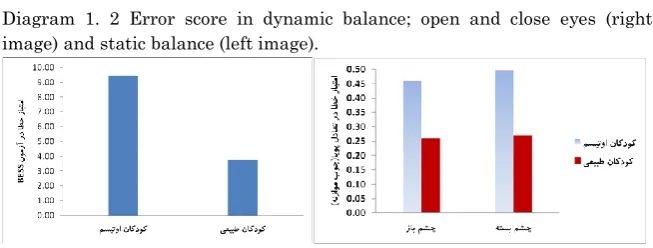
As shown in the following table; U Man - Whitney test showed that static and dynamic balance in autistic children compared to normal children in BESS test is significantly weaker.
Table 1. The results of U Mann-Whitney test in static balance.
Diagram 1. 2 Error score in dynamic balance; open and close eyes (right image) and static balance (left image).
Diagram 3. Simple reaction time in autistic and normal childere
The other result showed that choice reaction time in autistic children was significantly more in autistic children compared to normal children( U=100/5 & P=0/001).
Diagram 4. Choice reaction time in autistic and normal children.
DISCUSSION
Findings related to the impact of autism on some influential measures on postural control showed that there is a significant difference between static balance in autistic and normal children. Error rate of static balance in autistic children (average 101/5) compared to normal children (average 51/5 ) in BESS test was significantly more which shows low level static balance in autistic children. One of possible reasons is that motor disabilities caused by brain problems led to autistic
children with motor weakness and inability. This subject is reported in various researches such as Pan and colleagues' study (2009), Astaples vrid (2010) and Roshanbakhsh and Nateghi (1379) that the motor abilities of autistic children were lower than their peers and these skills are not completely formed in them and to improve them, they need practice programs. Thus, if there is a proper training and scientific program for these children, they can enhance their motor skills. The results showed that while there is vision, the error rate of autistic children (average 99/3) compared with normal children (average 51/8) was significantly more. Also, while there isn't vision, the error rate of autistic children (average 108) compared with normal children (average 50/5) was significantly more. This shows low level dynamic balance in autistic children. Obtained results are consistent with the research result that was conducted on specific subjects.[ Tabiee and colleagues(2009)about subjects with Parkinson's, Taheri and
colleagues(2011) about Down Syndrome, cote and
damage of more than one center, for example, impairment in visual or sensory somatic senses(such as disorders in patients with autism), besides the damage to the vestibular system, the performance of the individual in balance skills requires the use of these centers, which shows a major flaw (Desmond, 2007).
Another result was that simple and choice reaction time in children with autism were significantly different from normal children, So that it was significantly more in children with autism compared to normal children, therefore, it shows low level choice and simple reaction in autistic children. The results of recent researches show that the brains of children with autism react longer to stimuli in a fraction of a second compared to normal children, so that, the brain reaction in these children is about twenty to fifty percent slower while hearing these sounds.
autistic children ]. Since each of the aforementioned factors(anxiety, depression, mental health, arousal levels and IQ) has the potential to progress with increasing environmental enrichment (physical activity), it is suggested that in scheduling classes and choosing games, consider some skills to improve reaction time and balance, in order to develop these people's fundamental skills.
REFERENCES
1. Schmidt, Richard (1996). Fundamental concepts and modes of studying behavior and motor learning. Translated by Seyyed Mohammad Kazem Mousavi. Tehran. University Press.
2. Talat Rafei. (2006). Autism, evaluation and treatment, Tehran, Danzhh publication.
3. ,Forough Roshanbakhsh; Zohre Nateghi. (2000). Bachelor thesis in Exploring Autism, Department of Education in Tehran.
4. Sali Auznof, Geraldine Rawsen and James Mc Partlnd . (2006). Guide for parents of children with Asperger and autism with high performance. Translated by Parviz Sharifi Daramadi and Mahboobeh Haji Norouzi , Tehran, Sepahan Press .
5. Black Burn , T , Guskiewicz , K . M ;PeTschaur , M.A: PrenTice , W. E . (2000). BaLance and joint Stability: the relative contributions of proprioception and muscular strength , journal sport Rehabilitation, 9:315-328.
6. Desmond AL. Vestibular rehabilitation. In: Valente M, Hosford-Dunn H, Roeser RJ. Audiology Treatment. 2nd ed. New York: Thieme Medical Publisher Inc. 2007. p. 452-70.
disabilities. Developmental Medicine & Child Neurology; 50 (3): 822–827.
8. Pan, Chien-Yu., Tsai, Chia-Liang., Chu, Chia-Hua. (2009). Fundamental Movement Skills in Children Diagnosed with Autism Spectrum Disorders and Attention Deficit Hyperactivity Disorder, Springer Science & Business Media; 39 (4): 1694-1705.
9. Rusell, Lang., Kern, Koegel., Kristen, Ashbaugh., April, Regester., Whitney, Ence., Whitney,Smith. (2010). Physical exercise and individuals with autism spectrum disorders: a systematic review, Research in Autism Spectrum Disorders; 46 (3): (2010): 1-12.
10. Schmidt, A.; and A. Wrisberge (2005). Motor learning and performance. Human kinetcs. USA.460-462.
11. Schmitz N, Daly E, Murphy D.(2012) Frontal anatomy and reaction time in Autism. Source. Performing your original search, reaction time in autism, in PubMed will retrieve 550 records, NeurosciLett. 2013 Jan 22;412(1):12-7. Epub 2012 Dec 29
12. Shumway-cook A,Woollacott MH. Motor control: theory and practical applications.3th ed. Lippincott Williams and wilkins. 2007.
13. Staples K. l., Reid, G. (2010). Fundamental Movement Skills and Autism Spectrum Disorders. Autism Dev Disorder; 40 (3): 209-217.
14. Sutoo, D.; and K. Akiyama (2003). Regulation of brain function by exercise. Neurobiology of Disease .13.1-14. 15. Taskiran, O.; Z. Gunendi; N. Bolukbosi; and M.
Bayazova (2008). “The effect of a single session