Available online: https://edupediapublications.org/journals/index.php/IJR/ P a g e | 1261
Design and Analysis of Go-kart Chassis using CATIA
and ANSYS
M.Deepak kumar
1K.L.Narayan
2P.S.B.Choudary
3A.S.Ganapathi
41
M-Tech, Department of Mechanical SIR C R REDDY College of Engineering
2
Professor, Department of Mechanical SIR C R REDDY College of Engineering
3
Assosciate Professor, Department of Mechanical SIR C R REDDY College of Engineering
4
Assistant Professor, Department of Mechanical SIR C R REDDY College of Engineering
Abstract
:
A Go-Kart is a small four-wheeled vehicle without suspension or differential. It is a light powered vehicle which is generally used for racing. This work is aimed to model and perform the STATIC analysis of the go-kart chassis which is of constructed with circular beams. Modeling and analysis were performed in CATIA and ANSYS respectively. The go-kart chassis is different from ordinary car chassis. Here two different materials were compared with Circular models. Suitable materials were found to be AISI1018 and carbon fibre. By using front, rear side-impact methods, the chassis is designed in such a way that it requires less material and ability to withstand loads applied to it. Strength and light weight were the basic considerations for choosing the chassis material. Carbon fibre is the suitable material to be used for the go-kart chassis because of High Strength to weight ratio, Rigidity, Corrosion resistance, Electrical Conductivity, Fatigue Resistance. based on stresses and deformation values.
Keywords
:
Chassis, Go-Kart, AISI 1018, catia ANSYS 14.
1. Introduction
Kart racing or karting is a variant of open-wheel motorsport with small, open, four-wheeled vehicles called karts, go-karts, or shifter karts depending on the design. They are usually raced on scaled-down circuits. Karting is commonly perceived as the stepping stone to the higher ranks of motorsports. The Go-Kart is a small powered single/double occupancy racing vehicle, having a similar functioning as of an F1 vehicle but specifically meant for low powered engines. The Go-kart tracks are smaller when compared to F1 tracks but the door to F1 opens after being part of International Go-Kart Championships. The Go Kart is very volatile as similar to F1 car chassis
2. Literature Review
Lonny L.Thompson, et al [15] determined that a high sensitivity value indicates a strong influence on the torsional stiffness of the overall chassis. Results from the sensitivity analysis are used as a guide to modify the baseline chassis with the goal of increased torsional stiffness with minimum increase in weight and low center-of-gravity placement. The torsional stiffness of the chassis with various combinations of added members in the front clip area, engine bay, roof area, front window and the area behind the roll cage was predicted using finite element analysis. They concluded that with strategic placement of structural members to a baseline chassis, the torsional stiffness can be more than tripled with only a 180 N increase in weight.
Available online: https://edupediapublications.org/journals/index.php/IJR/ P a g e | 1262 is that the MBS calculations take much time
to consume, especially if flexible bodies are included, and are thus, not well suited for fast parameter studies. This literature survey reveals that there is a strong need to predict the transient response of truck chassis when subjected to dynamic loads while it encounters a bump with different speeds of the vehicle.
The stress analysis of truck chassis using riveted joints has been performed by Cicek Karaoglu et al [4], in order to achieve a reduction in the magnitude of stress near the riveted joint of the chassis frame. Side member thickness, connection plate thickness, and connection plate length were varied. Numerical results showed that stresses on the side member can be reduced by increasing the side member thickness locally. If the thickness change is not possible, increasing the connection plate length may be a good alternative.
In order to investigate the transient response of a vehicle–structure interaction system in the time domain, Tso-Chien Pan et al [20] developed a dynamic vehicle element (DVE) method. The DVE method treats the vehicle as a moving part of the entire system, which considers the vehicle influence at the element level by incorporating the detailed interaction between multiple vehicles and the structure induced by irregular road profiles. In addition, a simplified decoupled dynamic nodal loading (DNL) method is proposed. The DNL method generates a time series of concentrated nodal loading which represents the vehicle reaction force on the structure. The DNL method, therefore, accounts for the road irregularities and vehicle inertia effect but neglects the interaction between the two subsystems. Parametric studies for the effects of road roughness, speed parameter, mass ratio, and frequency ratio on the dynamic vehicle–structure interaction are then carried out using the DVE and DNL methods.
A.V. Pesterev et al [18] determine the dynamic amplification factor function for an irregularity represented as a superposition of simpler ones. Another purpose of this paper is to demonstrate the application of the pothole dynamic amplification factor (DAF) functions technique to finding a priori estimates of the effect of irregularities with a repeated structure. Specifically, the problem can be solved by finding the conditions under which the dynamic effect of two identical potholes located one after another is greater than that due to the single pothole. We also find the estimate for the number of periods of a periodic irregularity that are sufficient in order to consider the oscillator response as steady state.
3. Design Objectives
3.1 Design Objectives of chassis are:-
Provide full protection of the driver, by obtaining required strength and torsional rigidity, while reducing weight through diligent tubing selection Design for manufacturability, as well as cost reduction, to ensure both material and manufacturing costs are competitive with other Go Karts. Improvement in driver comfort by providing more lateral space in the driver compartment Maintain ease of serviceability by ensuring that chassis members do not interfere with other subsystems Deciding the cost efficiency of such in terms of large-scale manufacturing. Calculation of stresses acting on the chassis of the vehicle under different loading conditions. The product can prove to be very efficient in all the aspects such as cost, drivability, maintenance, easy usage, safety etc.
3.2 Methodology
DESIGN METHODOLOGY:
Design of any component is consists of three major principles:
1. Optimization 2. Safety 3. Comfort
Step 1: Collecting information and data related to gokart chassis
Step 2: A fully parametric model of the go-kart chassis is created in catia software.
Step 3: Model obtained in IGES is analyzed using ANSYS 14.5 (workbench) to obtain stresses, strain deformation strain energy etc.
Step 4: Manual calculations are done.
Step 5: Finally, we compare the results obtained from ANSYS and compared with different materials.(1018 and carbon epoxy)
3.3 Various loads acting on the frame:
1. Short duration Load – While crossing a broken patch.
2. Momentary duration Load – While taking a curve. 3. Impact Loads – Due to the collision of the vehicle. 4. Inertia Load – While applying brakes.
Available online: https://edupediapublications.org/journals/index.php/IJR/ P a g e | 1263
3.4 Functions of the frame
1. To carry the load of the passengers or goods carried in the body.
2. To support the load of the body, engine, gearbox etc.,
3. To withstand the forces caused due to the sudden braking or acceleration.
4. To withstand the stresses caused due to the bad road condition.
5. To withstand centrifugal force while cornering.
3.5 Material properties
3.5.1 AISI 1018
1018 is among the most commonly available grades available in the world. It is widely available in cold finished rounds, squares, flat bar, and hexagons. Despite its unimpressive mechanical properties, the alloy is easily formed, machined, welded and fabricated.
Material properties:
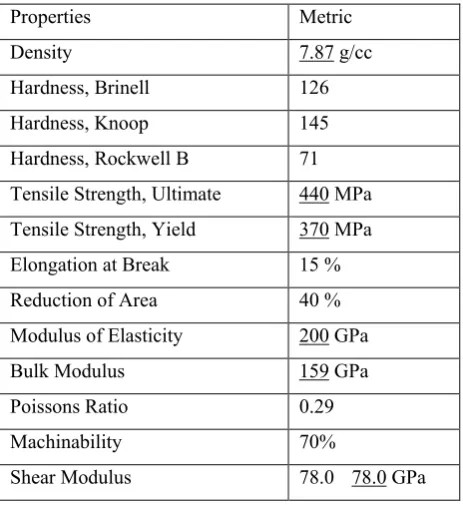
TABLE 3.1 AISI 1018 MATERIAL PROPERTIES
Properties Metric
Density 7.87 g/cc
Hardness, Brinell 126
Hardness, Knoop 145
Hardness, Rockwell B 71 Tensile Strength, Ultimate 440 MPa Tensile Strength, Yield 370 MPa Elongation at Break 15 %
Reduction of Area 40 %
Modulus of Elasticity 200 GPa
Bulk Modulus 159 GPa
Poissons Ratio 0.29
Machinability 70%
Shear Modulus 78.0 78.0 GPa
3.5.2 Carbon fibre material:
Carbon fiber is most notably used to reinforce composite materials, particularly the class of materials known as carbon fiber or graphite reinforced polymers. Non-polymer materials can also be used as
the matrix for carbon fibers. Due to the formation of metal carbides and corrosion considerations, carbon has seen limited success in metal matrix composite applications. Reinforced carbon-carbon(RCC) consists of carbon fiber-reinforced graphite and is used structurally in high-temperature applications. The fiber also finds use in filtration of high-temperature gases, as an electrode with the high surface area and impeccable corrosion resistance, and as an anti-static component. Molding a thin layer of carbon fibers significantly improves the fire resistance of polymers or thermoset composites because a dense, compact layer of carbon fibers efficiently reflects heat. The increasing use of carbon fiber composites is displacing aluminum from aerospace applications in favor of other metals because of galvanic corrosion issues.
TABLE 3.2 Carbon fibre material properties
Material
properties Carbon fiber
Density 1600 kg/m3
Young’s modulus 70*109
Poisson’s ratio 0.1
Bulk modulus 2.9167*1010Pa
Shear modulus 3.1818*1010Pa
Ultimate compressive
strength 1.9*10
5Pa
Specific modulus 43.75
Stiffness 26830 N/m
3.6 Problem identification:
Weight reduction is now the main issue in automobile industries. Because if the weight of the vehicle increases the fuel consumption increases. At the same time as the weight of the vehicle increases the cost also increases which becomes a major issue while purchasing an automobile. For example, if we take a frame of GOKART CHASSIS. It is manufactured with Steel. Steel structures exposed to air and water, such as bridges are susceptible to corrosion. In conditions of repeated stress and more temperatures, it can suffer fatigue and cracks. These are the main problems of steel and these are compensated by inducing composite material and apply impact loads.
Available online: https://edupediapublications.org/journals/index.php/IJR/ P a g e | 1264
4.Designing of the Model :
Create the rectangular profile in sketcher workbench as per the below dimensions after go to part design create plane now select plan go to sketcher now create two hollow circles at the end of the rectangle profile again go to part design apply rib option now converted into the solid body.
Figure 4.1 go-kart in catia work bench final output
5.Circular model AISI 1018 material:
four load conditions are applied to 1018 material model5.1 General load conditions:
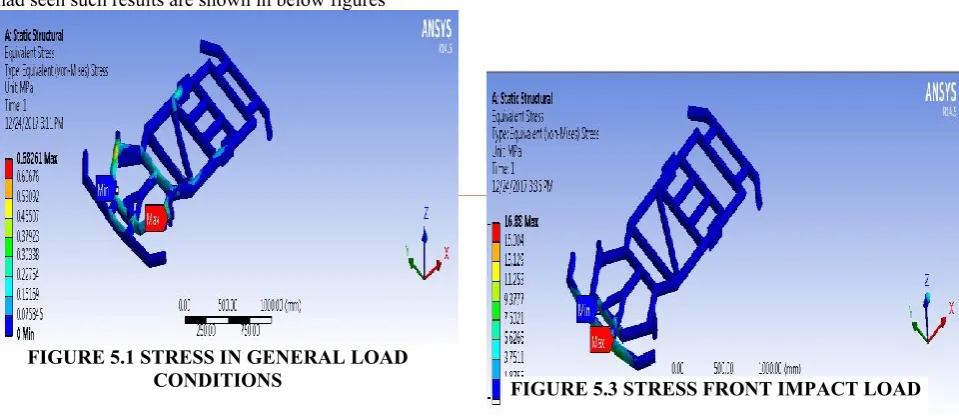
A force of 1127 N was applied to the throughout chassis body constraining the body panel rods and we had seen such results are shown in below figures
FIGURE 5.1 STRESS IN GENERAL LOAD CONDITIONS
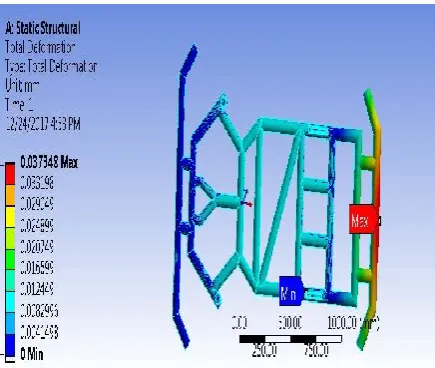
Figure 5.2 Total deformation in general
load conditions
5.2 Front impact:
The Front Impact Analysis has been carried out on the Ansys 15.0 while constructing a perfect space frame tubular chassis on catia and then it was imported to Ansys 15 have been applied on the regions A force of 14038 N was applied to the front ends constraining the body panel rods and the observed deformation, Stress and strain as shown in below figures.
Available online: https://edupediapublications.org/journals/index.php/IJR/ P a g e | 1265 5.3Side impact:
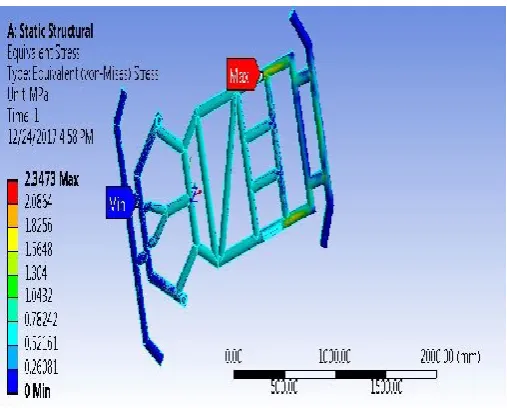
The Side Impact Analysis has been carried out on the Ansys 15.0while constructing a perfect space frame tubular chassis catia and then it was imported to Ansys 15.0 with a Force with respect to the 2G criteria A force of 7019N has been applied and the observed deformation, Stress, and strain are shown in below figures
FIGURE 5.4 STRESS IN SIDE IMPACT
5.4 Rear impact load :
A force of 4913 N was applied to the rear ends by totally constraining the degree of freedom of the suspension points and we had seen such results as shown And assuming and the observed deformation, Stress, and strain as shown in below figures
Figure 5.5 deformation in a rear impact
Figure 5.6 stress in rear impact
6.Circular model carbon fibre material:
four load conditions are applied to CARBON FIBRE material model
General load conditions: A force of 1127 N was applied to the throughout chassis body constraining the body panel rods and we had seen such results as shown in below figures
FIGURE 6.1 STRESS IN GENERAL
Available online: https://edupediapublications.org/journals/index.php/IJR/ P a g e | 1266
FIGURE 6.2 TOTAL LOAD CONDITIONS IN GENERAL LOAD CONDITION
6.1 Front impact :
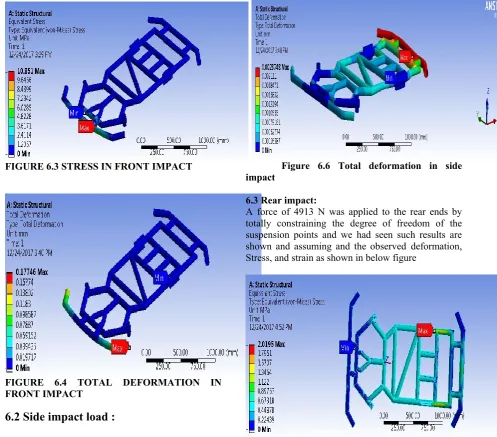
The Front Impact Analysis has been carried out on the Ansys 15.0 while constructing a perfect space frame tubular chassis on catia and then it was imported to Ansys 15 have been applied on the regions A force of 14038 N was applied to the front ends constraining the body panel rods and the observed deformation, Stress and strain as shown in below figures
FIGURE 6.3 STRESS IN FRONT IMPACT
FIGURE 6.4 TOTAL DEFORMATION IN FRONT IMPACT
6.2 Side impact load :
The Side Impact Analysis has been carried out on the Ansys 15.0while constructing a perfect space frame tubular chassis catia and then it was imported to Ansys 15.0 with a Force with respect to the 2G criteria A force of 7019N has been applied and the observed deformation, Stress, and strain as shown in below figure
FIGURE 6.5 STRESS IN SIDE IMPACT
Figure 6.6 Total deformation in side impact
6.3 Rear impact:
Available online: https://edupediapublications.org/journals/index.php/IJR/ P a g e | 1267
Figure 6.7 Stress in rear impact
Figure 6.8 Total deformation in rear impact
7. Stresses in static analysis graph:
This graph shows the stresses and maximum deformation values for two different materials, as shown in the below graph
Figure 7.1 Stresses in static analysis graph
8. Conclusion:
Circular section go-kart design and analysis were done with 1018, carbon fiber materials.It was concluded based on stresses and deformation values the suitable material for a go-kart. Static analysis using finite element method was successfully carried out on chassis catia model to determine in Ansys equivalent stresses and maximum deformations. Hence the chassis design is safe with carbon fiber material compared to steel AISI1018 material.Circular section go-kart design and analysis were done with 1018, carbon fiber materials. Finally, it was concluded that the carbon fiber material gave better performance compared to the
1018 material, Carbon fiber is the suitable material to be used for the go-kart chassis because of High Strength to weight ratio, Rigidity, Corrosion resistance, Electrical Conductivity, Fatigue Resistance. It was concluded based on stresses and deformation values the suitable material for a go-kart. Static analysis using finite element method was successfully carried out on chassis catia model to determine in Ansys equivalent stresses and maximum deformations. Hence the chassis design is safe with carbon fiber material compared to steel AISI1018 material.
9.References:
[1]HERB ADAMS," CHASSIS ENGINEERING”. [2] R.K. Rajput, “Strength of materials”.
[3] V.B. Bhandari, “Design of Machine Elements”.
TATA turbo truck SE1613” IJEAT 2014 page no.181-187.
[5] Vijaykumar V Patel and
R.I.Patel,2012,“Structural Analysis OF Ladder Chassis Frame”WJST 2012 .
[6] Mohd. Azizi Muhammad Nor, Helmi Rashid Wan MohdFaizul , Wan Mohyuddin , MohdAzuanMohdAzlan , Jamaluddin Mahmud,2012,“Stress analysis of low loaderChassis”IRIS 2012 page no.995-1001
[7] Ms.Kshitija A. Bhat1, Prof. Harish V. Katore,“ The FailureAnalysis of Tractor Trolley Chassis An Approach using Finite Element Method - A Review” IOSR-JMCE e-ISSN pageno. 2278-1684
[8] HemantB.Patil, SharadD.Kachave, Eknath R.Deore,“Stress Analysis of Automotive Chassiswith Various Thicknesses” IOSR-JMCE e-ISSN: 2278-1684 Volume 6, Issue 1 (Mar. - Apr.2013), PP 44tractor trailer chassis for self-weight reduction [9] N.K.Ingole, D.V. Bhope,2011,“Stress analysis of tractor trailer chassis for self-weight reduction” International Journal of Engineering Science and Technology (IJEST), ISSN:0975-5462 Vol. 3 No. 9,September 2011
[10] Dr.R.Rajappan, M.Vivekanandhan,“Static and Modal Analysis of Chassis by Using SolidWorks”, IJES Volume 2 Issue 2 Pages 63-73 2013
[11] “Beam formula with shear and moment diagram”, American forest and paper association, Inc, American Wood Council, 1111 19th St., NW. Suite 800, Washington. DC20036, 202 – 463 – 4713. [12] Sane, S. S., Jadhav, G., Anandraj, H,1955,“Stress Analysis of Light CommercialVehicle Chassis by FEM”,Piaggio Vehicle Pte.Ltd,pune.