Available online: https://edupediapublications.org/journals/index.php/IJR/ P a g e | 3281 ABSTRACT
This paper involves the study of optimization of burn rate techniques. Addition of small amount of inorganic and organic substances alters the burn rate. The purpose of this paper is to study the effects of additives on burn rate. Also optimization is done using changing the composition of the reacting species in the propellants. We used AP-PVC and black powder based propellants for the optimization. Additives, Al powder and Iron oxide were used in same propellants strand formulation. These materials are generally used in 1-5% of amount of basic propellants by weight. Optimization of propellant was studied by observing their burning characteristics of the propellant. The result shows that burn rate increase for some additive and decrease with some additive based on the composition of the additives and basic propellant.
I. Introduction
The basic thing of any propellant is computation of burn rate before its use and it is helpful in further calculation. This paper describes the optimization of burn rate of specific propellants based on potassium nitrate (KNO3) and Ammonium Perchlorate. Since
these compounds contain a high amount of oxygen content, the study is constrained to this oxidizer in the above propellant only. KNO3 is
a neutralized salt from nitric acid that has very high oxidizing power and any potassium base say potassium hydroxide and Ammonium perchlorate is a derivative of perchloric acid
that also contain high percentage of oxygen. Apart from content of oxygen in KNO3 it is
very cheaply available and can be manufactured in very less amount of time. Industrial production of KNO3 is very
inexpensive. It is like a conventional oxidizer used from 80’s. Ammonium perchlorate is another latest and high oxygen content used in the propellant. This study is based on Ammonium perchlorate and polyvinyl chloride propellant in which PVC acts as multifunctional substance as fuel as well as binder. This significant property made us to study the burn rate of these propellants and their optimization using some additives.
Additives used here are Aluminium powder of industrial grade and Fe2O3 powder.
Use of these additives is based on their property of heat absorption. Considering activation energy of any reaction, if after taking the activation energy from the environment gives more energy in the combustion then it is suitable for the addition in the basic propellant formulation. Since metal have the above described property, they are used for the burn rate optimization and Aluminium contains three electrons in its outer shell and thermal property is low i.e. low melting point. These characteristic features lead this metal for distinguishing burning and use in the propellants as an additive.
Burn rate empirical formula was given by;
𝑟 = 𝑎𝑃𝑛
Experimental Study on Solid Propellants
Prakhar Jindal
Available online: https://edupediapublications.org/journals/index.php/IJR/ P a g e | 3282
where, r is the burn rate
a is proportionality constant
P is the chamber pressure
n is Pressure index II. Literature Review
S.R Jain [11] presented a study about the different binders used in solid propellants based on the property of binding and environmental concern. He proposed AP is a good binder and fuel but only disadvantage of thus is formation of HCl gas during oxidation of AP which is a harmful gas. The first sugar rocket was made by colburn in 1947[12] Gordon and McBride in 1974 said that burn rate is altered by combustion instability inside the combustion chamber. K Kishore et.al [13] worked on the ignition delay of AP propellant. He has given empirical relation on the basis of concentration of propellant. He proposed ignition delay is inversely proportional to 2.32th power of concentration of oxidizer below 65% and at a temperature of 595K, Also it is inversely proportional to 1.14th power of concentration above 65% of oxidizer. Krishnan, [14] described that the procedure of mixing of additives in the propellant also plays great role in determining the burn rate. Bozic v.[15] worked on Ammonium perchlorate based propellants and its derivative and found out that basic ammonium perchlorate with PVC gives burning rate of 3 mm per second(averaged).
After going through the literatures certain research gaps are as follows:
Optimization of burn rate using additives.
Chemical effects of additives on the burn
rate of propellant.
Compatibility of different additives with
different compositions of propellant.
III. Methodology
Selection of propellants
Our study is focused in the burn rate of Black powder, sugar based propellant and
Ammonium perchlorate propellant. The
selection criteria for these propellants include the following points
Economy
Availability
Amount of Oxidizer content
Amount of fuel content
Amount of solid materials residue after
combustion
Reaction temperature
Amount of exhaust gases
These criteria make the study more easy and link to the recent use of rocket propulsive
fuels Casted in another plate as describes
above, and cut in strands of same dimensions as above.
Assortments of these chemicals are done on the basis of comparative study of their properties. Black powder is the basic and conventional explosive used in Indian history and has very high burn rate. It consists of charcoal and sulfur mixed with potassium nitrate.
Ammonium perchlorate, a salt of perchloric acid containing high amount of oxygen that can be used as an oxidizer. Polyvinyl chloride acts as fuel and binder as well that is also cheaply available. These special properties of species make us to choose it as a propellant in our study.
Available online: https://edupediapublications.org/journals/index.php/IJR/ P a g e | 3283
The reactions taking place in the propellant are given under as for black powder is
16KNO3 +6S + 13C 5K2SO4 + 6N2 + K2S +
11CO2
Reaction of ammonium perchlorate as combustion is
NH4ClO4 HClO4+NH3 2O2+HCl
Ammonium perchlorate a salt of per chloric acid and ammonia gas was mixed with a binder PVC i.e. polyvinylchloride and mixed with demoisturised di-butyl phthalate as a plasticizer. After mixing the species according to required number of moles it was stirred thoroughly for 3-4 hours continuously. 8-10% of plasticizer was added to make the mixture able of stirring at initial stage but since it is volatile we had to use 30-40% of plasticizer for the stirring purpose. The mixture was carried to next stage casting, making strands and for the curing about 100°C in the oven for 20 hours and finally taken out as strands of above dimensions.
The preparation of the gunpowder starts with obtaining a fine mixture of all the components such as Potassium Nitrate, Charcoal and Sulfur. To obtain the fine mixture of the components ball milling process for each component is carried out. After this process the required amount of components as Potassium Nitrate (75%), Charcoal (13%) and Sulfur (12%) is taken and mixed properly .After the mixing process, water (8%) is added in a step wise manner along with the mixing of the propellant is done until a thick clayey paste is
obtained. In order to remove the excessive water, numbers of clusters from the clayey paste is made and are allowed for soaking using the soaking paper. After the excess water is removed then the casting of the propellant is done in the appropriate container.
Smaller the particle size of combining species better will be the combustion. This mixture is carefully made into strands of standard size as discussed above, such that no air bubbles should trap in the propellant. Air trapped will alter the burn rate as presence of extra air will provide extra oxygen and less propellant.
IV.Results and Discussion
This section deals with the graphical representations for the results obtained from the above experimentations. These results will be used for the explanations regarding the burn rate for the propellant combinations with certain additives.
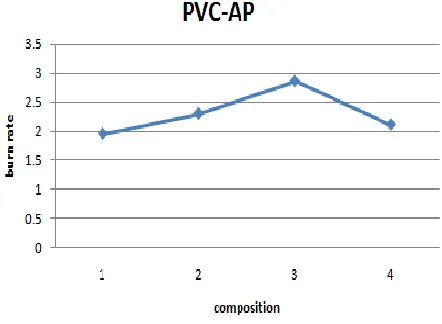
Fig 1 burn rate v/s composition of AP/PVC
Available online: https://edupediapublications.org/journals/index.php/IJR/ P a g e | 3284
the different compositions of propellant i.e. oxidizer and fuel, when mixed in certain proportions, it provides different burn rates. The effect arises here is due to the stochiometric ratio of the oxidizer and propellant. All the propellant when mixed with proper proportions calculated from the reaction, give the optimum burn rate. In the above figure o/f ratio gives maximum burn rate because this is the combining ratio of the reaction of combustion. Also considering the other compositions rate is not optimum. Reason behind that is AP cannot get the most efficient amount of fuel to PVC i.e. ratio of 4:1. When looking at the composition of 1 and 2 point in fig 1. PVC is more than the required. Here AP is not present in sufficient amount to carry out reaction.
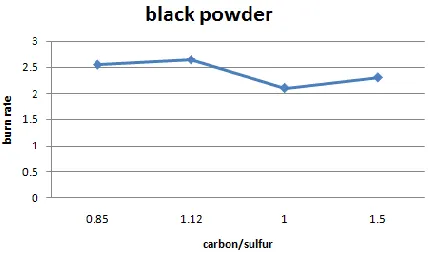
Fig 2 Burn rate with 75% of KNO3
Fig.2 represents the burn rate of Black Powder propellant with respect to the ratio of carbon and sulfur present in the propellant.
KNO3 is used in same amount i.e. 75% in
all compositions. Since here fuels are carbon and sulfur, study is carried out on the basis of varying the fuel ratio that is shown on the abscissa. Alteration of burn rate is not significant while changing the fuel
composition. It remains between 2 and 2.5. Now on the basis on above data, best of them was chosen for the further study. This was calculated from the reaction of gunpowder and experimental results were analogous to the analytical results. This proved our study to be worthy for carrying out the further experimentation.
V. Conclusion
Burn rate of PVC/AP is higher as compared to Black Powder in normal compositions. For different compositions of PVC/AP, the burn rate remains higher than those of the black powder.
References
[1]Wan Khairuddin Wan Ali; Ang Kiang Long;
Mohammad Nazri Mohammad
Jaafar,”Experimental Solid and Liquid Propellant Rocket Development” ,University Technology Malaysia : 1992-2011
[2] Ian von maltitz,” Black powder manufacturing, testing and optimization”
[3] Dr. Abhijeet Singh, “Sugar Based Rocket Propulsion System- Making, Analysis & Limitations”
[4] Sutton and biblarz; “Rocket propulsion elements”
[5] A.K Chatterjee; “Combustion studies of aluminized PVC plastisol”
Available online: https://edupediapublications.org/journals/index.php/IJR/ P a g e | 3285
[7] Sidhant Singh; “Solid Rocket Motor for Experimental Sounding Rockets”, University of Petroleum and Energy Studies Dehradun, India.
[8] David Newey, “Optimization of ammonium nitratesolid rocket fuel”, Brigham Young University – Idaho, December 2013
[9] Burning rate control factoring solid propellants Eleventh & Twelfth Quarterly Technical Summary Report. For the Period 1 July 1961 to 31 December 1961