A Study On Multi Criteria Model In Prioritization Of Road
Maintenance Between The Competing Needs
R.Bhargavi , PG STUDENT
Srikanth, ASSISTANT PROFESSOR
Department of Civil Engineering
ASHOKA Institute of Engineering & Technology(Approved By AICTE & Affiliated to JNTU. Hyd) Malkapur (V). Choutuppal (M). Nalgonda Dist-508252
Abstract - This paper present the model developed to solve the maintenance funds allocation challenges by developing a dynamic Multi Criteria Analysis model to support decision making on funds allocations. The Model incorporates social-economic benefits in prioritization. The main question in this paper is “How to maximize Tax payer services in roads investment in a given limited funds?” The result is a list of seven factors, the corresponding weight of each factor and a formula that combine the score in each factor into a single score. Keywords - Multi criteria analysis, prioritization model, Road asset management, TanRoads, Periodic Maintenance.
1.
IntroductionThe transportation service sector is an important component of any country’s economy[1]. Road sector makes a direct and significant contribution to GDP and job creation, and provides crucial inputs for the rest of the economy[2], thus having a significant effect on the overall quality of life of citizen [3]. The Road service sector accounts for a significant proportion of GDP in most countries, including low income countries, where it frequently generates over 50% of GDP. Roads services contributed to 47% of growth in Sub-Saharan Africa over the period 2000-2005, while industry contributed 37% and agriculture only 16%. Recent growth in Africa is due to infrastructure services. [2, 4]. In recognition of the need to improve the economic prospects of the productive sectors and social services, there is need to maintain and improve provision of physical infrastructure and in particular road networks. In Tanzania, road transport in particular account for over 70% freight transport and over 90% of passenger transport [2, 5]. This means the roads sub sector has a relative greater impact on poverty reductions and economic growth compared to other modes of Transport. If not well maintained roads transport is dangerous. Statistics shows that while developing countries own only 32% of the world’s vehicles, they account for 75% of annual accident fatalities [6]. During the period between 2000 and 2008, the number of road crashes increased by 42 percent whereby; the number of injuries had gone up by 27% and number of people killed had increased by 67 %.Nevertheless research has shown that well-designed infrastructure investments have long-term economic benefits[7, 8]; they can raise economic growth, productivity, and land values, while providing significant positive spillovers. However, investing wisely in infrastructure is critically important as over-investment can lead to big projects but with low marginal returns [9]. It is argued in [10]
that Transport is a crucial driver of economic and social development, bringing opportunities for the poor and enabling economies to be more competitive. It is evidence that even though rural roads have low traffic volume but can greatly prevents maternal deaths through timely access to childbirth-related care, boosts girls’ enrolment in school, and increase and diversifies farmers’ income by connecting them to marketsAccording to WB Report [11] road injuries cause more loss of life and disability-adjusted life in years than tuberculosis or malaria. This is the indication that problems in road administration are not only due to lack of funding but partly due to the lack of strategic and scientific approaches. Among the major challenges faced by road administrators in road planning is an immediate peak demand for funds to reduce backlog in the rehabilitation of bitumen roads. Another challenges is technical difficulties in determining the efficient level of funding of roads sector projects economically [8, 12]. According to [13] the typical challenge is associated with short, medium and long planning strategies. It is also noted in [14] that it is not clear which approach is most effective in implementing cross-asset optimization, though most agencies appear to. be taking a bottom-up approach. Even though there are many optimization model in road pavement management strategy, many of them focuses on optimization of road user cost and pavement deteriorating time by considering traffic flow. We attempt to solve the problem of planning strategy using MCA approach
by incorporating socialeconomic values. The
associated algorithm and program was developed and intergraded in Road Maintenance Management system (RMMS).
1.1.Related Model on Optimum Standard for Road User Cost
transport costs ( T ) also namely the society costs; the total transport or society costs comprise of two categories of costs, namely: Road agency costs (C) and Road User Costs (D). Road agency costs include construction costs and maintenance costs, while Road User Costs comprise of vehicle operation costs, passenger, cargo time costs and accident costs.
Others are a social cost which includes user’s convenience and comfort, i.e. quality of life improvement. The total transport cost has a minimum value at P, which represent the theoretical economic optimum. This was initially claimed to minimize the
total road transport costs.
That is T =f(C) + f(D) ………….………….. eqn 1 Conventionally most management systems focus on the first two costs, Road Agency and Road User Costs and pay less attention to Social Costs. It follows that, although the transport costs is
bone by whole society including rural
population, in form of taxes and levies, the rural benefits, mainly social are under estimated when it come to prioritization using traffic flow. It is argued in[7] that the life of road Infrastructure investment and the benefits accruing from it are depended on the ways in which the facility is maintained. Most appraisal assume optimal. Failure to provide maintenance effort means the return in the initial maintenance will be lower. Many methods exist for determination of maintenance needs, mostly applying the optimum standards concept. The serviceability model proposed in[18] found to be influenced by longitudinal and transverse profile as well as the extent of cracking and patching. The
Multi objective Optimization for Pavement
Maintenance Programming proposed by [9] focus on the selection of the optimum point but does not give explanation how low traffic a network is considered in the model. Additionally the GIS-based highway maintenance prioritization model proposed by [2] uses traffic as the key element in prioritization.
1.2.Contribution and organization of the paper The key contribution of this paper is found at section3.4. The paper contributes on the body of knowledge of pavement Maintenance prioritization. Also, the paper stipulate the best practice of planning with a limited fund while scaling out the justification of why should implementing unit invest in a particular road section. Themain question in this paper is “How to maximize Tax payer services in roads investment in a given limited funds?” The
paper is organized as follows. Section one gives a brief account of the challenges on road fund investment. Section two gives a brief on the approach used in developing the model and how it was integrated into the system. Section 3 provides brief account on the results and finally conclusion is drawn in section four.
2.
Approach in developing the Multi-criteria analysis
2.1.Factors Affecting Prioritization
In recognition of challenges of maintenance
prioritization based on traffic levels alone
TANROADS decided to develop a model which will consider other social economic factors in addition to traffic, the Multi Criteria Analysis (MCA) model. Despite of Traffic factor, MCA is the analysis that is used to rank road section(s) requiring maintenance by considering other social-economic factors that equally contribute to the importance of roads. The model was developed in a participatory approach by
collecting information from experienced
analysed statically and those which are reported by a minority and which are not quantifiable (such as political) were dropped as they are also indirectly carried by other factors. Generally seven (7) factors namely Economic (traffic), population served, production centers, social services, connectivity, road class and tourism were considered paramount to contribute to the importance of one road / section
over the other. The test model developed by excels using the identified factors and weights were simulated by applying post result on few roads. The identified of the roads used in testing was selected by reengineering experience. The results indicated that the model satisfactorily responded to the challenges faced by regional road administrators.
This was followed by design and programming of the model in RMMS. The RMMS was adjusted to store the MCA parameters and data necessary for applicability of the model. The model validation and system testing was conducted through another workshop prior to its roll out. After user satisfaction workshop, the model was integrated into the RMMS applicability of the model. The model validation and system testing was conducted through another workshop prior to its roll out. After user satisfaction workshop, the model was integrated into the RMMS system and roll out for first time in 2008 and system was fine-tuned in subsequence years. In Fig.2.1 is an interface for editing any factor for MCA.
3.
Results and DiscussionThe MCA parameters that were determined and weights assigned to each parameter is listed in table 1 below.
From the above table Traffic ( Economic factor contributes to 40% while the rest 60% is distributed as follows. Population, production centers, Road class and tourism contributes to 10% each. Connectivity contributes to 15 % while Social services contribute to 5%. Connectivity was considered to be one of the important non-economic factors. This finding is not surprising because the road will not achieve the intended purpose if it cannot connect with the rest of the network. The road is the means of
moving people, accessing social services, etc. It will not have impact if it does not connect to these other economic and social economic functions. Other factors were considered equally important and the road class was considered to have a marginal significance but still important. It means if you have two roads, the trunk road and regional/rural road with all other factors equal, the trunk road will be given the higher priority
Due to the need of addressing the prioritization by MCA, the RMMS database was adjusted to store seven more parameters and used to determine the MCA as follows:
(i) Economic Feasibility: EF=AADT/Coast …
eqn 2 Where AADT is the Annual Average Daily Traffic of a link/section and Cost is the Unit cost of the proposed treatment for the particular homogenous road section. This has been adapted as the surrogate to economic feasibility. It is a measure of the effectiveness of the treatment at a given traffic level. This concept is more or less similar to efficient frontier in HDM-4. The RMMS stores the AADT for each link and the unit cost of each treatment which is calculated during analysis.
(ii) (ii) Population: This is the number of people leaving within 5km from each side of the road link/section. The RMMS has been adjusted to store the number of people served by each link. The number of people served is determined from secondary census data available national bureau of statistic and supplemented by GIS application (iii)(iii) Production Centers: Determined as
number of production centers located along a link.
(iv)(iv) Social Services: These are determined as the number of social services located along the link. These include school, hospital, etc. (v) Connectivity: This is judged as the importance of a road section in network connectivity. This is judged for each link using qualitative
means as very low, low, medium, high or very high and stored in the database. The detailed guidelines on these judgments are contained in the MCA data collection manual.
(v) (vi) Road Class: The RMMS database store data on details of each road link including registration of its class. (vi)(vii) Tourism: This is judged as how the
road is important in accessing the tourism attractions. It is also judged qualitatively in a five scale band and stored for each link. The detailed guidelines on these judgments are contained in the MCA data collection manual.
3.2 Determination of Periodic Maintenance Needs
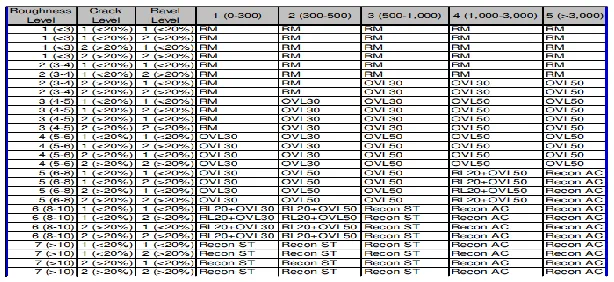
Many methods exist for determination of maintenance needs, mostly applying the optimum standards concept. TANROADS uses the Treatment Matrix (TM) algorithm for determination of needs for paved roads. The TM contains the optimum treatment required for a particular homogenous section meeting the criterion of the TM. It has been derived using the HDM-4 Strategic Analysis capability and therefore thus it encompasses the optimumstandard concept of roads user cost. The sample TM for paved roads is shown in Table 2 below. For unpaved roads the needs are determined using the algorism shown below in Fig. 2. The concept partly addresses the economic and social consideration as the needs are determined separately for low and high traffic sections, though at varying levels. This algorism has been developed using the combination economic concepts, the roads maintenance policy in Tanzania and the practical approach used by regional offices in determination of
3.1 Determination of Scores under individual MCA Parameters
3.1 Building up the MCA Scores
The score of each road section is determined for each of the MCA criterion. The combined score of each section is then determined by summing up the score in each of the individual parameter into a single score which is then used
to prioritize the maintenance as follows: Where MCAl is the cumulated MCA for a link Wi is the weight of the parameter and Si is the score value of the parameter.
Once priority of homogenous road section and budget allocation is known the user can inject the constrained budget and the algorithm picks those section with priority based on the available budget. The MCA score have been integrated into Periodic Maintenance Prioritization Model to produce a list of roads section qualifying for maintenance in descending order of MCA score. When constrained budget is supplied during analysis the system select the sections that qualify for maintenance depending on their MCA score. Situation may occur where the last but one section has big budget compared to the remaining proportion of budget. The priority algorithm try to search next priority section if can be accommodated with the remaining budget his ensure
that all money provided is utilized effectively. The pseudo code for budget picking based on the priority ranking is presented in Fg.3 bellows.
4.Conclusion and Recommendations
The results of the model have been used to allocate the maintenance funds to TANROADS regional offices which are responsible for implementing of maintenance activities on trunk and regional roads for more than eight years.
This approach therefore eliminate the
such as schools, hospitals, access to production centers such as markets, large farming plantations, factories, facilitating tourism, providing connectivity, etc .The MCA approach therefore practice fairness between rural roads and sub urban and city roads road management. From the above conclusion it is recommended that:-
i. The MCA approach can be
adopted to local government as
alternative simplified method of
ranking project by considering social-economic factors in addition to traditional economic (traffic) factors.
ii. RMMS are inevitably for
management and prioritization of maintenance of the road network to improve equally the infrastructure and contribute to improve people’s life.
iii. Adopting and Improving the
MCA Model will assist the top road
administrators to make efficient,
effective and informed decisions about the entire network management. iv. The MCA approach from Tanzania is simple to adopt and customizable to suite particular requirements of other implementing agencies. The MCA weights are dynamic and researchers are invited to investigate further on the adopted weights and scores.
References
[1] G. Gyeke, "Road Infrastructure Management Strategic Framework For Africa: A Case Study Of Nigerian Roads," School of Engineering Technology, 2010.
[2] F. Abeid. (2006, Feb 5,2006) Can the transport
sector development program deliver
MKUKUTA.Construction Business national
Construction Council.
[3] C. A. R. Cooperation, "Sector Assessment (Summary): Transport, And Summary: Transport, And Information And Communication TECHNOLOGY," Central Asia Regional Economic Cooperation2014.
[4] OECD, "The Contribution Of Services To Development And The Role Of Trade Liberalisation And Regulation," in Globle forum In International Investment VII, 2008.
[5] TANRAODS,
"Road_Asset_report_2001_02_to_2014_15," 2015.
6] A. A. A. Silas O. A, Isichei C, Echejoh G. O, Manasseh M. N and Olu-Silas R. A., "Road traffic accident deaths as seen in a Tertiary
Health Centre Jos University Teaching Hospital (JUTH)," presented at the Tertiary Health Centre Jos University Teaching Hospital, Nigeria, 2011.
[7] R. S. Volker Treichel, "African Department: Tanzania’s Growth Process and Success in Reducing Poverty," International Monetary Fund2005.