A New Shuffled Sub-swarm Particle Swarm
Optimization Algorithm for Speech Enhancement
Masoud Geravanchizadeh1, Sina Ghalami Osgouei1
Received (12-9-2011) Accepted (22-12-2011)
Abstract - In this paper, we propose a novel algorithm to enhance the noisy speech in the framework of dual-channel speech enhancement. The new method is a hybrid optimization algorithm, which employs the combination of
the conventional θ-PSO and the shuffled sub-swarms particle optimization (SSPSO) technique. It is known that the θ-PSO algorithm has better optimization performance than standard PSO
algorithm, when dealing with some simple benchmark functions. To improve further the
performance of the conventional PSO, the SSPSO
algorithm has been suggested to increase the diversity of particles in the swarm. The proposed
speech enhancement method, called θ-SSPSO, is a hybrid technique, which incorporates both θ-PSO and SSPSO, with the goal of exploiting the
advantages of both algorithms. It is shown that
the new θ-SSPSO algorithm is quite effective in achieving global convergence for adaptive filters,
which results in a better suppression of noise from
input speech signal. Experimental results indicate
that the new algorithm outperforms the standard
PSO, θ-PSO, and SSPSO in a sense of convergence rate and SNR-improvement .
Index Terms - Adaptive filtering, Particle Swarm Optimization, Shuffled Sub-Swarm, Speech Enhancement, θ-PSO.
1- Masoud Geravanchizadeh is with Electrical & Computer Engineering faculty, University of Tabriz, IRAN
2- Sina Ghalami Osgouei is with Electrical & Computer Engineering faculty, University of Tabriz, IRAN
I. INTRODUCTION
S
peech enhancement is a challenging problemin speech processing research, which aims
at recovering clean speech from noisy speech. So far many types of gradient-based algorithms have been proposed in speech enhancement,
which employ different schemes to adjust the
filter weights based on different criteria. Some of the common algorithms are the
Least-Mean-Squares (LMS) [1], the normalized version of
LMS [NLMS], and Recursive-Least-Squares (RLS) [2]. However, when the error surface
is multimodal, gradient descent algorithms
that work well for FIR adaptive filters, are not suitable for IIR filters. A further drawback of
gradient descent techniques is that they are likely
to get trapped in a local minimum solution. A few modifications to gradient decent algorithms exist
that can improve the performance, such as adding noise to the gradient calculation to make it more likely to escape from a local minima, or using the equation error adaptation to transform the error
surface to unimodal [3].
An alternative to gradient descent-based
techniques is a structured stochastic search of
error space. These types of global search methods are independent from system structure, because a gradient is not calculated and the adaptive filter
structure, aside from error computation, does not
directly influence parameter updates. Due to this
property, these types of techniques are potentially
capable of globally optimizing any class of adaptive filter structures or objective functions [4]. Stochastic optimization algorithms, such as PSO, have been studied for use in adaptive filtering problems, where the Mean-Square-Error (MSE) surface is ill-conditioned [5].
solutions much faster than other stochastic algorithms [6], is still suffers from premature
convergence, when complicated problems are
optimized, and needs further improvements to
avoid entrapping in local optima. Some suggest modifications and variations of the standard PSO algorithm to improve the overall efficiency [7-8].
In this paper, we propose a novel algorithm,
called θ-shuffled sub-swarms particle
optimization (θ-SSPSO) technique to solve the above mentioned problems and compare the results with the standard PSO, θ-PSO, and SSPSO algorithms for speech enhancement.
The paper is organized as follows. Section II describes the structure of a dual-channel speech
enhancement system, together with the techniques
of standard PSO, θ-PSO, and SSPSO. Section III introduces the proposed θ-SSPSO algorithm.
The results of applying the proposed method to
speech enhancement are presented in Section IV. Concluding remarks are given in Section V.
Recovered Signal e(n) _
y(n)
W(z)
Speech Source s(n) +
r(n) Noise Source
b(n) +
P(z)
Noisy Speech d(n)=s(n)+b(n) +
+ +
Figure1. Dual-channel speech enhancement
II. BACKGROUND
1. Dual-channel Speech Enhancement
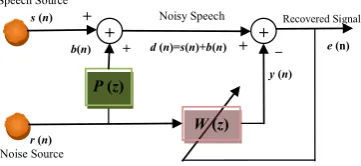
Figure 1 shows the block diagram for a general two-channel enhancement system [9]. The clean
speech signal s(n) is assumed to be present in only one channel, which is then corrupted by
the background noise b(n) to generate the noisy
speech signal d(n). The second channel has the
reference noise signal r(n). The adaptive filter,
W(z), tries to model the transfer function P(z). As
a result, the filter output y(n) becomes an estimate
of only the noise present in d(n).
Finally, the output of the structure e(n) will be
an estimate of the clean signal s(n).
Suppose that the unknown system P(z), which
we want to estimate, is described by
0 1
( ) L i ( ) M i ( ).
i i
y n a x n i b y n i
= =
=
∑
− −∑
− (1)where ai , bi are the unknown parameters,
which should be determined in an iterative way.
The parameters of the unknown system P(z)
are estimated by minimizing the Mean-Square
Error (MSE) between the noisy speech d(n) and
the output of the adaptive filter y(n).
The enhanced signal is obtained by subtracting
the estimated noise y(n) from the noisy speech d(n).
2. Standard PSO Algorithm
Particle swarm optimization (PSO) was introduced by Kennedy and Eberhart in 1995 [10]. This optimization technique, which is inspired by the social behavior of animals (e.g., fish schooling and bird flocking) has already come to be widely used in many areas [11].
The conventional PSO algorithm [12] begins
by initializing a random swarm of M particles,
each having R unknown parameters to be optimized. At each epoch, the fitness of each particle is evaluated according to the fitness function. The algorithm stores and progressively replaces the best previous position of each
particle (pbesti , i =1,2,...,M )”. as well as a single best particle (gbest).
Initialize particles with random positions and velocity vectors
For each particle’s position, evaluate the fitness Start
If fitness of pis better than fitness of pbest, then pbest = p
Set best of pbests as gbest
Update particle’s velocity and position by Eq.2 and Eq.3
Is the stop condition satisfied?
Stop, and givegbest as the optimal solution Yes
No
Figure2. Flowchart of the standard PSO algorithm
The parameters are updated at each epoch (k) according to
( 1) ( ) ( 1)
id id id
x k+ =x k vel k+ + (2)
(
)
(
)
1 1
2 2
( 1) ( ) ( )
( ) ,
id id pbestd id
gbestd id
vel k wv k c r p x k
c r p x k
+ = + − +
where veli is the velocity vector of the particle
i, r1, r2 are random numbers uniformly distributed
in the interval (0,1), c1 and c2 are the cognitive
and social coefficients toward gbest and pbesti ,
respectively, and w is the inertia weight. Inertia weight is updated as follow:
(
ini end)
(T t) end,w w w w
T
−
= − + (4)
where T is the maximum number of iterations.
wini and wendare initial and final values of the inertia weight, respectively. Through the run of PSO, the
inertia weight decreases from a relatively large
value to a small value. Using this technique, in
early stages of the algorithm, the particles search
the space globally. As the process goes on, their
velocity decreases gradually, where at some point
the particles begin to search the solution space locally [13].
Figure 2 represents flowchart of the standard PSO algorithm.
3. Standard θ-PSO Algorithm
Here, we introduce the θ-PSO algorithm to improve the performance of the standard PSO algorithm, which appears to be a promising approach of function optimization. In θ-PSO,
the velocity and position of each particle are
replaced by phase and phase increment using a mapping function [8]. The standard θ-PSO can be described in vector notation as follow
(
)
(
1 1)
2 2
( 1) ( ) ( ) ( ) ( ) ( ) ( ) ( )
i i pbesti i
gbest i
t w t c r t t t
c r t t t
∆ + = ∆ + × − +
× −
θ θ θ θ
θ θ (5)
( 1) ( ) ( 1)
it+ = i t + ∆ it+
θ θ θ (6)
( )
1
( ) ( )
it =f− it
xθ (7)
( )
( ) fitness ( ) ,
i i
F t = x t (8)
with θij∈(θmin,θmax), ∆θij∈ ∆( θmin,∆θmax) ,
(
min, max)
ij x x
x ∈ for i-th (i = 0,…, s) particle the j-th (j = 1,…,n) component, t is an index of
time (iteration), f is a monotonic mapping function, c1 and c2 are cognitive and social
coefficients, respectively, w is the inertia weight,
and r1(t) and r2(t) are random numbers uniformly distributed in the interval (0,1). xi(t) is the particle
position vector, decided by the mapping function
f-1, ( ) i t
θ is the phase angle, ∆θi( )t is the increment
of phase angle, θip( )t is the phase angle of best
solution (pbesti),θg( )t is the phase angle of global
best (gbest), and Fi (t) is the fitness value. In this paper, we define the mapping function as
max min max min
( ) sin( ) ,
2 2
ij ij
x x x x
f θ = − θ + + (9)
where
, , , .
2 2 2 2
ij π π ij π π
θ ∈ − ∆θ ∈ −
4. SSPSO Algorithm
In SSPSO (Shuffled Sub-swarms Particle Swarm Optimizer) [7], the swarm is partitioned equally into sub-swarms to increase the diversity of particles. The division of sub-swarms is not done randomly, but is based on the fitness of particles. Within each sub-swarm, the individual particles hold ideas (i.e., information) of searching for the destination that can be influenced by ideas of other particles. The particles of each sub-swarm evolve through a process of standard PSO algorithm. After a predefined number of generations, all sub-swarms are shuffled to
produce a new swarm, during which the ideas are
passed among sub-swarms. If the stop condition of the optimization process is not satisfied, the new swarm will be again partitioned into several new sub-swarms, and the computations are resumed. This process will be continued until the stop condition is satisfied. The division procedure for particle swarm in the SSPSO algorithm is shown as in Figure 3.
Swarm
Sub-swarm Sub-swarm Sub-swarm
Swarm
III. PROPOSED METHOD FOR SPEECH ENHANCEMENT
In this part, we propose a hybrid method, called θ-SSPSO as a new optimization method
to improve further the performance of previously
discussed algorithms, and apply it to dual-channel speech enhancement.
ALGORITHM1:SUMMARY OF Θ-SSPSOALGORITHM
1- Initialization:
1 2 min max
angle , , phase increament , , , ,
2 2 2 2
=0.9, w =0.4, =1.5, =1.2, = 100, =100
init end
w c c x x
π π π π
∈ − ∈ −
−
p - best gbest
2- Loop n =0,1,2,…
max min max min position( , )n j =x 2−x sin( )θnj +x 2+x ,
2.1- Compute cost function value for each particle.
2.2- Rank particlesby their corresponding fitness values.
The minimum cost takes the first rank.
2.3- Divide particlesto sub-swarms based on their ranks.
3- Update particles in each sub-swarm.
Loop i=1,2,3,…
3.1- If ith-particle’s cost function < (fittness value of pbest)
Cost of pbest=ith-particle’s fittness value; pbest=angle(i);
endif
3.2- If ith–particle’s fittness value < gbestfittness value gbestfittness value = ith–particle’s fittness value gbestvector =angle(i);
endif
3.3- Update angle and phase increment by Eq.5, Eq.6
End loop
4- Shuffle sub-swarms and generate one swarm.
End loop
1. θ-SSPSO Algorithm
In this paper, we propose a new optimization algorithm by combining the θ-PSO and SSPSO algorithms.
As discussed above, θ-PSO has better convergence behavior than standard PSO. So, it seems reasonable to combine the θ-PSO algorithm with the shuffled sub-swarms procedure to obtain a robust optimization algorithm. The resulting hybrid θ-SSPSO algorithm enhances the
diversity of particles, which leads to decrease the
possibility of entrapping in local minima.
The θ-SSPSO method can be described as follows:
Step1. Initialize randomly the positions and velocities of all particles. Set m = “number of sub-swarms” and n = “number of particles in each sub-swarm”.
Step2. Compute the fitness of each particle. Step3. Rank particles by their fitnesses. Step4. Partition particles into sub-swarms according to their fitness. For example, for the number of sub-swarm m=3, rank 1 goes to the first swarm, rank 2 goes to the second sub-swarm, rank 3 goes to the third sub-sub-swarm, rank 4 goes to the first sub-swarm, and so on.
Step5. Update the phase angle and phase angle increment of particles based on Eq. (5) and Eq. (6) in each sub-swarm.
Step6. Shuffle sub-swarms to produce a new swarm after a predefined number of iterations and rank particles according to their fitness.
Step7. Go to Step 4, if the stop condition is not satisfied. Otherwise, stop and obtain the results from the global best position (gbest) and the global best fitness.
Algorithm 1 shows pseudo code of our
proposed method.
2.θ-SSPSO Algorithm for Speech Enhancement The structure of a dual-channel speech enhancement is shown in Figure 1. The input signals are processed in frames. In the stochastic optimization-based speech enhancement, we need to define the cost function to evaluate the fitness of each particle. The average error between the
noisy speech signal, d(n), and the estimated noise
signal in each frame is used as the cost function. Fitter particles have less cost function values. The cost function of the i-th particle is given as:
[
]
20
1 ( ) ( ) ,
1
N
i i
k
J d k y k
N =
= −
+
∑
(10)where N is the number of samples in each
frame, and y(k) is the output of W(z) designed
by the algorithm. When Ji is minimum, then the
parameters of W(z) represent the best estimation
of the unknown system P(z).
In PSO-based optimization speech
enhancement, the position of each particle in
the swarm is a candidate for the coefficients of the adaptive filter. After a predefined number
calculated according to the position vector of
the best (global) particle in the swarm (gbest).
Then, y(n) is determined by modifying the noise
reference r(n) by the adaptive filter W(z). Finally, the enhanced frame is obtained by subtracting
y(n) from d(n).
IV. SIMULATION RESULTS
For our simulations, we use speech signal
from the NOIZEUS database [14]. As the noise references, we take noises from the NOISEX-92 database [15].
The noisy speech is obtained by adding
the clean speech signal to the noise reference
modified by the transfer function P(z). As
example, we have used the following filter P(z)
as acoustic path in our simulations:
1
1 2
1 ( )
1 1.2 0.36
P z
z z
−
− −
=
− + (11)
Corresponding to the selected (acoustic path)
filter P(z), the adaptive filter W(z) considered for
the particle i in the simulations is given as [5]:
1 1 1 2 2 3 ( ) , 1 i i i i p W z
p z p z
−
− −
=
+ + (12)
where i j
p is the j-th dimension of the i-th
particle in swarm.
As objective evaluation of our proposed
method, we use the segmental SNR (SNRseg) and
PESQ [16] tests.
For the computation of SNRseg, speech signals
are first segmented into frames. Then, SNR in each frame is computed as signal-to-noise power ratio. Finally, the computed SNR values are averaged over all frames. The overall process of
obtaining SNRseg can be given as:
[ ] [ ] [ ]
(
)
1 2 1 0 1 2 ' 0 0 11 10log .
1 N T n seg N m n
s n Nm N
SNR
T s n Nm s n Nm
N − − = − = = + = + − + ∑ ∑
∑ (13)
where s n Nm
[
+]
and s n Nm'[
+]
are the nthsample of the mth frame of the clean and the
enhanced speech signals, respectively, N is the
number of samples in each frame, and T is the
number of frames.
The perceptual evaluation of speech quality
(PESQ) measure is an alternative objective measure which is able to predict subjective quality of speech signals. This objective measure is based
on models of human auditory speech perception
which is selected as the ITU-T recommendations P.862 [17].
The range of the PESQ score is 0.5 to 4.5, although for most cases the output range will be a MOS-like score, i.e., a score between 1.0 and 4.5.
The PESQ score is computed as a linear
combination of the average disturbance value dsym
and the average asymmetrical disturbance value
dasym as follows:
sym
4.5 0.1. 0.0309. asym
PESQ= − d − d (14)
where dsym and dasym are computed as:
1 2 ''' 2 2 ( ) ( ) k k k sym k k D t d t =
∑
∑
(15)1 2 ''' 2 2 ( ) . ( ) k k k asym k k DA t d t =
∑
∑
(16)Here, '''
k
D and '''
k
DA are the averaged frame
disturbance values as described in [17]. The
summation over k is performed over the
speech-active intervals, and tk are weights applied to the
frame disturbances and depend on the length of the signal.
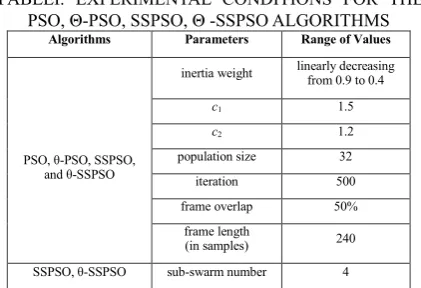
Four stochastic optimization techniques (i.e., PSO, θ-PSO, SSPSO, and θ-SSPSO) are used to assess our proposed method. The experimental
conditions for these algorithms are shown in
Table I.
The SNR of the input noisy signal for engine,
babble, and white noise types is set at -10, 0, and 5 dB, respectively. The results of each algorithm are averaged over 20 trial runs. Table III shows the SNR-improvement for each algorithm. It can be seen from this table that the θ-SSPSO algorithm outperforms other algorithms in a sense of SNR-improvement.
Table IV shows PESQ-improvement for each algorithm. The results of this evaluation show clearly that the θ-SSPSO algorithm outperforms other algorithms.
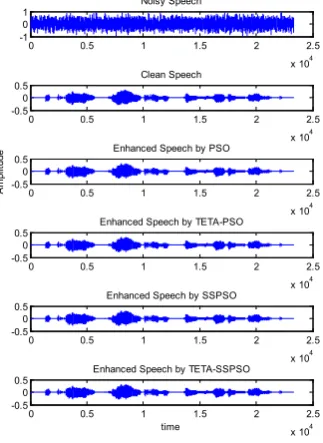
The time waveforms of the noisy, clean, and
enhanced speech obtained by the PSO, θ-PSO, SSPSO, and θ-SSPSO algorithms, respectively, are illustrated in Figure 4.
The MSE (cost function) of the best particle
in the population during the iterations (i.e.,gbest)
our proposed method outperforms simulated
stochastic-based algorithms in a sense of convergence rate and steady state error.
TABLEI. EXPERIMENTAL CONDITIONS FOR THE
PSO, Θ-PSO, SSPSO, Θ -SSPSO ALGORITHMS
Algorithms Parameters Range of Values
PSO, θ-PSO, SSPSO,
and θ-SSPSO
inertia weight linearly decreasing from 0.9 to 0.4
c1 1.5
c2 1.2
population size 32
iteration 500
frame overlap 50% frame length (in samples) 240
SSPSO, θ-SSPSO sub-swarm number 4
TABLEII. THE EXPERIMENTAL RESULTS OF PSO-BASED ALGORITHMS FOR DIFFERENT
BENCHMARK FUNCTIONS
Benchmarks FunctionSphere Rastrigin Function
Ex
pe
rim
en
ta
l C
on
dit
io
ns Formula
40 2
1
( ) i i
f x x
=
=∑ 10( ( )
2 1
( ) i 10cos 2 i 10 i
f x x πx
=
=∑ − +
Solution
space [-100,100] [-30,30]
Iteration 2000 1000
Actual
minimum 0 0
O
ptim
iz
atio
n r
es
ults Standard PSO 0.0104 7.9597
θ-PSO 0.0037 7.5617
SSPSO 1.3412 10× -16 6.9647
θ-SSPSO 3.0082 10× -17 4.2783
TABLEIII. SNR-IMPROVEMNET OF DIFFERENT ALGORITHMS FOR DIFFERENT NOISY INPUT
CONDITIONS
Algorithms
SNR-Improvement (dB) Engine noise
SNR of -10 dB
Babblenoise
SNR of 0 dB
White noise SNR of 5 dB
Standard PSO 20.6810 9.4010 3.8101
θ-PSO 21.0420 9.7440 3.8706
SSPSO 23.0313 10.1913 4.3730
θ-SSPSO 23.7804 10.3241 4.5181
As subjective measure, we use the MUlti Stimulus test with Hidden Reference and Anchor (MUSHRA) which is a ITU-R Recommendation BS.1534-1 [18] as implemented in [19]. The subjects are provided with test utterances plus
one reference and one hidden anchor, and are asked to rate the different signals on a scale of 0
to 100, where 100 is the best score. The listeners
are permitted to listen to each sentence several
times and always have access to the clean signal
reference. The test signals are the same as those, which are used for the objective evaluation. Three types of noise (i.e., white noise, destroyer engine noise, and babble noise) are used in our listening tests. A total of 10 listeners (2 females, 8 males between the ages of 18 to 30) have participated in these tests. Table V shows the subjective results of each algorithm for different noise types.
As an alternative way of evaluating the
performance of our proposed hybrid optimization algorithm, we use two famous benchmarks, which are composed of Sphere and Rastrigin functions.
The optimization results of each algorithm in
each benchmark are shown in Table II.
TABLE IV. PESQ-IMPROVEMNET OF DIFFERENT ALGORITHMS FOR DIFFERENT NOISY INPUT
CONDITIONS
Algorithms
PESQ-Improvement Engine noise
SNR of -10 dB
Babble noise SNR of 0 dB
White noise SNR of 5 dB Standard PSO 1.5898 0.5395 0.2890
θ-PSO 1.6240 0.5652 0.2903 SSPSO 1.6614 0.6548 0.3203 θ-SSPSO 1.6781 0.7104 0.3410
TABLE V. THE RESULTS OF MUSHRA COMPARATIVE LISTENING TEST FOR THE STANDARD PSO, θ-PSO, SSPSO, AND θ-SSPSO ALGORITHMS FOR DIFFERENT
NOISY INPUTS AND DIFFERENT SNR VALUES
Noise type
Speech Signals
Noisy
speech Standard PSO θ-PSO SSPSO θ-SSPSO
Engine noise SNR of -10
dB 12.6 53.7 55 58.2 60
Babble noise
SNR of 0 dB 16.4 46.5 47 50.1 52.6
White noise
SNR of 5 dB 18.2 44.2 44 46.1 46.8
0 50 100 150 200 250 300 350 400 450 500
-70 -60 -50 -40 -30 -20 -10 0
Iteration
M
SE (
dB)
MSE Plot for Babble Noise
pso teta-pso sspso teta-sspso
V. CONCLUSION
In Section II, we presented θ-PSO and SSPSO as two optimizations techniques. The major drawback of θ-PSO is that it may easily stick in local minima, when handling some complex or multi-mode functions. On the other hand, SSPSO
has the advantage that it increases the diversity of
particles in the search space. This in turn avoids
entrapping the optimization algorithm in local
optima.
The proposed hybrid θ-SSPSO algorithm combines the standard θ-PSO algorithm with shuffling sub-swarm idea. In order to evaluate
our proposed method, we test our new method in
some famous benchmarks. As the results show, the θ-SSPSO algorithm has the least final fitness value. In order to assess our proposed method
in the framework of speech enhancement, we
examine the quality of the enhanced speech both subjectively and objectively.
As objective assessment, we investigate the MSE plot, SNR-improvements, and PESQ-improvements. From the MSE plot, it can be obviously seen that θ-SSPSO converges faster than other algorithms. By considering the results of SNR and PESQ, we conclude that the θ-SSPSO algorithm outperforms other methods objectively.
0 0.5 1 1.5 2 2.5
x 104 -10
1 Noisy Speech
0 0.5 1 1.5 2 2.5
x 104
-0.50
0.5 Clean Speech
0 0.5 1 1.5 2 2.5
x 104 -0.50
0.5 Enhanced Speech by PSO
A
m
pl
itude
0 0.5 1 1.5 2 2.5
x 104 -0.50
0.5 Enhanced Speech by TETA-PSO
0 0.5 1 1.5 2 2.5
x 104 -0.50
0.5 Enhanced Speech by SSPSO
0 0.5 1 1.5 2 2.5
x 104 -0.50
0.5 Enhanced Speech by TETA-SSPSO
time
Figure 5. From the top, time waveforms of the noisy, the clean, and the recovered signals with PSO, θ-PSO, SSPSO,
and θ-SSPSO algorithms, respectively
The quality of the enhanced speech is evaluated
subjectively by listening tests. Listening tests show once again that the speech enhanced by
our proposed optimization method has the best quality among the enhanced signals processed by all other methods.
In general, it can be inferred from the conducted experiments that the new optimization method (i.e., θ-SSPSO) has the best performance
in the framework of speech enhancement as
compared with other implemented algorithms. By considering the advantages of the new
optimization method, it is worthwhile to utilize this new method in other applications which incorporate optimization in the heart of their
work.
As future works, the SSPSO algorithm can further be improved by employing other modified PSO-based algorithms instead of the standard PSO technique.
REFERENCES
[1] B. Widrow, and S. Stearns, “Adaptive Signal Processing”, Englewood Cliffs, NJ: Prentice Hall, 1985.
[2] T.Ueda, H suzuki, “Performance of Equilizers Employing a Re-training RLS Algorithm for Digital Mobile Radio Communiations”,40th IEEE Vehicular Thechnoly Conference, pp 553-558, 1990.
[3] Shynk, J.J., “Adaptive IIR Filtering,” IEEE ASSP Magazine, pp. 4-21, April 1989
[4] Krusicnski, D.J. and Jenkins, W.K.,“Adaptive Filtering Via Particle Swarm Optimization,” Proc. 37’Asilomar Conf on Signals, Systems. And Computers, November 2003.
[5] D. J. Krusienski and W. K. Jenkins, “Design and Performance of Adaptive Systems Based on Structured Stochastic Optimization Strategies,” Circuits and Systems Magazine, Vol. 5, No. 1, pp 8 –20, February 2005.
[6] P. Mars, J, R. Chen, and R. Nambiar, “Learning Algorithms: Theory and Application in Signal Processing, Control, and Communications”, CRCPress, Inc, 1996.
[7] Hui Wang, Feng Qian, “An Improved Particle Swarm Optimizer with Shuffled Sub_swarm an its Application in Soft-sensor of Gasoline Endpoint”, Atlantis Press, 2007.
[8] W.M. Zhong, S.J. Li, F. Qian, “θ-PSO: A New Strategy of Particle Swarm Optimization”, Journal of Zhejiang University SCIENCE, submitted.
[9] L.Badri asl ,M geravanchizadeh, “Dual-Channel Speech Enhancement based on Stochastic Optimization Strategies”, 10-th International Conference on Information Science, Signal Processing and their applications (ISSPA 2010), Malaysia, 2010.
[10] J. Kennedy, R.C. Eberhart, Particle swarm
optimization. Prof. of the IEEE International Conference on Neural Networks, IEEE Press, pp. 1942–1948, 1995.
[11] X. Hu, Y.Shi, R.C. Eberhart, “ Recent advances in Particle Swarm,” Prof. of the IEEE International Conference on Evolutionary Computation. Portland, pp.90-97, 2004.
Intelligence Focus on Ant and Particle Swarm Optimization,” First Edition, I-Tech Education and Publishing, December 2007.
[13] Y Shi, R Eberhart, “Empirical study of particle swarm optimization,” International Conference on Evolutionary Computation, IEEE, Washington, USA, pp. 1945-1950, 1999.
[14] http://www.utdallas.edu/~loizou/speech/noizeus
[15] http://www.speech.cs.cmu.edu/comp.speech/
Section1/Data/noisex.html
[16] A. W. Rix, J. G. Beerends, M. P. Hollier, and A. P. Hekstra, “Perceptual evaluation of speech quality (PESQ)—A new method for speech quality assessment of telephone networks and codecs,” in Proc. 26th IEEE Int. Conf. Acoust. Speech Signal Process., ICASSP-01, vol. 2, pp. 749–752, 2001.
[17] Philipos C. Loizou, “Speech Enhancement Theory and Practice,” CRC Press, 1 Edition, 2007.
[18] ITU-R, “Recommendation BS1543-1: Method for the Subjective Assessment of Intermediate Quality Level of Coding Systems”, 2001.