Finite Element Simulation of Simple Bending
Problem and Code Development in C++
ABDUL WASY Department of Mechanical Engineering Changwon National University, Changwon Republic of Korea MUNAWAR IQBAL Centre for High Energy Physics University of the Punjab, Quaid-e-Azam, Campus, Lahore
Pakistan JUNG IL SONG Department of Mechanical Engineering Changwon National University, Changwon Republic of Korea
Abstract:
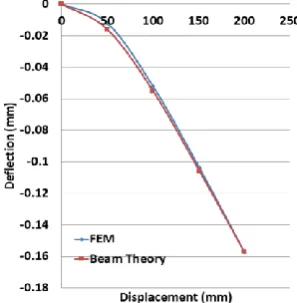
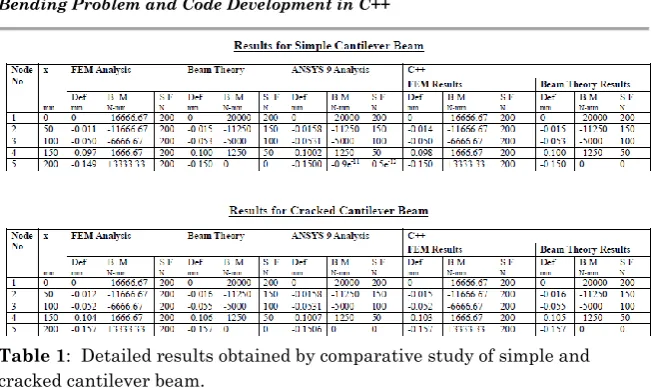
In this study, the simulation of simple bending problem is performed using an example of cantilever beam which is an important structural member. The author executed numerical simulations for simple and cracked cantilever beams using finite element stiffness method, analytical beam theory, finite element package (ANSYS) and then verified results with code generated in C++ language. In conclusions, the comparison of results is tabulated and the graphs suggested that the finite element method give less deflection as compared with the results obtained using beam theory for any specific location along span length. MD-Solid software is used to draw bending moment and shear force diagram.
Key words: Cantilever Beam, Crack UDL, Beam Theory, FEM Simulation, C++ , coating, Plasma
1 Introduction
bending moments are opposed. (Hool and Johnson 1920) Cantilever beams are used in manufacturing of micro and macro overhanging structures e.g. trusses, slabs balconies and bridges.
Cracks have unfavorable and negative effects that might appear on a structure during its utilization. They should be detected as soon as possible, as they may significantly decrease the global stiffness over the local reduction of flexural rigidity. (Skrinar and Plibersk 2008) Since in inverse identification of crack only a limited amount of measured data is available, it is thus usually not possible to obtain the information of crack directly but as a result of some gradual and systematic computational model modifications. In order to make the computational model more adaptable and a faster analysis process, it is reasonable to neglect all the irrelevant information from the computational model. Therefore, in simplified model a non-propagating crack beam can be analyzed for static conditions.
Cantilevers beams are commonly used in bridge structures, where the cantilevers are made in form of pairs for supporting the central section. The Elland Road Stadium in Leeds and Forth Bridge in Scotland are famous examples of cantilever structures. The largest cantilever in Europe is located at St James' Park in Newcastle-Upon-Tyne and the home stadium of Newcastle United F.C. (Cf. “James's Park” 1999 and “Existing stadiums: St James' Park, Newcastle” 2005) In micro structures, the topic is focused due to use of small cantilever beam component near high temperature devices as plasma and laser beam sources. The author consider a cantilever beam whose modulus of elasticity (E) is 200,000 N-mm-2, moment of inertia (I) is 6666.667 mm4, effective moment
of inertia (Ie) is 6368.104mm4 and load per unit area (w) is 1
N-mm-2, for cracked cantilever beam (CCB) a crack of 20*1*1mm
Figure 1: Nodal solution for simple cantilever beam with uniform distributed load
2 Calculations and Discussion
2.1 Simple Cantilever Beam 2.1.1 FEM simulation
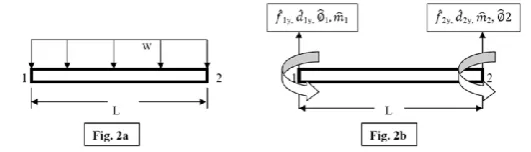
Using work equivalence method [5] the following equations were obtained where 1, 1y 1, 2, 1y, 2y
are slops, displacements, moments and forces respectively at two Consecutive nodes 1 and 2 as shown in Fig. 2 (a and b).
Figure 2: (2a) Beam subjected to uniformly distributed load. (2b)The equivalent nodal forces to be determined.
= =
(2.2)
1y is the vertical force reaction and 1 is the moment
reaction as applied by the clamp support at node 1. The results for displacement given by eq. 2.1 and the global nodal forces given by the above eq. 2.2 are sufficient to complete the solution for the cantilever problem.
The shear force (F), bending moment (M), displacement (d), slop ( ) were calculated by using following equations
F = w * L
(2.4)
M = ½ [w * L2]
(2.5)
(2.6)
(2.7)
2.1.2 Beam Theory
To obtain the solution from beam theory, double integration method (Logan 2007) is used. Therefore, the moment curvature equation is given below,
EI x M
y ( )
(2.8)
F
y
0
;
V(x)wLwx(2.9)
M
2
0
;
2
)
(
2
)
(
2x
wx
wLx
wL
x
M
(2.10) Solving the above equations yield following relation, 24 6 4
1 wL2x2 wLx3 wx4
EI y
(2.11) From eq. 2.11 deflection obtained by substituting respective parameters. Values of displacement and load at different locations along the beam spam were calculated by using the assumed cubic displacement function.
22 2 3 3 2 2 2
3
(
)
1
3
2
1
)
(
ˆ
x
L
x
L
L
d
L
x
x
L
x
v
y
(2.12)
The deflection of beams is necessary to make several real world decisions. Many times, maximum deflection on a beam under a set of loads is required and where it occurs as well. By using the boundary conditions 1y = 1= 0 in above
equation, displacement at certain length of the beam was calculated.
Bending moments and shear forces in the present problem were evaluated based on FEM simulation and beam theory. The bending moment is given by
d dx N d EI dx Nd d EI v EI M 2 2 2 2 ) ( ) ( (2.17)
As d is not a function of x. Or in terms of the gradient matrix B we have
EIBd
M
(2.18)
22 26
12
34
6
26
212
32
6
2L
x
L
L
x
L
L
x
L
L
x
L
dx
N
d
B
(2.19)The shape functions are used to obtain the recent above equation for the B matrix. For the single element solution, the bending moment is then evaluated by substituting this above equation into M = EIB d and by multiplying B by d to obtain
2 3 1 2 1 2 3 2 2ˆ
26
2
ˆ
12
6
ˆ
6
4
ˆ
12
6
L
x
L
d
L
x
L
L
x
L
d
L
x
L
EI
M
x x (2.20)By evaluating the moment at the fixed end, x = 0, with d1x = 1
= 0 and d2x and 2 are given by eq. 2.6 and eq. 2.7 we have,
24
12
10
)
(
2wLx
wL
x
M
(2.21) Shear forces was calculated by using formulas of beam theory and FEM simulation, by using eq. 2.4; F = w*L.
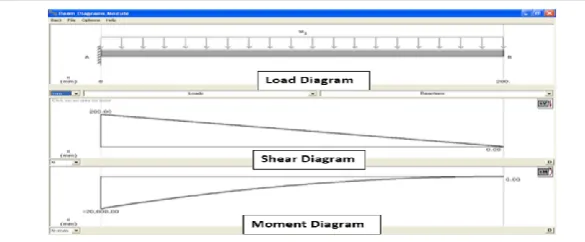
Beam normal stresses are computed from the flexure formula, which relates the internal moment and the beam cross-sectional properties to the normal stress. Transverse shear stresses were computed from the shear formula for beams, which relates the internal shear force and the beam cross-sectional properties to the shear stress. The internal forces and moments were used to compute the shear stress and normal stress, which were found from the shear force and bending moment diagrams.
Figure 3: BMD and SFD of cantilever beam in MD Solid
2.2 Cracked Cantilever Beam
Regardless of the method used for calculating deflections, a careful calculation is required to measure the moment of inertia for cracked cantilever beam. The trouble lies in the amount of cracking that has not occurred. If the bending moment is less than the cracking moment (that is, if the flexural stress is less than the modulus of rupture of about
7.5 for normal-weight concrete), the full un-cracked section provides rigidity, and the moment of inertia for the gross section Ig is available. When larger moments are present,
variable sized tension cracks occurred and the position of natural axis varies. Effective moment of inertia was calculated by using Brandon equation. (Pytel and Singer 1987)
= *Igt + *Icr (2.32)
Where:
m = experimentally determined exponent = effective moment of inertia
Icr = cracked moment of inertia
Igt = Moment of inertia of transformed cross-section Ma = applied moment
Mcr = cracking moment
(2.33)
(2.33)
Ig = gross moment of Inertia = 6666.667 N-mm
= 9.0369N-mm-2 (2.34)
Where is modulus of rupture and is load factor having specific value for each material.
mm4 (2.35)
mm4 (2.36)
While practical results for rectangular cross-section give m= 3 and putting the values in equation 2.32
= *22866.667+ mm4 (2.37)
Now all calculations will be done using the effect moment of inertia
= -0.1572 mm (2.38)
The slope can be calculated by using the formula
= -0.001048 rad (2.39)
The shear force and bending moment will be same as calculated for simple cantilever beam using because shear force and bending moment are not function of moment of inertia. By using the boundary conditions 1y = 1= 0 in eq. 2.11 and eq
2.3 Analysis using ANSYS
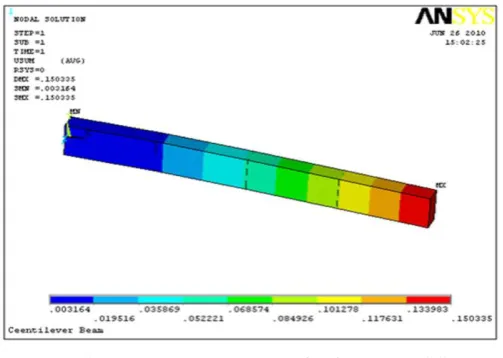
ANSYS (2006, 1) academic version is used for finite element analysis. This software is being used for solving structural, dynamic, electromagnetic and fluid flow problems. The Results obtained by ANSYS simulations are shown in Fig. 4 (a-b) for specific node.
Figure 4: (4a) Nodal results of deflection in SCB
(4b) Graphical representation of deflection in CCB
2.4 Computer Programming
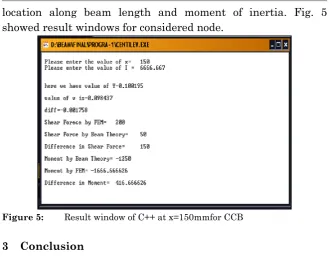
location along beam length and moment of inertia. Fig. 5 showed result windows for considered node.
Figure 5: Result window of C++ at x=150mmfor CCB
3 Conclusion
The theoretical and software based simulation work for simple bending problem were performed by considering example of cantilever beam. Numerical simulations for simple and cracked cantilever beams using finite element stiffness method, analytical beam theory and finite element package (ANSYS) were evaluated and then results were verified with code generated in C++ language. The results gathered by mathematical modeling are very beneficial. They enable a better understanding and ability to predict deformation process; however, when using the mathematical modeling assumptions may have to be made. In order to compensate, a factor of safety is always added into the equations when the results are going to be used in applications.
nodes. The variations in deflection, shear force and bending moment results for simple and cracked cantilever beam obtained from finite element method and beam theory are presented in Fig. 6, Fig. 7, Fig. 8 and Fig. 9.
Figure 6: Comparison of displacement obtained by FEM simulation and beam theory for SCB
Figure 8: Comparison of shear force obtained by FEM simulation and beam theory for SCB
Figure 9: Comparison of displacement obtained by FEM simulation and beam theory for CCB
Table 1: Detailed results obtained by comparative study of simple and cracked cantilever beam.
This is always true for the beam subjected to some form of distributed load that were modeled using the cubic function displacement. The exception to this result at the nodes where the beam theory and the finite element results are identical because of the work equivalence concept use which was used to replace the distributed load by work equivalent discrete loads at the nodes.
BIBLIOGRAPHY
_________. 2006. ANSYS, Inc., ANSYS FLOTRAN CFD Analysis Guide. Release 10.0. p. 1.
_________. 2005. “Existing stadiums: St James' Park, Newcastle.” The Architects' Journal. 1 July 2005
_________. 1999. “James's Park.” The Structural Engineer 77: 21.
Hool, George A., and Nathan Clarke Johnson. 1920. Handbook of Building Construction. Vol. 1. 1st edition. New York: McGraw-Hill.
Logan, Daryl L. 2007. A First Course in Finite Element Method. 4th edition. Delhi: Thompson.
Pytel, A. and F. L. Singer. 1987. Strength of Materials. 4th edition. New York: Harper Collins Publishers.
Skrinar, M., and T. Plibersk. 2008. “Transversely cracked beam's finite elements with a hinged.” American Journal of Applied Sciences, Jan, 2008.
Research Highlights
Simple bending problem was analyses using simple and cracked cantilever beam example.
Theoretical and Software based simulations were performed using finite element method, beam theory, ANSYS and code generated in C++.
A competitive approach was developed to understand the results and there reliability obtained by theoretical and software methods.
The constraints of finite element method and benefits of beam theory were highlighted.
Figure Captions
Figure 1: Nodal solution for simple cantilever beam with uniform distributed load
Figure 2: (2a) Beam subjected to uniformly distributed load. (2b)The equivalent nodal forces to be determined
Figure 3: BMD and SFD of cantilever beam in MD Solid
Figure 4: (4a) Nodal results of deflection in SCB,
(4b) Graphical representation of deflection in CCB
Figure 5: Result window of C++ at x=150mmfor CCB
Figure 6: Comparison of displacement obtained by FEM simulation and beam theory for SCB
Figure 7: Comparison of moment obtained by FEM simulation and beam theory for SCB
Figure 8: Comparison of shear force obtained by FEM simulation and beam theory for SCB
Figure 9: Comparison of displacement obtained by FEM simulation and beam theory for CCB
ACKNOWLEDGMENTS