© 2015, IJCSMC All Rights Reserved
284
Available Online atwww.ijcsmc.comInternational Journal of Computer Science and Mobile Computing
A Monthly Journal of Computer Science and Information Technology
ISSN 2320–088X
IJCSMC, Vol. 4, Issue. 1, January 2015, pg.284 – 290
RESEARCH ARTICLE
An Efficient Performance Analysis of
Different Adder Topologies
T. Manoj Kumar
1, S.Navaneethan
2, A.C.Murugesapandian
31
Assistant Professor, Department of ECE, Karpagam College of Engineering
2
Assistant Professor, Department of ECE, M.A.M College of Engineering
3
Assistant Professor, Department of ECE, Annai Mookambigai College of Engineering
[email protected]
1,
[email protected]
2,
[email protected]
3Abstract -This survey deals with the study of the comparative analysis of the performance of different adder logics. Here for our analysis we have considered the performance of four different adders such as carry look-ahead adder (CLAA), carry select adder (CSLA), Modified Carry select adder and carry save adder. The above design of multiplier multiplies two 16-bit unsigned integer values and gives a product term of 32-bit values. These multipliers have been designed in Verilog, simulated on Modelsim and synthesized on Xilinx FPGA Spartan 3E xc3s500E and their area; power and delay are calculated and compared.
Keywords: carry look ahead adder, carry select adder, modified carry select adder, propagation delay, Synthesis, Simulation
I. INTRODUCTION
Improving the processing performance and enhancing the reduction of power dissipation of the systems are the most predominant design challenges for all multimedia and signal processing (DSP) applications, in which multipliers mostly decides the system’s performance and power dissipation. Therefore several modifications are added to the multiplier design to improve the speed and reduce its power dissipation and delay which significantly improves the system performance.
Multiplication results due to the repeated form of the addition and shifting operations. Since addition is a fundamental operation for any digital multiplication, a fast, area efficient and accurate operation of a digital system is greatly decided by the performance of the resident adders. Therefore modification in the adder results in the performance variations in the multiplier.
Performance of an adder is decided by its speed and often speed of an adder can be directly related by its carry propagation from LSB to MSB. In this project we have selected three different adders which has its own variation in the speed, area and power consumption to determine the performance of multipliers designed with the above three adders.
© 2015, IJCSMC All Rights Reserved
285
We have selected Carry look ahead adder, Carry select adder, Carry save adder and multipliers are designed using these adders and performance was evaluated by considering input as 16 bit.
II. CARRY LOOK AHEAD ADDER
Carry look ahead addition was introduced by Weinberger & Smith in 1956. Carry look ahead adder is an adder circuit which detects the carry's well in advance with the help of some additional logical circuit. By using carry look ahead adders the need for carry propagation in the adder is avoided and the latency of one addition is equal to the gate delay of a full adder, independently of the data word length. Output can be expressed only with the help of input. The carry look ahead adder finds the carry of corresponding bits by using two terms. Those two terms decides the carry of corresponding bits. They are Generate term and Propagate term.
Generate and propagate term of a corresponding bit can be found from the below expressions.
Gi = Ai ∙ Bi called the generate function
If Gi=1 then Cout=1 Independent of previous carry
Pi = Ai⨁ Bi called the propagate function
If Pi=1 then Cout=C (ie previous carry)
The two outputs of carry look ahead adder can be calculated from the above two terms.
Si = Pi⨁Ci & Ci+1= Gi+Gi-1.Pi
For example if we need to add the third bit of two four bit numbers we can perform addition directly without waiting for the carry generated from the result of second digit addition. That carry can be generated priory with the help of generate and propagate terms.
C2=G2+G1.P2+G0.P1.P0
Where G2= A2.B2 , P2=A2⨁ B2 , G1 = A1.B1 , P1= A1⨁ B1 , P0= A0⨁ B0
In the previous expression of C2 there is no necessary C1.Therefore we can calculate the C2 as function independent of
C1 and C0. Thus generally carry at a particular digit can be calculated independently of previous carries in carry look ahead adders. Thus delay encountered in ripple carry adder is eliminated in the carry look ahead adder with the cost of additional circuitry. Thus Carry look ahead adder occupies more area than that of ripple carry adder but its performance is higher.
III. CARRY SELECT ADDER
© 2015, IJCSMC All Rights Reserved
286
IV. MODIFIED CARRY SELECT ADDER
Carry select adder which was discussed in previous section can be modified. In carry select adder we are having two adder structures which performs the addition operation by assuming the carry of each stages as either one or zero. Modification is done in the adder structure which adds the input values with carry input as zero. Since the carry input is zero the full adder at the first stage can be replaced with half adder since both yields the same output in this case. By the usage of this modification in each stage of adder a significant amount area can be saved and propagation delay also can be reduced. This adder is more efficient in area and delay than that of conventional carry select adder.
V. CARRY SKIP ADDER
To increase the speed of addition operation the carry is skipped from one position to other with the inclusion of additional logic circuit, thus eliminating the delay occurred in calculating that skipped carry. While considering group of adders, CSA eliminates the propagation delay by skipping over consecutive stages of adder. Carry skip logic is added in each stage to determine when carry input can be directly passed to next block.
Syntax of the carry skip logic for a four bit adder is given as
If(X1 or C3 =1) ; Where X1=C0.( P1= A1⨁ B1 )
Cout=1
Else
Cout=0
Thus either Carry input and propagation term of first bit or carry output of fourth bit decides the final carry output of an adder stage.Delay occurred in carry look ahead adder is minimized in carry skip adder but it occupies more area than that of carry look ahead adder because of the additional carry skip logic in each adder stage.
VI. SIMULATION RESULTS
© 2015, IJCSMC All Rights Reserved
287
Fig.2 Carry select adderFig.3 Modified carry select adder
© 2015, IJCSMC All Rights Reserved
288
VII. SYNTHESIS RESULTS
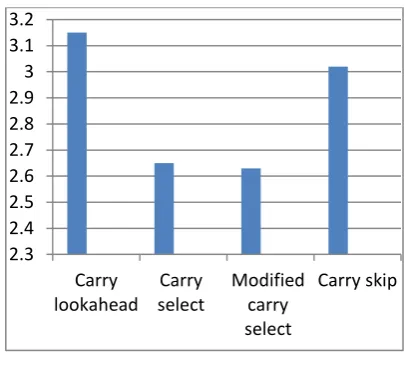
Fig.5 Area occupied
Fig.6 Gate used
Fig.7 Propagation delay 0
1000 2000 3000 4000 5000 6000 7000
0 100 200 300 400 500 600 700
© 2015, IJCSMC All Rights Reserved
289
Fig.8 Power consumedTABLE I
COMPARISON OF SYNTHESIS RESULTS OF DIFFERENT ADDERS. S.No Adder Area
(um2)
Gates used Delay (ns) Power (mW)
1 Carry Look
Ahead 2160 270 3.15 0.321 2 Carry Select 6205 605 2.65 1.12
3 Modified
Carry Select 6180 596 2.63 1.12
4 Carry Skip 3480 390 3.02 0.61
CONCLUSION:
In this work we have studied and demonstrated the performance of different adder structures. From the synthesis results it is clear that carry look ahead adder is an area efficient adder which has lesser number of gates in its structure but the propagation delay of carry look ahead adder is very high. Therefore it is not suitable for the applications which requires high speed operation. When the speed is an important criteria we can go for modified carry select adder which is area efficient and has lesser propagation delay when compared to that of carry select adder. This work can be extended by analyzing the performance of these adders for a particular operation like multiplication in image processing, signal processing etc..
REFERENCES
1. Shreehari veeramachaneni, M B Srinivas, " New improved 1 Bit full adder cells" IEEE 2008
2. Romana Yousuf and Najeeb-ud-din, " Synthesis of carry select adder in 65nm FPGA",IEEE
3. N. Weste and K. Eshraghian, Principles of CMOS VLSI Design - A Systems Perspective, Addition-Wesley Publishers, 1985.
© 2015, IJCSMC All Rights Reserved
290
5. B.Ramkumar, Harish M Kittur, P.Mahesh Kannan, “ASIC Implementation of Modified Faster Carry Save Adder”, European Journal of Scientific Research ISSN 1450-216X Vol.42 No.1, pp.53-58,2010.
6. David J. Willingham and izzet Kale, “A Ternary Adiabatic Logic (TAL) Implementation of a Four- Trit Full-Adder,IEEE, 2011.
7. G.Shyam Kishore, “A Novel Full Adder with High Speed Low Area”, 2nd National Conference on Information and Communication Technology (NCICT) 2011 Proceedings published in International Journal of Computer Applications® (IJCA).