ISSN(Online): 2320-9801
ISSN (Print): 2320-9798
International Journal of Innovative Research in Computer
and Communication Engineering
(An ISO 3297: 2007 Certified Organization)
Vol. 4, Issue 10, October 2016
Moodle as an E- Learning Approach for
Training and Education
Er.Gurpreet Singh
Assistant Professor, Department of Computer Sci., Baba Farid College, Bathinda, Punjab, India
ABSTRACT:Present scanario of education and training is changing with inventions of technology.In this paper; i tried to explain the overview about Moodle especially in training and education.LMS Moodle has been adopted by many people and organizations around the world because it offers a tightly integrated set of tools said to be designed from a social constructive perspective. Moodle has been developed under the general public license and many of its
components were developed without a specific design documentation including its security services. It is a best open
source Learning Management Software.It explore the concept of e-learning.First i gave an introduction about Moodle. The modular structure standards of moodle explained.The study about uses and applicatons of this platform are presented. Then there is brief description about tools useful for training and education.At the end, the main role of this platform and future aspects are described.
KEYWORDS:LMS, LAMP, WAMP, VLE, SCORM
I. INTRODUCTION
The training and education are learing environments in which there is need to use modern approaches to explore the various aspects of topics.There are number of software and hardware tools available for learning.Many of learing systems are closed and some are open. Virtual learning environments (VLEs) such as Moodle are now widely used in universities and other organisations. Moodle is a open source Learning Management System (LMS).One crucial factor in the successful employment of such platforms is the ability and commitment of teaching staff to adopt the system. MOODLE stands for Modular Object Oriented Dyniamic Learning Environment.It is just like Virtual Univerity or College. It is qulaity tool for E-learning. Moodle is a web application written in PHP.Moodle is designed by artin Dougiamas. Dougiamas established http://moodle.org as a site for user interaction and support [1]. The site is one of the most active and useful sites. It isn’t unusual for as many new users to enroll daily to make use of the various “courses” and “forums’. Discussion areas are available for each major feature of Moodle as well as for those under development and testing. There are also courses for users of Moodle in 65+ languages and dialects, and a “Teachers” Hands-on Playground” where teachers can take full control and experiment with Moodle’s features. Some points related to importance of Learning Management Systems:
1) Enriches learning exeperience 2) Increase student’s participation 3) Manages contents delivery
4) Standarized format can be used for contents and can share contents of course
By using Moodle, the students have the opportunity to access learning materials, interact with teachers and colleagues and receive specific tasks as home-works. Moodle presents multiple characteristics which made it to become in short time a representative elearning platform [2]. It supports a variety of different learning object (LO) formats and question types.Despite these advantages, Moodle is course-based and does not cater for the individual needs of students. However, its extensibility (plug-ins and modules) offers a promising possibility to introduce personalised learning support, which gives the learner more freedom to control their own learning process [3].
II. RELATED WORK
ISSN(Online): 2320-9801
ISSN (Print): 2320-9798
International Journal of Innovative Research in Computer
and Communication Engineering
(An ISO 3297: 2007 Certified Organization)
Vol. 4, Issue 10, October 2016
perceptions of students in the second year of the degree in Primary Education and Social Education at the University of Castilla-La Mancha in Cuenca Campus (Spain).
In [5], authors make a usability evaluation of standard modules in Moodle, one of the leading open sources learning management systems.Learning management systems are becoming ubiquitous technology adopted at institutions of higher learning. Before these systems can be considered effective the user experience must be studied and analyzed to provide the optimum solution to meet pedagogical needs of both faculty and students. This study compared the user experience between the leading proprietary solution, Blackboard, and the leading open source solution Moodle [6]. They used online surveys to compare the user experience of the basic functionality of each system such as communication tools, student-student interaction tools, student-instructor interaction tools.
In [7], the authors represent the use of moodle in higher classes. Many Canadian Educational Psychology classes currently emphasize and model constructivist teaching practices in addition to integrating the notion of connectivity and Web 2.0 into educational theory. This study examines "Moodle" as a technological tool to further enhance participation and performance in addition to the regularly used "semiotic tools" and social-dialogical activities found in a teacher education program.
III.MOODLE STRUCTURE
Moodle provides various modules for training and education to students and learners.The basic structure of this platform is depend upon the heirarchical approach asshown in Fig.1.
Fig.1 Basic Structure of Moodle
1) Plugins
Plugins are a flexible tool set, allowing Moodle users to extend the features of the site. There are hundreds of plugins for Moodle, extending the features of Moodle's core functionality.Each plugin is maintained in the Moodle plugins directory. As of April 2015, there are over 1,000 plugins available for Moodle with over 7 million downloads.
2) Themes
Graphical themes for Moodle can be installed to change the look and functionality of a Moodle site or of an individual course.
3) Translations
Moodle has been translated in over 100 languages, available for any site administrator to install.People in various countries maintain and contribute to the various language packs.
4) Mobile
ISSN(Online): 2320-9801
ISSN (Print): 2320-9798
International Journal of Innovative Research in Computer
and Communication Engineering
(An ISO 3297: 2007 Certified Organization)
Vol. 4, Issue 10, October 2016
IV.E-LEARNING STANDARDS ADOPTED BY MOODLE
a) Sharable Content Object Reference Model (SCORM) is a collection of elearning standards and specifications that define communications between client side content and a server side learning management system, as well as how externally authored content should be packaged in order to integrate with the LMS effectively. SCORM represents a “comprehensive picture of how a Learning Management System (LMS) might serve up Web-based learning content to learners in a standard way” [8]. There are two versions: SCORM 1.2 and SCORM 2004. Moodle is SCORM 1.2 compliant, and passes all the tests in the ADL Conformance test suite 1.2.7 for SCORM 1.2. SCORM 2004 is not supported in Moodle, however Rustici Software have a Moodle plugin which can turn any Moodle site into a fully compliant SCORM 2004 LMS.
b) The AICC HACP standard for CMI was developed by the Aviation Industry Computer-Based Training Committee (AICC)and is used to call externally authored content and assessment packages. AICC content packages are supported in Moodle 2.1 and later versions.
c) IMS Content Packages can also be imported into Moodle. In addition, Moodle Book activities can be exported as IMS Content Packages.
d) Learning Tools Interoperability (LTI) is a standard way of integrating rich learning applications (often remotely hosted and provided through third-party services) with educational platforms. Moodle uses the External Tool activity to act as an 'LTI consumer' as standard, and will act as an 'LTI provider' using a plugin.
V. USE OF MOODLE
Users can download and install Moodle on a Web server, such as Apache HTTP Server, and a number of database management systems, such as PostgreSQL, are supported.it is easy to install using LAMP(Linux,Apache,MySql,PHP) or WAMP(Window, Apache,MySql,PHP).
Pre-built combinations of Moodle with a Web server and database are available for Microsoft Windows and Macintosh. Other automated installation approaches exist, such as installing a Debian package, deploying a ready-to-use TurnKey Moodle appliance, using the Bitnami installer, or using a "one-click install" service such as Installatron.
Certified Moodle Partners provide other Moodle services, including hosting, training, customization and content development.This network of providers support development of the Moodle project through royalties.
Major applications of Moodle are given below:
1) It can provide material for trainees and students.The material can divided according to requirements. 2) The assessment of trainee and students
3) Useful for every subject teacher or trainer
4) Moodle is the world’s most widely used learning management system
5) Moodle is a massively successful open-source project
6) Core moodle has a robust set of teaching & learning tools
7) Moodle has thousands of regular community contributors pushing the product forward everyday
8) Moodle is free for anyone to download and support, but resources are necessary to maintain the system.
VI.USEFUL TOOLS FOR TRAINING AND EDUCATIONS
ISSN(Online): 2320-9801
ISSN (Print): 2320-9798
International Journal of Innovative Research in Computer
and Communication Engineering
(An ISO 3297: 2007 Certified Organization)
Vol. 4, Issue 10, October 2016
of courses and facility to add activities along with various courses.For example you can add use various plugins to enhance the activities under coureses.
A) QUIZ
It is tool for learning assessment, which is also adopted by a large community along the world [9]. Quizzes are a useful
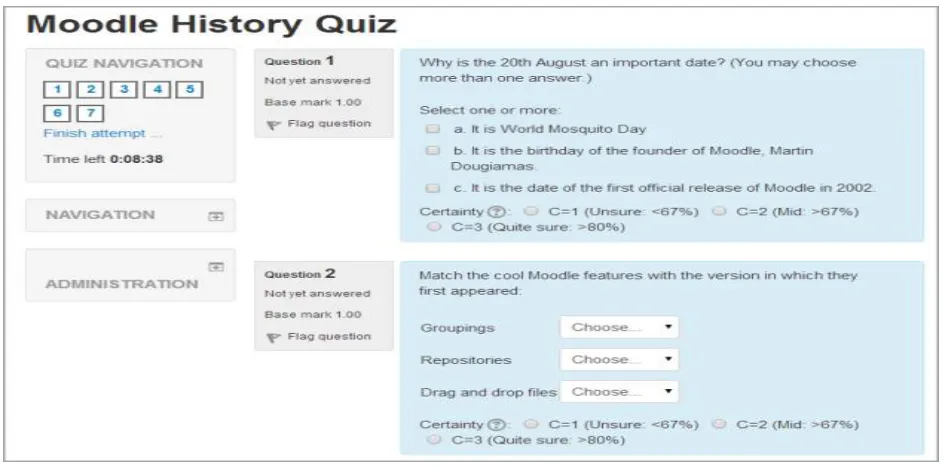
tool for students to test their level of knowledge. All the questions posed there are based on basic concepts of Physics previously explained in the classroom. Moodle provides a wide range of quiz types. For our online course we have chosen questions that can be of two types: true/false and multiple-choice questions. Apart from the questions themselves, there are many parameters one can adjust in the quizzes: the date at which the quiz is available, the time they have got to solve it, the number of tries; with the wrong answers the teacher can send a comment to the student [10]. They know the score they have gotten in real-time. When a quiz is created as shown in Fig.1, one can define the number of tries one student can do. Students can therefore try again when they think they have improved the knowledge they have on these issues. Each time the students try to solve one of them the questions appear in different order.
Fig. 2.Quiz Example
B) ASSIGNMENT
ISSN(Online): 2320-9801
ISSN (Print): 2320-9798
International Journal of Innovative Research in Computer
and Communication Engineering
(An ISO 3297: 2007 Certified Organization)
Vol. 4, Issue 10, October 2016
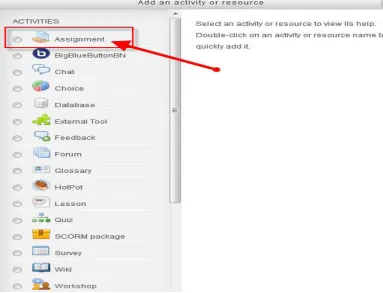
Fig. 3.Assignment Activity in Moodle
Student submissions are together on one screen of your course. You can require them to submit one or several files and/or to type text essays. It is possible to have them submit work as a group and you can also choose as a teacher to grade their work 'blind' in other words not to see the identities of those who have submitted assignments. Assignments can have deadlines and cut off dates - which you can also extend if necessary. To add an assignment you should turn on the editing and select it from the Activity chooser.
In Submission type of asssignment, Students can type directly into Moodle, upload files or add media. The options are in the Submission types section and if you don't see a particular option, get the admin to check the Site administration settings in Assignment settings documentation. Teachers may give feedback in various ways. The options available are in the Feedback types section and if you don't see a particular option, get the admin to check the Site administration settings in the Assignment settings documentation.Assignments types can be Grading assignments. Assignments may be graded with simple Grade points or customisable Scales. If you change the Grading method to Advanced grading, you can then use a Marking guide or Rubric.
Other type of communication tools like chat and messaging are also available for students and teachers to submit queries and forum for exchanging ideas.
VII. CONCLUSION
ISSN(Online): 2320-9801
ISSN (Print): 2320-9798
International Journal of Innovative Research in Computer
and Communication Engineering
(An ISO 3297: 2007 Certified Organization)
Vol. 4, Issue 10, October 2016
R
EFERENCES1. Thomas N Robb,” Moodle: A Virtual Learning Environment for the Rest of Us”, The Electronic Journal for English as a Second Language, Volume 8, Number 2, September 2004
2. Gabriel et al.,” Aspects Related to the Usefulness of a Distance Training Course Having Moodle as Course Management System Support”, Proceedings of the 9th WSEAS International Conference on distance learning and web engineering, 2009
3. Simone et al.,” Combining Self-Regulation and Competence-Based Guidance to Personalise the Learning Experience in Moodle”, IEEE 14th International Conference on Advanced Learning Technologies, 2014
4. Jose et al.,” The student’s perspective: Teaching usages of moodle at university”, Proceedings of ICERI2012 Conference, Madrid, Spain 2012 5. Gorgi et al.,” Evaluating usability in learning management system moodle”, Proceedings of the ITI 2008 30th International Conference on Information Technology Interfaces, 2008
6. Michael, Eric,”Blackboard vs. moodle: Comparing user experience of learning management systems”, 37th Annual Frontiers In Education Conference - Global Engineering: Knowledge Without Borders, Opportunities Without Passports, 2007
7. Wood, Shaunda,” Technology for Teaching and Learning: Moodle as a Tool for Higher Education”, International Journal of Teaching and Learning in Higher Education, v22 n3 p299-307, 2010
8. Félix, Antonio,”Evaluating e-learning platforms through scorm specifications”, IADIS Virtual Multi Conference on Computer Science and Information Systems 2006
9. Jose et al.,”iQuiz: Integrated assessment environment to improve Moodle Quiz”, Frontiers in Education Conference, 2013 IEEE
10. Teresa, Ana,” The role of new technologies in the learning process: Moodle as a teaching tool in Physics”, Computers & Education, Elsevier,2008
11. Daniel, Jeremy, “Integrating Web-Based and 3D Learning Environments: Second Life Meets Moodle”, UPGRADE Journal, Vol. IX, No. 3, June 2008