ISSN(Online): 2320-9801
ISSN (Print): 2320-9798
I
nternational
J
ournal of
I
nnovative
R
esearch in
C
omputer
and
C
ommunication
E
ngineering
(An ISO 3297: 2007 Certified Organization)
Vol. 4, Issue 10, October 2016
An Efficient Human Detection using HOG in
Surveillance video
Shaik Ayesha, B. Balvinder Singh
M.Tech Student, Dept. of CSE, Vignan’s Lara Institute of Technology and Science, Guntur, India
Assistant Professor, Dept. of CSE, Vignan’s Lara Institute of Technology and Science, Guntur, India
ABSTRACT: Detecting human beings accurately in a video surveillance system is crucial for diverse application areas including abnormal event detection, human giant characterization, person identification, gender recognition, fall detection in elderly people etc. In existing system the first step of the detection process is to detect an object which is in
motion. Detecting a human being has two methods. Object detection is performed by background subtraction, optical
flow and spatio temporal filtering techniques. Once object detected then classifying as a human being using shape-based, texture-based or motion-based features. In this paper we are proposing a fast and resourceful algorithm to detect humans in a surveillance video. Here we have used hog features to detect humans in a surveillance video. Once object detected classifying the moving object by AdaBoost classification algorithm. This algorithm can have applied to real time systems due to the low time complexity and increasing the performance of the system.
KEYWORDS: Human Detection, Video Surveillance, Background Subtraction, Optical Flow, Spatio Temporal Filter, HOG Feature Extraction, AdaBoost Classifier.
I. INTRODUCTION
The problem of object detection is to decide whether a explicit object within a class of objects is contained in an image or not. This problem can be seen as a counterpart between the object model and a set of descriptors, which are extracted from an image test. This over simplification, as easy as it seems to be, is able to explain the existence of multiple approaches that depends on the selection of object descriptors, type and difficulty of its model, and the methods used for the learning and similar object model. Outside being a general problem in computer vision, object detection is an main tool for many applications. It is used in video observation, digital image databases, and largely for difficult robotic tasks as in our case. Person detection is mostly complicated, mainly because of the high inconsistency of appearances and feasible situations. The problem is to find a depiction of a human that is both suitably generic to cover all types of situations, and suitably discriminative for humans. For this, we generally use an transitional representation, based on the calculation of one or more features, taken from the information contained in the only values of the image pixels. In this paper, we calculate the problem of person detection from images taken by a CCD camera. Several approaches have been implemented in synchronized, to perform an capable and fast detection, in order to be used in independent routing tasks. This work has been done in the context of independent moving system project of NCRM team, in CDTA.
II. RELATED WORK
ISSN(Online): 2320-9801
ISSN (Print): 2320-9798
I
nternational
J
ournal of
I
nnovative
R
esearch in
C
omputer
and
C
ommunication
E
ngineering
(An ISO 3297: 2007 Certified Organization)
Vol. 4, Issue 10, October 2016
upper and lower body parts, heads and faces. There are existing systems which uses filters such as particle filters [12],
Kalman filters [13] and HMM (Hidden Markov Model) filters [14] to track humans in video.
Object detection, tracking and segmentation are three fundamental tasks in computer vision. In this chapter, we review a number of relevant works in literature related to the two tasks. We present prominent works in object detection including several of the most popular object detectors, together with a few recent methods that leverage unsupervised learning for object detection. We also present some object tracking work in two classes; single object tracking and multi-object tracking. In addition, we present object segmentation work including early approaches and recent graph optimization approaches. We discuss their respective advantages and drawbacks and describe where our work fits into the context of these methods.
III. PROPOSED WORK
Here we are used HoG features and correlation based method to detect humans in video frame. For human detection in surveillance video, HoG features are extracted all candidate frames from the given input video. This reduces time required to detect the human objects in the video frames. In general case the candidate frames are selected in frequent intervals. For our research we have selected the interval as N, where N=number of frames per second. If we have the information about the surveillance area in earlier, strip based method for candidate frame selection can be used. Hog descriptor is that the local appearance and shape of object in an image can be described by the intensity distribution of gradients or direction of the contours. The HOG descriptor has some key advantages. Since it operates on localized cells, the method maintains the invariance to geometric and photometric transformations. We implemented the HOG descriptor on Matlab DIP libraries .
Block diagram
Fig1 : Human detection system
A. SPLIT FRAMES:
Splitting frames from the selected input video. The purpose of this step is to prepare the adapted video frames by removing noise and unnecessary objects in the frame in order to increase the amount of in sequence gained from the frame. Preprocessing of a image is a process of collecting trouble-free image processing tasks that change the unprocessed input video information into a format. This can be processed by subsequent steps. Preprocessing of the video is required to improve the detection of moving objects.
B. SELECT CANDIDATE FRAME:
Select Candidate Frame Detection Background subtraction is mainly a normally used technique for motion segmentation in static video. It attempts to detect moving regions by subtracting the present image pixel-by-pixel from a mention background image that is created by most of images over time in an initialization period. The pixels are classified as foreground where the dissimilarity is above a threshold. After creating a foreground pixel map, some morphological post doling out operations such as erosion, dilation and closing are perform to reduce the effects of noise
ISSN(Online): 2320-9801
ISSN (Print): 2320-9798
I
nternational
J
ournal of
I
nnovative
R
esearch in
C
omputer
and
C
ommunication
E
ngineering
(An ISO 3297: 2007 Certified Organization)
Vol. 4, Issue 10, October 2016
dynamic scene changes. There are different methods to the basic scheme of background subtraction in terms of foreground section detection, background preservation and post processing.
C. HOG FEATURE EXTRACTION:
Histograms of Oriented Gradients (HoG) features are used to get a fast and exact human detection system. The features used in our method are HoGs of variable-size blocks that extract orientation of edges in human images automatically. Using AdaBoost classifier, the suitable block is identified from the set of variable size boxes as the detestation window.
D. ADABOOST CLASSIFIER:
AdaBoost classifier, used the suitable block is identified from the set of variable size boxes as the contempt window AdaBoost is sensitive to noise. In some troubles it can be less vulnerable to the over fitting problem than other learning algorithms. The personality learners can be poor, but as long as the presentation of each one is somewhat better than random guessing, the final model can be verified to converge to a strong learner.
E. BACK GROUND:
The background subtraction system is used to grant foreground image during the threshold of difference image between the present image and mention image. As the reference image is the before frame, this method is called temporal differencing. The temporal differencing is very adaptive to active environment. Background elimination was agreed
away using mean squared error concept
.
IV. EXPERIMENT RESULT
Experimental results prove that our system is fast and have high success rate in human detection. From the experiments we have achieve more than 86% of detection rate. Some videos are taken for the experiment. HOG feature extraction method can also detect to some extent occluded human objects. Results of detection for some videos
Step: 1 This is the first GUI that appears when we execute the project in MATLAB. It consist of six push buttons select a video split frame, select candidate frame, HOG feature extraction, AdaBoost classifier, background, detect.
Fig: 2 Basic GUI.
ISSN(Online): 2320-9801
ISSN (Print): 2320-9798
I
nternational
J
ournal of
I
nnovative
R
esearch in
C
omputer
and
C
ommunication
E
ngineering
(An ISO 3297: 2007 Certified Organization)
Vol. 4, Issue 10, October 2016
Fig 3: Selecting video from the KTH data base.
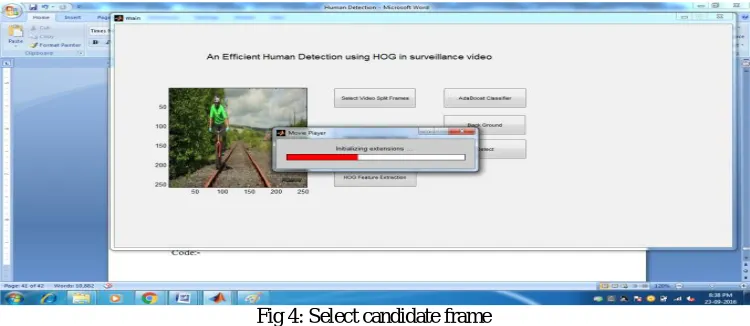
Step:3 Select the candidate frame from the splitting video for initializing extensions.
Fig 4: Select candidate frame Step: 4 Feature extraction :
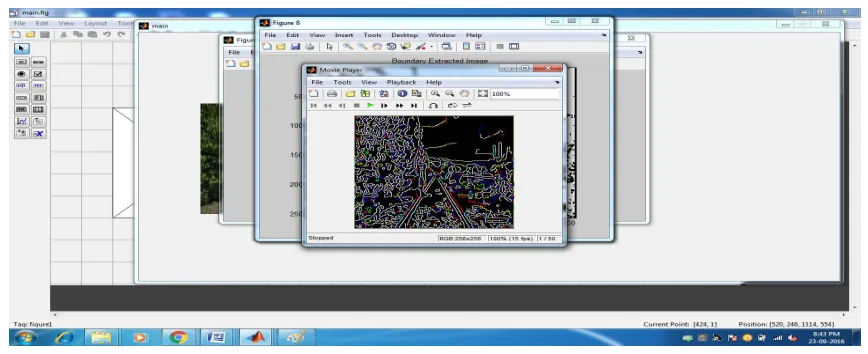
The Histogram of Oriented Gradient (HOG) feature descriptor is popular for object detection. We compute the HOG descriptor and display visualization.
ISSN(Online): 2320-9801
ISSN (Print): 2320-9798
I
nternational
J
ournal of
I
nnovative
R
esearch in
C
omputer
and
C
ommunication
E
ngineering
(An ISO 3297: 2007 Certified Organization)
Vol. 4, Issue 10, October 2016
Step:5 Classification:
Applying adaboost classifier on training set. If a training pattern is accurately classified; then its chance of being used again in a subsequent component classifier is reduced. Conversely, if the pattern is not accurately classified, then its chance of being used again is raised.
Fig6: Classification using AdaBoost algorithm
Step6: To detect the humans for threat assessment. The target intruder is classified as human or animal or vehicle
based on the height to width ratio (H/W) of the moving object detected during background subtraction
.
Fig7: Background detected
ISSN(Online): 2320-9801
ISSN (Print): 2320-9798
I
nternational
J
ournal of
I
nnovative
R
esearch in
C
omputer
and
C
ommunication
E
ngineering
(An ISO 3297: 2007 Certified Organization)
Vol. 4, Issue 10, October 2016
Fig 8: human is detected.
V. CONCLUSION
A video monitoring detecting system was thus developed successfully in this project. This system mainly provides an efficient method for surveillance videos for detecting a human. Thus action based change recognition in .avi video format was completed and effectively implemented. We propose an instance based method for human detection in videos, which is motivated by a wide range of applications. An implementation and system design of a prototype system developed for testing purposes is reviewed in this report as well. In this paper, a human detection algorithm based on the mixture of sequential information and shape information is designed. Initially, moving objects are detected using the proposed background elimination technique. Secondly shape information is used to discriminate human body and other moving object and the outside rectangle of moving object is computed using the maximum width and height value of the moving regions.
REFERENCES
[1] Papageorgiou, C., Poggio, T. Trainable Pedestrian Detection, Center for Biological and Computational Learning Artificial Intelligence Laboratory MIT, 1999.
[2] Kennedy, J., Eberhart, R. Particle Swarm Optimization, IEEE Inter. Conference on Neural Networks, 1995. [3] Mohan, A. Object Detection in Images by Components, MIT AI Memo, 1664 (CBCL Memo 178), June 1999.
[4] Papageorgiou, C., Oren, M., and Poggio, T., A General Framework for Object Detection, Proc. International Conf. Computer Vision, Jan. 1998.
[5] Papageorgiou, C., Poggio, T. A Trainable System for Object Detection, International Journal of Computer Vision 38(1), 15–33, Kluwer Academic Publishers. Manufactured in The Netherlands, 2000.
[6] Levi, K., Weiss, Y., Learning Object Detection from a Small Number of Examples: The Importance of Good Features, Proceeding of CVPR(2): 53-60, 2004.
[7] O. Tuzel, F. Porikli, and P. Meer. Human detection via classification on riemannian manifolds. In Conf. Comp. Vis. & Patt. Recognition, 2007. [8] H. Sidenbladh. Detecting human motion with support vector machines. In Int. Conf. on Pattern Recognition (ICPR), volume 2, pages 188–191,2004. [9] C. Wren, A. Azarbayejani, T. Darrell, and A.P. Pentland. Pfinder: Realtime tracking of the human body. Trans. Pattern Anal. Machine Intell., 19(7):780– 785, July 1997.
[10] D. M. Gavrila and V. Philomin. Real-time object detection for smart vehicles. Coference on Computer Vision and Pattern Recognition (CVPR), 1999. [11] K. Mikolajczyk, C. Schmid, and A. Zisserman. Human detection based on a probabilistic assembly of robust part detectors. The 8th ECCV, Prague, Czech Republic, volume I, pages 69. 81, 2004.
[12] M. Arulampalam, S. Maskell, N. Gordon, and T. Clapp, “A tutorial on particle filters for Online nonlinear/non-Gaussian Bayesian tracking,” IEEE Trans. Signal Process., vol. 50, no. 2, pp. 174–188, Feb. 2002.
[13] L. Jiao, Y. Wu, G. Wu, E. Y. Chang, and Y. Wang, “Anatomy of a multicamera video surveillance system,” Multimedia Syst., vol. 10, no. 2, pp. 144–163, Aug. 2004.
[14] M. Brand and V. Kettnaker, “Discovery and segmentation of activities in video,” IEEE Trans. Pattern Anal. Mach. Intell., vol. 22, no. 8, pp. 884–851, Aug. 2000.
[15] Viola, P., Jones, M. Robust Real-time Object Detection, Second International Workshop on Statistical and Computational Theories of Vision Modeling, Learning, Computing, and Sampling, Vancouver, Canada, July 13,2001.