MANAGEMENT PRACTICES AND CHANGE IMPLEMENTATION IN PUBLIC HEALTH FACILITIES IN THARAKA NITHI COUNTY, KENYA
CALLEN GATUNE FRANCIS D53/OL/EMB/24587/2014
A RESEARCH PROJECT SUBMITTED IN PARTIAL FULFILLMENT OF THE REQUIREMENTS FOR THE AWARD OF THE DEGREE OF MASTER OF BUSINESS ADMINISTRATION (STRATEGIC MANAGEMENT) OF KENYATTA
UNIVERSITY
ii
DECLARATION
This research project is my original work and has not been presented for a degree in any other university. No part of it may be reproduced or transmitted in any manner without permission in writing from the researcher or Kenyatta University.
Signature___________________________________Date____________________________
CALLEN GATUNE FRANCIS D53/OL/EMB/24587/2014
This research project has been submitted for examination with my approval as the appointed university supervisor. I confirm that the work reported in this research project was carried out by the candidate under my supervision.
Signature____________________________________Date___________________________ Mr. Henry Kegoro
iii
DEDICATION
iv
ACKNOWLEDGEMENT
v
TABLE OF CONTENTS
DECLARATION ... ii
DEDICATION ... iii
ACKNOWLEDGEMENT ... iv
LIST OF TABLES ... viii
FIGURE ... ix
OPERATIONAL DEFINITION OF TERMS ... x
ABSTRACT ... xii
CHAPTER ONE ... 1
INTRODUCTION ... 1
1.1 Background to the Study ... 1
1.1.1 Management Practices ... 3
1.1.2 Change Implementation ... 5
1.1.2 Public Health Sector in Kenya ... 6
1.1.3 State of Health Sector in Tharaka Nithi ... 8
1.2 Statement of the Problem... 11
1.3 Objectives ... 12
1.3.1 General Objective ... 12
1.3.2 Specific Objectives ... 13
1.4 Research Questions ... 13
1.5 Significance of the Study ... 13
1.6 Scope of the Study ... 14
1.7 Limitations of the Study ... 15
1.8 Organization of the Study ... 15
CHAPTER TWO ... 16
LITERATURE REVIEW ... 16
2.1 Introduction... 16
2.2. Theoretical Review ... 16
2.2.1 Theory of Planned Change ... 16
vi
2.2.3 Ricky Griffins Theory ... 19
2.2.4 Human Capital Theory ... 21
2.3 Empirical Review ... 22
2.3.1 Leadership Style and Change Implementation ... 22
2.3.2 Communication Styles and Change Implementation ... 24
2.3.3 Employee Training and Change Implementation ... 26
2.4 Conceptual framework... 31
CHAPTER THREE ... 33
RESEARCH METHODOLOGY ... 33
3.1 Introduction... 33
3.2 Research Design ... 33
3.3Target Population... 34
3.4 Sampling Procedure and Sample size ... 34
3.5 Data Collection ... 36
3.6 Validity and Reliability of the Instrument ... 37
3.6.1 Validity Testing ... 37
3.6 2 Reliability Testing ... 37
3.7 Data Analysis and Presentation ... 38
3.8 Ethical Considerations ... 38
CHAPTER FOUR ... 40
RESEARCH FINDINGS AND DISCUSSION ... 40
4.1 Introduction... 40
4.2 Response Rates ... 40
4.3 Demographic Characteristics ... 41
4.3.1 Gender of Respondent ... 41
4.3.2 Age of Respondents ... 42
4.3.3 Respondents Level of Education ... 42
4.3.4 Duration of Work ... 43
4.4 Leadership Styles ... 44
4.5 Communication Styles ... 45
vii
4.7 Measurement of Performance ... 48
4.8 Inferential Statistics ... 50
4.9 Diagnostic Tests... 50
4.9.1 Normality Test ... 50
4.9.2 Linearity Test ... 51
4.9.3 Homogeneity Test ... 52
4.9.4 Multicollinearity Test ... 52
4.10 Correlation Analysis ... 53
4.11 Regression Analysis... 53
4.12 Model Summary ... 55
CHAPTER FIVE ... 57
FINDINGS, CONCLUSION AND RECOMMENDATION ... 57
5.1 Introduction... 57
5.2 Summary of Findings ... 57
5.2.1 Leadership Style ... 57
5.2.2 Communication Style ... 57
5.2.3 Employee Training ... 58
5.3 Conclusion ... 58
5.4 Recommendation ... 59
5.5 Suggestions for Further Research ... 60
REFERENCES ... 61
APPENDICES ... 68
Appendix 1: Questionnaire for Employees of Public Health Facilities in Tharaka Nithi County, Kenya ... 68
Appendix 2: Questionnaire for Patients of Public Health Facilities in Tharaka Nithi County, Kenya ... 72
Appendix 3: Kenyatta University Graduate School Letter ... 76
Appendix 4: National Commission for Science, Technology and Innovation ... 76
viii
LIST OF TABLES
Table 2.1: Summary of Literature Review and Knowledge Gaps ... 29
Table 3.1 Population Frame ... 34
Table 4.1: Gender of Respondent ... 41
Table 4.2: Age of Respondents ... 42
Table 4.3: Respondents Level of Education ... 43
Table 4.4: Duration of Work ... 44
Table 4.5: Leadership Styles... 44
Table 4.6: Communication Styles ... 46
Table 4.7: Employee Training ... 47
Table 4.8: Measurement of Performance... 49
Table 4.9: Normality Test ... 50
Table 4.10: Linearity Test... 51
Table 4.11: Homogeneity Test ... 52
Table 4.12: Multicollinearity Test ... 53
Table 4.13: Correlation Coefficients ... 54
Table 4.14: Regression Coefficients ... 53
ix FIGURE
x
OPERATIONAL DEFINITION OF TERMS
Communication Style is a technique which organizations use to communicate policies to employees. Communication styles may include upward approach, downward approach, formal approach and informal approach.
Change Implementation Is a state in which an organization (public health facilities) translate or execute newly formulated policies into action. It is a transition where an organization moves from the old state to a new state by embracing new policies, models or practices intended to enhance service delivery. The selected metrics of change implementation includes efficiency, effectiveness, customer satisfaction, accountability.
Employee Training Is a systematic process of equipping employees with the necessary skills, knowledge and capabilities in order to perform their duties in a more efficient and effective manner. The selected metrics of employee training involves skills, knowledge, abilities and participation.
Leadership style The activity of leading a group of people or an organization or the ability to do this. Leadership styles adopted in this study includes -democratic style, laissez-faire style and authoritative style.
xi
ABBREVIATIONS AND ACRONYMS CHMT County Health Management Team
GDP Gross Domestic Product GoK Government of Kenya
KHPF Kenya Health Policy Framework
KHSSP Kenya Health Sector Strategic and Investment Plan MDG Millennium Development Goals
MoH Ministry of Health
xii ABSTRACT
1
CHAPTER ONE INTRODUCTION 1.1 Background to the Study
In the world of competition, changing consumer needs, influence of technology and globalization, change implementation in an organization is not only considered a success but also a challenging task if not effectively managed (Sethuraman & Suresh, 2014). Large and small organization are driven by effective implementation of change if appropriate organizational practices are embraced (Nanjundeswaras & Swamy, 2014). Even though change implementation is associated with multiple factors in an organization, change has been viewed as an idea that is consistent and runs through all organizations regardless of size, industry and age. Without effective strategies in an organization, change implementation in private and public organizations is viewed to be a challenging task (Kariel, 2016).
2
accelerated by firm rivalry, globalization, client changing demands and emergence of new technologies.
Further, Karuhanga, (2015) in Uganda observed that strategy implementation was thought to be influenced by strategic competencies of leaderships. Similarly, Alshaher (2013) in Somalia observed that most of the private and public organizations were incapable of implementing new changes due to structural inertia and failure to articulate strategic planning. Odero Reeves and Kipyego (2015) posits that public health sector in Kenya has experienced a transformational change due to devolution of healthcare services to County Governments.
Mathooko and Ogutu (2014) assert that change in organizations is dragging due to lack of strategic approach and dedicated leaders. Institutionalization of change in any competitive organization is purely dependent on leadership spirit to create a climate that enhances two-way communication. Similarly, Ofori and Atiogbe (2012) ascertain that market dynamics have made it difficult for higher institutions of learning to implement new policies in order to compete in the global education sector. The development of modern economies has presented impeding business opportunities for many private and public organizations. Many organizations worldwide are recognizing the importance of accepting the aspect of change and also realizing that if they fail to implement change they will become extinct or irrelevant (Alshaher, 2013).
3
implementation (Langley, Smallman, Tsoukas, & Van De Ven, 2013).Choosing the correct point is not a simple assignment, and there is no single right response for all organization (Bakar, Tufail, Yusof & Virgiyanti, 2011).
Cuganesan, Dunford and Palmer (2012) contend that the leader's spirit, insight, wisdom, compassion, values, and learning skills are all important facets in the capabilities to lead others to embrace change. The leader who prompts change within a firm is often subject to approximate thought. Without strong leadership, effective organizational change may be unrealistic course to pursue. Managing change in an effective manner requires change leaders that can lead a team which has the courage to drive change properly in an existing system (Achitsa, 2014).
4 1.1.1 Management Practices
Management practices are described as initiatives that employees of an organizan can adopt in order to implement change more effectively (Aldehayyat & Khattab, 2013). Management practices selected in this study and thought to influence change implementation in public facilities in Kenya includes leadership styles, communication styles and employee training (Abok, 2013).Aldehayyat, (2011) posits that leadership styles are techniques employed by leaders or managers in an organization in order to influence employee behaviours towards organizational goals. The ability of managers to have unique qualities to influence employees will result to improved organizational productivity in the changing business environment (Aldehayyat & Khattab, 2013). Using a combination of management styles like democratic, bureaucratic, free style, management by objectives and management by walking around will facilitate change implementation in an organizations (Maina, 2012).
Communication style is thought to be a process by which information is communicated from one level to another in a formal system (Jehad, Aldehayyat & Naseem, 2012). Communication systems in organizations are considered to be different depending on the flexibility of the structure. Organizational with centralized structures are more likely to experience resistance to change compared to organizations with decentralized structures that facilitate coordination of activities from one unit to another thus team spirit (Obonyo & Arasa, 2012).
5
individual. Training is an organized increase of the know-how skills and sensations needed for staff members to execute efficiently in the offered process, as well as, to operate in underling situation. Flavián and Guinalíu (2015) argue that satisfied employees are likely to adapt to changes more easily compared to dissatisfied workers.
1.1.2 Change Implementation
Change is regarded as a continuous process that is concerned with renewing of institutions’ direction, structure and capabilities to achieve the ever changing needs of both external and internal consumers (Okibo & Agili, 2015). Change can be viewed as feature that organizations cannot avoided because of its continued presence in the organizational life (Odongo & Owuor, 2015). Overseeing change incorporates understanding the drivers of the change and developing methodologies to control both internal and external effects on the organization while assessing human elements especially attitudes and practices of individuals involved and organizational psychology (Obonyo & Arasa, 2012).
6
Aldehayyat (2011) argues that change comes at a cost and henceforth, it is almost certainly to receive some resistance. An organization may have obviously thoroughly considered the inception or change formulations stage, however, if the change is not well executed it may not actualize. The implementation stage is characterized by doing things differently (Adesina & Ayo, 2010). Abok (2013) contends that change implementation can turn out badly particularly if those that are charged with implementation do not consider the proposed change to be the most effective or most appropriate action.
1.1.2 Public Health Sector in Kenya
Everywhere throughout the world, there is pressure on the governments to offer more productive, effective and practical health services to its citizenry (World Health Organization Report, 2014). Change initiatives have cleared through governments bringing news about endeavors to reevaluate, transform, or change government health organizations (KIPPRA, 2015). In the developing world, change management has also been believed to radiate in all spheres of the public sector. The health sector reform initiatives have been run under healthcare change programs. Africa particularly has had a turbulent change condition that has shaped the change management process in the health sector over the last 50 years (Ministry of Health Report, 2015).
7
inter-sectoral coordination. In 2010, a new constitution was promulgated through a nationwide public referendum and it accommodates devolution of some of the administrative capacities from the national level to semi-independent counties countrywide (Ministry of Health, 2015).
These are regulated by elected county pioneers. Counties have the authority to prioritize and allocate resources got from the national level, collect local level taxes and undertake other types of local resource mobilization to reinforce service provision. This initiative has altogether changed government operations across the devolved sectors, including healthcare in the public sector (KIPPRA, 2015).The new constitution additionally created a maximum number of ministries for the country and in this way; the coordination of health services has been reverted back to the Ministry of Health.
The government has additionally pledged to cancel the current user fee policy making services free in health centers and dispensaries and to present free maternity care throughout the health system, despite the fact that if, when and how this will happen stays hazy (Government of Kenya Report, 2012). These health sector governance changes have essential ramifications to the outline, implementation and impact of service delivery to the Kenyan citizenry (MOH, 2015).
8
introduced the most anticipated hope for Kenyans of ‘bringing services closer to the people (KIPPRA, 2015)
1.1.3 State of Health Sector in Tharaka Nithi
Many of the health problems in Africa are evident in Kenya. According to the WHO Global Health report (2015), Kenya has a population of about 43 million people, with more than 42% of its populace being children under fifteen years of age. The report additionally expresses that the under-five mortality rate still stands at 73 per 1000 live births. Life expectancy for males and females is 58 and 61 years, respectively. Kenya also only spent 4.5% of its GDP in 2011 on health (WHO, 2015).
The organization of the health care system is divided into central, provincial, district, and rural levels. After the political crisis in 2007, the Ministry of Health was divided into two branches: the Ministry of Medical Services and Ministry of Public Health (KIPPRA, 2015).Tharaka Nithi County, like most other Counties in Kenya, since the devolution of health sector has been grappling with numerous health challenges. Such challenges range from health infrastructure, emergency response and rescue, health supplies and health workforce among other key challenges (MOH, 2015).
9
Management Team (CHMT), Sub County Health Management teams, health facilities and the various community health units (KIPPRA 2015).
Ministry of Health Report (2015) point out that it is important to recognize that implementation of County health programme is critical to the attainment of the highest possible health standards in a manner responsive to the population needs. There is need for allocating sufficient financial resources for the implementation of County health programme interventions. Lessons learnt so far indicate that the national government still have strong say into what budgets are allocated to what County, including what parameters underpin the size of the budget. With limited financial resource base coupled with huge financial demand from other sectors, the risk of Counties allocating insufficient finances that is not able to fund healthcare within the County is imminent (KIPPRA, 2015).
The remaining option is to seek funding from other sources to bridge the gap to support healthcare (MOH, 2015). Recruitment and hiring of staff for devolved functions are the counties’ responsibilities. It remains unclear on what the Ministry of Health will be able to do to support the efficient management of the healthcare workforce and ensure that the poorer Counties retain their best staff. Key areas of concern include availability of appropriate and equitably distributed health workers, attraction and retention of required health workers, improving of institutional and health worker performance, and training capacity building.
10
imbalances where urban areas have higher concentrations of trained healthcare personnel than rural areas, imbalance of skills‘ mix and poor skills and high degree of absenteeism. Effective decentralization must recognize the vital role of stakeholders in resource mobilization and the process of planning and implementation of health programmes.
County health programme put in place mechanisms of bringing all stakeholders together in defining health priorities and resource requirements for effective service delivery and to establish common planning, implementation, disbursement, reporting and accounting systems, based on existing government arrangements (MoH, 2015). The central level likewise incorporates the two national hospitals, Kenyatta National Hospital and Moi Teaching and Referral Hospital that are used for teaching and dissemination of care. At the provincial level, a Provincial Medical Officer is assigned to each of the eight provincial hospitals that correspond to the number of provinces in the country.
11 1.2 Statement of the Problem
According to KPMG (2013), public sector in Kenya and more specifically public health facilities in Kenya are experiencing key challenges such as service delivery inconsistencies, employee strikes, inadequate number of medical officers to attend patient needs, inadequate medical facilities to provide specialized treatment to patients. Further, Ministry of Health (2015) established that with the devolved health system, majority of the public health facilities are dragging behind implementation new changes.
Similarly, a comparative survey conducted by World Health Organization across East African Countries on the status of public health, it was observed that majority 79% of the services provided by public health facilities in Kenya were unsatisfactory due to issues of change implementation. Even though limited studies have been conducted in the health sector to examine the link between organizational practices on change implementation, it is observed that there is no clear understanding on the link between leadership styles, communication styles on change implementation in public health facilities in Tharaka Nithi County.
12
affecting effective implementation of strategic change at co-operative bank of Kenya. Further, Maina (2012) studied managing change at National bank of Kenya Limited. A survey by KIPPRA (2015) sought to investigate determinants of reforms implementation among health care institutions in Kenya and Aldehayyat (2011) south to examine organizational characteristics and the practice of strategic planning in Jordanian hotels From the findings of the empirical studies conducted by Okibo and Agili (2015); Ombui et al. (2014); Maina (2012); KIPPRA (2015); KPMG (2013) and MOH (2015), it is concluded that the studies examined variables of the current study partially or in isolation thus posing conceptual gaps to be addressed. Further, some studies were confined to different countries and sectors thus posing contextual gaps to be addressed by this study. Additionally, constraints of operationalizing and contextualizing theories pose theoretical gaps to be addressed and variability of research designs, sampling designs and data analysis methods resulted to inconsistencies in research findings thus methodological gaps to be addressed by the current study. Based on this research gaps, it is on this premise this study sought to establish the role of organizational practices on change implementation in public health facilities in Tharaka Nithi County.
1.3 Objectives
1.3.1 General Objective
13 1.3.2 Specific Objectives
The specific objectives of this study were;
i). To establish the effect of leadership style on change implementation in public health facilities in Tharaka Nithi County.
ii). To establish effect of communication style on change implementation in public health facilities in Tharaka Nithi County.
iii). To determine the effect of employee training on change implementation in public health facilities in Tharaka Nithi County.
1.4 Research Questions
The study sought to answer the following research questions:
i). How does leadership style affect change implementation in public health facilities in Tharaka Nithi County?
ii). How does communication style affect change implementation in public health facilities in Tharaka Nithi County?
iii). How does employee training affect change implementation in public health facilities in Tharaka Nithi County?
1.5 Significance of the Study
14
on the fact that with effective implementation of change in public health facilities, there may be improved healthcare services. The county government may also benefit from this study by gaining information on the issues affecting strategic change management thereby solving disputes between the county governments and their staff.
The study may assist the senior, management and subordinate staff to benefit from improved working conditions and motivation from the County governments. The findings may help the general public to be aware of the nature and manner of service delivery in public health facilities. The information may help policy makers such as the ministry of health in Kenya and other health agencies such as World Health Organization in formulating policies that would stimulate change implementation in public health facilities in Kenya. The information may help scholars and researchers in identifying research gaps thus enrich their literature and existing theories in the field of strategic change management.
1.6 Scope of the Study
15 1.7 Limitations of the Study
Despite limited studies conducted to focus on the organizational practices on change implementation, the study sought to review related studies that examined variables of this study in a combined way on change implementation in public health facilities in Tharaka Nithi County, Kenya. Non-cooperation from particular sections of participants that was witnessed was overcome by assuring respondents of confidentiality of information given and their privacy. Further, the objective of the study was articulated in advance before data collection. Inability of participants to fill some sections of the questionnaires was overcome by clarifying some issues before giving the intended information and this enhanced accuracy of the information collected.
1.8 Organization of the Study
The study is divided into three chapters. Chapter one highlights the background of the study, statement of the problem, the purpose of the study which explains what the study intended to accomplish, research objectives and research questions, the significance and limitation of the study. Chapter two discusses the theoretical review of the study, empirical review, summary of knowledge gaps and conceptual framework.
16
CHAPTER TWO LITERATURE REVIEW 2.1 Introduction
This chapter presents an overview of the theories which informs the study, empirical review section that discusses related studies conducted globally, regionally and locally. Further, the chapter illustrates summary of knowledge gaps and conceptual framework that depicts on the interrelationship between variables of the study.
2.2. Theoretical Review
This study was anchored on the theory of planned change and supported by Lewin’s change management model, Ricky Griffin’s theory and human capital theory as discussed.
2.2.1 Theory of Planned Change
17
literature based on the assumption that change is likely to take place in an organization if effective planning is embraced by top leaders (Onyango, 2012).
The theory argues that planned change consists of three phases which includes unfreezing, changing and re-freezing. It emphasizes that understanding the change process improves the probability of accomplishment in a change initiative (Otiso, 2008). Lewin identified the equilibrium between restraining and driving forces. For him, a change happens at a point where driving forces push back controlling forces to a minimum or achieve ‘semi-stationary equilibrium (Rajasekar, 2014). The theory proposes that the organization’s present state ought to be disrupted to accomplish a new equilibrium (unfreezing stage). Unfreezing requires the transfer of a considerable amount of resources to overcome a powerful system of forces, which maneuvered the organization into the present state (Sethuraman & Suresh, 2014).
18
Change from national government to devolved County governments required planned structural adjustments that would fit in those units (Mbaka & Mugambi, 2014). Unfortunately, there were hiccups in the transition from national to County governments that necessitated this study. This theory was applicable this study on the assumption that public health facilities are likely to implement changes if they embrace communication styles.
2.2.2 Kurt Lewin’s Change Management Model
This model was established by Kurt Lewin in 1950s. The theory proposed that the majority of people tend to prefer and operate within certain zones of safety (Mopeni et al., 2014). The three stages proposed by Kurt Lewin for effective implementation of reforms in any organization were unfreezing, transition and refreezing. First, managers must unfreeze or disrupt any comfort zone that may tend to support the status quo. Managers should discourage old practices among workers and replace them with new practices for effective implementation of reforms (Mostovicz et al., 2009)
19
transparency. The fundamental aspects employees should keep in mind when going through any form of an organizational reform process is that they should be flexible to accept new practices and be part of the reform process (Obonyo & Arasa, 2012).
To achieve any strategic objectives, reforms are necessary for private and public entities in the competitive business sectors (Ofori & Atiogbe, 2012). Effective communication between the top level managers and lower level employees promote implementation of reforms in any organization (Okibo & Agili, 2015). Interaction in the planning process for reforms is essential as well as it gives an opportunity to minimize change resistance in the system. For systemic and individual acceptance of reforms, employees are the key determinants of any successful change (Ombui, Mwende & Kariuki, 2014). This theory was applicable in this study based on the assumption that public health facilities are likely to implement changes if they management embraces communication styles.
2.2.3 Ricky Griffins Theory
20
Leaders offer direction and influences organization performance. An organization structure is another factor proposed by the model (Karuhanga, 2015). Organic structure that are decentralized enhance change implementation while mechanical structures that are centralized hinder effective change implementation of competitive firms. Decentralized structures enhance communication, transparence and accountability among leaders and employees in any organization (Kariel, 2016).
Division of labor, decentralization decisions within the organization create an environment that promotes employee participation, motivation and minimal resistance in the organization. Organization objectives are achieved by dedicated team of employees who are influenced by leadership qualities (Amaoko, 2012).The third factor is Technology. Proper use of technology, job designing can influence organization performance. Information control system, proper control system which includes financial budgeting, information system, proper rules and procedures will influence organization change implementation (Aarons et al., 2015).
21 2.2.4 Human Capital Theory
The theory was founded by Becker’s (1993). The theory argues that there are different kinds of capitals that include schooling, a computer training course and expenditures on medical care (Aarons et al., 2015). Becker noted that the most valuable of all capital is that of investment in human being. The theory point out that firm-specific human capital includes expertise obtained through education and training in management information systems, accounting procedures, or other expertise specific to a particular firm. The central tenets of the theory emphasize that competitive organizations have to consider investing in employee training and skills in order to implement new changes effectively (Aarons et al., 2015). Resistance witnessed in organizations can be as a result of employee inability to perform or system inertia to facilitate communication and coordination of activities (Abdalkrim, 2013). Human capital arises out of any activity able to raise individual worker productivity. For workers, investment in human capital involves both direct costs, and costs in foregone earnings (Abok, 2013).Workers making the investment decisions compare the attractiveness of alternative future income and consumption streams, some of which offer enhanced future income, in exchange for higher present training costs and deferred consumption (Adesina & Ayo, 2010).
22
inseparable components. Efficiency and effectiveness in service delivery will only be achieved if organizations are capable of motivating employees using financial and non-financial rewards (Efendioglu & Karabulut, 2010).
To a larger extent, delegating responsibilities, promoting and training not only influence employee performance but general organizational productivity. Employee behaviour in an organization is purely dependent on their knowledge to understand the fundamental policies of the organization (Amaoko, 2012).This theory was applicable in this study based on the premise that employee training is one of the management practices that is thought to influence change implementation in public health facilities in Kenya if effectively managed.
2.3 Empirical Review
2.3.1 Leadership Style and Change Implementation
23
Abok (2013) on the factors that influence the effective implementation of strategic plans in non-governmental organizations established that management styles affect the implementation of strategic plans in NGOs. The researcher found out that there was redundancy in as far as the implementation of policies is concerned although a significant percentage agreed that strategic plans were available, but they were not being implemented effectively.
24
Obonyo and Arasa (2012) suggest strategic leadership entails the leader’s ability to anticipate, envision, and maintain flexibility and to empower others to create strategic change as necessary. Leaders can apply a number of management styles to influence the behavior of employees. Democratic, autocratic, free style, management by objectives and management by walking around are some of the styles managers can use to achieve organizational goals. Jehad, Aldehayyat and Naseem (2012) contend that many organizations, including the public health sector, are encountering and overseeing change which might be either planned or emergent. For effective change implementation, Amaoko (2012) acknowledge that leaders should have personality traits such as self-confidence, ambition, drive and tenacity, realism, psychological openness, the appetite for learning, creativity, fairness and dedication.
Abok (2013) opines that organizational learning is function that is dependent on the organizational ability to embrace effective leadership styles. With increased competition in the business environment, organizational leaders should not only focus on managing people to work but also manage the change process effectively by creating maximum awareness and the need for change. Poor implementation of change in any entity is not only attributed to poor leadership but also lack of appropriate mechanisms and structures to facilitate the change process (Adesina & Ayo, 2010).
2.3.2 Communication Styles and Change Implementation
25
the challenges of effective change implementation process. Odongo and Owuor (2015) assert that organizational communication plays an important role in training, knowledge dissemination and learning during the process of strategy implementation. Communication is pervasive in every aspect of strategy implementation, as it relates in a complex way to organizing processes, organizational context and implementation objectives which, in turn, have an effect on the process of implementation.
Efendioglu and Karabulut (2010) posit that communication and shared understanding play an important role in the change implementation process. In particular, when vertical communication is frequent, strategic consensus is enhanced and an organizations performance improves. They explore vertical communication linkages as a means by which strategic consensus and performance can be enhanced. The corporate communication function is the department or unit whose purpose is facilitate strategy implementation through communication. This department can also serve as the antenna of an organization, receiving reactions from key constituencies to the strategy of the firm.
26
Aldehayyat (2011) opines that formal communication is a communication system which is to achieve the organizational objective while the informal communication is the system to achieve individual objectives in an informal group. The formal communication is focused on doing the tasks or jobs which one has to take. Formal communication has a formal and well-defined structure. On the other hand, informal communication takes the informal talks and gathering among the employees (Abdalkrim, 2013). Similarly, Amaoko (2012) advocate that change implementation in any organization is dependent on the culture of communication between top and lower level of management.
Organizations with rigid structures are likely to be inefficient and ineffective compared to organizations with organic structures that facilitate communication and exchange of information within the system (Aldehayyat & Al Khattab, 2013). Organizations that have open door culture are more likely to productive than those organizations with closed systems of communication. Due to changing business environment, organizations are viewed to be environmental dependent. Without effective environmental analysis, organizations may find it quite challenging to implement new strategies formulated. Subsequently, if organizations fail to embrace best practices such as innovation and creativity, they cease to exist in totality (Amaoko, 2012).
2.3.3 Employee Training and Change Implementation
27
have different needs and that these needs will change over time as these workers continue in their careers. Top management plays an ever increasing role to ensure that a knowledge-friendly culture is built in the organization. However, the study was confined to firms in Israel but not public health sector in Kenya.
Mbaka and Mugambi (2014) carried out a study on the factors that influence strategy implementation in the Kenyan water sector. The researchers found out that the employees in the public sector lack the capabilities, skills, and enthusiasm to drive the process of implementation. There is also an information gap between the strategy formulators and the staff. Hence, the employees barely understand what is expected of them. Further, the study established that resources rendered to the water sector are not adequate to facilitate full implementation of strategies. There has also been a notable technological gap in the water sector in Kenya, which makes implementation quite challenging. The limitations the study were ranged from relying on secondary data only that was biased, outdated and irrelevant. Theories adopted in their study were inappropriate with regard to the problem that was under investigation. Recommendations of the study were not based on findings. Ethical considerations were ignored.
28
Kenya. Armenakis (2013) contends that workers willingness for change is highly dependent on knowing and acknowledging the reasons and benefits of the change. Well-informed employees give credibility even to the reactions of a company faced with serious adverse publicity. Many predictors like change agent role, proper process, need for change, and the capability of organization, participation, culture, belief, environment, and commitment have been found to be related to employee readiness for change implementation.
In attitudinal resistance to change, an employee response depends on psychological rejection of change on the basis of need, whereas behavioral resistance probably relates to individual behaviors that reflect unwillingness to support the change or unwillingness to stay with the organization through this troubled time (KIPPRA, 2013). People do not necessarily resist change but instead resist the loss of status, pay, or comfort that may be associated with it. The response manifesting itself as by anger or fear constitutes resistance to change (Kinyanjui & Juma, 2014). Mbaka and Mugambi (2014) postulate that understanding employee behaviour and attitudes plays a very crucial role in order to develop relevant interventions to guide the change process. Organizational culture is not only able to guide behaviour and change attitudes within the work environment but also contributes to organizational performance.
29
Onyango (2012) established that majority of the public organizations are more likely to experience high level of resistance to change compared to private organizations due to centralized structures. However, despite extensive studies conducted on change implementation, it is observed that there is no clear understanding on the link between organizational practices on change implementation in public health facilities in Kenya thus pertinence of this study to fill the research gaps.
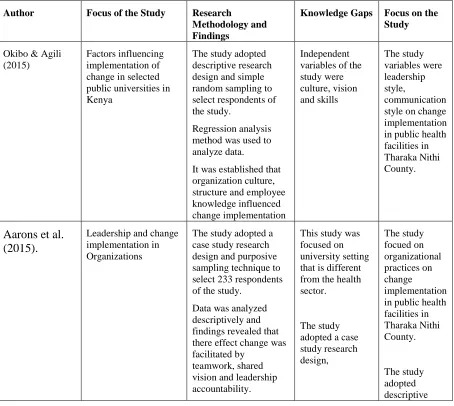
Table 2.1: Summary of Literature Review and Knowledge Gaps
Author Focus of the Study Research
Methodology and Findings
Knowledge Gaps Focus on the Study
Okibo & Agili (2015)
Factors influencing implementation of change in selected public universities in Kenya
The study adopted descriptive research design and simple random sampling to select respondents of the study.
Regression analysis method was used to analyze data. It was established that organization culture, structure and employee knowledge influenced change implementation
Independent variables of the study were culture, vision and skills The study variables were leadership style, communication style on change implementation in public health facilities in Tharaka Nithi County.
Aarons et al. (2015).
Leadership and change implementation in Organizations
The study adopted a case study research design and purposive sampling technique to select 233 respondents of the study.
Data was analyzed descriptively and findings revealed that there effect change was facilitated by
teamwork, shared vision and leadership accountability.
This study was focused on university setting that is different from the health sector.
30
research design and stratified sampling technique Achitsa, (2013) Effects of leadership
and management of strategic change at equity bank limited Kenya.
The study adopted positivist paradigm and stratified sampling technique to select 256 respondents.
Data was analyzed using multiple regression.
The study revealed a significant positive relationship between leadership and strategic change implementation.
The study focused on a sole variable of the study and failed to examine the effect of communication style and employee training on change implementation in the public health sector.
The study was adopted a case study as a research design and simple random sampling to collect data.
The study focused on organizational practices on change implementation in public health facilities in Tharaka Nithi County
The study focused on 62 public health facilities in Tharaka Nithi County.
Maina (2013) Challenges of change management, as well as determine change management practices adopted by NBK.
The study adopted a case study design and a census approach. The study revealed that lack of employee knowledge, structure and poor leadership were challenges of change implementation at National Bank of Kenya. The study examined challenges of change implementation. The study adopted a case study research design. Questionnaires and interview guides were used to collect data. Mathooko &
Ogutu (2014).
Coping Strategies Adopted by Public Universities in Kenya in Response to Environmental Changes.
The study adopted correlational research design.
Data was analyzed using factor analysis method.
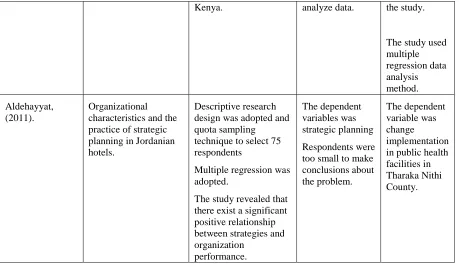
The study found out that organization culture influences change implementation in public universities in
The study was limited to strategic responses on university responses on environmental changes. Factor analysis was used to
The study was confined to the public health sector.
31
Kenya. analyze data. the study.
The study used multiple regression data analysis method. Aldehayyat, (2011). Organizational characteristics and the practice of strategic planning in Jordanian hotels.
Descriptive research design was adopted and quota sampling
technique to select 75 respondents
Multiple regression was adopted.
The study revealed that there exist a significant positive relationship between strategies and organization performance. The dependent variables was strategic planning Respondents were too small to make conclusions about the problem. The dependent variable was change implementation in public health facilities in Tharaka Nithi County.
Source: (Literature Review, 2018) 2.4 Conceptual framework
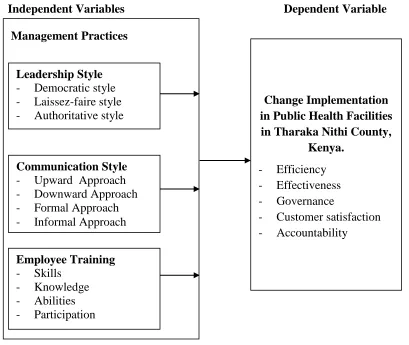
Figure 2.1 illustrates the interrelationship between independent variables on the dependent
variable. As depicted in Figure 2.1, the study established that leadership style,
communication style and employee training had a positive significant influence on change
implementation in public health facilities in Tharaka Nithi County, Kenya. Change
implementation indicators of this study involved improved services, reduced change resistance and employee retention.
Leadership styles that influenced change implementation involves democratic style,
32
upward and downward communication approach and formal and informal approach of
communication had an influence on change implementation. Further, the study revealed that
employee trainings indicators such as workshops, mentorship programs, delegation of duties and employee evaluation had a positive significant influence on change implementation
among public health facilities in Tharaka Nithi County.
Independent Variables Dependent Variable
Figure 2.1 Conceptual Framework (Researcher, 2018) Management Practices
Change Implementation in Public Health Facilities in Tharaka Nithi County,
Kenya. - Efficiency - Effectiveness - Governance
- Customer satisfaction - Accountability Leadership Style
- Democratic style - Laissez-faire style - Authoritative style
Communication Style - Upward Approach - Downward Approach - Formal Approach - Informal Approach
Employee Training - Skills
33
CHAPTER THREE RESEARCH METHODOLOGY 3.1 Introduction
This chapter presents the research methodology that includes: Research design, study population, sampling procedure and sample size, research instruments data collection and analysis and presentation.
3.2 Research Design
Black (2010) regards the research design as an arrangement of conditions for collection and analysis of data in a manner that aimed to combine relevance to the research purpose with economy in procedures. The study adopted cross-section research design to establish the influence of organizational practices on change implementation in public health facilities in Tharaka Nithi County, Kenya. The cross-sectional research design was appropriate because it explored and described the relationship between variables in their natural setting without manipulating them. Further, it provided the opportunity to discover new knowledge in a given area of study thus control of the problem under investigation.
34
it relied on existing theories and findings of empirical studies to make deductive conclusions and recommendations concerning the problem that was under investigation.
3.3Target Population
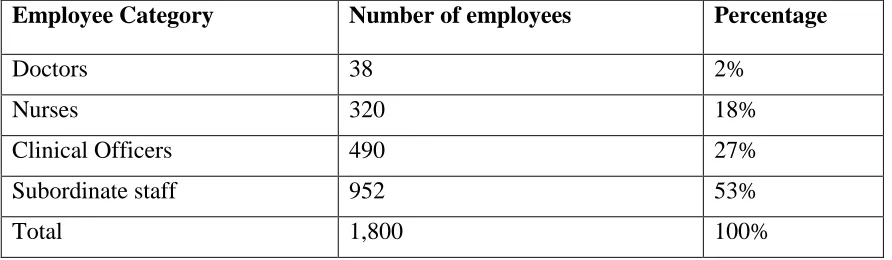
The target population refers to the universe from which the sample is selected (Black, 2010)). On the other hand, Collis and Hussey (2014) argue that a population is a well-defined or set of people, services, elements, and events, group of things or households that are being investigated. The target population of this study consisted of 1,800 respondents of 62 public health facilities in Tharaka Nithi County, Kenya as shown in appendix (5). The unit of analysis was public health facilities in Tharaka Nithi County while Unit of observation were employees and patients of public health facilities in Tharaka Nithi County.
Table 3.1 Population Frame
Source: (Ministry of Health, 2018) 3.4 Sampling Procedure and Sample size
Black (2010) defines a sample as part of large population, which is a representative of the larger population. Sampling is a process of selecting a number of individuals or objects from a population such that the selected group contains elements representatives of characteristics
Employee Category Number of employees Percentage
Doctors 38 2%
Nurses 320 18%
Clinical Officers 490 27%
Subordinate staff 952 53%
35
found in the entire group. A sample is a subset of the study population (Fisher, 2010). In other words, a sample is extracted from the target population. In the context of this study, sampling was necessary based on the fact that the target population was large and not feasible to include all the respondents in the study.
The respondents of the study were categorized into four groups or stratum which included doctors, nurses, clinical officers and subordinate staff. Stratified sampling procedure was applied in each stratum to select subjects giving them equal opportunity of being sampled and a final sample size of 379 respondents were drawn from 62 public health facilities in Tharaka Nithi County using Nassiuma’s (2008) formula to derive the sample size.
Where,
= Sample size N = Target population
C = Coefficient of variation at 50% = Degree of precision at 0.05
Substituting these values in the equation, estimated sample size (n) will be:
36
The sampled respondents will be drawn from the target population using simple random sampling method. As such this sampling method will ensure fair and equitable distribution of respondents.
3.5 Data Collection
37 3.6 Validity and Reliability of the Instrument 3.6.1 Validity Testing
Validity entails the appropriateness, meaningfulness and usefulness of inferences a researcher makes based on the data collected (Black, 2010). Face and content validity of the instrument was determined by the researcher through seeking opinions of experts in the field of study especially the researcher’s supervisor and industry experts working in public organizations. The construct validity approach concerns the degree to which the test measures the construct it will be designed to measure. Criterion-related validity is concerned with detecting the presence or absence of one or more criteria considered to represent traits or constructs of interest (Collis & Hussey, 2014). An appropriate inference was one that was relevant to the purpose of the study while a meaningful inference was one which said something about the meaning of the information obtained through the use of the instruments.
3.6 2 Reliability Testing
38 3.7 Data Analysis and Presentation
Black (2010) ascertains that analysis means categorizing, ordering, manipulating and summarizing of data to obtain answers to research questions. Statistical Package for Social Sciences, (SPSS version 24) software was used to analyze data quantitatively. The data collected was edited, coded, classified on the basis of similarity and then tabulated. Descriptive, correlation and multiple regression methods were used to analyze data and explain the findings.
Multiple regression was conducted at 95% confidence interval and 5% significance level. Using a measuring scale of 1-5, items of the instruments was analyzed and descriptive statistics such as mean scores, standard deviation, frequency distributions and percentages were used to summarize and relate variables which were obtained from the study. The specific multiple regression model adopted was of the form. Y = β0 + β1X1 + β2X2 + β3X3+ α, where, β0, β1, β2 and β3 are the regression co-efficient, Y denoted change implementation in public health facilities in Tharaka Nithi. X1 denoted Leadership Styles, X2 denoted Communication Style and X3 denoted Employee Training and ε denoted factors not included in the model.
3.8 Ethical Considerations
39
40
CHAPTER FOUR
RESEARCH FINDINGS AND DISCUSSION
4.1 Introduction
This chapter presents findings of the study according to the research objectives. The objectives of the study were to establish the effect of leadership styles, communication styles and employee training on change implementation in public health facilities in Tharaka Nithi County. Quantitative data was analyzed using descriptively statistics and inferential statistics such as correlation and multiple regression were conducted to determine the statistical relationship between variable.
4.2 Response Rates
41 4.3 Demographic Characteristics
4.3.1 Gender of Respondent
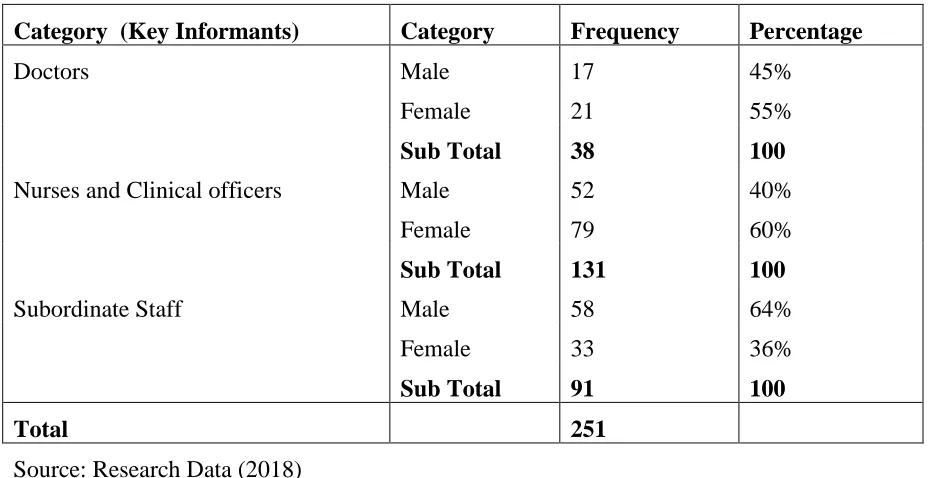
The study sought to determine the gender of respondents who participated in the study and the following were the findings as shown in Table 4.1.
Table 4.1: Gender of Respondent
Category (Key Informants) Category Frequency Percentage
Doctors Male 17 45%
Female 21 55%
Sub Total 38 100
Nurses and Clinical officers Male 52 40%
Female 79 60%
Sub Total 131 100
Subordinate Staff Male 58 64%
Female 33 36%
Sub Total 91 100
Total 251
Source: Research Data (2018)
42 4.3.2 Age of Respondents
The study sought to determine the age of respondents and the following were the findings as shown in Table 4.2:
Table 4.2: Age of Respondents
Years Frequency Percentage
Below 25 years 20 08%
26-35 years 109 43%
36-45 years 68 27%
Above 46 years 54 22%
Total 251 100
Source: Research Data (2018)
As shown in Table 4.2, majority (43%) of the respondents were aged between above 26-35, 27% of them were aged between 36-46 years, 22% of them were aged above 46 years and 08% of them were aged below 25 years. The results implies that majority of the respondents of the public health facilities in Tharaka Nithi were young nurses and clinical officers who were recruitment by their respective Counties to provide services in public health facilities due to devolved healthcare services to the County governments.
4.3.3 Respondents Level of Education
43 Table 4.3: Respondents Level of Education
Level Frequency Percentage
Bachelors 21 08%
Diploma 167 67%
Certificate 63 25%
Total 143 100
Source: Research Data (2018)
As depicted in Table 4.3, the results indicated that majority (67%) of the respondents were diploma holders who worked as nurses and clinical officers, 25% were certificate nurses and 08% were degree holders who had advanced their studies after joining the service. The findings implies that most the respondents were diploma nurses and clinical officers who worked in various public health facilities.
4.3.4 Duration of Work
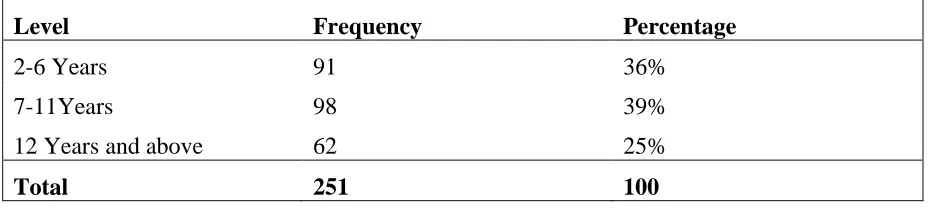
The study sought to determine the duration respondents had worked and the following were the findings as shown in Table 4.4:
Table 4.4: Duration of Work
Level Frequency Percentage
2-6 Years 91 36%
7-11Years 98 39%
12 Years and above 62 25%
Total 251 100
44
As illustrated in Table 4.4, majority (31%) of the respondents had worked for a period between 7-11 years, 36% of them had worked for a period between 2-6 years and 25 % of them had worked for a period more than 12 years. This findings implies that majority of the respondents of this study had worked for longer period of time and had adequate experience about organizational practices and change implementation in public health facilities in Kenya.
4.4 Leadership Styles
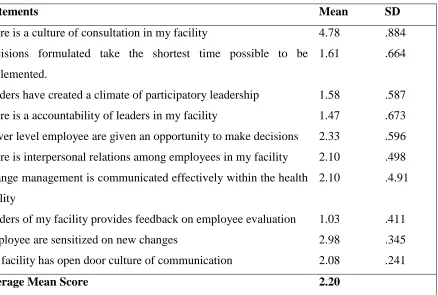
The study sought to determine the effect of leadership styles on change implementation in public health facilities in Tharaka Nithi County and the following were the findings as shown in Table 4.5
Table 4.5: Leadership Styles
Statements Mean S.D
Leaders provides an opportunity for employees to make independent decisions
2.26 .884 Leaders use dialog when implementing new policies 2.21 .664 Leaders use coercion to influence employee to perform 1.23 .587 Employees have a flexible schedule of working 4.11 .673 Employees work in an environment that encourages teamwork 4.04 .596 Employee are given freedom to make decisions 2.59 .498 Employees are delegated responsibilities 4.98 .781
Employees are empowered to perform 2.03 .467
Average Mean Score 3.30
45
As illustrated in Table 4.5, the study found out that the mean score for 5 of 8 statements was less than 4.00 which meant that majority of the respondents disagreed or were neutral with the statement while the rest either agreed. The findings implies that despite there was flexible working schedules, teamwork and delegation of responsibilities, to a larger extent their leaders did not given room for independent decision making, promote dialog, give freedom in decision making or empower workers to perform. It emerged leaders of public health facilities did not have leadership qualities that can make them influence other workers to perform towards organizational goals.
This findings are consistent with that of Jehad et al. (2012), Karuhanga (2015), Maina (2012), Kinyanjui and Juma (2014) whom established that leadership was directly correlated to effective change implementation in organizations. The studies pointed out that firms that were able to embrace democratic leadership styles and motivate workers were more likely to perform effectively in terms of change implementation as compared to firms that adoped autocratic styles of management.
4.5 Communication Styles
46 Table 4.6: Communication Styles
Statements Mean SD
There is a culture of consultation in my facility 4.78 .884 Decisions formulated take the shortest time possible to be
implemented.
1.61 .664
Leaders have created a climate of participatory leadership 1.58 .587 There is a accountability of leaders in my facility 1.47 .673 Lower level employee are given an opportunity to make decisions 2.33 .596 There is interpersonal relations among employees in my facility 2.10 .498 Change management is communicated effectively within the health
facility
2.10 .4.91
Leaders of my facility provides feedback on employee evaluation 1.03 .411 Employee are sensitized on new changes 2.98 .345 My facility has open door culture of communication 2.08 .241
Average Mean Score 2.20
Source: Research Data (2018)
47
and Swamy (2014) who established that employee resistance to change was attributed to poor communication within the system. Organizations with structures that promote top down and bottom up communication are likely to perform effectively in terms of change implementation.
4.6 Employee Training
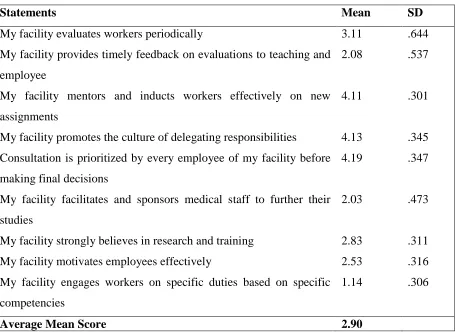
The study sought to determine the effect of employee training on change implementation in public health facilities in Tharaka Nithi County and the following were the findings as shown in Table 4.7
Table 4.7: Employee Training
Statements Mean SD
My facility evaluates workers periodically 3.11 .644 My facility provides timely feedback on evaluations to teaching and
employee
2.08 .537
My facility mentors and inducts workers effectively on new assignments
4.11 .301
My facility promotes the culture of delegating responsibilities 4.13 .345 Consultation is prioritized by every employee of my facility before
making final decisions
4.19 .347
My facility facilitates and sponsors medical staff to further their studies
2.03 .473
My facility strongly believes in research and training 2.83 .311 My facility motivates employees effectively 2.53 .316 My facility engages workers on specific duties based on specific
competencies
1.14 .306
Average Mean Score 2.90
48
As shown in Table 4.7, the study indicates that the mean score for 5 of 9 statements was less than 2.00 which meant that majority of the respondents disagreed or were neutral with the statement while a few agreed. The findings implies that even though employee training influenced change implementation, to a larger extent management of public health facilities did not promote employee knowledge and skills in order to improve their performance. Challenges such as providing timely feedback on employee evaluation, sponsorship of workers to advance their studies, motivation workers and believing in research and training were attributed to failure of realizing new goals in public health facilities.
This findings are in line with that of Nduko (2008), Obonyo and Arasa (2012), Odero et al. (2015), Ofori and Atiogbe (2012) who noted that employee training is one of the fundamental factors which influences change implementation in any competitive organization. The studies pointed out that even though there were differences from the findings of empirical studies by Sethuraman and Suresh (2014), Wessel and Christensen (2012) on the relationship between employee training and change implementation, to a larger extent change implementation in facilitated by transforming employee mind-sets through formal education.
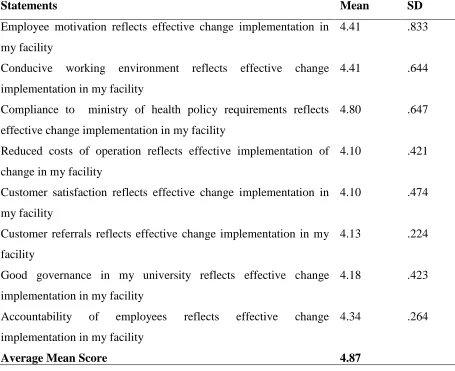
4.7 Measurement of Performance
49 Table 4.8: Measurement of Performance
Statements Mean SD
Employee motivation reflects effective change implementation in my facility
4.41 .833
Conducive working environment reflects effective change implementation in my facility
4.41 .644
Compliance to ministry of health policy requirements reflects effective change implementation in my facility
4.80 .647
Reduced costs of operation reflects effective implementation of change in my facility
4.10 .421
Customer satisfaction reflects effective change implementation in my facility
4.10 .474
Customer referrals reflects effective change implementation in my facility
4.13 .224
Good governance in my university reflects effective change implementation in my facility
4.18 .423
Accountability of employees reflects effective change implementation in my facility
4.34 .264
Average Mean Score 4.87
Source: Research Data (2018)
50
compliance to ministry of health regulations, reduced costs, transparency and accountability, customer satisfaction, referral and good governance.
This findings are supported by the research work of Rajasekar (2014), Onyango (2012), Okibo and Agili (2015) whom observed that change implementation in any organization is measured using parameters such as employee commitment, organizational efficiency and effectiveness in service delivery and adoptability of the organization to new regulation and use of technology in service delivery.
4.8 Inferential Statistics
Before subjecting data to regression analysis, statistical assumptions such as normality, linearity, homogeneity and multicollinearity tests were conducted to determine conformity of data to statistical assumptions for further data analysis.
4.9 Diagnostic Tests 4.9.1 Normality Test
Shapiro-Wilk test was used to test normality. According to Guest (2010), data is seen to be normally distributed when statistical figures ranges from zero to one and significance values are less than 5%.
Table 4.9: Normality Test
Variables Statistics df Sig
Leadership Style 0.872 143 0.003
Communication Style 0.811 143 0.002
Employee Training 0.746 143 0.000
51
As shown in Table 4.9, the consolidated variables of organizational practices variable had figures ranging from -0.1 to +1.0 and most of them were skewed towards +1.0. The calculated probability values of the three independent variables were (0.872, 0.811 and 0.746) indicating that they met the threshold of more than 0.05 level of significance as recommended by Crowther and Lancaster (2012).
4.9.2 Linearity Test
To determine linearity of data, Pearson’s product moment of correlation coefficient was used to establish the association between change implementation and leadership styles, communication styles and employee training as shown in Table 4.10.
Table 4.10: Linearity Test
Independent Variables Performance
Leadership Styles Pearson Correlation 0.546**
Sig(2-tailed) 0.001
N 143
Communication Styles Pearson Correlation 0.437**
Sig(2-tailed) 0.000
N 143
Employee Training Pearson Correlation 0.436**
Sig(2-tailed) 0.002
N 143
**p< 0.05
Source: Research Data (2018)
52
findings reveals that there was a co-movement of variables in the same direction thus facilitating causal relationship as recommended by Collis and Hussey (2014).
4.9.3 Homogeneity Test
To test homoscedasticity of homogeneity of Variances, Levene’s Test was used which confirmed that the dependent variable exhibited equal variance across the three predictor variables with the calculated probability values greater than 0.05 as recommended by Novikov and Novikov (2013).
Table 4.11: Homogeneity Test
Variables Lavene
Statistics
df Sig
Leadership Style 6.456 1 0.719
Communication Style 6.432 1 0.549
Employee Training 6.334 1 0.554
Change Implementation 5.047 1 0.057
Source: Research Data (2018)
As shown in Table 4.11, the results indicate that the calculated probability of the five variables of the study were greater than 0.05 ranging between 0.057 to 0.719. Since significance values of the five variables were greater than 0.05, variance homogeneity was confirmed as proposed by Fisher (2010).
4.9.4 Multicollinearity Test