Jurnal Mekanikal
June 2009, No. 28, 16 - 27
_________________________
*Corresponding author : [email protected]
LOAD SUSTAINED RIG FOR BOND DURABILITY STUDY
Shukur Abu Hassan* , Yob Saed Ismail1 , Abd Rahman Mohd. Sam2
1Department of Applied Mechanics, Faculty of Mechanical Engineering,
Universiti Teknologi Malaysia, 81300 Skudai, Johor Bahru,
MALAYSIA
2Department of Structure and Materials, Faculty of Civil Engineering, Universiti Teknologi Malaysia,
81300 Skudai, Johor Bahru, MALAYSIA
ABSTRACT
This paper describes the development of a special-built experimental rig used for bond durability study of composites specimen under combination of sustainable mechanical load and weathering effects. The specimen under study was Carbon Fibre-Reinforced Plastic (CFRP) plates bonded with special structural epoxy adhesive to a concrete prism. The fully mechanical rig was designed to create and sustain pull-push load configuration to the specimen. From setting-up process, laboratory monitoring works and CFRP plate strain data, it shows that the rig performed well without any maintenance throughout the period.
Keywords: Bond durability, CFRP plate-concrete bonded system, experimental rig, load sustainable.
1.0 INTRODUCTION
Jurnal Mekanikal, June 2009
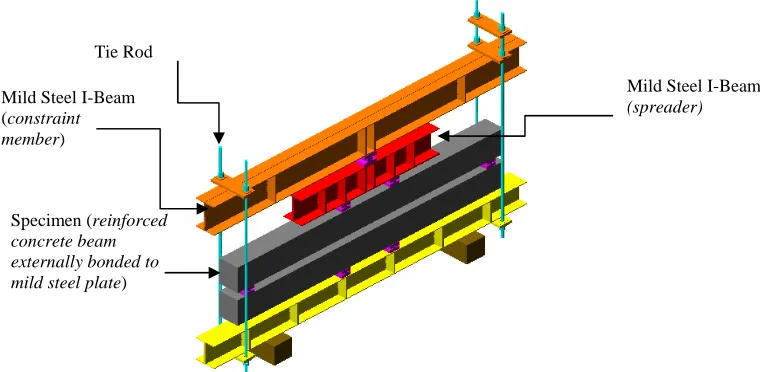
had been successfully conducted by numerous researchers [1-8]. They have used fully mechanical experimental rig as shown in Figure 1. The rig was designed to create a sustainable four points flexural load imposed onto a pair of externally steel plate-concrete beam bonded system. The rig was used without any maintenance for bond durability studies of reinforced concrete beam that externally bonded to mild steel plate. The specimens were exposed for more than 15 years to an aggressive environment industrial area around Sheffield, United Kingdom. Apart from that, the geometries and the loading configuration that assigned to the FRP or steel plate-concrete bonded specimen can be referred to numerous researches works, for example Nakaba, et al. [9] in studying bond characteristics under various loading effects such as bending, single face shear, direct tensile and double face shear. From their study, it shows that the double face shear was the preferred test method that provided a significant result. These were proven by Swamy, et al. [2], Mukhopadhyaya et al. [10], Maeda, et al. [11], Brosens and Van Gemert [12], Horiguchi and Saeki [13] and Toutanji and Ortiz [14]. From literatures, it shows that no experimental rig has been developed specifically for bond durability study under pull-push loads configuration. Therefore, it is very important in this research to develop the rig that can create and sustain the mechanical load for long-term bond durability study.
This paper discusses the methodology of how a simple mechanical rig has been developed, produced and tested for bond durability study of CFRP plate bonded to concrete prism using structural type epoxy adhesive. The mechanical performances of the rig also has been discussed to proof the mechanics of the overall rig-specimen integration in terms of load transfer and sustainable.
Figure 1: Four points flexural load sustained rig
2.0 DESIGN OBJECTIVE AND METHODOLOGY
Tie Rod Mild Steel I-Beam (constraint member)
Specimen (reinforced concrete beam externally bonded to mild steel plate)
Jurnal Mekanikal, June 2009
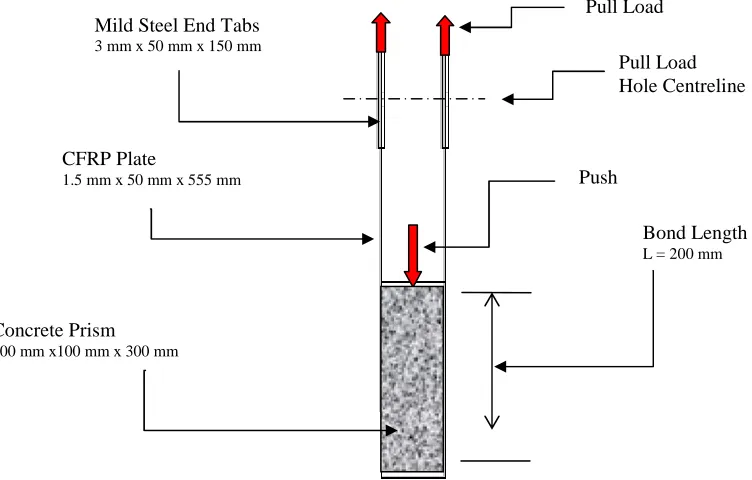
The main objective of developing the experimental rig was to create a sustainable pull-push loads that can be imposed on CFRP plate bonded to concrete specimen (Figure 2) for bond durability assessment. The first stage in the design process was to establish the problem statements which focuses to the critical needs of the product. In this study, the critical parts of the rig design is to counter the problems that related with specimen’s geometry and loading configuration that need to be assigned to the specimen’s respected individual material. After completing the parametric study of the specimen, three rig design concepts have been produced. Finally, the design concept based on the ability in meeting most of design criteria has been selected and develop for further technical evaluation. Apart from that, the mechanical testing was also performed on individual rig components and specimen materials in order to determine load and stresses limit state. The specimen materials test data are very important for the overall rig-specimen design consideration.
2.1 Design Solution
Apart from developing the rig, the analysis and investigation of the ultimate limit state of the bond joint between mild steel end tabs to CFRP plate was also considered as a top priority in the overall design process. This is important because the failure in the bond region is not acceptable within certain load limit. This was to ensure the specimen would not fail in the clamping region rather than in the CFRP plate-concrete bonded area [15, 16]. The application of mild steel plate as end tabs was to prevent or to overcome the weakness of orthotropic
Figure 2: Specimen configuration under study
Mild Steel End Tabs
3 mm x 50 mm x 150 mm
CFRP Plate
1.5 mm x 50 mm x 555 mm
Bond Length
L = 200 mm
Pull Load Hole Centreline Pull Load
Push
Concrete Prism
Jurnal Mekanikal, June 2009
properties of CFRP plate under tensile stress [17, 18]. Mukhopadhyaya, et al. [10] in their experimental study of Glass Fibre-Reinforced Plastic (GFRP) plate-concrete specimen had used mild steel plate geometry of 150 mm x 90 mm x 1.2 mm bonded on both side of GFRP plate in order to ensure the GFRP plate did not tear off prematurely due to reduced cross section across the drilled hole. No failure along the bonded area of GFRP plate-mild steel end tabs bonded area was reported in their study. Therefore, performing both bond numerical analysis and bond test was the best approach to reach the conclusion in determining the load and stress limit around the pinhole region within the end tabs. From pull-push load test shown in Figure 3, it can be seen that the weakness in shear properties of orthotropic CFRP plate was the main factor that initiated the failure in end tabs bond region. The test result shows that the debonding of mild steel end tabs from CFRP plate was due to excessive local bond stress which was developed at specimen loaded end interface (i.e. tensile) bond region [19, 20]. This can best be referred to strain distribution around pin hole under various applied load level as shown in Figure 4.
Figure 3: Close-up view of shear-out bond failure within mild steel end tabs CFRP plate under pull-pull load.
Figure 4: Typical strain distribution around end tabs pinhole at various load levels. -1000
-800 -600 -400 -200 0 200 0
45
90
135 180
225 270
315
5 kN 10 kN 15 kN 20 kN 25 kN 30 kN 35 kN End tabs
Jurnal Mekanikal, June 2009
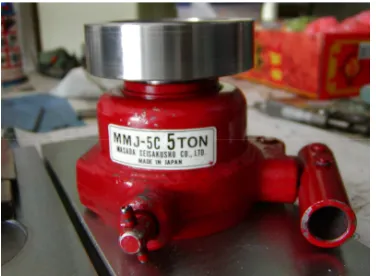
The rig final design is shown in Figure 5 which consists of an upper constrain plate, lower constrain plate, bearing block, guide block, pin, bolts, nuts and tie rods. All the mechanical design calculation was referred to design handbooks [21-24]. In this design, the safety factor of 1.5 has been used for all critical components. This was based on material testing and numerical analysis. The assumption made in this design analysis was that the rig and the specimen were in the state of equilibrium. The design analysis started with first identifying the most critical rig components and specimen material (i.e. specimen area that subjected to critical stress under load). To overcome the constraint in identifying the correct loading mechanism which able to produce higher limit load and also able to fit the specimen loading point configuration, a mini-hydraulic jack with 50 kN maximum load capacity has been selected (Figure 6). The load applied to the rig-specimen was measured by a load transducer with the maximum capacity of 50 kN brand TML supplied by Tokyo Sokki Kenkyujo Co. Ltd. [25]. The load transducer was first calibrated to confirm it mechanical performances prior been used for load measurement during rig-specimen set-up (Figures 7 and 8).
Figure 5: Final design of load sustained bond experimental rig spring under compression load test.
Figure 6: Mini hydraulic jack with capacity of 50 kN.
Jurnal Mekanikal, June 2009
Figure 7: Calibration of 50 kN load cell using 100 kN Instron Universal Testing Machine.
Figure 8: Graph of machine load versus load cell load reading under increment and decrement of applied machine loads.
3.0 RIG-SPECIMEN SET-UP DESCRIPTIONS
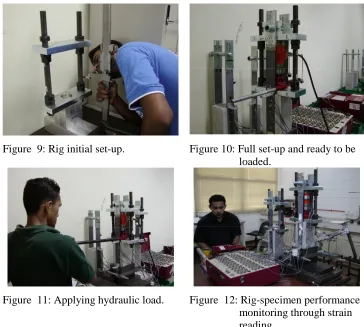
The rig-specimen set-up started with the assembly the rig components configuration prior to the installation of the specimen to the rig itself. After the completion of setting-up works the mini hydraulic jack was installed onto the lower plate follow by the installation of load transducer in between hydraulic jack and the upper constraint plate. The lateral movement of hydraulic jack and load transducer was constraint by a circular holes depth of 3 mm in depth and 50 mm in diameter were formed at both lower and upper constraint plates. Both tie rods were subjected to full compression load after the specimen reached it limit load. This was achieved by tighten both rods using double system nuts. Finally, the torque wrench was used to lock the nuts prior to releasing the hydraulic load. At the early stage, observation on the rig-specimen performances were monitored through data logger TDS-302 on the CFRP plate strains output. The monitoring was performed in every 15 minutes for the first 24 hours, followed by every 30 minutes for the next 48 hours and finally by every 24 hours for the duration of 45 days. There are three rig-specimens used in this experiment, namely;
Load decreas ed y = 0.9757x - 0.0401 Load increased
y = 0.9757x + 0.046
0 10 20 30 40 50
0 10 20 30 40 50 Load Cell Reading (kN)
M a c h in e L o a d in g R e a d in g ( k N
) Loading Increased
Jurnal Mekanikal, June 2009
BOLTALS50-C1, BOLTALS50-C2 and BOLTALS50-C3. The complete rig-specimen set-up are shown in Figures 9 to 12.
Figure 9: Rig initial set-up. Figure 10: Full set-up and ready to be
loaded.
Figure 11: Applying hydraulic load. Figure 12: Rig-specimen performance
monitoring through strain reading.
4.0 DISCUSSIONS
Jurnal Mekanikal, June 2009
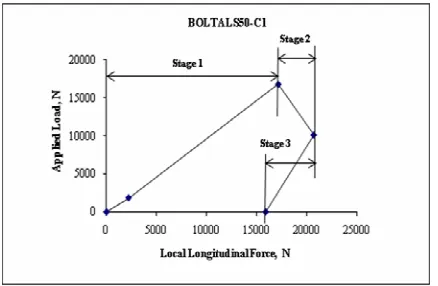
used as a standard benchmark to evaluate the balancing between both sides of the specimen in terms of load transfer from the applied hydraulic load. The results show that the different strain readings between each pair (i.e. reading of strain gauges at the same location, for example SG2A and SG2B etc.) for BOLTALS50-C1 ranged from 0.5% to 30% for the three loading stages and 3% to 85% for low load level condition. The same results were also recorded by BOLTALS50-C2 where the readings ranged from 0 to 20% for the three last stages and 20 to 85% for low load level condition. Finally, BOLTALS50-C3 showed a larger difference between those two specimens whereby the difference ranged from 20% to 125% for the last three stages and 7% to 19% for low load level condition. It could be said that at low to higher load levels the rig-specimen slowly adjusted their loading condition until they reached the final state of equilibrium. In the final stage, it could be seen that strain readings dropped to the final value (i.e. less than the value just after locking) just after the applied hydraulic load had been released (i.e. load equal to zero). The rate of strains decreased along the bonded length in linear mode. The reduction was due to the loss of support provided by the hydraulic jack used during pre-stressing. Therefore, it could be seen that the rig worked successfully as designed and capable of sustaining the stressed load imposed to the specimen.
During the performance observation in the laboratory environment for 45 days it can be seen that the CFRP plates strain readings were almost constant after reaching their full statics equilibrium (Figure 16) just about after two weeks time period. The laboratory room temperature and humidity parameters had not significantly affect the stressed conditions due to very small fluctuation of the overall strain readings during the monitoring periods. Finally, the rig-specimen was exposed to outdoor condition for the period of six months. During the exposure period, the rig-specimen performance was regularly monitored through strain reading measured at CFRP plate and concrete.
Jurnal Mekanikal, June 2009
Figure 14: CFRP plate strain along the bond length at various load levels during pre-stressing.
0 500 1000 1500 2000 2500
SG01 SG02 SG03 SG04 SG01 SG02 SG03 SG04 SG01 SG02 SG03 SG04 SG01 SG02 SG03 SG04
S
tr
a
in
(
µεµεµεµε
)
SGA
SGB
Low Applied Load Maximum Applied Load Just Before Applied
Load Released
Just After Applied Load Released
Figure 15: Strain readings between Side A and Side B for CFRP Plate after applied load released.
Jurnal Mekanikal, June 2009
5.0 CONCLUSIONS
The first design and fabricated load sustainability test rig was successfully produced. The rig successfully produced pull-push loading configuration on the CFRP plate-concrete prism adhesive bonded specimen. The rig was capable of transferring the load-stresses onto the specimen and sustained the load up to 50% to 65% of the control specimen ultimate failure load. The reliability of the rig was technically proven during the observation periods under laboratory condition.
ACKNOWLEDGEMENT
The authors wish to thank Ministry of Science and Technology of Malaysia for funded the research project and UTM Research Management Centre (RMC) for managed the research activities under Vote 74180. The authors also wish to acknowledge the assistance of Mr. Rizal Khaus (Materials and Structural Laboratory, Faculty of Mechanical Engineering, UTM) for his technical support in rig prototype development and testing.
REFERENCES
1. Macdonald, M. D., and Calder, A. J. J., 1982. Bonded Steel Plating for
Strengthening Concrete Structures, International Journal of Adhesion and
Adhesive, Vol. 2, No. 2, pp. 119-127.
2. Swamy R.N., Jones R, and Charif A., 1986. Shear Adhesion Properties of
Epoxy Resin Adhesives, Proceedings of International Symposium on
Adhesion Between Polymers and Concrete, pp. 741-755.
3. Calder, A.J.J., 1979. Exposure Tests on Externally Reinforced Concrete
Beams – First Two Years. Transport and Road Research Laboratory,
Supplementary Report 529, Berkshire, UK: Crowthrone.
4. Calder, A.J.J., 1982 The Microstructure of Epoxy Bonded Steel-to-Concrete
Joints. Transport and Road Research Laboratory, Supplementary Report
705, Berkshire, UK: Crowthrone.
5. Calder, A.J.J.,1988 Exposure Tests on Externally Reinforced Concrete
Beams–Performance after 10 Years. Transport and Road Research
Laboratory, Supplementary Report 129, Berkshire, UK: Crowthrone.
6. Calder, A.J.J.,1989 Exposure Tests on 3.5m Externally Reinforced Concrete
Beams The First 8 Years, Transport and Road Research Laboratory,
Supplementary Report191, Berkshire, UK: Crowthrone.
7. Calder, A.J.J.,1990 Durability of Steel Plates Bonded to Concrete with
Structural Epoxy Adhesive International Seminar on Structural Repairs
Strengthening by the Plate Bonding Technique, University of Sheffield,
SIRIUS.
8. Swamy, R.N, Hobbs, B. and Roberts, M.,1995 Structural Behaviour of
Externally Bonded Steel Plated RC Beams after Long-Term Exposure.
Jurnal Mekanikal, June 2009
9. Nakaba, K, Kanakubo, T., Furuta T. and Yoshizawa H.,2001. Bond
Behaviour between Fibre-Reinforced Polymer Laminates and Concrete. ACI
Structural Journal, pp. 359-367.
10. Mukhopadhyaya, P, Swamy, R.N., and Lynsdale C.J.,1998 Influence of
Aggressive Exposure Conditions on the Behaviour of Adhesive Bonded Concrete – GFRP Joints, Journal of Construction and Building Materials 12, pp. 427-446.
11. Maeda T., Asano Y., Sato Y., Ueda T. and Kakuta Y.,1997 A Study on
Bond Mechanism of Carbon Fiber Sheet, Non-Metallic (FRP) Reinforcement for Concrete Structure, Proceeding of the Third
International Symposium, Vol.1, pp. 279-286.
12. Brosens, K and Van Gemert, D., 1997 Anchoring Stresses Between
Concrete and Carbon Fibre Reinforced Laminates, Non-Metallic (FRP) Reinforcement for Concrete Structures, Proceeding for Third International
Symposium, Vol. 1, pp. 271-278.
13. Horiguchi, T. and Saeki, N.,1997 The Effect of Test Methods and Quality of
Concrete on Bond Strength of CFRP Sheet, Proceeding of Non-metallic
FRP Reinforcement for Concrete Structure, pp. 265-274.
14. Toutanji, H. and Ortiz, G.,2001 The Effect of Surface Preparation on the
Bond Interface between FRP Sheets and Concrete Members, Journal of
Composite Structures, pp. 457-462.
15. Abdul Rahman M. S. and Shukur, A. H. 2005 Fibre Reinforced Polymer
Composites in Construction”, National Civil Engineering Conference 2005
(NACEC2005), KUITTHO, Johor.
16. Hodgkinson, J.M. Mechanical Testing of Advanced Fibre Composites.
Woodhead Publishing Limited, Cambridge England, 2000 pp. 121.
17. Shukur, A. H., Abdul Rahman, M. S. and Yob, S.I. 2002 Tensile Behaviour
of CFRP and GFRP Reinforcements. Research Seminar on Materials and
Construction, UTM, Malaysia.
18. Hojo, M., Sawada, Y. and Miyairi, H, 1994 Influence of Clamping Method
on Tensile Properties of Unidirectional CFRP in 0º and 90º Directions – Round Robin Activity for International Standardization in Japan, Journal of
Composites, Vol. 8, No. 1-4.
19. Shukur, A.H., Abdul Rahman, M. S. and Yob Saed, I., 2003 Bond
Behaviour of CRFP Plate Bonded of Concrete. Malaysia Science and
Technology Congress.
20. Shukur, A. H., 2007 Mechanical Performance of Carbon Fibre Reinforced
Vinyl Ester Composite Plate Bonded Concrete Exposed to Tropical Climate,
PhD Thesis, UTM.
21. Shigley, J.E., Mischke, C.R. and Budynas, R.G., 2003 Mechanical
Engineering Design. 7th edition, pp. 24.
22. Juvinall, R.C. and Marshek, K.M., 1991 Fundamental of Machine
Components Design. Second Edition, John Wiley & Sons, pp. 190.
23. Swanson, R.S.,1997 Introduction to Design and Analysis with Advanced
Composite Material. Prentice-Hall International, Inc.
24. Clarke John L., 1996 Structural Design of Polymer Composites: Eurocomp
Jurnal Mekanikal, June 2009
25. Tokyo Sokki Kenkyujo Co., Ltd: 2003 TML Strain Gauge Test Data.