Detection of Normal and Abnormal
Condition for Disability Peoples by Using
Mind Wave Reading System
P.Saranya1, S.Selvaraju2, C.Arunkumar Madhuvappan3, Dr.T.Muthumanickam4
II year M.E.(EST), VMKVEC, Salem, India1
Associate Professor, Dept of ECE, VMKVEC, Salem, India2
Assistant Professor, Dept of ECE, VMKVEC, Salem, India3
Professor & Head, Dept of ECE, VMKVEC, Salem, India4
ABSTRACT: The purpose of this project is to enable people to communicate that don't have the use of their limbs,
and don't have the ability to vocalize speech. With all of the recent attention on ALS (Lou Gehrig's disease), this project is an answer to an internal challenge to provide something with the potential to help existing and future ALS patients, as well as other people with disabilities that don't have enough manual dexterity for touch-based apps and they also don't have the ability to vocalize. Other systems that use eye-tracking are very costly by comparison to the combination of this app and an affordable NeuroSky Mind Wave Mobile headset .
KEYWORDS: NeuroSky Mind Wave Mobile headset, Bio-signal computer command; mind-reading device
I. INTRODUCTION
ISSN(Online): 2320-9801
ISSN (Print) : 2320-9798
I
nternational
J
ournal of
I
nnovative
R
esearch in
C
omputer
and
C
ommunication
E
ngineering
(An ISO 3297: 2007 Certified Organization)
Vol. 4, Issue 7, July 2016
LITERATURE SURVEY:
Mind-Reading System - A Cutting-Edge Technology”, by Farhad Shir, Ph.D, McGinn IP Law, PLLC ,Vienna,
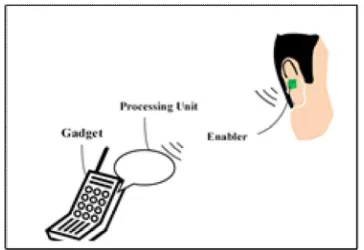
Virginia U.S.A, In this paper, we describe a human-computer interface (HCI) system that includes an enabler for controlling gadgets
based on signal analysis of brain activities transmitted from the enabler to the gadgets. The enabler is insertable in a user’s ear and includes a recorder that records brain signals. A processing unit of the system, which is inserted in a gadget, commands the gadget based on decoding the recorded brain signals. The proposed device and system could facilitate a brain machine interface to control the gadget from electroencephalography signals in the user’s brain. Wolpaw, J. R., Birbaumer N., McFarland, D. J., Pfurtscheller, G., Vaughan, T. M., (“Brain-computer interfaces for communication and control. Clinical Neurophysiology”), Vol.113, pp.767-791. Jun.2002.
This paper addresses the current technologies in mind-reading systems, the deficiencies and limits of the existing technologies, along with possible solutions to have a practical device for brain-computer interaction, and the future plans to achieve such cutting-edge technology.
II. ARCHITECTURE OF MIND READING SYSTEM
A transmitting device installed in the enabler produces a radio frequency signal corresponding to voltages sensed by the recorder and transmits the radio frequency signal by radio frequency telemetry through a transmitting antenna. The transmitting device could include the transmitting antenna, a transmitter, an amplifying device, a controller, and a power supply unit, such as a battery. The amplifying device could include an input amplifier and a bandpass filter. The amplifying device receives an electrode signal from the recorder.
Fig.1 TRANSMITTER NODE
Fig.2 RECEIVER NODE
III. FUTURE PLANS, LIMITATIONS
The electrode signal is a response to changes in the brain electrical activities of the user. The input amplifier could provide an initial gain to the electrode signal, and the bandpass filter could provide an additional gain to the electrode signal resulting in an output signal with an overall gain of much higher than the electrode signal. The controller is electrically connected to the bandpass filter. The output signal from the bandpass filter is inputted to the controller.
Fig. 3. Mind-reading enabler communicating with a processing unit of a gadget
ISSN(Online): 2320-9801
ISSN (Print) : 2320-9798
I
nternational
J
ournal of
I
nnovative
R
esearch in
C
omputer
and
C
ommunication
E
ngineering
(An ISO 3297: 2007 Certified Organization)
Vol. 4, Issue 7, July 2016
Fig .4 Brainwave Visualizer .
The decoder decodes the data output using a common algorithm such as pattern classifier. By evaluating frequencies in a wide range from theta to gamma brain signals recorded by the recorder, complex cognitive signals are decodable and are used for controlling the gadget.
.
IV. RESULTS AND DISCUSSION
EEG under general anesthesia depends on the type of anesthetic employed. With halogenated anesthetics, such as halothane or intravenous agents, such as protocol, a rapid (alpha or low beta), nonreactive EEG pattern is seen over most of the scalp, especially anteriorly; in some older terminology this was known as a WAR (widespread anterior rapid) pattern, contrasted with a WAIS (widespread slow) pattern associated with high doses of opiates. Anesthetic effects on EEG signals are beginning to be understood at the level of drug actions on different kinds of synapses and the circuits that allow synchronized neuronal activity.
Wave patterns
ALPHA WAVES:
Fig.5 Alpha waves
In addition to the posterior basic rhythm, there are other normal alpha rhythms such as the mu rhythm (alpha activity in the contralateral sensory and motor cortical areas that emerges when the hands and arms are idle; and the "third rhythm" (alpha activity in the temporal or frontal lobes). Alpha can be abnormal; for example, an EEG that has diffuse alpha occurring in coma and is not responsive to external stimuli is referred to as "alpha coma".
BETA WAVES:
Beta is the frequency range from 12 Hz to about 30 Hz. It is seen usually on both sides in symmetrical distribution and is most evident frontally. Beta activity is closely linked to motor behavior and is generally attenuated during active movements. Low amplitude beta with multiple and varying frequencies is often associated with active, busy or anxious thinking and active concentration. Rhythmic beta with a dominant set of frequencies is associated with various pathologies and drug effects, especially benzodiazepines. It may be absent or reduced in areas of cortical damage. It is the dominant rhythm in patients who are alert or anxious or who have their eyes open.
Fig.6 Beta waves
GAMMA WAVES:
Fig.8 Gamma wave is the frequency range approximately 30–100 Hz. Gamma rhythms are thought to represent binding of different populations of neurons together into a network for the purpose of carrying out a certain cognitive or motor function.
ISSN(Online): 2320-9801
ISSN (Print) : 2320-9798
I
nternational
J
ournal of
I
nnovative
R
esearch in
C
omputer
and
C
ommunication
E
ngineering
(An ISO 3297: 2007 Certified Organization)
Vol. 4, Issue 7, July 2016
and in general distribution with diffuse lesions, metabolic encephalopathy hydrocephalus or deep midline lesions. It is usually most prominent frontally in adults (e.g. FIRDA - Frontal Intermittent Rhythmic Delta) and posteriorly in children (e.g. OIRDA - Occipital Intermittent Rhythmic Delta).
Fig.8 Delta waves
THETA WAVES:
Theta is the frequency range from 4 Hz to 7 Hz.Fig.9. Theta is seen normally in young children. It may be seen in drowsiness or arousal in older children and adults; it can also be seen in meditation. Excess theta for age represents abnormal activity. It can be seen as a focal disturbance in focal subcortical lesions; it can be seen in generalized distribution in diffuse disorder or metabolic encephalopathy or deep midline disorders or some instances of hydrocephalus. On the contrary this range has been associated with reports of relaxed, meditative, and creative states.
Fig.9 Theta waves
V. CONCLUSIONS
In conclusion, although considerable, rigorous research now demonstrates the potential deleterious effects of negative affective states and stress during pregnancy on birth outcomes, fetal and infant development, and family health, we do not yet have a clear grasp on the specific implications of these facts. Key issues for the next wave of research are as follows: disentangling the independent and comorbid effects of depressive symptoms, anxiety symptoms, pregnancy anxiety, and various forms of stress on maternal and infant outcomes; better understanding the concept of pregnancy anxiety and how to address it clinically; A processing unit of the system commands the device based on decoding the recorded brain signals. The proposed enabler could provide a compact, convenient, and hands-free device to facilitate a brain-machine interface to control the gadget from electroencephalography signals in the user’s brain.
REFERENCES
[1]Vaughan, T. M., Heetderks, W. J., Trejo, L. J., Rymer , W. Z., Weinrich, M., Moore, M. M., Kübler, A., Dobkin, B. H., Birbaumer, N., Donchin, E., Wolpaw, E. W., Wolpaw, J. R,(“ Brain-Computer Interface Technology: A Review of the Second International Meeting. IEEE Transactions on Neural Systems and Rehabilitation Engineering”),vol.11, pp.94-109,Jun.2003.
[2]Wolpaw, J. R., Birbaumer N., McFarland, D. J., Pfurtscheller, G., Vaughan, T. M.,(“ Brain-computer interfaces for communication and control. Clinical Neurophysiology”),vol.113 , pp.767-791. Jun.2002
[4]Molina, G., Nelson G., Bruekers, A., Damstra, M., Weda, J., (“Relating to computer brain interfaces, U.S. Patent Application Publication”) No. 2011/0238685, September 29, 2011.
[5]Liao, X., Yao, D., Li, C.,(“ Transductive SVM for reducing the training effort in BCI. Journal of Neural Engineering”), vol.4 pp. 246-254,Dec.2007.
[6]Tan, D., Saponas, T., Morris, D., Turner, J.,(“ Wearable electromyography-based for human-computer interface, U.S. Patent Application”), Publication No. 2009/0326406, December 31, 2009.
[7]Zimmerman, A. W., Pepper, B. T., Blankenship, D. V.,(“ Electroencephalograph incorporating at least one wireless link”), U.S. Patent No. 5,279,305, January 18, 1994.
[8]Schuette, F. M., Junker, A.,(“ Method and apparatus for using biopotentials for simultaneous multiple control functions in computer systems”), U.S. Patent Application Publication No. 2011/0301488, December 8, 2011