CALIBRATION OF A DIGITAL CAMERA FOR CLOSE-RANGE PHOTOGRAMMETRY APPLICATION
Nor Azira Alias, Halim Setan & Zulkepli Majid Department of Geomatics Engineering, Faculty of Geoinformation Science and Engineering, Universiti Teknologi Malaysia (UTM) Skudai, Malaysia
e-mail:
[email protected] [email protected] [email protected]
Tel: + 6075530801 Fax: +6075566163
Abstract
Lately, close-range photogrammetry became more popular to model any objects in varies field. With the advent of powerful computers and cheap optical devices, photogrammetric methods are now being implemented in several aspects of medicine. The body shape measurement such as craniofacial mapping is included of close-range photogrammetry applications. Compared with other technique like laser scanning, digital close-range photogrammetry is more cost-effective, flexible and easy to use. Integrated with new commercial three-dimensional (3D) modeling and measurement software such as PhotoModeler Scanner that can be used with many digital cameras, it was very effective technique. However, to give high-accuracy results, the cameras must be calibrated to determine parameter of the camera that will be used. The paper presents the camera calibration (Sony DSC-F828 digital camera) using the new 3D software, PhotoModeler Scanner and the results will be compared with the Australis 6.0 software.
Keywords: Close-range photogrammetry, 3D Modeling and Measurement software, Camera Calibration
1.0 INTRODUCTION
Photogrammetry (the art, science, and technology of obtaining reliable information from photographic images) has traditionally utilized commercial, large-format, aerial photography. This technology can be used to measure, document, or monitor almost anything that is visible within a photograph. According to Karrara (1989), photogrammetry can be defined as method used to get quantitative information about physical object and conditions through measurement, recording and images described. The photogrammetry also can be divided into a few categories, depending on the distance of the camera from the subject. Two techniques of photogrammetry that depending on the lens-setting (distance) of the camera are far range photogrammetry (with camera distance setting to indefinite) and close-range photogrammetry (with camera distance to finite values).
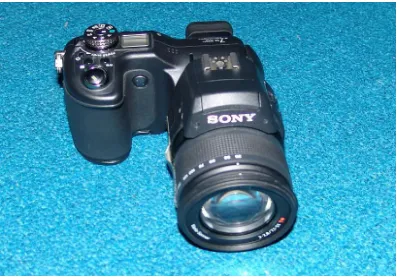
the object itself (Cooper & Robson, 1996). In this study, Sony DSC-F828 digital camera was chosen to do the calibration process. It was categorized as amateur camera which also known as non-metric camera. Commonly, amateur camera is suitable for many purposes such as artifact photogrammetry, architecture photogrammetry, accident reconstruction, forensic photogrammetry and 3D visualization applications. In this study, the commercial software was using to calibrate the Sony DSC-F828 digital camera that
2.0 CAMERA CALIBRATION
In photogrammetry, the camera calibration is the important issue because before started to take any image using digital cameras, the calibration process must be completed. It is important because to avoid the images taken from all systematic errors in measurement. In order to achieve such measurement resolution, the camera should be in good quality conditions such as the calibration and orientation. The calibration process was implemented to determine two basically things that is interior orientation elements and lens distortion parameters. The interior orientations of a camera indicate the focal length and image co-ordinates of the principle point of the photograph. For the self-calibration requirements, the digital camera needs to roll by 900 (at least once but more is better). The minimum is six photographs and the maximum is twelve photographs should be taken from different locations. Others are to process the data, at least twenty well-distributed points were needed in the entire measurement but the more is better.
Different camera models have been formulated and used in close-range photogrammetry, but generally sensor orientation and calibration is performed with a perspective geometrical model by means of the bundle adjustment (Brown, 1971). A more specific classification can be made according to the parameter estimation and optimization technique employed. There have a combination of linear and non-linear techniques where a linear method is employed to recover initial approximations for the parameters, after which the orientation and calibration are iteratively refined (Tsai, 1987; Weng et al., 1992).
3.0
METHODS
Figure 1:
Methods
3.1 DATA COLLECTING
Data collecting with different methods was carried out using control photogrammetric frame and calibration grid and 6 images acquired with a Sony DSC-F828 digital camera (8 Mega Pixel) at an image resolution of 3264 X 2448 pixels. The focal length was fixed at minimum zoom (widest angle) and the network included two images with ±90 roll angles.
Figure 2:
Sony DSC-F828 digital camera
Data Collecting
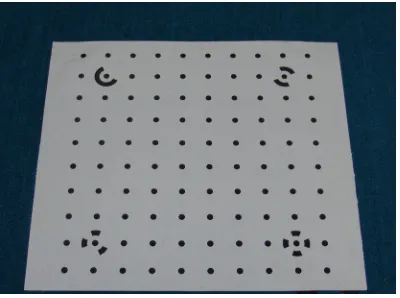
Images of control photogrammetric frame Images of calibration grid
Data Processing PhotoModeler Scanner
Software
Australis 6.0 software
A control photogrammetric frame with 49 retro-reflective targets and known coordinates is placed on a floor covering the field of view of the camera suitable for Sony DSC-F828 digital camera. This array need only remain stable for as long as it takes to capture the images. A convergent network of six images incorporating orthogonal roll angle diversity is then captured from a set-back distance of less than 1 meter (effectively infinity focus on the DSC-F828 which is zoomed to either shortest or to its longest principal distance setting).
Figure 3:
Control Photogrammetric Frame with Scale Bar
The calibration grid was placed on the floor and the grid affix to the floor or smooth surface so that the grid does not move between shots. Then camera positions during the image capturing were close to 45 degrees from the horizontal and vertical as needed. At least two photos with roll angles of 90 degrees (portrait orientation). The photographs should have good focus across the pattern (a small amount of blur due to insufficient depth of field is acceptable) and taken with the same setting. Six photographs were captured for one set of data and five set were acquired in this study. The digital camera was focused at the distance that will be used for most measurement projects.
3.2
DATA PROCESSING
The data processing was carried out using the commercialize software that involved in this study is PhotoModeler Scanner and Australis 6.0. It was bundle adjustment and camera self-calibration software. The outcome of camera self-calibration processed were camera parameters that is focal length, principal point (Xp, Yp), radial distortions (K1, K2, K3) and decentering distortion (P1, P2) and also residuals (RMS).
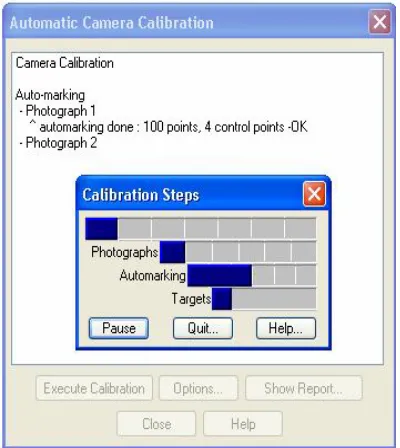
The camera calibration in PhotoModeler Scanner will run automatically (after all the appropriate photographs of the grid have been loaded) was carrying out with several steps during the processed. The steps were automatic target marking and identification of coded targets, estimation of the camera’s focal length, initial approximate orientation of all photographs that have sufficient marks, proceeded with camera calibration processing and automatic referencing (remaining marks should be correctly referenced). Finally processed was automatic deviation, correlation checks and processing parameter adjustment. After the calibration dialog was closed, the calibration will be completed and if it was successful and the images have sufficient EXIF data, it is prompted to add the camera to the Camera Library.
Figure 5: Automatic calibration process
targets and must be started with manual marking first. The manual marking only needed the targets that can be seen by user. In this study, manual targets marking were used.
Figure 6: Example of manual points marking in Australis 6.0
4.0 RESULTS AND ANALYSIS
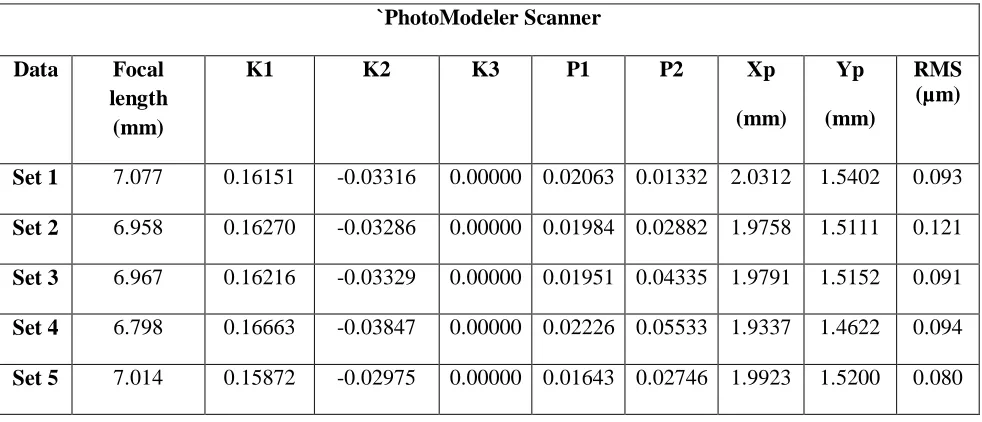
The table below shown the results of the camera calibration using PhotoModeler Scanner and Australis 6.0 software to process the images.
Table 1: Camera parameters results using PhotoModeler Scanner `PhotoModeler Scanner
Data Focal length
(mm)
K1 K2 K3 P1 P2 Xp
(mm)
Yp (mm)
RMS (µm)
Table 2: Camera Parameters results using Australis 6.0
Australis 6.0 Data Focal
length (mm)
K1 K2 K3 P1 P2 Xp Yp RMS
(µm)
Set 1 7.349 0.12395 0.01178 -0.00282 0.00357 0.01665 -0.0640 0.0155 0.38 Set 2 7.338 0.13502 -0.00741 0.00278 0.00134 0.01960 -0.0950 0.0005 0.34 Set 3 7.353 0.13421 -0.01355 0.00182 0.01558 0.01021 -0.0823 0.0002 0.35 Set 4 7.353 0.11678 0.00457 -0.00501 -0.01205 0.01288 -0.0580 0.0034 0.41 Set 5 7.358 0.14218 -0.01412 0.00317 0.00956 0.01012 -0.0800 0.0110 0.36
Figure 7: Graph shown the comparison of focal length
In Table 1 and 2 performed the results of the focal length and lens distortions parameters of the Sony DSC-F828 digital camera with that software. The comparison values of focal length between PhotoModeler Scanner and Australis is quite obvious. The resulting of focal length for overall images from set 1 to set 5 for the both software shown that the results of PhotoModeler Scanner is more nearest to the actual values of focal length, 7.1mm. The differential of PhotoModeler Scanner is between 0.022mm to 0.302mm compared with Australis 0.238mm to 0.258mm. From figure 7, it seen that Australis can give more consistent results of focal length than PhotoModeler Scanner. The comparison of radial (K1, K2 and K3) and decentering distortions (P1 and P2) shown that the values similar but slightly different. This is actually also due to the low redundancy of the camera system for the methods which, beside the focal length, also try to estimate the position of the principal point (Xp,Yp).
Differential of Focal Length
6.5 6.6 6.7 6.8 6.9 7 7.1 7.2 7.3 7.4
Set 1 Set 2 Set 3 Set 4 Set 5
Focal length
V
a
lu
e
s PhotoModeler Scanner
5.0 CONCLUSIONS
As use of consumer-grade cameras is becoming more and more common in photogrammetric applications, there is a requirement for adoption of appropriate calibration procedures. The self-calibrating bundle adjustment is a very flexible and powerful tool for camera calibration and systematic error compensation, and it provides for accurate sensor orientation and object reconstruction, while treating all the system unknowns as stochastic variables. Therefore, the effective and high-accuracy software should be used besides the self-calibration of digital camera to ensure that capable of achieving internal accuracies suitable for close-range photogrammetric applications. Compared with Australis 6.0, the PhotoModeler Scanner is more easy to use, flexible, fast processing and fully automatic marking software.
6.0 ACKNOWLEDGEMENT
The author would like to acknowledge financial assistance, Research Students Grant vote 79256.
REFERENCES
Brown, D.C., 1971: Close-range camera calibration. PE&RS, Vol. 37(8), pp.855-866
Cooper, M. A. R. & Robson, S. ( 1996 ). Introduction Dlm. Atkinson, K. B. ed. Close Range Photogrammetry and Machine Vision. Scotland: WhittlesPublishing Services. 9
Karara, H.M., ed (1989). Non-Topographic Photogrammetry. Fall Church, VA: American Society of Photogrammetry & Remote Sensing.
Tsai, R.Y., 1987: A versatile camera calibration technique for high-accuracy 3D machine vision metrology using off-the-shelf TV cameras and lenses. IEEE Int. Journal Robotics and Automation, Vol. 3(4), pp. 323-344