Impact
of Coordinator Mobility in a
Zigbee/IEEE 802.15.4 Based Wireless Personal
Area Network
Shallu Yadav1, Dr. Dinesh Chaudhary2
M. Tech. Student, Department of CSE, Shri Ram College of Engg. & Mgmt, Palwal, Haryana, India 1,
Assistant Professor, Department of CSE, Shri Ram College of Engg. & Mgmt, Palwal, Haryana, India2
ABSTRACT: A network which links a number of distributed low-power sensor nodes together, with every node devoted to a previously defined operation can be seen as a Wireless Sensor Network (WSN). The network must have the ability of collecting and transmitting the data created by end nodes effectively. The wide parts of Zigbee based LR-WPAN (Low Range-Wireless Personal Area Network) are- routers, coordinator and end devices. In this research paper the writers focussed on Zigbee based LR-WPAN and examined the impact of static and dynamic condition of Zigbee PAN Coordinator on the network performance. Here the evaluation is done on 3 topologies such as- mesh, star and tree with the support of Riverbed simulator. Writers advised that rather than building the dynamic end devices, the coordinator can move throughout the network region more easily, providing better performance of global network on static coordinator network with respect to end to end delay and throughput. For various configurations, different effects on network parameters are achieved. The primary objective of this work is to measure, by simulations, the impact of coordinator mobility in a ZigBee/IEEE 802.15.4 based wireless personal area network (PAN) and permit the people to form the network configuration as per the need and performance achieved here.
KEYWORDS: WSN, star, tree and mesh topologies, mobile coordinator, End to End delay, Throughput.
I. INTRODUCTION
Personal Area Networks (WPAN) standard with high level of simplicity and stability. However, 2.4GHz band, is also used by the other wireless standards. The coexistence of the devices has become an important issue that they can operate without interference on each other. Especially with IEEE802.11 stations, IEEE 802.15.4 stations may be really important if the similar carrier frequencies are chosen. This scenario will cause to a Physical Layer (PHY) timeout. The effect of other systems (microwave ovens or Bluetooth) on IEEE802.15.4 results in an elaborated packet error rate, since, the level of below 10 % is not significant [2]. It indicates that the ZigBee interference has more impact on the IEEE 802.11g uplink as compared to the downlink. Moreover, the results show how IEEE 802.11g has greater impact by Bluetooth as compared to Zig Bee and how IEEE 802.11g affects the Zig Bee performance when the selected channels spectrum of operation co-inside [3].
Figure 1: Zigbee Communication
IEEE802.11 standard utilizes Carrier Sense Multiple Access with Collision Avoidance (CSMA/CA) medium access method which provides support to the three configurations. The media access is depending on contention; since, employing the optional super frame structure, time slots can be assigned by the coordinator to devices with time based data. ZigBee coordinator can offer link to the other networks. [4].
power. Zigbee is normally utilized for control and monitoring while Bluetooth is all about link between laptops, PDA‘s, and other such devices. [9].
II. ZIGBEE-802.15.4- OVERVIEW
The development in wireless technology has lead to a growth of many standards particularly in the ISM radio band with frequencies: 868 MHz, 915 MHz and 2.4 GHz. The 868 MHz frequency band is employed primarily in Europe, the 915 MHz primarily in North America while the 2.4 GHz is employed throughout the world. There was often a requirement for a standard communication between sensors with low power consumption and low data rate. As a solution to this difficulty, several companies formed an alliance to produce a standard which could be accepted throughout the world. It was the Zigbee Alliance which produced Zigbee. [11] ZigBeeis a specification depending on IEEE 802.15-2006 standard employed for high level communication protocols, building a personal area networks from small and low-powered digital radio system. ZigBee‟s are able of propagating data over long distances by travelling data through intermediary devices, arriving more distant ones, hence building a network. The main elements of a Zigbee network are- routers, PAN coordinator, and end devices. All these components can be assembled to work with various applications as large as 124 at the same time. ZigBee‟s are used in applications which need a longer battery
life, lower data rate and protected networking. It has a defined 250kb/s data rate. The technologies explained in the ZigBee specification are planned to be simpler and less costly as compared to other (WPANs) technology.[6] ZigBee comprises of four layers. The top two (Application and Network & security) layers specifications are offered by the ZigBee Alliance to offer manufacturing standards. The bottom two (PHY and MAC) layers specifications are offered by the IEEE 802.15.4-2006 standard to assure availability without interference with other wireless protocols i.e. Wi-Fi. [12]
2.1 Zigbee Stack Protocol
Figure 2: Zigbee Stack Protocol Layers [1]
2.1.1 Physical Layer
2.1.2 MAC layer-
The transmission Channel is obtained mainly by Carrier Sense Multiple Access- Collision Avoidance (CSMA-CA) protocol. The MAC layer can manage transmitting data. The MAC layer selects whether to employ unslotted or slotted CSMA-CA. It also manages the scanning of channel, starting PANs, discovering and resolving PAN ID issues, doing device discovery etc [12].In our scenarios we held channel sensing duration as 0.1 seconds for optimizing the consumption of power with acknowledgements enabled.
2.1.3 Network and Security layer-
The network layer manages device configuration, network startup, topology specific routing, and offering security. On every node, the network layer is the part of the stack that performs the route computations, neighboring node discovery and reception control. [12] In our work the route discovery time-out is held as 20 seconds, enough for network region of 100 meters coverage.
2.1.4 Application Support Sub Layer
It interfaces the application layer and network layer offering a basic set of facilities by two entities, APS Management Entity and the APS Data Entity. These offered facilities like group filtering, creating application level PDU, and maintaining Object database. [12]
III. ZIGBEE NETWORK TOPOLOGIES-OVERVIEW
3.1 Zigbee Network Devices:
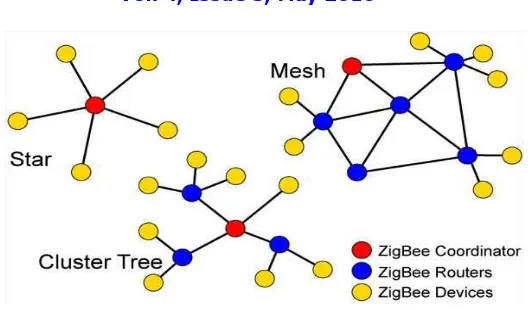
3.1.1 Zigbee Coordinator (ZC): It is very capable device which makes the root of the network tree and bridge to other networks. It gathers and collect the network information. A coordinator has the following features: It • permits end devices and routers to integrate the network • guides in data routing• cannot sleep- always on device.
3.1.2 Zigbee Router (ZR): A Zigbee Router can perform as an intermediary device, propagating on data from other devices and also running an application function.
3.1.3 Zigbee End devices (ZED): Its task is to intercommunicate with the parent node (either the router or Coordinator).It cannot pass data from other devices. This relationship permits the node to be sleep a essential amount of the time hence providing long battery life. A ZED needs the minimum amount of memory, and so it is less costly in comparison of ZR or ZC.
3.2 Zigbee Network Topologies:
3.2.1 Star Topology: In star topology, a coordinator is the parent node and all other nodes are directly linked to it. Each data interchange between 2 end devices must travel first through the coordinator. This configuration is very much prone to collapses since the complete network goes down if the parent node fails. Using routers is a waste of energy here as their work is never actually utilized. [13]
3.2.2 Tree Topology: In tree topology, the parent node would be the network root node with hierarchical body. There is a point to point link between any 2 nodes such as a single route is available for arriving a node. Because of the self maintained ability of dynamic routing used, in situation of collapses the backup would be made from the vicinity at that instant (if exists).[13]
Fig 3: Star, mesh and tree topologies
IV. SIMULATION TOOLS
4.1Wireshark: Wireshark [11], previously called Ethereal, is a free and open-source and free packet analyser tool utilized for network troubleshooting and examine for Windows and Unix systems. It has been also utilized as a packet sniffing application and utilizes the pcap library to catch packets. It draws network data utilizing a libpcap file format supported by WinPcap and libpcap, so it can exchange caught network traces with other applications that utilize the similar format, involving tcpdump. Wireshark is a tool that realizes the structure of several networking protocols and thus can analyze the fields, along with their meaning as defined by several networking protocols. Apart from catching live traffic, it can also read several different capture file formats. This tool was very important for us in examining the raw network data such as tcpdump file and realizing the network data, which also permits several filtering options for network data visualization.
4.2 WEKA: WEKA [13] is a tool which composed of no. of machine learning algorithms for data mining tasks i.e. classification, data preprocessing, regression, clustering, association rule mining along with data visualization services. It is freely existed for downloading and can be utilized for academic aim. We have utilized this for computing ‘Gain Ratio’ and ‘Information Gain’.
4.3 MATLAB: Matlab [14] is a tool utilized for numerical calculation, programming and visualization. It offers an easy platform to code and examine data along with in-built functions to conduct clustering, classification and visualization tasks. It can be also utilized with other programming languages i.e. java, C/C++ and Python. It has a rich set of toolkits which are easy to utilize and helps to decrease the time and enhance the work efficiency. We have utilized MATLAB for the aim of our main processing which involves performing clustering and classifying the general patterns utilizing one-class SVM.
4.4 jNetPcap: jNetPcap [16] is an open-source java library which consists java wrapper for closely all libpcap library native calls. jNetPcap utilizes a mixture of java and native implementation for optimal packet decoding performance. It supports to decode caught packets in real-time and offers a huge library of network protocols. It offers a framework for the subscribers to easily add their own protocol definitions utilizing java SDK. We have employed this library for the TCP headers information extraction.
4.5 LIBSVM: LIBSVM [12] is a library for Support Vector Machines. It provides support to regression (epsilon-SVR, nu-SVR), vector classification (C-SVC, nu-SVC) and distribution estimation (one-class SVM). It also provides multi-class categorization. LIBSVM offers a simple interface which subscribers can easily utilize to connect it with their own programs. We have utilized this tool for the aim of utilizing one-class SVM in Matlab. The primary characteristics of LIBSVM are:
Deals with several SVM formulations
permits effective multi-class classification
Can perform cross validation for model selection
permits probability estimation
Easy usage of several kernels (involving pre calculated kernel matrix)
permits to use weighted SVM for unbalanced data
offers a simple GUI establishing SVM regression and classification
offers extension to tools like R, Python, Perl, MATLAB, Weka, Ruby.
V. SIMULATION SCENARIOS FOR CAMPUS ENVIRONMENT
Riverbed is robust tool employed to simulate and model sensor networks. The latest version provides support to heterogeneous networks simulation which can be employed in many communications protocols. Riverbed provides support to network simulation at packet-level to examine static, mobile and satellite networks. The Riverbed modeled environment favors the Zigbee based sensor networks simulation by offering three elements. We have considered a campus having dimensions of 100m x 100m. The simulation results are then modeled. This practical environment can be employed to connect various Departments i.e. in Schools, Hospitals and College etc. Take a College consisting six departments and every department is linked to central coordinator. These departments are connected with 3 different network configurations namely mesh, star and tree topology. Efficiency of every network is measured. We have taken mobile Zigbee coordinators in the second scenario. These mobile coordinators are very important for an industry run application process or may be in field to keep track of enemies. We are taking two scenarios in account. First, writers are doing the comparison of the three possible topologies (Star, Mesh and Tree topology) to each other utilizing six
ZigBee routers (ZR), only one ZigBee Coordinator (ZC), and six ZigBee End devices (ZED) in every configuration. This comparison involves global throughput and end-to-end delay. For the second scenario, we are considering the same three configurations and similar Zigbee devices but ZC as mobile that shown in figure 3, 4 and 5.
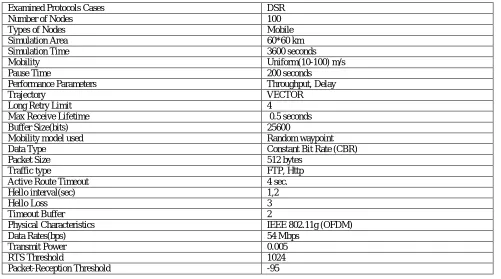
Table 4: Simulation Parameters
Examined Protocols Cases DSR
Number of Nodes 100
Types of Nodes Mobile
Simulation Area 60*60 km
Simulation Time 3600 seconds
Mobility Uniform(10-100) m/s
Pause Time 200 seconds
Performance Parameters Throughput, Delay
Trajectory VECTOR
Long Retry Limit 4
Max Receive Lifetime 0.5 seconds Buffer Size(bits) 25600
Mobility model used Random waypoint
Data Type Constant Bit Rate (CBR)
Packet Size 512 bytes
Traffic type FTP, Http
Active Route Timeout 4 sec.
Hello interval(sec) 1,2
Hello Loss 3
Timeout Buffer 2
Physical Characteristics IEEE 802.11g (OFDM) Data Rates(bps) 54 Mbps
Fig-3 Dynamic Zigbee Coordinator-Star Topology
Figure 5: Dynamic Zigbee Coordinator-Tree Topology
VI. SIMULATION RESULTS
We have taken end to end delay and Throughput as the primary parameters for efficiency comparison between Mesh, Star and Tree topologies.
6.1 Throughput: The Network throughput is the rate of successful message delivery throughout a communication channel. This data may be arrived over a logical or physical connection, or pass through a particular network node. It is often evaluated in bits per second, bit/s or bps.
6.1.1 Throughput: Static Zigbee Coordinator: For ZC as Static, throughput is high in the case of Tree Topology with mean value of 35000bits/s that shown in figure 6. In the case of Star and Mesh Topology with mean value of 30000bits/s, 28000 bits/sec that shown in figure 6.
Figure 6: Throughput of Static Zigbee Coordinator
6.1.2 Throughput: Dynamic Zigbee Coordinator
For ZC as Dynamic, the performance of Tree topology is better in comparison of Static ZC with throughput little greater than the earlier by 35000 bits/s and the case of Star and Mesh Topology with mean value of 30000bits/s, 25000 bits/sec that shown in figure 7.
0 5000 10000 15000 20000 25000 30000 35000 40000
15 min 30 min. 45 Min. 60 min.
Star
Mesh
Figure 7: Throughput of Dynamic Zigbee Coordinator
6.2 End To End Delay:
End-to-end delay means the time taken for a packet to arrive from source node to destination node in a network.
6.2.1 Static Zigbee Coordinator end to end delay: ZC as Static Mesh topology is having minimum End to End delay of 0.0132s that shown in figure 8. In the case of Star and Mesh Topology with mean value of 0.015 seconds, 0.0181 seconds that shown in figure 8.
Figure 8: Delay of Static Zigbee Coordinator
6.2.2 Dynamic Zigbee Coordinator End to End delay: ZC as Dynamic, Mesh topology is having minimum End to End delay and has good performance in comparison of Static ZC.
0 5000 10000 15000 20000 25000 30000 35000 40000
15 min 30 min. 45 Min. 60 min.
Star
Mesh
Tree
0 0.002 0.004 0.006 0.008 0.01 0.012 0.014 0.016 0.018 0.02
15 min 30 min. 45 Min. 60 min.
Star
Mesh
Figure 9: Delay of Dynamic Zigbee Coordinator
VI. CONCLUSION
In this research paper we have studied various analysis for obtaining optimal throughput and end to end delay for smart campus for Zigbee. By creating the coordinator as dynamic in Zigbee based LR-WPAN, throughput of tree topology enhances substantially in comparison of star and mesh topologies. Our Riverbed simulator results show that by utilizing dynamic coordinator least end-to-end delay is obtained. In dynamic, coordinator end to end delay decreases in comparison of static, therefore when end to end delay decreases automatically energy consumption also decreases. We can say that our analysis obtained good performance with respect to end to end delay and throughput for dynamic tree topology in comparison of any other. This work can be continued further for large scale WSNs.
REFERENCES
[1] ZigBee Alliance. ZigBee Overview. September 2003.
[2] A. Sikora and V. F. Groza, ”Coexistence of IEEE802.15.4 with other Systems in the 2.4GHz-ISM-Band”, in IEEE Instrument and Measurement Technology Conference, vol. 3, pp. 1786-1791, May 2005.
[3] K. Shuaib, M. Boulmalf, F. Sallabi and A. Lakas, “Co-existence of ZigBee and WLAN”, A Performance Study, ‖ Wireless Telecommunications Symposium, WTS '06, pp. 1 – 6, 2006
[4] T. Sawamura, K. Tanaka, M. Atajanov, N. Matsumoto, and N. Yoshida, “Adaptive router promotion and group forming in ad-hoc networks, “in Proceedings of International Journal of Ad Hoc and Ubiquitous Computing, Vol. 3, pp. 217-223,2008.
[5]http://www.QUALNET.com/solutions/network_rd/modeler.html
[6] Jorjeta G. Jetcheva, Yih-Chun Hu, Amit Kumar Saha, and David B. Johnson. “Design and Evaluation of a Metropolitan Area Multitier WirelessAd Hoc Network Architecture in Wireless Sensor Networks” In Proceedings of the Fifth IEEE Workshop on Mobile Computing Systems & Applications,Monterey, CA, pp 32-37,2004
[7] Patrick Kinney, ―ZigBee Technology: Wireless Control that Simply Works‖, Communications Design Conference, 2 October 2003
[8] ZigBee Alliance .ZigBee Specification. December 14th, 2004 [9] http://www.mobilenetx.com/zigbee-vs-bluetooth
[10] Jun Huang1; Guoliang Xing1; Gang Zhou2; Ruogu Zhou1, ―Beyond Co-existence: Exploiting WiFi White Space for ZigBee Performance
Assurance‖ IEEE ICNP, Kyoto, Japan, 2010
[11] I. S. Hammoodi, B. G. Stewart, A. Kocian1, S. G. McMeekin, “A Comprehensive Performance Study of QUALNET Modeler For ZigBee Wireless Sensor Networks,” Third International Conference on Next Generation Mobile Applications, Services and Technologies, pp, 35-40, 2006. [12] Mathioudakis, I et al, “Wireless Sensor Networks: A case study for Energy Efficient Environmental Monitoring", Proceedings of Eurosensors conference, Dresden, Germany, September 2008.
[13] Sokullu, R.; Donertas, C, “Combined effects of mobility, congestion and contention on network performance for IEEE 802.15.4 based networks”, Computer and Information Sciences, 2008. ISCIS '08. 23rd International Symposium on, Vol 3, pp. 1-5, 2008
[14] Harsh Dhaka, Atishay Jain, Karun Verma, “Impact of Coordinator Mobility on the throughput in a ZigBee Mesh Networks”, 2010 IEEE 2nd International Advance Computing Conference, Thapar University, Patiala
[15] Petr Jur_ík, Anis Koubaa, Mário Alves, Eduardo Tovar, Zden_k Hanzálek, “A Simulation Model for the IEEE 802.15.4 Protocol: Delay/Throughput Evaluation of the GTS Mechanism”, pp 32-37.
[16] Mikko Kohvakka, Mauri Kuorilehto, Marko Hännikäinen, Timo D. Hämäläinen, ―Performance analysis of IEEE 802.15.4 and ZigBee for large-scale wireless sensor network applications,‖ Energy Efficient algorithms, pp. 48 – 57,2006
0 0.002 0.004 0.006 0.008 0.01 0.012 0.014 0.016 0.018
15 min 30 min. 45 Min. 60 min.
Star
Mesh
[17] Tseng Y.C., Y.S. Chen, and J.P. Sheu, "The broadcast storm problem in a mobile ad hoc network(ZIGBEE)," In Proceeding of the 5th ACM/IEEE International Conference on Mobile Computing and Networking, NY, USA, pp. 51-162, 2009.