Towards Optimal Leakage Exploitation Rate in
Template Attacks
Guangjun Fan1, Yongbin Zhou2, Hailong Zhang2, Dengguo Feng1
1 Trusted Computing and Information Assurance Laboratory,
Institute of Software, Chinese Academy of Sciences
[email protected],[email protected]
2
State Key Laboratory of Information Security,
Institute of Information Engineering, Chinese Academy of Sciences {zhouyongbin,zhanghailong}@iie.ac.cn
Abstract. Under the assumption that one has a reference device iden-tical or similar to the target device, and thus be well capable of char-acterizing power leakages of the target device, Template Attacks are widely accepted to be the most powerful side-channel attacks. However, the question of whether Template Attacks are really optimal in terms of the leakage exploitation rate is stillunclear. In this paper, we present a negative answer to this crucial question by introducing a normalization process into classical Template Attacks. Specifically, our contributions are two folds. On the theoretical side, we prove that Normalized Tem-plate Attacks are better in terms of the leakage exploitation rate than Template Attacks; on the practical side, we evaluate the key-recovery efficiency of Normalized Template Attacks and Template Attacks in the same attacking scenario. Evaluation results show that, compared with Template Attacks, Normalized Template Attacks are more effective. We note that, the computational price of the normalization process is of ex-tremely low, and thus it is very easy-to-implement in practice. Therefore, the normalization process should be integrated into Template Attacks as a necessary step, so that one can better understand practical threats of Template Attacks.
Keywords: Side-Channel Attacks, Power Analysis Attacks, Template Attacks, Leakage Exploitation Rate.
1
Introduction
are widely accepted to be the strongest side-channel attacks from an information theoretic point of view [1].
Principally, Template Attacks consist of two stages. The first stage is the profiling stage and the second stage is the extraction stage. In the profiling stage, one can accurately characterize signals and noises in different time samples and builds templates for each key-dependent operation with the reference device. In the extraction stage, one can exploit a small number of power traces measured from the target device and the templates to classify the correct (sub)key. We note that, Template Attacks are important tools to evaluate the physical security of a cryptographic device.
In many real world settings, one can not classify the correct (sub)key with only a single trace in the extraction stage due to noises and accuracy of tem-plates. Therefore, one needs more than one trace to classify the correct (sub)key. According to the attack scenarios, one may apply maximum likelihood approach on the product or the sum of the conditional probabilities to classify the correct (sub)key. Below are the two cases and some specific examples.
Case 1: When the traces are statistically independent, one will apply max-imum likelihood approach on the product of conditional probabilities [2]. For convenience, we call classical Template Attacks in this case as “Template At-tacks for Case 1”.Example for Case 1: When one can attack the output of the S-boxes in the first round of AES-128 with random message inputs chosen by himself, he will apply maximum likelihood approach on the product of condi-tional probabilities. Because the outputs of the S-boxes are random, the traces are statistically independent.
Case 2: When the traces are not statistically independent, one may apply maximum likelihood approach on the sum of conditional probabilities when the key-dependent operations in different traces are the same [3]. For convenience, we call classical Template Attacks in this case as “Template Attacks for Case 2”. Example for Case 2: If one tries to recover a fixed secret value, he will obtain a number of traces corresponding to the fixed secret value. Since every block cipher contains some sort of key scheduling mechanism which processes the secret key, this case is likely to exist.
1.1 Motivations
In the extraction stage of Template Attacks, onedirectly applies maximum like-lihood approach on the product or the sum of the conditional probabilities to classify the correct (sub)key. However, it is unknown that whether this simple way of exploiting traces and templates optimizes the leakage exploitation rate even if templates are accurately built in the profiling stage. Therefore, an impor-tant question is whether or not there exists a more powerful way in the extraction stage which has a higher leakage exploitation rate than classical Template At-tacks? In this paper, we try to answer this important question.
Attacks has not been established. In this paper, we try to find somequantitative factors in the extraction stage which reduce leakage exploitation rate of Template Attacks.
1.2 Contributions
The main contributions of this paper are two-fold as follows. Although Template Attacks are widely accepted to be the strongest side-channel attacks from an in-formation theoretic point of view, we first prove that the leakage exploitation rate of classical Template Attacks is not optimal. This observation is obtained by introducing a normalization process into classical Template Attacks yielding Normalized Template Attacks. In the extraction stage, Normalized Template Attacks have higher leakage exploitation rate than classical Template Attack-s. Second, we find a quantitative factor which affects the leakage exploitation rate of classical Template Attacks. This quantitative factor gives us a better understanding of Template Attacks in theory.
1.3 Related Work
Template Attacks were firstly introduced in [1]. In [3], C. Rechberger et al. pro-vided answers to some basic and practical issues of Template Attacks, such as how to select interesting points in an efficient way and how to preprocess noisy data. Template Attacks for Case 2 were also presented in [3] (Amplified Template Attacks). PCA-Based Template Attacks were investigated in [4]. However, this kind of Template Attacks is inefficient due to its high computational require-ments [3] and may not improve the classification performance [5]. Therefore, PCA-Based Template Attacks are not used widely in practice. In [6], Template Attacks were used to attack a masking protected implementation of a block cipher. In [7], an efficient leakage characterization method was introduced to efficiently characterize power leakages of the target device. Recently, a simple pre-processing technique of Template Attacks, normalizing the sample values using the means and variances was evaluated for various sizes of test data [5]. In [8], the assumption of Template based DPA was relaxed with machine learn-ing techniques. Also, the paper [9] relaxed the assumption made in Template Attacks by using a method based on a semi-supervised learning strategy. How-ever, the important discoveries in this paper are not considered or neglected in the previous papers.
1.4 Organization of This Paper
2
Preliminaries
In this section, we briefly review Template Attacks. We will introduce the two stages of Template Attacks in the following.
2.1 The Profiling Stage
In the profiling stage, one has a reference device identical or similar to the target device. One can use power traces measured from the reference device to characterize power leakages of the target device.
Let us assume that there existKdifferent (sub)keyskeyi, i= 0,1, . . . , K−1
which need to be classified. Also, there exist K different key-dependent oper-ations Oi, i = 0,1, . . . , K−1. Usually, one will generate K templates, one for
each key-dependent operation Oi. One can exploit advanced techniques [3, 10]
to chooseN interesting points (P1, P2, . . . , PN). Each template is composed of a
mean vector and a covariance matrix. Specifically, the mean vector is used to esti-mate the data-dependent portion of side-channel leakages. It is the average signal Mi = (Mi[P1], . . . , Mi[PN]) for each one of the key-dependent operations. The
covariance matrix is used to estimate the probability density of the noises at dif-ferent interesting points. It is assumed that noises at different interesting points approximately follow the multivariate normal distribution. A N dimensional noise vectorni(S) is extracted from each traceS= (S[P1], . . . , S[PN])
represent-ing the template’s key dependencyOi asni(S) = (S[P1]−Mi[P1], . . . , S[PN]−
Mi[PN]). One computes the (N ×N) covariance matrix Ci from these noise
vectors. The probability density of the noises occurring under key-dependent operationOi is given by the N dimensional multivariate Gaussian distribution
pi(·), where the probability of observing a noise vectorni(S) is:
pi(ni(S)) =
1
√
(2π)N|C
i|
exp
(
−1
2ni(S)C
−1
i ni(S)T
)
ni(S)∈RN. (1)
In equation (1), the symbol|Ci|denotes the determinant ofCi and the symbol
Ci−1 denotes its inverse.
2.2 The Extraction Stage
In the extraction stage, one tries to classify the correct (sub)key with a small number of traces obtained from the target device. Usually, due to noises and accuracy of templates, one can not recover the correct (sub)key with only one s-ingle trace. When one can obtain more than one trace in the extraction stage, one can classify the correct (sub)key by applying the maximum likelihood approach on the product or the sum of conditional probabilities.
Assume one obtains t traces (denoted by S1, S2, . . . , St) in the extraction
stage. When the traces are statistically independent, one will apply maximum likelihood approach on the product of conditional probabilities [2], i.e.
keyck=argmaxkeyi
{∏t
j=1
P r(Sj|keyi), i= 0,1, . . . , K−1 }
where P r(Sj|keyi) =pf(Sj,keyi)(nf(Sj,keyi)(Sj)). The keyck is considered to be
the correct (sub)key. The output of the functionf(Sj, keyi) is the index of a
key-dependent operation. For example, when the output of the first S-box (denoted bySbox) in the first round of AES-128 is chosen as the target intermediate value, one builds templates for each output of the S-box. In this case, f(Sj, keyi) =
Sbox(mj⊕keyi), wheremj is the plaintext corresponding to the power traceSj.
When the traces are not statistically independent, one may applies maximum likelihood approach on the sum of conditional probabilities [3], i.e.
keyck=argmaxkeyi
{∑t
j=1
P r(Sj|keyi), i= 0,1, . . . , K−1 }
,
where P r(Sj|keyi) = pf(keyi)(nf(keyi)(Sj)). The keyck is considered to be the
correct (sub)key. The output of the function f(keyi) is the index of a
key-dependent operation. In this case, the output off(keyi) only depends onkeyi.
For example, when the output of a S-box in the key expansion algorithm of AES-128,f(keyi) =Sbox(keyi) is chosen as the target intermediate value.
3
Normalized Template Attacks
In this section, we first introduce the main idea of Normalized Template At-tacks. Then, we explain why Normalized Template Attacks have higher leakage exploitation rate compared with Template Attacks.
Main Idea:We introduces a normalization process in the extraction stage and does not change the profiling stage. The normalization process helps improve the leakage exploitation rate of Template Attacks. The reason is that it reduces the effects of noises in each trace and inaccuracy of templates by exploiting normalized conditional probability instead of conditional probability.
Now, we show Normalized Template Attacks for Case 1. We call this method as “Normalized Template Attacks for Case 1”, which is summarized as Algorithm 1. The profiling stage of Normalized Template Attacks for Case 1 is the same as classical Template Attacks. Therefore, we ignore the profiling stage here and only show the extraction stage. For simplicity, we rewriteP r(Sj|keyi) asP(i, j), i=
0,1, . . . , K−1, j= 1,2, . . . , t.
Step 1-Step 3 in Algorithm 1 are called the normalization process. We note that, the computational cost of the normalization process is extremely low. In the following, we explain why Normalized Template Attacks have a higher leakage exploitation rate compared with classical Template Attacks.
For each trace Sj (j = 1,2, . . . , t), we compute maxln(j). Clearly, for each
conditional probability P(i, j), i = 0,1, . . . , K−1 obtained from a single trace Sj (j= 1,2, . . . , t), there exists a real numberα(i,j)∈(0,1], i= 0,1, . . . , K−1 such thatα(i,j)=maxln(j)/H(i, j). Note that the numberα(i,j)is proportional toP(i, j) for a fixed traceSj. Let
Algorithm 1Normalized Template Attacks for Case 1
Input:P(i, j), i= 0,1, . . . , K−1, j= 1,2, . . . , t
Output:a candidate keykeyck, ck∈ {0,1, . . . , K−1}
Step 1Computes the natural logarithm of each conditional probabilityP(i, j), i.e.
H(i, j) =lnP(i, j), i= 0,1, . . . , K−1, j= 1,2, . . . , t.
Step 2Computes
maxln(j) =max{H(0, j), H(1, j), . . . , H(K−1, j)}
for each tracesSj, j= 1,2, . . . , t.
Step 3Computes normalized conditional probabilityV(i, j) for each traces:
V(i, j) =exp (
maxln(j)
H(i, j)
)
, i= 0,1, . . . , K−1, j= 1,2, . . . , t.
Step 4Applying maximum likelihood approach on∏tj=1V(i, j). Let
keyck=argmaxi
{∏t
j=1
V(i, j), i= 0,1, . . . , K−1
} .
Step 5Returnkeyck.
We callV(i, j) the normalized conditional probability.
We note that the probability that the following two inequalities (inequal-ity (3) and inequal(inequal-ity (4)) happen simultaneously is extremely low. The rea-son is that for the correct key keyck and most traces Sj (j = 1,2, . . . , t), the
value α(ck,j) is much closer to 1 than α(i,j) for all the wrong keys keyi,∀i ∈
{0,1, . . . , K−1}\ck with high probability.
t ∏
j=1
V(ck, j)≤
t ∏
j=1
V(i, j),∃i∈ {0,1, . . . , K−1}\ck. (3)
t ∏
j=1
P(ck, j)>
t ∏
j=1
P(i, j),∀i∈ {0,1, . . . , K−1}\ck. (4)
Now, we assume for the correct keykeyck, it holds that
t ∏
j=1
V(ck, j)>
t ∏
j=1
V(i, j),∀i∈ {0,1, . . . , K−1}\ck.
If
t ∏
j=1
P(ck, j)>
t ∏
j=1
Template Attacks for Case 1 will return the correct key keyck. However, when
noises are large and/or templates are not very accurate, classical Template At-tacks may return a wrong key keywk, wk ∈ {0,1, . . . , K−1}\ck. We will show
the reasons why classical Template Attacks return a wrong key in the following. We divide the t traces {S1, S2, . . . , St} into two sets. In the first set Set1,
there areusamples{Si1, . . . , Siu}satisfy
P(ck, i1)> P(wk, i1), . . . , P(ck, iu)> P(wk, iu).
In the second setSet2, there aret−usamples{Sj1, . . . , Sjt−u}satisfy
P(ck, j1)≤P(wk, j1), . . . , P(ck, jt−u)≤P(wk, jt−u).
LetP1ck=
∏u
k=1P(ck, ik),P2ck=
∏t−u
k=1P(ck, jk),P1wk=
∏u
k=1P(wk, ik), andP2wk=
∏t−u
k=1P(wk, jk).LetV1ck=
∏u
k=1V(ck, ik),V2ck=
∏t−u
k=1V(ck, jk),
V1wk=
∏u
k=1V(wk, ik), andV2wk =
∏t−u
k=1V(wk, jk).According to the
defini-tion, we have P1ck > P1wk, P2ck ≤P2wk, V1ck > V1wk, and V2ck ≤V2wk.
Due to
t ∏
j=1
V(ck, j) =V1ckV2ck> V1wkV2wk= t ∏
j=1
V(wk, j),
we further have
V1ck
V1wk
>V2wk V2ck
. (5)
However, if classical Template Attacks (Template Attacks for Case 1) return keywk as the output, it holds that
t ∏
j=1
P(ck, j) =P1ckP2ck< P1wkP2wk = t ∏
j=1
P(wk, j).
Therefore, we have
P1ck
P1wk
<P2wk P2ck
. (6)
Now, we assumeV(ck, S) andV(wk, S) are twofixed values andV(ck, S)> V(wk, S) for some traceS. Whenmaxln(S) is large (i.e. The valuemaxln(S) is close to 0.), the value ofexp(H(ck, S))−exp(H(wk, S)) is large. Whenmaxln(S) is small (i.e. The valuemaxln(S) is far from 0.), the value ofexp(H(ck, S))− exp(H(wk, S)) is small even ifV(ck, S) andV(wk, S) are twofixed values. This property induces inequality (5) and inequality (6) hold simultaneously and will reduce leakage exploitation rate of classical Template Attacks when one directly computes conditional probabilities and applies maximum likelihood approach on the produce or the sum of conditional probabilities in the extraction stage.
−100 −9 −8 −7 −6 −5 −4 0.002
0.004 0.006 0.008 0.01 0.012 0.014 0.016 0.018 0.02
Fig. 1.The Functionf(x) =exforx∈[−10,−4]
For example, Figure 1 shows the function f(x) =ex for x∈ [−10,−4]. We
assume one obtains two traces{S1, S2}in the extraction stage and computes maxln(S1) =−4, H(ck,1) =−4, H(wk,1) =−6.4,
maxln(S2) =−6, H(wk,2) =−6, H(ck,2) =−9.23.
Normalized Template Attacks for Case 1 will return the correct keyck because
V(ck,1)V(ck,2) =exp(1)exp(0.65)
> V(wk,1)V(wk,2) =exp(0.625)exp(1).
However, classical Template Attacks will returnwkas the answer because
exp(H(ck,1))exp(H(ck,2)) =exp(−4)exp(−9.23)
< exp(H(wk,1))exp(H(wk,2)) =exp(−6.4)exp(−6).
Template Attacks to have a higher leakage exploitation rate than classical Tem-plate Attacks.
We know thatV(i, j)∈[e0, e] andP(i, j) =eH(i,j)=V(i, j)H2(i,j)/maxln(j), i = 0,1, . . . , K−1, j= 1,2, . . . , t. Consequently, the valueH2(i, j)/maxln(j) will reduce leakage exploitation rate of classical Template Attacks.
Normalized Template Attacks for Case 2 are identical to Normalized Tem-plate Attacks for Case 1 except that they apply maximum likelihood approach on∑tj=1V(i, j) to determine the correct key, namely
keyck=argmaxi
{∑t
j=1
V(i, j), i= 0,1, . . . , K−1
}
in Step 4.
4
Experiments
An attack method with a higher leakage exploitation rate will has a higher success rate [11]. Therefore, in this section, we will experimentally evaluate the success rates of Normalized Template Attacks and classical Template Attacks for both Case 1 and Case 2.
For the implementation of cryptographic algorithms with countermeasures, one usually first use some method to delete the countermeasures and then tries to attack the implementation using classical attacks (Such as Template Attacks). For example, if one has traces with random delays, he may first use the method proposed in [12] to remove the random delays and then use classical attacks to recover the correct key. Therefore, we take unprotected AES-128 implementation as example for Case 1 and Case 2 of Template Attacks. The real power traces of all the practical experiments were sampled from PowerSuite 4.0 which is a software benchmark evaluation board designed and developed by ourselves. The CPU of this board is an typical 8-bit microcontroller STC89C58RD+. The real power traces were acquired with a sampling rate of 50MS/s from this board. The average number of real power traces during the sampling process was 10 times. The leakage function of our device approximates the Hamming-Weight leakage function. In all the practical experiments, we chose the interesting points using CPA based method [13] with the properties introduced in [3].
will be shown. In fact, we also executed simulated experiments and the obser-vations obtained from simulated experiments are similar to those of practical experiments.
4.1 Case 1
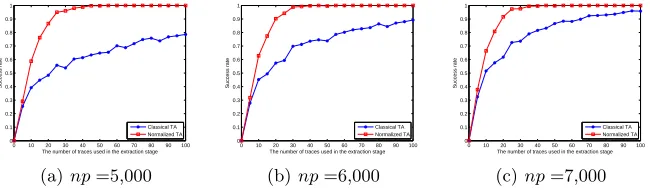
We tried to attack the output of the first S-box in the first round of unprotected AES-128 software implementation over PowerSuite 4.0 as an example. We used 5,000, 6,000, and 7,000 real power traces to build the 256 templates respectively. The three groups of real power traces were generated with a fixed main key and random plaintext inputs. We generated additional 100,000 real power traces with another fixed main key and random plaintext inputs. The 100,000 real power traces were used in the extraction stage. We tested the success rate of Normalized Template Attacks for Case 1 (denoted bySR(ne,N T A1)) and the success rate of Template Attacks for Case 1 (denoted bySR(ne,T A1)) when one can usenetraces in the extraction stage as follows. We repeated the two attacks 500 times. For each time, we chose ne traces from the 100,000 real power traces uniformly at random. Both Normalized Template Attacks for Case 1 and Template Attacks for Case 1 used the same templates and the same ne traces in the extraction stages. We respectively recorded how many times the two attacks can successfully recover the correct subkey (denoted bynum(ne,N T A1) for Normalized Template Attacks for Case 1 and num(ne,T A1) for Template Attacks for Case 1). Then, we computed the success rateSR(ne,N T A1)(SR(ne,N T A1)=num(ne,N T A1)/500)
andSR(ne,T A1)(SR(ne,T A1)=num(ne,T A1)/500).
We will showSR(ne,N T A1) and SR(ne,T A1) for different nein Figure 2. For every S-box in the first round of AES-128, Normalized Template Attacks for Case 1 are more effective than Template Attacks for Case 1. Table 2 in Appendix A shows the success rate of Normalized Template Attacks for Case 1 and the success rate of Template Attacks for Case 1 in the practical experiments for differentnp and ne. In each entry “A/B” of Table 2, “A” representsSR(ne,N T A1) and “B” represents SR(ne,T A1).
0 10 20 30 40 50 60 70 80 90 100 0 0.1 0.2 0.3 0.4 0.5 0.6 0.7 0.8 0.9 1
The number of traces used in the extraction stage
Success rate
Classical TA Normalized TA
(a)np=5,000
0 10 20 30 40 50 60 70 80 90 100 0 0.1 0.2 0.3 0.4 0.5 0.6 0.7 0.8 0.9 1
The number of traces used in the extraction stage
Success rate
Classical TA Normalized TA
(b) np=6,000
0 10 20 30 40 50 60 70 80 90 100 0 0.1 0.2 0.3 0.4 0.5 0.6 0.7 0.8 0.9 1
The number of traces used in the extraction stage
Success rate
Classical TA Normalized TA
(c)np=7,000
It can be seen from Figure 2 and Table 2 that, Normalized Template Attacks for Case 1 have obviously higher success rate (higher leakage exploitation rate) than Template Attacks for Case 1. When we use more real power traces to build the templates in the profiling stage and use more real power traces in the extraction stage, the success rate of Normalized Template Attacks for Case 1 is not lower than the success rate of Template Attacks for Case 1. Hence, we only show the cases that one uses less real power traces here.
4.2 Case 2
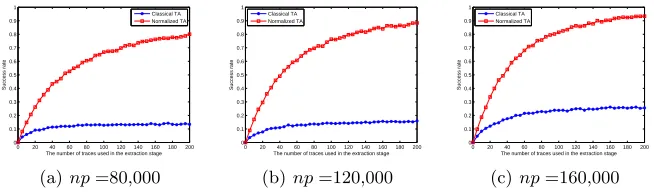
To verify Case 2, we attacked the key expansion algorithm of unprotected AES-128 software implementation over PowerSuite 4.0 as an example. Algorithm 2 in Appendix B describes the key expansion algorithm of unprotected AES-128. RotWord in Algorithm 2 performs a one-byte circular left shift on a word. This means that an input word [b0,b1,b2,b3] is transformed into [b1,b2,b3,b0]. Sub-Word in Algorithm 2 performs a byte substitution on each byte of its input word, using the S-box. If the adversary can recover w[3],w[7],w[11], and w[15], then he can recover the main key key[0],key[1],. . .,key[15] using the mathematical struc-ture of the key expansion algorithm easily. Note that w[3],w[7],w[11], and w[15] are the input of RotWord. And the output of RotWord is the input of Sub-Word. Therefore, one can try to attack the outputs of the S-boxes in SubWord and to recover w[3],w[7],w[11], and w[15] completely if he obtains the outputs of every S-box in SubWord successfully. In all of our practical experiments for Normalized Template Attacks for Case 2 and Template Attacks for Case 2, we attacked an output of a S-box in SubWord and tried to recover key[15] in w[3] as an example. The processes of attacking other key bytes in w[3],w[7],w[11], and w[15] are similar.
for Case 2 used the same templates and the same ne traces in the extraction stages. For the ith (i = 1,2, . . . ,32) value of key[15], we respectively recorded how many times the two attacks can recover the output of S-box successfully (denoted by num(ne,i,N T A2) for Normalized Template Attacks for Case 2 and
num(ne,i,T A2) for Template Attacks for Case 2). For the ith (i = 1,2, . . . ,32)
value of key[15], we use sr(ne,i,N T A2)(sr(ne,i,N T A2)=num(ne,i,N T A2)/128) and
sr(ne,i,T A2) (sr(ne,i,T A2) =num(ne,i,T A2)/128) to denote the success rate. The
success rates of the two attacks for the case one usingnetraces in the extraction stage were computed by
SR(ne,N T A2)=
∑32
i=1sr(ne,i,N T A2)
32 , SR(ne,T A2)=
∑32
i=1sr(ne,i,T A2)
32 .
We will show SR(ne,N T A2)andSR(ne,T A2)for differentnein Figure 3. Table 3 in Appendix A shows the success rates of Normalized Template Attacks for Case 2 and Template Attacks for Case 2 in the practical experiments for differentnp and ne. In each entry “A/B” of Table 3, “A” representsSR(ne,N T A2) and “B” represents SR(ne,T A2).
0 20 40 60 80 100120 140 160 180 200 0 0.1 0.2 0.3 0.4 0.5 0.6 0.7 0.8 0.9 1
The number of traces used in the extraction stage
Success rate
Classical TA Normalized TA
(a)np=80,000
0 20 40 60 80 100 120 140 160 180200 0 0.1 0.2 0.3 0.4 0.5 0.6 0.7 0.8 0.9 1
The number of traces used in the extraction stage
Success rate
Classical TA Normalized TA
(b) np=120,000
0 20 40 60 80 100 120140 160 180 200 0 0.1 0.2 0.3 0.4 0.5 0.6 0.7 0.8 0.9 1
The number of traces used in the extraction stage
Success rate
Classical TA Normalized TA
(c)np=160,000
Fig. 3.Practical Experiments Results of Normalized Template Attacks for Case 2 and Template Attacks for Case 2 (SR(ne,N T A2),SR(ne,T A2))
5
Conclusion and Future Work
In this paper, we prove that leakage exploitation rate of classical Template At-tacks is not optimal by introducing a normalization process. The normalization process can be used in both Case 1 and Case 2 yielding Normalized Template Attacks. We verified Normalized Template Attacks by experiments. Remarkably enough, the normalization process is of extremely low computation cost. There-fore, we argue that this normalization process should be integrated into Template Attacks as one necessary step in order to better understand practical threats of this kind of attacks. Additionally, we find a quantitative factor in the extraction stage of classical Template Attacks which reduces the leakage exploitation rate. Our work inspire us to think about the following two questions. First, whether the leakage exploitation rates of other profiled side-channel attacks (especially in the extraction stages) is optimal? Second, what are the quantitative factors in the extraction stages of other profiled side-channel attacks affect their effec-tiveness? Other profiled side-channel attacks include the stochastic model based attacks [14], reduced Template Attacks [15], PCA-Based Template Attacks [4], and LDA-Based Template Attacks [16] etc. We believe that the two question-s are worth requestion-searching. It iquestion-s alquestion-so very necequestion-squestion-sary to further verify Normalized Template Attacks in other devices such as FPGA and ASIC. Moreover, it would be interesting to have a formula that expresses leakage exploitation rate of a side-channel attack in terms of the number of traces in future work.
References
[1] Chari, S., Rao, J.R., Rohatgi, P.: Template Attacks. CHES2002, LNCS 2523, pp.13-28, 2003.
[2] Mangard, S., Oswald, E., Popp, T.: Power Analysis Attacks: Revealing the Secrets of Smart Cards. pp.156, Springer (2007).
[3] Rechberger, C., Oswald, E.: Practical Template Attacks. WISA2004, LNCS 3325, pp.440-456, 2004.
[4] Archambeau, C., Peeters, E., Standaert, F.-X., Quisquater, J.-J.:Template At-tacks in Principal Subspaces. CHES2006, LNCS 4249, pp.1-14, 2006.
[5] Montminy, D.P., Baldwin, R.O., Temple, M.A., Laspe, E.D.: Improving cross-device attacks using zero-mean unit-variance mormalization. Journal of Crypto-graphic Engineering, Volume 3, Issue 2, pp.99-110, June 2013.
[6] Oswald, E., Mangard, S.: Template Attacks on Masking—Resistance Is Futile. CT-RSA2007, LNCS 4377, pp.243-256, 2007.
[7] Zhang, H., Zhou, Y., Feng, D.: An Efficient Leakage Characterization Method for Profiled Power Analysis Attacks. ICISC2011, LNCS 7259, pp.61-73, 2011. [8] Lerman, L., Bontempi, G., Markowitch, O.: Side Channel Attack: An Approach
Based On Machine Learning. COSADE2011, pp.29-41, 2011.
[9] Lerman, L. Medeiros, S.F., Veshchikov, N., Meuter, C., Bontempi, G., Markow-itch, O.: Semi-Supervised Template Attack. COSADE2013, LNCS 7864, pp.184-199, 2013.
[11] Standaert, F.-X., Malkin, T.G., Yung, M.: A Unified Framework for the Analysis of Side-Channel Key Recovery Attacks. EUROCRYPT2009, LNCS 5479, pp.443-461, 2009.
[12] Durvaux, F., Renauld, M., Standaert, F.-X. et al.: Efficient Removal of Random Delays from Embedded Software Implementations Using Hidden Markov Models. CARDIS2012, LNCS 7771, pp. 123-140, 2013.
[13] Mangard, S., Oswald, E., Popp, T.: Power Analysis Attacks: Revealing the Secrets of Smart Cards. Chapter 6, Springer (2007).
[14] Schindler, W., Lemke, K., Paar, C.: A Stochastic Model for Differential Side Chan-nel Cryptanalysis. CHES2005, LNCS 3659, pp.30-46, 2005.
[15] Mangard, S., Oswald, E., Popp, T.: Power Analysis Attacks: Revealing the Secrets of Smart Cards. pp.108, Springer (2007).
Appendix A: The Tables
In all the tables, the number of traces used to build the templates is denoted by np and the number of traces used in the extraction stage is denoted byne.
Table 1.The Variance ofmaxln(j)
np 5,000 6,000 7,000
variance 2.7356 2.5252 2.1740
Table 2.The Success RatesSR(ne,N T A1)andSR(ne,T A1)in Practical Experiments
HH HHH ne
np
5,000 6,000 7,000
25 0.95/0.56 0.94/0.59 0.97/0.73
50 1.00/0.65 1.00/0.74 1.00/0.87
75 1.00/0.75 1.00/0.84 1.00/0.93
Table 3.The Success RatesSR(ne,N T A2)andSR(ne,T A2)in Practical Experiments
HH HHH ne
np
80,000 120,000 160,000
50 0.47/0.12 0.56/0.13 0.62/0.20
100 0.67/0.13 0.76/0.14 0.81/0.24
Appendix B: The Key Expansion Algorithm of
Unprotected AES-128
In this section, we introduce the key expansion algorithm of unprotected AES-128 in Algorithm 2.
Algorithm 2Key Expansion Algorithm of AES-128
KeyExpansion(bytekey [16],wordw[44]) {
wordtemp
for(i = 0; i<4; i++)
w[i] = (key[4∗i], key[4∗i+1], key[4∗i+2], key[4∗i+3]);
for(i = 4; i<44; i++) {
temp = w[i−1];
if (i mod 4 = 0)
temp = SubWord(RotWord(temp))⊕Rcon[i/4]; w[i] = w[i−4]⊕temp;
} }
![Fig. 1. The Function f(x) = ex for x ∈ [−10, −4]](https://thumb-us.123doks.com/thumbv2/123dok_us/7901076.1311591/8.612.240.374.253.360/fig-function-f-x-ex-x.webp)