Rich QR Code with Two Storage Levels for
Private Data Sharing
Madhuri M. Jagtap1, S.K. Bhatia2
PG Student [Signal Processing], Dept. of E&TC, Imperial College of Engineering &Research Wagholi, Pune, India1
Professor, Dept. of E&TC, Imperial College of Engineering &Research Wagholi, Pune, India2
ABSTRACT:QR code is used for public and private message transfer, which help to authenticate original information
in QR code. Our proposed work uses 2 level QR code first level is public and second is private storage level of document storage. The public level is same as standard QR code storage level which can be read by any QR code readable device. The private level is used for secret data hiding and which is constructed by replacing the black modules of standard QR code by specific textured patterns. It consists of information encoded using an error correction code, this may be Read-Solomon code or cyclic code. This allows us not only to increase the storage capacity of the QR code, but also to distinguish the original document from a copy. This authentication is achieved due to the sensitivity of the used patterns instead of black modules of QR code to the print-and-scan (P&S) process. It is based on maximizing the correlation values between P&S degraded patterns and reference patterns. The storage capacity of QR code can be significantly improved by increasing the code alphabet q or by increasing the textured pattern size. The experimental results show a perfect restoration of private information. And comparatively increases storage capacity of QR code.
KEYWORDS:QR code, two storage levels, private message, document authentication, pattern recognition,
print-and-scan process
I.INTRODUCTION
Nowadays, different types of graphical codes are used in order to store, retrieve and manage the related information such as EAN-13 Barcode, Data matrix, PDF41, Quick Response(QR) code. The use of QR codes is increased because they are easy to the copying process, easy to read by any device and any user, they have small size but having a high encoding capacity enhanced by error correction capacity and QR code has special structure for geometrical correction and easy to high speed decoding. Following are the advantages
1) Information encoded in a QR code can be easily read by any QR reader which are easily available to scan the QR code
2) It is easy to make duplicate of original QR code by using print and scan process.
Due to above advantages of QR code it is difficult to hide the information in QR code because it’s easily accessible and anyone can copy the same QR code proposes to overcome these shortcomings by enriching the standard QR code encoding capacity.
levels has to be chosen during QR code generation. The lowest level can restore nearly 7% of damaged information, the highest level can restore nearly 30%. Today, 40 QR code versions are available with different storage capacities. The smallest QR code version (version V1) has a 21 × 21 module size. It can store 152 bits of raw data at the lowest correction level. The biggest QR code version (version V40) has a 177 × 177 module size. It can store a maximum of 7089 bits of raw data at its lowest correction level. As illustrated in Fig. 1, the QR code has a specific structure for geometrical correction and high speed decoding.
Fig 1 Basic Structure of Standard QR code
II.RELATED WORK
Iuliia Tkachenko, William Puech, et al [1] QR code is designed for storage information and can be used for document authentication. This new rich QR code, named two-level QR code, has public and private storage levels. The public level is the same as the standard QR code storage level; therefore, it is readable by any classical QR code application. The private level is constructed by replacing the black modules by specific textured patterns. It consists of information encoded using q-ary code with an error correction capacity. This allows us not only to increase the storage.capacity of the QR code, but also to distinguish the original document from a copy.
P.-Y. Lin, Y.-H. Chen et al, [2] and proposed secrete message hiding technique using QR code is the commonly used two-dimensional (2D) barcode recently with the advantages of larger QR content and error correction capability. Based on the error correction property of QR code, designed a secret hiding technique for QR barcode.
J. Rouillard, et al [3] It relates to the static QR code information with a particular context. The authors developed a specific application, which takes into account the individual users parameters (time, device type, IP address, location) in order to personalize (add the name of a user, change the language) an output message and to transmit user information into a server database.
T. V. Bui, N. K. Vu, T. T. P. Nguyen et al [4] robust message hiding technique using QR code steganography, which aims to hide secret message into a QR code, was introduced. the authors suggest to insert the secret message by using the error correction capacity of the QR code.
III.PROPOSED SYSTEM
The proposed 2LQR generation and reading process is as shown in the block diagram.
The private level is created by replacing black modules with specific textured patterns One important feature of the textured patterns used is their sensitivity to the P&S process.
Fig 2: block diagram of proposed system
The suggested textured patterns can be distinguished only after one P&S process. Therefore, we can use the detection method with original patterns in order to ensure good document authentication results.
1 Public message storage
The public message is stored in the standard QR code, using the classical generation method. The standard QR code generation algorithm includes the following steps.
2: Private message encoding
STEP 1: The private row-bit string is encoded using error correction code (ECC) import Zxing–core files and Zxing-javase jar files for error correction capacities and barcode formats
STEP 2: The pattern selection is used instead of black modules for data storage here barcode pattern is used.
The code word is inserted in standard QR code by replacing the black modules with textured patterns respecting the code word starting from the bottom-right corner.
4: 2LQR GENERATION
The two level QR code consist of private and public massage is generated
IV.STORAGE CAPACITY STUDY
The calculation of the storage capacity for several QR code versions in Table 1. The use of second storage level increases the storage capacity of QR code up to 30% and using a fixed surface equal to 1.2 × 1.2 cm2 and a fixed pattern density equal to approximately 42%. We can increase the storage capacity of the QR code
V. RESULT AND DISCUSSION
1.RESULT1
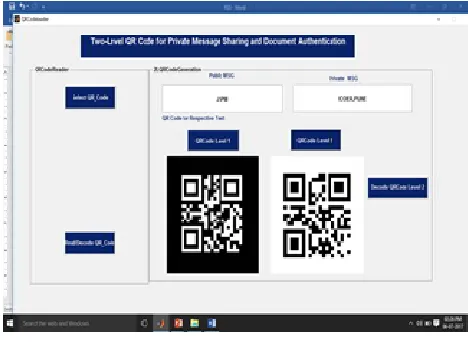
Result 1 show that the public message and private messages are given to the text box to edit the message and the respective QR code for public message is shown. And the second level QR code is also generated by replacing black modules and error correction code. encoding is done by using error correction capacity
Fig .1 Generation of two storage level QR code
3. RESULT 3shows decoding of the second level QR code the result shows private message in the message box
4.RESULT 4COMPARATIVE STUDY OF DIFFERENT GRAPHICAL CODES
Code Name Storage Capacity (bits/inch2) Color
Printing
Copy Sensitivity Public Private Total
HCC2D Code 15048 0 15048 Yes No
Multilevel 2D Barcode 11224 0 11224 No No
Graphical code for authentication 0 0 0 No Yes
QR code with hidden messages 7548 3102 10650 No No
Proposed 2LQR CODE 7548 6386 13934 NO Yes
VI.CONCLUSION
The new rich QR code with Two StorageLevel presented in this paper. The suggested 2LQR code has two storage levels: the public level is readable by any standard QR code read, the private level is accessible only for authorized users. The private level is constructed using textured patterns. Therefore, this storage level allows us not only to increase the storage capacity of initial QR code, but also to detect unauthorized duplication of the 2LQR code. The maximal tested storage capacity of this 2LQR code is 13934 bits/inch2 using 8 textured patterns of size 6 *6 pixels and the QR code version 40, where the public level contains 7548 bits/inch2 and the private level stores 6386 bits/inch2. Numerous experiments of 2LQR code copy sensitivity were provided using four different copy machines. The obtained results show the robustness of our 2LQR code against duplication. The proposed enrichment process can be extended to any standard barcode.
REFERENCES
[1] Iullia Tkachenko, William puech “Two –Level QR code for Private Message Sharing and Document Authentication,” IEEE Transaction on Information Forensics and Security, vol.11 NO.3, MARCH 2016
[2] J. Rouillard, “Contextual QR codes,” in Proc. IEEE 3rd Int. Multi-Conf. Comput. Global Inf. Technol. (ICCGI), Jul./Aug. 2008, pp. 50–55. [3] M. Querini, A. Grillo, A. Lentini, and G. F. Italiano, “2D color barcodes for mobile phones,” Int. J. Comput. Sci. Appl., vol. 8, no. 1, pp. 136–
155, 2011.
[9] T. Langlotz and O. Bimber, “Unsynchronized 4D barcodes,” in Proc. 3rd Int. Symp., ISVC 2007, Lake Tahoe, NV, USA, Nov. 26–28, 2007, pp. 363–374.
[10] C.-Y. Lin and S.-F. Chang, “Distortion modeling and invariant extraction for digital image print-and-scan process,” in Proc. Int. Symp. Multimedia Inf. Process., 1999, pp. 1–10.
[11] P.-Y. Lin, Y.-H. Chen, E. J.-L. Lu, and P.-J. Chen, “Secret hiding mechanism using QR barcode,” in Proc. IEEE Int. Conf. Signal-Image Technol. Internet-Based Syst. (SITIS), Dec. 2013, pp. 22–25.