Diamond Search Improvement for Motion
Estimation
in High Efficiency Video Coding
Dr. Eng. Jamal Kamil Al-Rudaini
Computer Engineering Techniques Department, Al-Nisour University College Baghdad, Iraq
Abstract
High Efficiency Video Coding (HEVC) for video stream is illustrated in this work. Motion estimation stage of the encoder is focused. The main part of motion estimation (ME) is the search algorithm selection. Improvement of coding efficiency for video sequences using Diamond Search algorithm compared with full search algorithm is the main task of this work. Diamond Search algorithm resulting in faster search speed compared with other algorithms. The experimental results are done on different sequences for comparison. The procedure was showing high efficiency with effective and robust results.
Keywords: Motion compensation, Motion estimation, High Efficiency Video Coding.
1. Introduction
The advantage of Advanced Video Coding (AVC) which known as H.264 standard was most likely coded way for video recording in webs and mobile watching. This standard was developed in 2003 and become widely used in 2008 [1].
HEVC is recognized also as H.265. HEVC has been adopted to be used in 2013 for video compression by the group of Moving Picture Experts Group (MPEG). HEVC shows high ability as twice efficiently as AVC for video compression of higher quality level. Also, HEVC has efficient recording and distribution of video compared with Ultra High Definition (UHD) [2].
Adaptive Motion Vector Predictor mode (AMVP) and merge mode are the main two motion vectors (MV) applied in HEVC. AMVP data is coming from the blocks of the reference picture and the previously predicted blocks. The merge mode takes the data from neighboring motion information. The most time consumption occurs during the motion estimation (ME) stage of the encoder during searching the motion vectors. Reduction of mathematical complexity of motion estimation algorithms in the video coding attracts many researches. A suggested procedure is presented in this work to decrease the time during the motion estimation stage of the encoder without decreasing the coding efficiency.
2. Coding Techniques Overview
H.265 is a new video compression standard. It is developed by the Joint Collaborative Team on Video Coding (JCT-VC). The JCT-VC attracts image and video encoding experts around the world. HEVC is approved by Motion Picture Experts Group (MPEG) and Video Coding Experts Group (VCEG) [3].
The goal of HEVC development is to provide a compression efficiency double of the AVC standard. HEVC enables video is compressed to half the size of AVC file and it delivers significantly a better visual quality. The efficiency of HEVC coding of video files compared with AVC standard is shown in the following facts [4]:
Motion compensated prediction technique is the most powerful stage of video compression standards. Each frame of video stream is presented by Blocks of pixels. Each block is encoded with reference to another area in the same frame as (intra-prediction), or in another frame as (inter-prediction). The decoded block in H.264/AVC is up to 16×16 pixels where in HEVC could be up to 64 x 64 pixels.
Different block sizes are allowable in HEVC coding for predicted blocks to be coded in prediction quad-tree. The residual error obtained from a 32×32 inter coded coding unit is combined by a mixture transforms as 16×16, 8×8, and 4×4 blocks. Encoded motion vectors in HEVC has 35 intra-picture directions while only 9 for AVC.
3. Searching Algorithms:
The searching algorithm in motion estimation and motion compensation is an important manner in video coding techniques [5]. The basic type of searching methods is the full-search algorithm. The computational time is very high and takes more than 96% of the total encoding period [6, 7]. Diamond-search algorithm is presented and tested in this work to decrease the computational time without affecting the coding efficiency.
3.1 Full-Search Algorithm:
The full-search method of motion estimation is a method of comparing the reference block with all the blocks within the predetermined search range. The full search procedure uses a 64✕64 block to compare all blocks in the search range. Sum of absolute differences (SAD) is the most commonly used for matching criterion. SAD is chosen for its simplicity and easy hardware implementation.
3.2
Diamond-Search Algorithm:
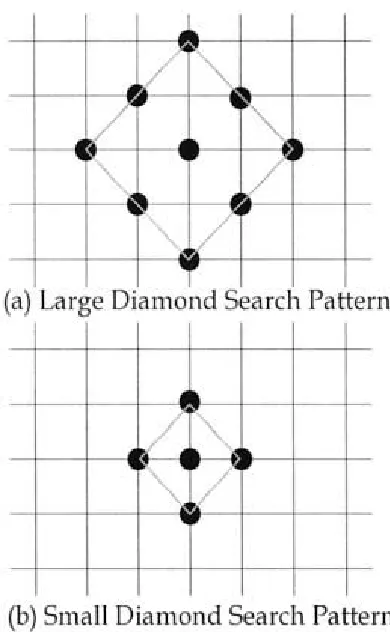
The Diamond algorithm calculates only 4 or 8 search points in a grid search. The search distance of each pattern is increased by 2 times in each step, increasing the search distance from 1 to 8 and searching from 1 to 64 of the search areas [1]. After the search, the point with the smallest Sum of Absolute Difference value is set as the midpoint of the next search step, and the search distance is stored ( Fig. 1).
4. Experiments and Results
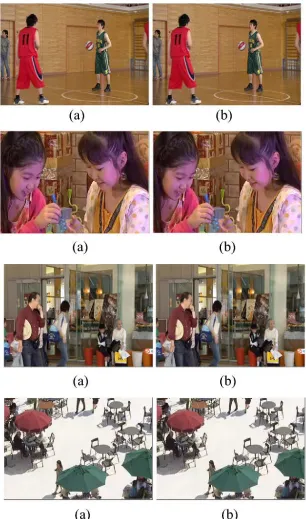
In this paper, a comparison study between HEVC with DS algorithm and HEVC with FS algorithm that allow reducing time have been presented. The performed experiments showed that the HEVC with DS algorithm led to average time reduction to over 26% in random access configuration and 29% in low delay configuration for video sequences recorded with the HEVC with DS algorithm comparing to the HEVC with FS algorithm. In same time, during use of both algorithms the video performance doesn’t change as shown in the selected frames in (Fig. 2).
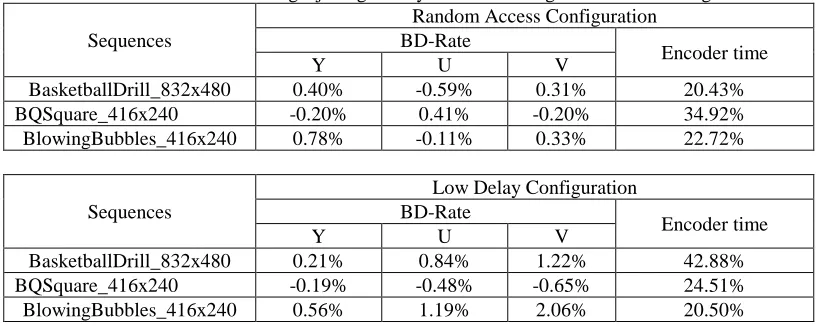
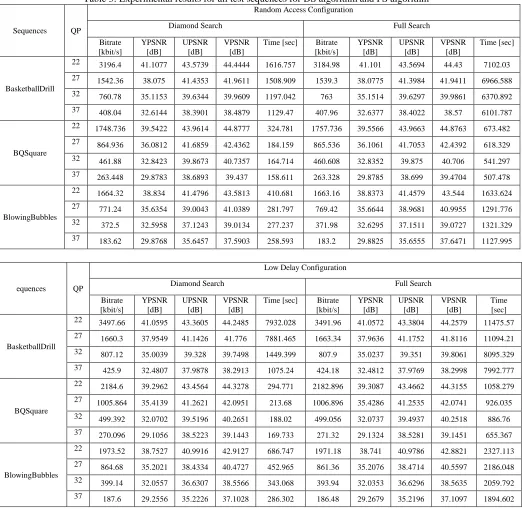
The proposed method can estimate the motion between consecutive frames with the shortest time. Spacious tests have been executed in order to assess the performance of proposed method. Evolutions have been performed in reference of Two Dimensional- High Efficiency Video Coding 2D-HEVC codec version HM-KTA [8]. Each experiment has been performed accordance with the Common Test Conditions (CTC) of Joint Collaborative Team on Video Coding JCT-VC, which dub encoder configuration for valuation of 2D codec execution used by International Organization for Standardization (ISO). Main parameters of the encoders have been collected in Table 1. The coding efficiency is measured at four operating points (QP = 27; 22; 37; 32), calculating time reduction and the average rate reduction in comparison to HEVC with full search algorithm (FS) following the method described in [9] and the results can be summarized in Table 2. The Peak Signal to Noise Ratio (PSNR) values and the corresponding total bitrates for all test sequences for HEVC with diamond search algorithm and HEVC with full search algorithm and presented in Table 3.
Table 1: Main parameters configuration of the encoders.
Parameter Value
Profile Main
GOP size 4
FrameSkip 0
Intra period 24
SEIDecodedPictureHash 1
MaxCUHeight 256
MaxCUWidth 256
QuadtreeTULog2MaxSize 6
MaxPartitionDepth 6
LoopFilterTcOffset_div2 -2
InternalBitDepth 8
SearchRange 64
Table 2: BD-rate using Bjontegaard by mean of DS algorithm verse FS algorithm.
Sequences
Random Access Configuration BD-Rate
Encoder time
Y U V
BasketballDrill_832x480 0.40% -0.59% 0.31% 20.43%
BQSquare_416x240 -0.20% 0.41% -0.20% 34.92%
BlowingBubbles_416x240 0.78% -0.11% 0.33% 22.72%
Sequences
Low Delay Configuration BD-Rate
Encoder time
Y U V
BasketballDrill_832x480 0.21% 0.84% 1.22% 42.88%
BQSquare_416x240 -0.19% -0.48% -0.65% 24.51%
Reference:
[1] Iain E. Richardson , “The H.264 Advanced Video Compression Standard”, 2nd Edition, John Wiley & Sons 2010. [2] Benny Bing, “Next-Generation Video Coding and Streaming”, John Wiley & Sons, 2015.
[3] Sullivan, G.J., Ohm, J.R., Han, W.J., et al: “Overview of the high efficiency video coding (HEVC) standard”, IEEE Trans. Circuits Syst. Video Technol., 22, 2012, pp. 1649–1668.
[4] Kanika Sihag, C. Lamba, “Algorithm and Architecture Design of High Efficiency Video Coding (HEVC) Standard", IJCSMC, Vol. 5, Issue. 10, October 2016, pp.171 – 178.
[5] J. Abbas, A. Alanssari, M Patlayenko, V. Pilyavskiy, "Improvement to Motion Estimation for High-Efficiency Video Coding" of the O.S. Popov ОNAT 2019 (1), pp. 112-120.
[6] Fatma E. Sayadi, Marwa CHouchene , Haithem Bahri , Olfa Haggui, Bouraoui Ounir, “Improved approach for full search motion estimation on GPU”, International Journal of Computers, Volume 2, 2017, pp. 220-222.
[7] Ankita S. Sawalkar, Vinay Keswani, “SVM Based Saliency Map Technique For Reducing Time Complexity In HEVC”, International Research Journal of Engineering and Technology (IRJET), Volume: 04 Issue: 06, June -2017, pp. 880-882.
[8] Joint Collaborative Team on Video Coding, “HMKTA reference software 16.6”.
Table 3: Experimental results for all test sequences for DS algorithm and FS algorithm
Sequences QP
Random Access Configuration
Diamond Search Full Search
Bitrate [kbit/s] YPSNR [dB] UPSNR [dB] VPSNR [dB]
Time [sec] Bitrate [kbit/s] YPSNR [dB] UPSNR [dB] VPSNR [dB] Time [sec] BasketballDrill
22 3196.4 41.1077 43.5739 44.4444 1616.757 3184.98 41.101 43.5694 44.43 7102.03 27 1542.36 38.075 41.4353 41.9611 1508.909 1539.3 38.0775 41.3984 41.9411 6966.588 32 760.78 35.1153 39.6344 39.9609 1197.042 763 35.1514 39.6297 39.9861 6370.892 37 408.04 32.6144 38.3901 38.4879 1129.47 407.96 32.6377 38.4022 38.57 6101.787
BQSquare
22 1748.736 39.5422 43.9614 44.8777 324.781 1757.736 39.5566 43.9663 44.8763 673.482 27 864.936 36.0812 41.6859 42.4362 184.159 865.536 36.1061 41.7053 42.4392 618.329 32 461.88 32.8423 39.8673 40.7357 164.714 460.608 32.8352 39.875 40.706 541.297 37 263.448 29.8783 38.6893 39.437 158.611 263.328 29.8785 38.699 39.4704 507.478
BlowingBubbles
22 1664.32 38.834 41.4796 43.5813 410.681 1663.16 38.8373 41.4579 43.544 1633.624 27 771.24 35.6354 39.0043 41.0389 281.797 769.42 35.6644 38.9681 40.9955 1291.776 32 372.5 32.5958 37.1243 39.0134 277.237 371.98 32.6295 37.1511 39.0727 1321.329 37 183.62 29.8768 35.6457 37.5903 258.593 183.2 29.8825 35.6555 37.6471 1127.995
equences QP
Low Delay Configuration
Diamond Search Full Search
Bitrate [kbit/s] YPSNR [dB] UPSNR [dB] VPSNR [dB]
Time [sec] Bitrate [kbit/s] YPSNR [dB] UPSNR [dB] VPSNR [dB] Time [sec] BasketballDrill
22 3497.66 41.0595 43.3605 44.2485 7932.028 3491.96 41.0572 43.3804 44.2579 11475.57 27 1660.3 37.9549 41.1426 41.776 7881.465 1663.34 37.9636 41.1752 41.8116 11094.21 32 807.12 35.0039 39.328 39.7498 1449.399 807.9 35.0237 39.351 39.8061 8095.329 37 425.9 32.4807 37.9878 38.2913 1075.24 424.18 32.4812 37.9769 38.2998 7992.777
BQSquare
22 2184.6 39.2962 43.4564 44.3278 294.771 2182.896 39.3087 43.4662 44.3155 1058.279 27 1005.864 35.4139 41.2621 42.0951 213.68 1006.896 35.4286 41.2535 42.0741 926.035 32 499.392 32.0702 39.5196 40.2651 188.02 499.056 32.0737 39.4937 40.2518 886.76 37 270.096 29.1056 38.5223 39.1443 169.733 271.32 29.1324 38.5281 39.1451 655.367
BlowingBubbles