ISSN: 1524-4571
Copyright © 2002 American Heart Association. All rights reserved. Print ISSN: 0009-7330. Online TX 72514
Circulation Research is published by the American Heart Association. 7272 Greenville Avenue, Dallas,
DOI: 10.1161/01.RES.0000020562.07492.D4
2002;90;1153-1158; originally published online May 2, 2002;
Circ. Res.
Cole, D.P.R. Muller, A. Lucas, S.E. Humphries and J.E. Deanfield
C.P.M. Leeson, A.D. Hingorani, M.J. Mullen, N. Jeerooburkhan, M. Kattenhorn, T.J.
With Environmental and Dietary Factors to Influence Endothelial Function
Glu298Asp Endothelial Nitric Oxide Synthase Gene Polymorphism Interacts
http://circres.ahajournals.org/cgi/content/full/90/11/1153
located on the World Wide Web at:
The online version of this article, along with updated information and services, is
http://www.lww.com/reprints
Reprints: Information about reprints can be found online at
[email protected] 410-528-8550. E-mail:
Kluwer Health, 351 West Camden Street, Baltimore, MD 21202-2436. Phone: 410-528-4050. Fax: Permissions: Permissions & Rights Desk, Lippincott Williams & Wilkins, a division of Wolters
http://circres.ahajournals.org/subscriptions/
Subscriptions: Information about subscribing to Circulation Research is online at
at UNIV COLLEGE LONDON on November 26, 2008 circres.ahajournals.org
Glu298Asp Endothelial Nitric Oxide Synthase Gene
Polymorphism Interacts With Environmental and Dietary
Factors to Influence Endothelial Function
C.P.M. Leeson, A.D. Hingorani, M.J. Mullen, N. Jeerooburkhan, M. Kattenhorn, T.J. Cole,
D.P.R. Muller, A. Lucas, S.E. Humphries, J.E. Deanfield
Abstract—An endothelial nitric oxide synthase (eNOS) gene polymorphism (Glu298Asp) has been associated with
cardiovascular disease. We investigated whether carriage of the polymorphism was associated with functional changes in the endothelium, and how genotype altered the harmful and beneficial impact of environmental influences on the endothelium. Endothelium-dependent, flow-mediated brachial artery dilatation (FMD) and endothelium-independent dilatation response to glyceryl trinitrate were measured using high-resolution ultrasound in 248 subjects (131 female, 117 male, aged 20 to 28) genotyped for the Glu298Asp polymorphism. Vascular function was compared between genotype groups and interactions with the proatherogenic risk factor, smoking, and the antiatherogenic influence of n-3 fatty acids (n-3FA) were investigated. Vascular function was not related to genotype in the group as a whole or within sexes. However, among males, smoking was associated with lower FMD in Asp298 carriers (nonsmokers 0.125⫾0.085 mm versus smokers 0.070⫾0.060 mm, P⫽0.006) but not in Glu298 homozygotes (nonsmokers 0.103⫾0.090 mm versus smokers 0.124⫾0.106, P⫽0.5). In the whole group, n-3FA levels were positively related to FMD in Asp298 carriers (reg coeff⫽0.023 mm/%, P⫽0.04, r⫽0.20) but not in Glu298 homozygotes (reg co-eff⫽⫺0.019 mm/%, P⫽0.1). These differences between genotype groups were significant in interaction models. The Glu298Asp polymorphism is associated with differences in endothelial responses to both smoking and n-3 FA in healthy young subjects. These findings raise the possibility of genotype-specific prevention strategies in cardiovascular disease.
(Circ Res. 2002;90:1153-1158.)
Key Words: endothelium 䡲 nitric oxide synthase 䡲 diet 䡲 smoking 䡲 genetics
D
espite major advances in treatment, coronary artery disease remains the biggest cause of mortality and morbidity in the developed world.1Further reduction of thecardiovascular disease burden in society may require new strategies not only to improve the management of clinical disease but also to modify the initiation and progression of atherosclerosis early in life.2– 4Genetic variation is likely to
be an important determinant of both the development of atherosclerosis and clinical sequelae. Clinical research has focused on the association of genetic factors to late cardio-vascular outcome5–9and conflicting data has been obtained
on the impact of gene polymorphisms. This may be, at least in part, because any genetic effect is modified throughout life by environmental influences, and this potentially confound-ing lifetime risk factor burden is hard to quantify retrospectively.
Less attention has been paid to genetic influences on the vascular biology of atherosclerosis during the long preclinical
phase that begins in childhood. Functional polymorphisms in the gene that encodes vascular endothelial nitric oxide syn-thase (eNOS) have the potential to affect early disease development. eNOS is responsible for the conversion of L-arginine to nitric oxide in the endothelium10 and loss of
endothelial-derived nitric oxide plays a key role in athero-genesis.11 Experimental inhibition of nitric oxide synthesis
accelerates the formation of early atherosclerotic lesions12
and nitric oxide is known to influence platelet aggregation,13
smooth muscle cell migration,14 and growth,15 as well as
oxidation of low-density lipoprotein.16 A Glu298Asp
poly-morphism in the eNOS gene has recently been associated with development of ischemic heart disease and myocardial infarction.9,17The effect of this polymorphism on endothelial
function, and in particular its influence at an earlier stage in atherogenesis, remains unknown.
Flow-mediated arterial dilation is a nitric oxide– dependent endothelial response that can be measured noninvasively in
Original received January 15, 2002; revision received April 15, 2002; accepted April 22, 2002.
From the Medical Research Council Childhood Nutrition Research Centre (C.P.M.L., M.K., A.L.), Biochemistry, Endocrinology and Metabolism Unit (D.P.R.M.), and Department of Statistics, Epidemiology and Public Health (T.J.C.), Institute of Child Health, University College London; Vascular Physiology Unit (C.P.M.L., M.J.M., M.K., J.E.D.), Great Ormond Street Hospital for Children, London; and the Centre for Clinical Pharmacology (A.D.H., N.J.) and Centre for Cardiovascular Genetics (S.E.H.), University College London, London, UK.
Correspondence to Prof J.E. Deanfield, Vascular Physiology Unit, Great Ormond Street Hospital, London, WC1N 3JH UK. E-mail [email protected]
© 2002 American Heart Association, Inc.
Circulation Research is available at http://www.circresaha.org DOI: 10.1161/01.RES.0000020562.07492.D4
vivo using high-resolution ultrasound.18,19 We used this
method to investigate, first, whether the Glu298Asp poly-morphism influenced endothelial function in young, preclin-ical subjects and, second, whether the polymorphism influ-enced the vascular response to environmental risk factors. We chose to examine the interaction between genotype and two factors known to have opposite effects on endothelial func-tion: the proatherogenic risk factor of cigarette smoking and antiatherogenic influence of n-3 fatty acid intake.18,20 –22
Materials and Methods
Study Design
We studied 248 subjects (131 female, 117 male) aged 20 to 28 years. Invitations to attend a clinic for cardiovascular risk profile evaluation by venepuncture, questionnaire, physical measurements, and vascu-lar studies were sent to random samples of individuals born in Cambridge Maternity Hospital (in whom early growth measures had been recorded) between 1969 and 1975 until the planned study size was reached. With this sample size the study had 80% power at 5% significance to identify a 0.02 mm or 0.6% difference in flow-mediated dilatation (FMD) between groups, such as smokers and nonsmokers. Ethical approval was received from local research ethics committees and informed consent was obtained at the time of the study visit.
Measurement of Cardiovascular Risk Factors Personal and family medical histories were obtained by question-naire at interview. Subjects were classified as smokers if they reported smoking 1 or more cigarettes a day for the previous 6 months. Blood pressure was measured as the average of the last 2 of 3 seated readings using an automated oscillometric device (Critikon Inc, USA). Weight was recorded (to⫾0.1 kg) using scales (Soenhle Ltd) and height (to⫾0.1 mm) with a portable stadiometer.
Biochemical Measurements
In each subject, fasting venous blood samples were analyzed for insulin, glucose, total cholesterol, HDL, LDL, and triglyceride concentrations by routine methods. During the study, plasma and erythrocyte membrane ghost samples were stored to permit measure-ment of the n-3 fatty acids, docosahexaenoic acid (DHA) and eicosapentaenoic acid (EPA), in plasma and red blood cell mem-branes. Total fatty acid methyl esters were prepared from the samples by the direct 1-step trans-esterification method23and then analyzed by gas chromatography with flame ionization detection.24 The area of the DHA plus EPA peaks, expressed as a percentage of the total fatty acid peak areas, was used as the measure of n-3 fatty acid status.
DNA Extraction and Genotyping of the eNOS Glu298Asp Polymorphism
DNA was extracted from stored buffy coats by the salting-out method. The G894T polymorphism in exon 7 of the eNOS gene, which predicts a Glu298Asp amino acid substitution in the mature protein, was genotyped by PCR and allele-specific restriction en-zyme digestion. PCR was performed for 35 cycles in a volume of 30
L containing 50 ng of dry DNA, 50 mmol/L KCl, 10 mmol/L Tris (pH 8.3), 0.1% gelatin, and 0.2 mmol/L of each dNTP, 10 pmol of each primer, and 2U of Taq DNA polymerase using primer pairs 5⬘-CCCCTCCATCCCACCCAGTCAAC-3⬘ and 5⬘ -AGGAAA-CGGTCGCTTCGACGTGCTG-3⬘. Denaturation was at 95°C, an-nealing at 63°C, and a final extension at 72°C, all for 45 seconds. Ten microliters of PCR products (151 bp) were subjected to digestion with 2U DpnII, which cuts only in the presence of T at position 894 (corresponding to Asp298). Digested samples were then loaded on an ethidium bromide–stained gel and electrophoresed for 1 hour at 10 V/cm at room temperature and the products detected by UV transillumination. An independent observer confirmed all
geno-types marked. Discrepancies were resolved by repeat PCR and enzyme digestion.
Vascular Study Measurements
Endothelium-dependent and independent responses in the brachial artery were measured for each subject while lying supine on a couch, as reported previously.18After 10 minutes rest, the right brachial artery was imaged in longitudinal section between 10 and 15 cm above the antecubital fossa using a 7-MHz linear array transducer and an Acuson 128XP/10 system. To measure blood flow, arterial flow velocity was obtained with a pulsed Doppler signal at 70° to the vessel with the range gate (1.5 mm) in the center of the artery. Baseline brachial artery diameter was measured using an automated Wall Tracking System (Medical Systems), which utilizes the move-ment in the radio frequency amplitude peaks over the cardiac cycle to identify the arterial walls.25A pneumatic cuff placed distal to the ultrasound probe was then inflated to suprasystolic pressure on the forearm for 4.5 minutes to induce reactive hyperemia. Cuff deflation resulted in increased blood flow through the brachial artery, stimu-lating endothelial-dependent flow-mediated dilatation. Maximal blood flow and brachial artery diameter 1 minute after cuff release were measured. After 10 minutes rest, a further arterial diameter measurement was made between 3 and 4 minutes after a single sublingual spray of glyceryl trinitrate (around 200 g), which produces an endothelial-independent dilatation. Endothelial-dependent and -inEndothelial-dependent responses were represented, respec-tively, as change in vessel diameter after increased blood flow (flow-mediated dilatation or FMD) and after GTN (GTND). Both absolute and proportional changes in arterial diameter are presented, where appropriate, as in previous studies.19
Statistical Analysis
Variation in vascular function by genotype was assessed using 1-way analysis of variance and the significance of differences between genotype groups and smokers and nonsmokers by unpaired Student’s
t tests.
Continuous relationships between variables and vascular function were assessed using multiple linear regression models. The variables were added to a model of absolute FMD that included resting vessel size as an independent variable.19Standard interaction models were used to determine whether the influence of a risk factor on endothe-lial function varied between genotype groups. Interaction of risk factors and genotype was assumed if an interaction term, being the product of the risk factor and a variable defining the genotype groups, was significant when added to the regression model contain-ing both variables. Results are presented as mean⫾SD unless otherwise stated. Significance was assumed when P⬍0.05.
Results
Sample Characteristics
The characteristics of the study sample are summarized in Table 1. There were no associations between cardiovascular risk factors and resting vessel size or brachial artery blood flow. Females had smaller brachial artery diameters com-pared with males (2.9⫾0.3 versus 3.7⫾0.5 mm; P⬍0.001). There was no difference in mean FMD or GTND between sexes. Smokers had lower mean FMD than nonsmokers (0.090⫾0.080 versus 0.109⫾0.081 mm, P⬍0.05/ 2.86⫾2.41% versus 3.52⫾2.55%, P⫽0.04) with no differ-ence in GTND (0.677⫾0.225 versus 0.674⫾0.184 mm, P⫽0.90/21.5⫾7.9% versus 21.8⫾7.2%, P⫽0.79). There were no associations between other risk factors (cholesterol, LDL, HDL, fasting insulin, glucose, blood pressure) and vascular function.
1154 Circulation Research June 14, 2002
at UNIV COLLEGE LONDON on November 26, 2008 circres.ahajournals.org
Endothelial Function, Genotype, and Risk Factors
Genotypic proportions were in Hardy-Weinberg equilibrium with the frequency of the Asp298 allele being 33.3% similar to that observed in previous studies in Caucasian subjects. There were no significant differences in body size, resting vessel size, blood flow, or birthweight19 between genotype
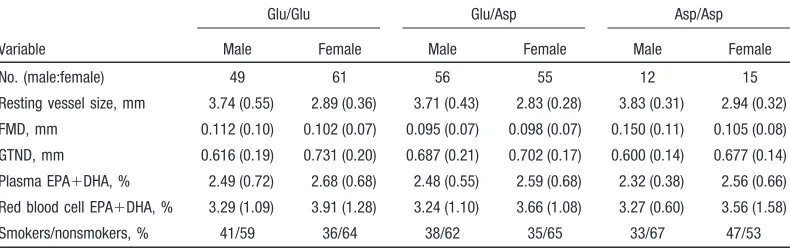
groups. There were also no significant differences in smoking frequency or levels of blood pressure, blood lipids, n-3 fatty acids, or other risk factors according to genotype (Table 2). Within the whole group, and in males and females, vascular function did not differ between genotype groups (ANOVA for difference in FMD, P⫽0.6, and difference in GTND, P⫽0.4).
Of the classical risk factors, only smoking influenced endothelial function, and in males, genotype influenced the impact of smoking on FMD. In Glu298 homozygotes, there was no difference in FMD between smokers and nonsmokers (smokers 0.124⫾0.106 mm [3.57⫾3.10%] versus nonsmok-ers 0.103⫾0.090 mm [2.81⫾2.64%], P⫽0.5), whereas in Asp298 carriers (heterozygotes and Asp298 homozygotes) smokers had reduced FMD (smokers 0.070⫾0.060 mm [1.93⫾1.70%] versus nonsmokers 0.125⫾0.085 mm [3.36⫾2.35%], P⫽0.006 [P⫽0.01]). The difference in the association between FMD and smoking between genotype groups was significant in an interaction model (significance of interaction term, P⫽0.04).
Degree of smoke exposure did not impact on the different associations in genotype groups. Nonsmoking male Asp298 carriers had significantly greater flow-mediated dilatation than both “light”-intensity smokers, that is those with less than 4 pack years of smoking (the median number of pack years smoke exposure) (0.125⫾0.085 versus 0.0815⫾0.062 mm; P⫽0.03) and “high”-intensity smokers, those with 4 or more pack years (0.0585⫾0.0584 mm; P⫽0.02). The apparent graded relation-ship between smoking intensity and flow-mediated dilatation in male Asp298 carriers did not reach significance in regression analysis (regression coefficient⫽⫺0.007 mm/pack year 95%CI ⫺1.678 to 0.098; P⫽0.1). Glu298 homozygotes with 4 or more pack years still did not have a significant reduction in flow-mediated dilatation compared with nonsmokers (0.100⫾0.092 versus 0.103⫾0.100 mm; P⫽0.7).
Genotype was not associated with differences in the relationship between FMD and smoking in females, and there was no evidence of a gene-smoking interaction on GTND.
Endothelial Function, Genotype, and n-3 Fatty Acid Status
There was no significant association between plasma n-3 fatty acids and FMD in Glu298 homozygotes (reg co-eff⫽⫺0.019 mm/%, 95%CI ⫺0.042 to 0.003; P⫽0.10). There was, however, a positive association between plasma n-3 fatty acids and FMD in Asp298 carriers (reg co-eff⫽0.023 mm/%, 95%CI 0.001 to 0.04; P⫽0.04, r⫽0.20) (Figure). The difference by genotype in the association between FMD and plasma n-3FA levels was significant in an interaction model(significance of interaction term, P⫽0.01). The relationships were seen in the whole group, with no differences by sex or smoking history. For Asp298 carriers, the coefficients for the association between n-3 fatty acids and FMD were positive in males(reg coeff⫽0.047 mm/%, n⫽68), females (reg coeff⫽0.008 mm/%, n⫽70), smokers (reg coeff ⫽0.028 mm/%, n⫽51), and nonsmokers (reg coeff ⫽0.011 mm/%, n⫽87) with no significant difference between these subgroups in interaction models. Similar patterns were seen with red blood cell membrane n-3 fatty acid levels among Asp298 carriers (reg coeff⫽0.002 mm/%). There were no associations between n-3FA and GTND in either genotype group (Glu298 homozygotes: reg coeff⫽⫺0.03 mm/%, 95%CI ⫺0.08 to 0.03, P⫽0.3; and Asp298 carriers: reg coeff ⫽⫺0.04 mm/% 95%CI⫺0.09 to 0.02, P⫽0.2).
TABLE 2. Vascular Measures, n-3 Fatty Acid Levels, and Number of Smokers in 248 Study Subjects Divided by Glu298Asp Genotype
Variable
Glu/Glu Glu/Asp Asp/Asp
Male Female Male Female Male Female
No. (male:female) 49 61 56 55 12 15
Resting vessel size, mm 3.74 (0.55) 2.89 (0.36) 3.71 (0.43) 2.83 (0.28) 3.83 (0.31) 2.94 (0.32)
FMD, mm 0.112 (0.10) 0.102 (0.07) 0.095 (0.07) 0.098 (0.07) 0.150 (0.11) 0.105 (0.08)
GTND, mm 0.616 (0.19) 0.731 (0.20) 0.687 (0.21) 0.702 (0.17) 0.600 (0.14) 0.677 (0.14)
Plasma EPA⫹DHA, % 2.49 (0.72) 2.68 (0.68) 2.48 (0.55) 2.59 (0.68) 2.32 (0.38) 2.56 (0.66)
Red blood cell EPA⫹DHA, % 3.29 (1.09) 3.91 (1.28) 3.24 (1.10) 3.66 (1.08) 3.27 (0.60) 3.56 (1.58)
Smokers/nonsmokers, % 41/59 36/64 38/62 35/65 33/67 47/53
Mean (SD) is presented for each variable. TABLE 1. Main Characteristics of 248 Study Subjects
Variable Male Female
No. 117 131
Age, y 23 (20 to 27) 23 (20 to 28)
Height, cm 176 (7) 163 (7)
Weight, kg 74.9 (12) 63.4 (7)
Body mass index, kg/m2 24.2 (3.3) 24.0 (3.6)
Total cholesterol, mmol/L 4.37 (1.00) 4.71 (0.95)
LDL cholesterol, mmol/L 2.69 (0.86) 2.94 (0.85)
HDL cholesterol, mmol/L 1.10 (0.25) 1.28 (0.32)
Fasting insulin, mU/L 8.1 (4.3) 10.3 (6.6)
Systolic blood pressure, mm Hg 136 (12) 121 (12)
Diastolic blood pressure, mm Hg 73 (8) 68 (8)
Discussion
There was no overall influence of the Glu298Asp poly-morphism of the eNOS gene on endothelial function in this group of young, preclinical adult subjects with a representa-tive range of environmental risk factors. However, this study provides evidence of an impact of this common variant of the eNOS gene on the relationships between environmental influences and endothelial function. Carriage of the eNOS Asp298 allele increased the likelihood of a smoking-associated reduction in endothelial function in males and of a positive effect on vascular function of increased n-3 fatty acid levels. These findings, which demonstrate a genetically de-termined modulation of this phenotype of early atherosclero-sis, raise the possibility of a potentially beneficial, genotype-specific interventional approach to risk factors in the young. Our study confirmed that the powerful adverse effect of smoking on endothelial function18,20 is already present in
young subjects. The impact of smoking, however, depended on the genotype of the individual. A smoking-gene interac-tion has previously been reported in a small group of older subjects with the rarer polymorphism in intron-4 of the eNOS gene in relation to clinical cardiovascular outcome.8 Our
findings provide evidence that smoking interactions with the eNOS gene may not only influence the late stages of disease but also alter the early pathogenesis of atherosclerosis by modulation of endothelial function.
The molecular effects of the Glu298Asp polymorphism on eNOS enzyme function are still unclear. The kinetics of nitric oxide synthesis do not differ between eNOS Glu298 and eNOS Asp298, but recently, eNOS Asp298 was found to be more susceptible to proteolytic cleavage than eNOS Glu298.26The steady-state level of eNOS enzyme in subjects
with the Asp298 variant might therefore be lower, with a resultant reduction in capacity for nitric oxide production. Nitric oxide levels in Asp298 carriers may be sufficient to maintain vascular homeostasis in the absence of other risk factors. Smoking, however, increases vascular oxidative stress and thus may reduce bioavailability of a limited nitric oxide resource, accounting for the interactive effects of smoking and eNOS genotype on endothelial function ob-served in this study. Further studies, perhaps to assess the impact on the association of antioxidants, which might limit the oxygen-derived free radical breakdown of nitric oxide, will be of interest.
In females, there was no interaction between genotype and smoking risk. The development of endothelial dysfunction and atherosclerosis in premenopausal females follows a different pattern to men, probably due to estrogen-mediated
protection of the endothelium.27Estrogen has been shown to
have numerous vasculoprotective actions, including upregu-lation of endothelial nitric oxide synthase, and this might account for the observed difference in the interaction between smoking and genotype in males and females. Of interest in future studies would be whether variation in endothelial function through the menstrual cycle is sufficient to interact with an underlying association.
In those subjects carrying the Asp298 allele, higher n-3 fatty acid levels had an opposite effect on endothelial func-tion to that of smoking, and this was graded across the levels of n-3FA usually present in normal populations.22,28Dietary
supplementation with n-3 fatty acids has been shown to improve microvascular endothelial function, in vitro, in those at risk for cardiovascular disease,29 and this may be a
mechanism for the inverse association between fish consump-tion, the major dietary source of n-3 fatty acids, and cardio-vascular disease mortality.28 Furthermore, the current study
shows that the impact on endothelial function of n-3 fatty acids depends on eNOS genotype, with the influence of n-3 fatty acid level being greater in Asp298 carriers.
The mechanism for this interaction between genotype and n-3 fatty acids is not clear. n-3 fatty acids have been shown to regulate gene expression in lipogenic tissues, such as hepa-tocytes and adipocytes, probably by altering mRNA stability or the rate of gene transcription through interaction with a polyunsaturated fatty acid responsive element. n-3 fatty acids have also been shown to regulate genes in nonlipogenic tissues, including the immune system and gastrointestinal tract, although there have been no studies on the endotheli-um.30At a cellular level, raised levels of n-3 fatty acids are
associated with greater membrane fluidity, resulting in in-creased activation of membrane bound enzymes, which include eNOS, and signal transduction pathways.28Thereby,
n-3 fatty acids may optimize a genetically limited endothelial nitric oxide response.
Our finding that vascular function is affected in those with 1 or more Asp298 allele is supported by recent experimental work and is consistent with the hypothesis that such individ-uals have a reduced nitric oxide– generating capacity. In patients on circulatory bypass, the pressor effect of phenyl-ephrine was shown to be associated with Glu298Asp geno-type, with the blood pressure response being positively associated with the number of Asp298 alleles.31Furthermore,
in women studied early during healthy, singleton pregnancy, when endothelial function is upregulated, flow-mediated dilatation was inversely correlated with the number of Asp298 alleles.32
The figure shows the significant positive relationship between n-3 fatty acid levels and flow-mediated dilation in carriers of the Asp298 allele with no overall relation-ship between n-3 fatty acids and flow-mediated dilation in Glu298 homozy-gotes. The mean level of flow-mediated dilation with standard errors are present-ed for each third of the plasma
EPA⫹DHA distribution.
1156 Circulation Research June 14, 2002
at UNIV COLLEGE LONDON on November 26, 2008 circres.ahajournals.org
In our present study of young subjects, functional differ-ences in the endothelium were only evident when other environmental risk factors were taken into account. Cross-sectional clinical studies have shown the Asp298 allele to be more prevalent among myocardial infarction sufferers and individuals with angiographic coronary heart disease.9 A
complex interaction between genotype and lifetime risk factor burden is likely to determine eventual cardiovascular mortality and morbidity. Our study suggests that carriage of the eNOS Asp298 variant is associated with altered endothe-lial function from as early as the third decade of life, which becomes manifest in the presence of cardiovascular risk factors.
Our data do not prove genotype, n-3 fatty acids, or smoking is causally related to alterations in endothelial function, and potential confounding influences need to be investigated in future studies. In our study, the association between smoking and flow-mediated dilatation persisted in partial correlation, controlling for n-3 fatty acid levels (cor-relation coefficient⫽⫺0.28, P⫽0.02), suggesting these fac-tors interact independently with genotype. It has been pro-posed that smoking and n-3 fatty acids may themselves interact to influence endothelial function and larger studies will be of interest to define potential multiple interactions. The present work has studied a cohort with a range of risk factors and smoking prevalence similar to that seen in the normal United Kingdom young adult population. No influ-ences of lipids or blood pressure on vascular function were found, very likely because of the narrow ranges of these risk factors in the study group. Further geographically distinct studies would be useful to confirm our findings and the impact of interventions to modify environmental risk factors should be examined in prospective studies of genotyped individuals.
We have shown that the eNOS Glu298Asp polymorphism is associated with differences in the response of the endothe-lium to both a proatherogenic environmental risk factor, smoking, and also an antiatherogenic factor related to diet, n-3 fatty acid status. Male subjects with the Asp298 allele may have a specific increased risk from smoking and such information could add extra force to individual counseling on smoking prevention. The interaction between n-3 fatty acid status and genotype is a novel finding. In clinical trials, variation in response to n-3 fatty acids may be partly explained by differences in genotype. Further research is needed to determine whether dietary advice to increase fish consumption could be specifically directed toward subjects with genetic differences that disturb endothelial function. Our results demonstrate that genetic effects on cardiovascular disease need to be studied in conjunction with other modify-ing environmental factors to determine their impact on vascular disease development.
Acknowledgments
The Cambridge Young Adults Study and C.P.M.L. were funded by the Medical Research Council and the n-3 fatty acid analyses by the Ministry of Agriculture, Fisheries and Food. A.D.H. is a British Heart Foundation Senior Fellow. N.J. was funded by a Common-wealth Scholarship and S.E.H. by the British Heart Foundation (grant No. RG95005). We would like to thank Anuska Mann and Ian
Merryweather for their help with n-3 fatty acid measurements. We are very grateful for the expert assistance of Lisa Jones in genotyping the subjects.
References
1. World Health Organization. World Health Report. Geneva, Switzerland; WHO: 1999.
2. World Health Organization. Prevention in childhood and youth of adult cardiovascular disease: time for action. World Health Organ Tech Rep
Ser. 1990;792:1–105.
3. Stary HC. Evolution and progression of atherosclerotic lesions in coro-nary arteries in children and young adults. Arteriosclerosis. 1989;99:I-19 –I-32.
4. McGill HC, McMahon CA, Malcolm GT, Oakman MC, Strong JP. Effects of serum lipoproteins and smoking on atherosclerosis in young men and women: the Pathobiological Determinants of Atherosclerosis in the Young research group. Arterioscler Thromb Vasc Biol. 1997;17: 95–106.
5. Cambien F, Poirier O, Lecerf L, Evans A, Cambou JP, Arveiler D, Luc G, Bard JM, Bara L, Ricard S. Deletion polymorphism in the gene for angiotensin-converting enzyme is a potent risk factor for myocardial infarction. Nature. 1992;359:641– 644.
6. Behague I, Poirier O, Nicaud V, Evans A, Arveiler D, Luc G, Cambou JP, Scarabin PY, Bara L, Green F, Cambien F.-Fibrinogen gene poly-morphisms are associated with plasma fibrinogen and coronary artery disease in patients with myocardial infarction: the ECTIM study.
Circu-lation. 1996;93:440 – 449.
7. Nakayama M, Yasue H, Yoshimura M, Shimasaki Y, Kugiyama K, Ogawa H, Motoyama T, Saito Y, Ogawa Y, Miyamoto Y, Nakao K. T-786 to C mutation in the 5⬘-flanking region of the endothelial nitric oxide synthase gene is associated with coronary spasm. Circulation. 1999;99:2864 –2870.
8. Wang XL, Mahaney MC, Sim AS, Wang J, Wang J, Blangero J, Almasy L, Badenhop RB, Wilcken DE. Genetic contribution of the endothelial constitutive nitric oxide synthase gene to plasma nitric oxide levels.
Arterioscler Thromb Vasc Biol. 1997;17:3147–3153.
9. Hingorani AD, Liang CF, Fatibene J, Lyon A, Monteith S, Parsons A, Haydock S, Hopper RV, Stephens NG, O’Shaughnessy K, Brown MJ. A common variant of the endothelial nitric oxide synthase (Glu-Asp) is a major risk factor for coronary heart disease in the UK. Circulation. 1999;100:1515–1520.
10. Moncada S, Palmer RM, Higgs EA. Nitric oxide: physiology, pathophys-iology and pharmacology. Pharmacol Rev. 1991;43:109 –142. 11. Ross R. The pathogenesis of atherosclerosis: a perspective for the 1990s.
Nature. 1993;362:801– 809.
12. Cayatte A, Palacino JJ, Horten K, Cohen RA. Chronic inhibition of nitric oxide production accelerates neo-intima formation and impairs endothe-lial function in hypercholesterolemic rabbits. Arterioscler Thromb. 1994; 14:753–759.
13. Radomski MW, Palmer RM, Moncada S. Endogenous nitric oxide inhibits human platelet adhesion to vascular endothelium. Lancet. 1987; 2:1057–1058.
14. Sarker R, Meinberg EG, Stabley JC, Gordon D, Webb RC. Nitric oxide reversibly inhibits the migration of cultured vascular smooth muscle cells.
Circ Res. 1996;78:225–230.
15. Garg UC, Hassid A. Nitric oxide– generating vasodilators and 8-bromo-cyclic guanosine monophosphate inhibit mitogenesis and proliferation of cultured rat vascular smooth muscle cells. J Clin Invest. 1989;83: 1774 –1777.
16. Hogg N, Kalyanaraman B, Joseph J, Struck A, Parthasarathy S. Inhibition of low-density lipoprotein oxidation by nitric oxide: potential role in atherogenesis. FEBS Lett. 1993;334:170 –174.
17. Hibi K, Ishigami T, Tamura K, Mizushima S, Nyui N, Fujita T, Ochiai H, Kosuge M, Watanabe Y, Yoshii Y, Kihara M, Kimura K, Ishii M, Umemura S. Endothelial nitric oxide synthase gene polymorphism an acute myocardial infarction. Hypertension. 1998;32:521–526. 18. Celermajer DS, Sorenson KE, Gooch VM, Spiegelhalter DJ, Miller OT,
Sullivan I, Deanfield JE. Non-invasive detection of endothelial dys-function in children and adults at risk of atherosclerosis. Lancet. 1992; 340:1111–1115.
20. Celermajer DS, Adams MR, Clarkson P, Robinson J, McCredie R, Donald A, Deanfield JE. Passive smoking and impaired endothelium-dependent arterial dilatation in healthy young adults. N Engl J Med. 1996;334:150 –154.
21. Simopoulos AP. Omega-3 fatty acids in health and disease and in growth and development. Am J Clin Nutr. 1991;54:438 – 463.
22. Shimokawa H, Vanhoutte PM. Dietary cod-liver oil improves endotheli-um responses in hypercholesterolemic and atherosclerotic porcine coro-nary arteries. Circulation. 1988;78:1421–1430.
23. Burton GW, Ingold KU, Thompson KE. An improved procedure for the isolation of ghost membranes from human red blood cells. Lipids. 1981; 16:946.
24. Liebich HM, Wirth C, Jakober B. Analysis of polyunsaturated fatty acids in blood serum after fish administration. J Chromatogr. 1991;572:1–9. 25. Hoeks APG, Brands PJ, Smeets FAM, Reneman RS. Assessment of the
distensibility of superficial arteries. Ultrasound Med Biol. 1990;16: 121–128.
26. Tesauro M, Thompson WC, Rogliani P, Qi L, Chaudhary PP, Moss J. Intracellular processing of endothelial nitric oxide synthase isoforms associated with differences in severity of cardiopulmonary disease:
cleavage of proteins with aspartate vs. Glutamate at position 298. Proc
Natl Acad Sci U S A. 2000;97:2832–2835.
27. Celermajer DS, Sorensen KE, Spiegelhalter DJ, Georgakopoulos D, Robinson J, Deanfield JE. Aging is associated with endothelial dys-function in healthy men years before the age-related decline in women.
J Am Coll Cardiol. 1994;24:471– 476.
28. Nestel PJ. Fish oil and cardiovascular disease: lipids and arterial function.
Am J Clin Nutr. 2000;71:228 –231.
29. Goode GK, Garcia S, Heagerty AM. Dietary supplementation with marine fish oil improves in vitro small artery endothelial function in hypercholesterolemic patients. Circulation. 1997;96:2802–2807. 30. Sessler AM, Ntambi JM. Polyunsaturated fatty acid regulation of gene
expression. J Nutr. 1998;128:923–926.
31. Philip I, Plantefeve G, Vuillaumier-Barrot S, Vicaut E, LeMarie C, Henrion D, Poirier O, Levy BI, Desmonts JM, Durand G, Benessiano J. G894T polymorphism in the endothelial nitric oxide synthase gene is associated with an enhanced vascular responsiveness to phenylephrine.
Circulation. 1999;99:3096 –3098.
32. Savvidou M, Vallance PJ, Nicolaides KH, Hingorani AD. Endothelial nitric oxide synthase gene polymorphism and maternal vascular adaptation to pregnancy. Hypertension. 2001;38:1289 –1293.
1158 Circulation Research June 14, 2002
at UNIV COLLEGE LONDON on November 26, 2008 circres.ahajournals.org