A Study of the Impact of Ict Tools on Achievement of Students in Learning Educational Technology Page 244
A Study of the Impact of Ict Tools on Achievement of
Students in Learning Educational Technology
Princy Sharma
Research Scholar
University of Jammu, Jammu, India
ABSTRACT
The present paper examined the impact of teaching through different Information and Communication Technology (ICT) tools on the academic achievement of pupil teachers in Educational Technology which is one of the important subject of B.Ed. The sample of the study comprised of 30 pupil teachers studying in Aravali College of Advance studies in Education, Faridabad (Haryana). The study was experimental in nature and single group Pre-test and Post- test design was used. Before starting the experiment a pre –test was administered on the sample after that these 30 pupil teachers were taught by using different ICT tools for 15 days and after completion of the treatment post-test was administered on the sample. Both the pre-test and post- test was prepared by the investigator itself based on the syllabus of Educational Technology in B.Ed. The data was analyzed by obtaining the pre-test and post- test scores and then arranging these scores into an award list. The mean, standard deviation, correlation and standard error was calculated and two tailed test of significance was used to test the null hypothesis that there is no significant difference between the pre-test and post-test scores of the students taught through ICT tools. The findings of the study revealed that sample scored higher on post- test then pre- test after being taught through different ICT tools. Hence it was safely concluded that learner should be put in the centre of education process use of ICT tools is a learner centered philosophy because it promotes greater learner interaction to sustain learning through co-operation and involvement.
A Study of the Impact of Ict Tools on Achievement of Students in Learning Educational Technology Page 245 INTRODUCTION
Information and Communication Technology (ICT) is making dynamic
changes in the society, especially in the field of education as it plays important role in empowering the technology in to the educational activities. Information and communication technology in education can
be understood as the application of digital equipments to all aspects of teaching and learning process. ICT can be used in terms of e-mails, word- processing, Power-point
presentation, internet etc. Being aware of the significant role of ICT (internet) in our life, especially in the educational activities, education authorities should be wise enough in implementing the strategies to empower
ICT in supporting the teaching and learning process in the classroom. The provision of information and communications technology (ICT) to schools and its use for educational purposes can increase student achievement
in at least two ways. First, the availability of ICT in the classroom shifts the level of educational inputs and could thus affect students’ learning outcomes. Second,
exposure to ICT may increase the cognitive abilities of students, allowing them to learn faster.
In prevailing dominant examination system over emphasis on text book can be easily seen. Books offered in the schools represent
drudgery and tedious work. A mechanical aspect which includes rigid timings of the library and limited number of books does not fit to the needs of all the students. Now more emphasis is given to the alternative
sources of information other than books which can provide qualitative and appealing representation of the content thereby improving the understanding of the students.
It is therefore becomes the need of the hour to overcome the time barrier, limited numbers of books and providing qualitative information to the students. With the Internet and the World Wide Web, a wealth
of learning materials in almost every subject and in a variety of media can now be accessed from anywhere at any time of the day and by an unlimited number of people. Internet and other ICT tools serve as a
panacea for providing the information efficiently, anywhere and anytime.
ICTs in schools provide an opportunity to teachers to transform their practices by providing them with improved educational content and more effective teaching and
A Study of the Impact of Ict Tools on Achievement of Students in Learning Educational Technology Page 246
increase learner motivation and facilitate the easy acquisition of basic skills. The use of various multimedia devices such as
television, videos, and computer applications offers more challenging and engaging learning environment for students of all ages. In fact in the growing world of today, it become necessary to develop in
pupil skills for assessing information from various sources which are more updated, valid and qualitative. Information derived from internet is not only easy to access but
also has added advantage of speed, low cost and ease of downloading advantages.
ICT can in various ways helps teachers in their professional development which is an on-going process and should never be
considered as one time injection of training. Teachers need to update themselves as when school curriculum and technologies changes. ICT usage has several benefits for both students and teachers for teachers it
facilitates sharing of resources with others all over the world, and to take expert advice. It provides greater flexibility and gain in ICT literacy will make teachers confident
and enthusiastic. And if teacher uses ICT tools for teaching in the classroom then it motivates the students to continue using learning outside school hours. Students can
use ICT to find out information and to gain
new knowledge. They may find out information by communicating with people elsewhere using email ICT can also be by
the students to present their work by creating documents and slideshows to demonstrate what they have learned, and then share this with other students, with their teacher, and even via email with people all
around the world.
OBJECTIVES OF THE STUDY
Objectives of the present study are as follows:-.
• To find the pre-test scores of the pupil teachers on achievement test developed by the researcher.
• To find the post-test scores of the pupil teachers on achievement test developed by the researcher.
• To compare the pre-test and post-test scores of pupil teachers.
HYPOTHESIS
The present study has only one null
hypothesis which is as follow:-
A Study of the Impact of Ict Tools on Achievement of Students in Learning Educational Technology Page 247 METHODOLOGY
SAMPLE:-
The researcher used lottery method to select the sample of 30 pupil teachers out of 100 from Aravali College of Advanced studies in Education, Haryana. Chits were made from number 1 to 100 and all of these chits were
mixed in a bowl and every pupil teacher was asked to bring out one chit from the all. Those students who got the chits numbered from 1 to 30 were selected as the sample for the present study.
TOOL
Achievement tests for both pre-test and post-test was developed by the researcher.
Both the achievement tests were objective type and standardized by calculating discriminating power and difficulty value along with validity.
RESEARCH DESIGN
Single group pre-test post-test experimental group design was used for the present study and following variables was delineated:-
1. Independent variable:- Learning by
ICT tools
2. Dependent variable:- Achievement
in Educational Technology
PROCEDURE OF DATA
COLLECTION
The data was collected in the following major phases:-
STEP 1. Administration of pre-test:- The
previous knowledge is an important variable which affect the learning outcomes. So the
information was collected regarding the prior knowledge of students as related to communication process. This was done by administrating the achievement test on the experimental group.
STEP 2. Treatment: - At this step treatment was given to the students. They
were given treatment in the form that they were taught an important chapter of Educational Technology i.e. Communication Process by using different ICT tools like
CD,s, DVD,s , LCD projectors, power point presentations, internet etc for 15 days.
STEP 3. Administration of post-test:- At
this step post-test was administered to the sample after providing treatment for 15 days.
DATA ANALYSIS
A Study of the Impact of Ict Tools on Achievement of Students in Learning Educational Technology Page 248
First of all the scores obtained on both pre-test and post-pre-test was complied in to an award list. Then the mean, standard
deviation was calculated for both pre-test and post-test after that co-relation between the pre-test scores and post-test scores was calculated. The t- test was chosen to test the
null hypothesis proposed earlier that there is no significant difference between the pre-test and post-pre-test scores of the pupil teachers
taught through ICT tools. True level of significance was considered at .0.05 and 0.01 as the two arbitrary standards for accepting or rejecting null hypothesis.
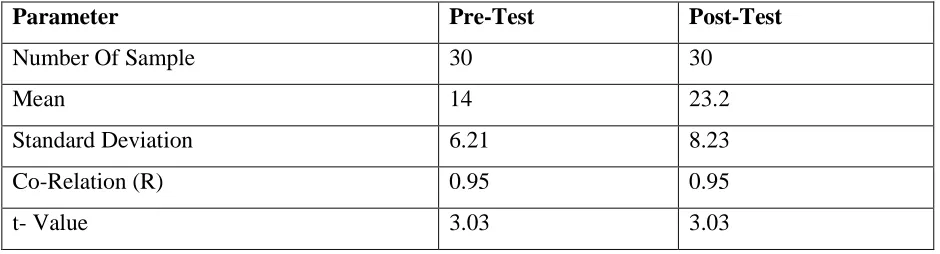
Table showing t-value and co-relation value
Parameter Pre-Test Post-Test
Number Of Sample 30 30
Mean 14 23.2
Standard Deviation 6.21 8.23
Co-Relation (R) 0.95 0.95
t- Value 3.03 3.03
Degree of freedom = 29
Table value at 0.05 level is 2.04 and at 0.01 is 2.76.
From the table it is clear that t- value is significant at both the levels hence null hypothesis is rejected i.e. “There will be no significant difference in pre-test and
post-test scores of pupil teachers taught through ICT tools”. And it is concluded that there is significant effect of ICT tools and pupil teachers who are taught by ICT tools showed improvement in their academic
achievement.
FINDINGS OF THE STUDY
The analysis and interpretation of the data helped to draw out the following important findings:-
• The participants of the group differed significantly in their concept
attainment of educational technology as exhibited by the analysis of their pre-test and post-test scores.
• There were certain topics in educational technology which
A Study of the Impact of Ict Tools on Achievement of Students in Learning Educational Technology Page 249
methods other than lecture method in the classroom.
• The mean value of pre-test was 6.21 and for the post –test it was 8.23 the
observed difference between the two mean found significant at 0.01 and 0.05 level of significance so the difference can be attributed to the intervention, i.e. the use of ICT tools
for teaching Educational Technology.
• It was found that teaching through ICT tools enhances academic achievement of the pupil teachers.
EDUCATIONAL IMPLICATIONS
The educational implications of the study are listed below:-
• ICT tools provide improvement in the academic performance irrespective of their individual ability. Therefore, such approach is particularly desirable in actual
classroom situations.
• The spirit of co-operation and competition should be developed by
the use of ICT tools through mail services.
• Possibilities of students updating of current knowledge could be enhanced by the use of ICT tools. • ICT tools could be used by the
teachers to enhance their teaching. • Books based on ICT could be
developed.
• In- service programmes, refresher programmes, orientation schedule and even the pre-service teacher training programme should be
provided for newer ICT based methods.
• School infrastructure should be stressed in terms of facilities to promote and use ICT tools.
• Curriculum based on ICT could be developed for students of special
A Study of the Impact of Ict Tools on Achievement of Students in Learning Educational Technology Page 250 REFERENCES
Best, J.W., & Kahn, J.V. (2011). Research in Education (10th ed.). New Jersey: Pearson Prentice Hall.
Carrillo, P., Onofa, M., & Ponce, J. (2010). Information technology and student achievement: Evidence from a randomized experiment in Ecuador. IDB Working Papers Series no. IDB-
WP-223, pp 1-28.
Devi, S., Rizwaan, M., & Chander, S. (2012). ICT for quality of education in India. International
Journal Of Physical And Social Sciences, 2(6), pp 542-554.
Garrett, H.E. (2004). Statistics in psychology and education. New Delhi: Paragoan International Publishers.
Islam, Md.S., & Fouji, M.H. (2010). The impact of ICT on students performance: A case study of ASA University Bangladesh. ASA University Review, 4(2), 101-106.
Jangir, N.K., & Jangira, P. (1995). Effective Teaching. New Delhi: National Publishing House,
Koul, L. (2012). Methodology of educational research (4th ed.). Noida: Vikas Publishing House.
Mayankale. (2011). The role of ICT in education sector. StudyMode.com. Retrieved from:
http://www.studymode.com/essays/The-Role-Of-Ict-In-Education-758816.html