Improving Face Detection Rate Using
AdaBoost
A.Chehrehgosha, Dr. Mehran Emadi
Department of CE, Yazd Branch, Islamic Azad University, Yazd, Iran
Assistant Professor, Department of EE, Islamic Azad University, Mobarakeh Branch, Mobarakeh, Iran
ABSTRACT: Human being’s face is a dynamic object with a high degree of variability in its appearance. This makes faces detection as a fundamental problem in the field of machine vision and also this is considered to be the first and most essential step towards face recognition systems. The aim of face detection is to segment all the existing areas in a color image, apart from 3D mode, rotation, and light condition around that image and consequently to determine face location and its separation from the background. Face detection has many applications such as image retrieval, image coding, and monitoring in noisy environments. There are several problems in face detection including state switching, changing light intensity, face covering, etc. To resolve these problems, the present study utilizes an advanced algorithm based on the a structured Adaboost algorithm. According to the above, normalized data are entered into a three-layer LBP Adaboost fed with the data from databases and the output is reached through using error propagation algorithm. It was found that the method has the detection accuracy of 75%, detection feature of 72%, and sensitivity of 77%; and the final detection result of the human being’s face is feasible up to 94%.
KEYWORDS: Face Detection, Adaboost, Face Recognition, Biometric.
I.INTRODUCTION
Face plays a major role in identifying people and displaying their feelings in the society. Human being possesses a significant ability to recognize faces. This skill stands against changes under visual conditions as like facial expression, age, as well as changes in glasses, beard or hair style. Currently, understanding human’s face is an area of active research in the field of machine vision, for which detection or determination of a human’s face location is a prerequisite [1]. In fact, face detection is the first essential step towards face recognition systems. Of its applications, one may refer to person tracking, security in public and military environments, recovery or blocking indecent and obscene content, access control, legal affairs, licensing and identifying documents and supervision in areas like human-computer interaction, virtual reality, recovery from databases, multimedia and computer entertainment, etc. [7].
The aim of face detection is to segment all areas in a color image regardless of the three-dimensional mode, rotation, and light conditions in its surroundings [2]. Facial detection techniques can be divided in two categories i.e. characteristics-based and image-based methods. The first method relies on the use of apparent characteristics such as skin color or face geometry and the second one depends on face pattern detection from the samples, the results of statistical analysis, and machine learning [6]. In general, studying how the faces are perceived by the human has led to lots of interesting findings that can be of great help in the design of useful and practical devices.
Researchers have been able to solve the problem of detecting faces in different gestural positions, lighting, and different face positions. Earlier efforts include the use of eigen facial expansion – a version of face image for which Eigenvector mathematical equations have been applied. In this method, different eigen spaces have been created and each of these spaces records different information from different viewing angles. To resolve the problem of gesture differences, a 3D model was made and 2D views of the extract were used for each gesture.
II.RELATED WORKS
local properties of a person's face. An important point about Gottumukkal method is that there is no need to detect specific components of the original image such as mouth, nose, and eyes for face detection. Moreover, the proposed algorithm is robust against rapid changes in lighting and facial expressions and shows a good performance.
G. Zhang et al. [11] proposed a face detection method with the accuracy of 97.9% using AdaBoost to select a set of local areas and their weights and also taking the characteristics of LBP into account. They used images available in FERET database and analyzed them by filtering through 40 Gabor filters with different scales. The proposed method is suitable not only for face analysis, but also for face recovery, medical image analysis, motion analysis, and modeling the environment. However, this method has a weak performance in the creation of large feature vectors.
Kai-Biao Ge et al. combined AdaBoost algorithm with skin segmentation and face description based on LBP in order to create an efficient method for face detection. They used MB-LBP instead of Haar features and this led to a great reduction in errors rate. Although the combination of AdaBoost and skin color has been used in this method, it has a poor performance for pictures with several images. This algorithm is capable of more than 90% accuracy in correct face detection [3].
In a paper by Trupti [9], a combined method has been proposed by mixing PCA algorithm with some other algorithms. In fact, a hybrid method is used in this paper, i.e. the combination of different methods of facial detection. The choice of such a mechanism can solve lots of problems in the field of detection and recognition, such as environmental light changes, changes in facial expressions, change in camera position, change in the position of a person, etc. In the proposed algorithm, face detection system for processing the ORL images database works in two modes: practice and classification. The practice mode includes normalization and feature extraction from images using PCA and ICA algorithms. Then the extracted features will be analyzed using BPNNs in order to classify the features into different groups. In classification mode, new images are added to the results of practice mode. A combining method will be applied on the practice results so as to classify the new images based on appeared groups.
However, designing new ways which are robust and powerful in resisting to changes in uncontrolled lighting environments is yet an unsolved issue. In this study, we tried to propose an algorithm that improves face detection rate in addition to have resistant against changes in light, turning heads, and covered faces. In the following, the procedure of proposed algorithm (section 2), the results (section 3), and discussion and conclusions (section 4) will be presented
III.PROPOSED METHODOLOGY
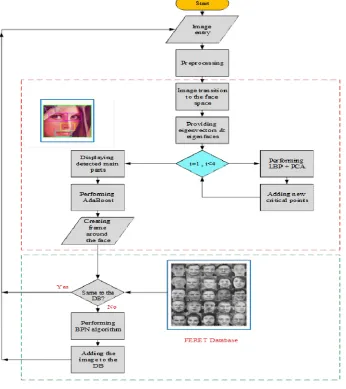
The main idea of research and proposed algorithm is described in this section. Adaboost is an expert analyst of biometrical points of the face through systems and LBP methods and sometimes PCA. This algorithm is a simple processor system through the analysis of bio-metrical points of face that leads to human being’s face detection. Basically, the Adaboost algorithm performance is based upon critical points in the face. The main idea is presented in Figure 1.
The procedure is shown in two parts of the main algorithm (the red dotted line) and Adaboost training (green dotted line). For this purpose, FERET data base was applied. As evident in the graph, the first stage is the reception of image from the input, which can be done online (shooting the scene and converting the same into 20 image frames) or offline (using the stored images).
FERET database is a standard set of data that is used for the evaluation of face detection systems. FERET technology is managed by the Defense Advanced Research Projects Agency (DARPA) and National Institute of Standards and Technology (NIST). This includes 2413 face images belonging to 856 different persons. In this paper, 72 images will be used for the training of Adaboost algorithm.
A. AdaBoost
Adaboost is a machine learning algorithm derived from Adaptive boosting that can be used along with other algorithms to improve their efficiency. Adaboost makes a stronger classification algorithm using the output of weighted classification algorithms, which are known as “weak learner”. A weak learner is defined the way that it can only be better than random mode or in other words, is closer to the right orientation. In contrast, strong learners refer to a set of classification algorithms that are highly correlated with the correct orientation [8].
one or two characteristics, a high positive error rate will be expected. In the same way and using the cascaded model of classification algorithm that exists in the first stage of the cascade, the easiest and the lowest calculation will be made. As the algorithm moves to the next cascaded stages, these algorithms become more complex and need more calculations.
There are 38 stages in cascaded model and more than 6,000 components are used, in which each stage is more complex and heavier than the previous one. If successful, the outcomes of the first stage will move to the second stage of the cascade. Some of the outcomes lacking the necessary components will be rejected. This way, many of the images not belong to the human faces will be deleted and more calculations will be done on those frames that have better chances of including the face in themselves.
Fig. 1Flowchart of the main steps
The aim of pre-processing the image is to prepare it for entering the same into the algorithm. It includes all the necessary steps as well. These steps differ based on the kind of image such as normalization, narrowing, compression, image format conversion, gray scaling, and leveling.
their similarity with human face, they are called eigen vectors. It is noteworthy to say that all the formulas in this equation are based on the assumption that the image matrix is considered as a column vector. To calculate the eigen vector, the average of images has to be obtained first. Afterwards, the difference of each image from the average is calculated. Ukand λk vectors are special vectors and values in correlation matrix, respectively. UK vector is chosen in a way that λk is maximized:
= 1 ( Ф )
(1)
= = 1 if =
0 otherwise
(2)
Afterwards, the correlation matrix is obtained based on the following equation:
= 1 Ф Ф =
(3)
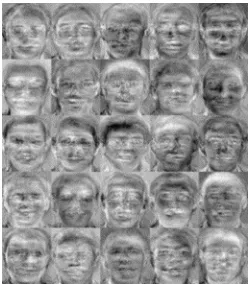
U vector is eigenface. Figure 2 depicts one of the sample results.
Fig. 2The results of making eigenfaces
After the first step in approximate detecting of the face margin, critical points have to be entered in LBP. Critical points in the present study are as follows:
Step 1: lip corners, nose corners, and eye corners
Step 2: lip corners, nose corners, and eye corners, nose cone, chick, forehead,
Step 3: lip corners, nose corners, and eye corners, nose cone, chick, forehead, under the ears, above the eyebrows, on the cheeks, and above the lips
Fig. 3Critical points
IV.TEST RESULTS
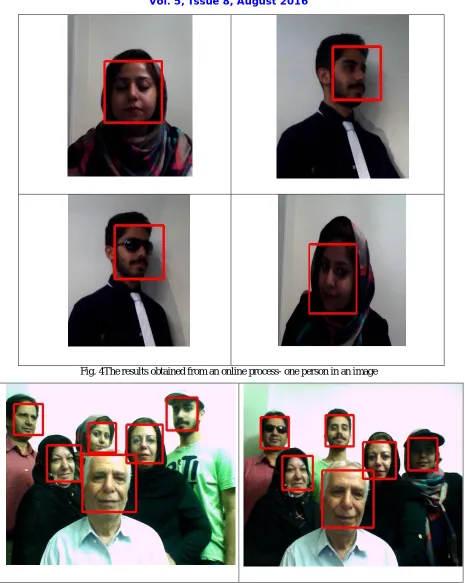
The advantages of proposed algorithm are high speed processing, detecting several faces in one image, covered face detection, and optimized programming. As mentioned in section III, this experiment has used 72 images related to FERET database.
A. Online Processing
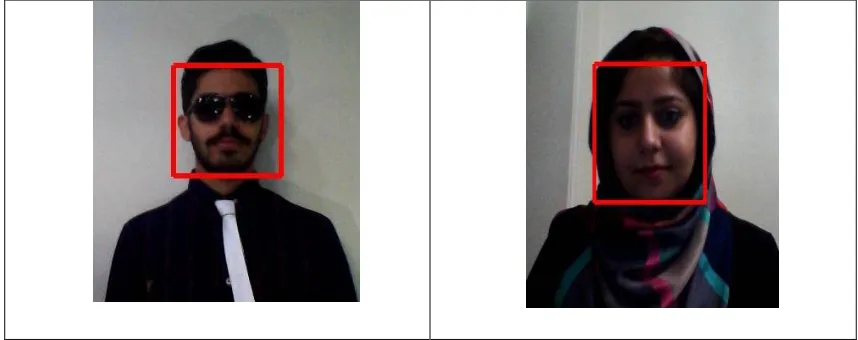
As described in previous sections, offered algorithm is able to perform face detection procedure without any database. This process takes place in the following order:
1) Performing the program by the user
2) Connecting the program to system’s webcam 3) Imaging the face
4) Performing the face detection algorithm 5) Detecting the face by algorithm
6) Creating a red frame around the recognized face 7) Returning to 3rd step and performing other steps
All the above steps are continued until the image is received and 20 frames are created.
Fig. 4The results obtained from an online process- one person in an image
Fig. 5 The results obtained from an online process- more than one person in an image
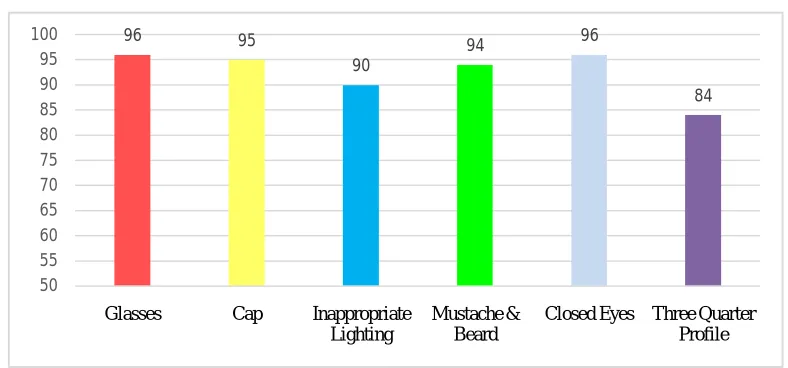
To depict the results in a better way, the detection accuracy of proposed algorithm under different conditions is measured separately, for which the results are as follows:
Fig. 6 Recognition accuracy of algorithm under different conditions
B. Comparison of the proposed algorithm with similar algorithms
Yuseok Ban et al. faded out some non-skin points using an upgraded algorithm that focused on skin color data. They also used LBP to create cascaded classification [1]. The accuracy of this method is approximately 65%.
G. Zhang et al. selected a set of local districts and their weights using AdaBoost and also considering the characteristics of LBP in order to propose a way for face detection with the accuracy of 97.9% [11].
Rein-Lien Hsu et al. offered a face detection algorithm based upon a nonlinear conversion to YCbCrcolorful space in order to detect the face in different lighting circumstances and backgrounds [5]. Although this algorithm is tested on several databases and a certain result cannot be obtained for the algorithm, the average detection rate is 88.5%. Yan-Wen Wu et al. offered a combination of AdaBoost and skin color classification [10]. This has done using Gaussian simple model and morphological operation on binary image. This algorithm is able to recognize the correct face in 92.9% of cases.
According to the above table, detecting the faces in offline mode was the main aim of the present study, which has the accuracy of 94% and has a dramatic improvement in comparison to other similar algorithms.
V. DISCUSSION AND CONCLUSION
One of the well-known issues in the field of computer vision is face detection that has been focused for more than two decades and always improvements and sustainable methods are being proposed to detect areas of faces in digital images. One of the best ways to detect faces and facial areas (such as the eyes, mouth, and nose) is boosting method. The most famous boosting algorithm is Adaboost, which is widely used in the fields of learning. On the other hand, LBP method is considered to be a great success in the field of image analysis due to its high tolerance to light changes. In the present study, an advanced algorithm based on LBP and structured Adaboost algorithm are used in order to improve the detection rate of a human being’s face, which possess a very high accuracy (94) and an excellent performance. What can be done to improve the project targets is to increase the selected critical points in order to raise the accuracy of the algorithm. To reduce the error rate, it is also possible to increase the number of fed layers in LBP Adaboost algorithm to raise the number of critical points. Increasing the number of layers makes it possible to approach 100% detection rate. On the other hand, considering the practice and learning capability of Adaboost, as the number of images in the database (input primary training data to the algorithm) increases, generalizability and consequently the performance detection algorithm will be optimized as well.
REFERENCES
[1] Y. Ban, S. K. Kim, S. Kim, K. Toh, and S. Lee, “Face detection based on skin color likelihood}, Pattern Recognition,”vol. 47, pp. 1573 – 1585, 2014.
[2] H. D. Cheng, X. Jiang, A. Sun, and J. Wang, “Color image segmentation: advances and prospects}, Pattern Recognition,” vol. 34, pp. 22 – 59, 2001. 96 95 90 94 96 84 50 55 60 65 70 75 80 85 90 95 100
Glasses Cap Inappropriate Lighting
Mustache & Beard
[3] K. B. Ge, J. Wen, and B. Fang, “Adaboost algorithm based on MB-LBP features with skin colorsegmentation for face detection,” International Conference on Wavelet Analysis and Pattern Recognition (ICWAPR), vol. 6, pp. 40 – 43, 2011.
[4] R. Gottumukkal, V. K. Asari, “An improved face recognition technique based on modular PCA approach,” ELSEVIER, 2003).
[5] R. L. Hsu, M. Abdel Mottaleb, and A. K. Jain, “Face detection in color images,” IEEE Transactions on Pattern Analysis and Machine Intelligence, vol. 24, pp. 696 – 706, 2002.
[6] Z. Jin, Z. Lou, J. Yang, and Q. Sun, “Face detection using template matching and skin color information,” International Conference on Intelligent Computing, vol. 70, pp. 794 – 800, 2005.
[7]R. Khan, A. Hanbury, J. Stöttinger, and A. Bais, “Color based skin classification,” Pattern Recognition Letters, vol. 33, pp. 157 – 163, 2012. [8]R. E. Schapire, “Explaining adaboost,” Festschrift in Honor of Vladimir N. Vapnik, part II, pp. 37 – 52, 2013.
[9] Trupti M. Kodinariya,“Hybrid Approach to Face Recognition System using Principle component and Independent component with score based fusion process,”CoRR abs, pp. 1 -11, 2014
[10] Y. W. Wu, and X. Y. Ai, “Face detection in color images using adaboost algorithm based on skin color information,” First International Workshop on Knowledge Discovery and Data Mining, pp. 339 – 342, 2008.
[11] G. Zhang, X. Huang, S. Z. Li, Y. Wang, and X. Wu, “Boosting local binary pattern (LBP)-based face recognition,” 5th Chinese Conference on Biometric Recognition, pp. 179 – 186, , 2004.
BIOGRAPHY
Arezou Chehrehgosha is currently a M.Sc. student in Computer Engineering (Computer Systems Architecture) at Islamic Azad University, Yazd, Iran.