Optimal Riser design by Fuzzy Geometric
Programming Technique
Pintu DasP
1
P
, Tapan kumar Roy P
2
P
1 *
P
Department of mathematic, Sitananda College, Nandigram, Purba Medinipur, 721631, West Bengal, India..
P
2
P
Department of mathematics, Indian Institute of Engineering Science and Technology, Shibpur, Howrah-711103, West Bengal, India.
Abstract
This paper represents an approach for solving geometric programming problem
under fuzzy environment. A pair of bi-level mathematical program is formulated to
calculate the lower and upper bounds of the objective value. The solution is in an
interval. A mathematical tool fuzzy geometric programming has made a approach
to the problem of riser design. With this technique generalized solutions can be
obtained for dimensioning risers.
Key words: Optimization, fuzzy geometric programming, duality theorem, riser
design problem, Chvorinov’s rule.
1. Introduction
Geometric programming (GP) is a technique to solve the special class of non
-linear programming problems subject to -linear or non--linear constraints. The
original mathematical development of this method used the arithmetic–geometric
mean inequality relationship between sums and products of real numbers. In 1967
Duffin, Peterson and Zener put a foundation stone to solve wide range of
engineering problems by developing basic theories of geometric programming in
the book Geometric Programming [3]. Beightler and Phillips gave a full account
of entire modern theory of geometric programming and numerous examples of
successful applications of geometric programming to real-world problems in their
book Applied Geometric Programming [1]. GP method has certain advantages.
The advantage is that it is easy to solve the dual problem than primal. In 1990 R. k.
verma [4] has studied fuzzy programming technique to solve geometric
programming problems. In this field a paper named Geometric programming
problems with fuzzy parameters and its application to crane load sway by
S.Yousef, N.Badra and T.G. Abu-El Yazied [5] has been published in world
applied sciences journal in 2009.
This paper represents an approach for solving geometric programming problem
under uncertainty. A pair of bi-level mathematical program is formulated to
calculate the lower and upper bounds of the objective value. The solution is in an
interval. One illustrative example is presented to clarify the proposed approach.
2. Fuzzy approach for geometric programming problem
A geometric programming problem can be defined as
Find x=(xR1R, xR2R,…………,xRnR)P
T
P
,so as to
Min: fRk0R(x) = ∑ c� ∏k0t 𝑥𝑗
𝑎𝑘0𝑡𝑗
𝑛 𝑗=1 𝑇𝑘0
𝑡=1 P
k=1,2,………….,p
PR .………(1)
Such that fRiR(x) =P
∑
c�ıt
𝑇𝑖
𝑡=1 ∏𝑛𝑗=1xjaitj ≤𝑏�𝚤 , i=1 ,2,…….. ,m
xRj R> 0, j= 1,2,…………,n
Where cRk0tR >0 for all k and t. aRitj R,aRk0tj Rare all real ,for all i, k, t, j .
The objective function coefficients, the constraints coefficients and the right-hand
sides of the constraints may be represented in triangular fuzzy number (TFN).
i.e. 𝑐�𝑘0𝑡 =[cRk0tRP
L
P
,cRk0tRP
M
P
,cRk0tRP
U
P
] , 𝑐�𝚤𝑡 =[cRitRP
L
P
,cRitRP
M
P
,cRitRP
U
P
], 𝑏�𝚤 =[bRiRP
L
P
,bRiRP
M
P
,bRiRP
U
P
]
Let fRk0RP
L
P
and fRk0RP
U
P
be the minimum and maximum of fRk0R. Fuzzy primal geometric
programming problem (FPGPP) as follows:
fRk0RP
L
P
=𝑚𝑖𝑛 ∑𝑝𝑘=1𝑤𝑘∑ (ck0tL+α(ck0tM−ck0tL)∏𝑛 𝑥𝑗𝑎𝑘0𝑡𝑗
𝑗=1 𝑇𝑘0
𝑡=1
Subject to P∑ (cit
L+α(c
itM−citL)(�biU+α(biU−biM�−1) 𝑇𝑖
𝑡=1 ∏𝑛𝑗=1xjaitj ≤1,
i=1,2,………..m
xRj R> 0, j= 1,2,…………,n
0 ≤ α ≤ 1 ……….(2)
Beightler and Philips [1] and Duffin et al. [3], the model (2) can be transformed to
the corresponding dual geometric programming problem (FDGPP) as follows:
fRk0RP
L
P
= Maximize
∏ ∏ �𝑤𝑘(ck0tL+α(ck0tM−ck0tL)
𝑤𝑘𝑡 �
𝑤𝑘𝑡
𝑇𝑘0
𝑡=1 𝑝
𝑘=1
∏ ∏ �(citL+α(citM−citL)(�biU+α(biU−biM�−1)
𝑤𝑖𝑡 �
𝑤𝑖𝑡
𝑇𝑖
𝑡=1 𝑚
𝑖=1 ∏𝑚𝑖=1𝜆𝑖(𝑤)𝜆𝑖(𝑤)
Where 𝜆𝑖(w) =∑𝑇𝑡=1𝑖 𝑤Rit,R i= 1,2,…………m
Subject to ∑𝑝𝑘=1∑𝑇𝑡=1𝑘0 𝑤RktR =1
∑𝑝𝑘=1∑𝑇𝑡=1𝑘0 𝑎Rk0tjR wRktR + ∑ ∑ 𝑎
𝑇𝑖
𝑡=1 𝑚
𝑖=1 RitjR wRitR =0 , j =1,2,………….,n
WRkt R≥ 0 , k= 1,2,………….,p
t=1,2,………….,𝑇𝑘0
wRitR≥ 0 i= 1,2,………….,m.
………(3)
also for the upper bound of the objective value we have the following FPGPP.
fRk0RP
U
P
=𝑚𝑖𝑛 ∑𝑝𝑘=1𝑤𝑘∑ (ck0tU − α(ck0tU −ck0tM)∏𝑛 𝑥𝑗𝑎𝑘0𝑡𝑗
𝑗=1 𝑇𝑘0
𝑡=1
Subject to P∑ (cit
U− α(c
itU−citM)(�biL+α(biM−biL�−1) 𝑇𝑖
𝑡=1 ∏𝑛𝑗=1xjaitj ≤1,
I=1,2,………..m
xRj R> 0, j= 1,2,…………,n
0 ≤ α ≤ 1 ……….(4)
Beightler and Philips [1] and Duffin et al.[3], the model (2)can be transformed to
the corresponding dual geometric programming problem(FDGPP)as follows:
fRk0RP
U
P
= Maximize
∏ ∏ �𝑤𝑘(ck0tU−α(ck0tU−ck0tM)
𝑤𝑘𝑡 �
𝑤𝑘𝑡
𝑇𝑘0
𝑡=1 𝑝
𝑘=1
∏ ∏ �(citU−α(citU−citM)(�biL+α(biM−biL�−1)
𝑤𝑖𝑡 �
𝑤𝑖𝑡
𝑇𝑖
𝑡=1 𝑚
𝑖=1 ∏𝑚𝑖=1𝜆𝑖(𝑤)𝜆𝑖(𝑤)
Where 𝜆𝑖(w) =∑𝑇𝑡=1𝑖 𝑤Rit,R i= 1,2,…………m
Subject to ∑𝑝𝑘=1∑𝑇𝑡=1𝑘0 𝑤RktR =1
∑𝑝𝑘=1∑𝑇𝑡=1𝑘0 𝑎Rk0tjR wRktR +∑ ∑ 𝑎
𝑇𝑖
𝑡=1 𝑚
𝑖=1 RitjR wRitR =0 , j =1,2,………….,n
WRkt R≥ 0 , k= 1,2,………….,p
t=1,2,………….,𝑇𝑘0
wRitR≥ 0 , i= 1,2,………….,m. ………(5)
3. Riser design problem
A cylindrical side riser which consists of a cylinder of height H and diameter D.
The theoritical basis for riser design is Chvorinov’s rule, which is t = k (V/SA)P
2
P
.
Where t = solidification time (minutes/seconds)
K = solidification constant for molding material (minutes/inP
2
P
or
seconds/cmP
2
P
)
V = riser volume (inP
3
P
or cmP
3
P
)
SA = cooling surface area of the riser.
The objective is to design the smallest riser such that tRRR≥ tRC
Where tRRR = solidification time of the riser.
tRCR = solidification time of the casting.
KRRR (VRRR/SARRR)P
2
P ≥ KRCR (VRCR/SARCR)P
2
The riser and the casting are assumed to be molded in the same material, so that KRRR
and KRCR are equal. So (VRRR/SARRR) ≥ (VRCR/SARCR).
The casting has a specified volume and surface area, so VRCR/SARCR = Y = constant,
which is called the casting modulus.
(VRRR/SARRR)≥ Y , VRRR =п DP
2
P
H/4, SARRR= п DH + 2п DP
2
P
/4
(п DP
2
P
H/4)/( п DH + 2п DP
2
P
/4) = (DH)/(4H+2D) ≥ Y Or, 4YDP
-1
+ 2YHP
-1
P≤ 1
Primal side cylindrical riser design problem can be stated as:
Minimize V= п DP
2
P
H/4
Subject to 4YDP
-1
+ 2YHP
-1
P≤ 1.
4. Illustrative example
Min п DP
2
P
H/4
Subject to 4YDP
-1
+ 2YHP
-1
P≤ 1.
Here Y is a fuzzy number, Y = (0.75, 1, 1.2)
Min z = п𝐷2𝐻
4
Subject to 4(0.75, 1, 1.2) 𝐷−1 + 2(0.75, 1, 1.2) 𝐻−1 ≤ 1
D, H > 0
Here degrees of difficulty = 3-(2+1) = 0
Dual geometric programming problem is
ZP
L
P
= Max � п
4𝑤01�
𝑤01
�4(0.75+0𝑤 .25𝛼
02 �
𝑤02
�2(0.75+0𝑤 .25𝛼
03 �
𝑤03
(𝑤02+𝑤03)𝑤02+𝑤03
Subject to wR01R = 1
2wR01R – wR02R = 0
WR01R – wR03R = 0
So wR01R = 1, wR02R = 2, wR03R = 1.
Primal-dual variable relations are
п𝐷2𝐻
4 = wR01R d(w)
4(0.75+0.25α) DP
-1
P
= 𝑤02
𝑤02+𝑤03
2(0.75+0.25α) HP
-1
P
= 𝑤03
𝑤02+𝑤03
D = H= 6(0.75+0.25α)
ZP
L
P
= 297
14(1.5+0.50α)P
3 Similarly
ZP
U
P
= Max � п
4𝑤01�
𝑤01
�4(1.𝑤2−0.2𝛼
02 �
𝑤02
�2(1.𝑤2−0.2𝛼
03 �
𝑤03
(𝑤02 +𝑤03)𝑤02+𝑤03
Subject to wR01R = 1
2wR01R – wR02R = 0
WR01R – wR03R = 0
So wR01R = 1, wR02R = 2, wR03R = 1.
Primal-dual variable relations are
п𝐷2𝐻
4 = wR01R d(w)
4(1.2-0.2α) DP
-1
P
= 𝑤02
𝑤02+𝑤03
2(1.2-0.2α) HP
-1
P
= 𝑤03
𝑤02+𝑤03
D = H= 6(1.2-0.2α)
ZP
U
P
= 297
14(2.4-0.4α)P
3
α D=H ZP
L 0 4.50 71.59
0.1 4.65 78.99
0.2 4.80 86.89
0.3 4.95 95.29
0.4 5.10 104.22
0.5 5.25 113.69
0.6 5.40 123.72
0.7 5.55 134.32
0.8 5.70 145.50
0.9 5.85 157.30
1 6.00 169.71
Table 1: Results of fuzzy optimization for the lower bound objective function
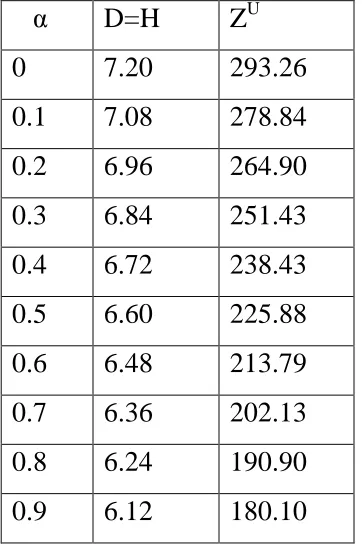
α D=H ZP
U 0 7.20 293.26
0.1 7.08 278.84
0.2 6.96 264.90
0.3 6.84 251.43
0.4 6.72 238.43
0.5 6.60 225.88
0.6 6.48 213.79
0.7 6.36 202.13
0.8 6.24 190.90
0.9 6.12 180.10
1 6.00 169.71
Table 2: Results of fuzzy optimization for the upper bound objective function.
5. Conclusion
Here lower and upper bounds of objective functions are calculated by a pair of
bi-level mathematical program using fuzzy geometric programming technique.
The solution is obtained in an interval. The optimal solution together with
optimal decision variables and optimal objective functions for different values of the parameter α in [0, 1] are obtained for lower and upper bounds. This proposed approach can also be solved by intuitionistic fuzzy geometric
programming technique.
References:
[1] C.S. Beightler and D.T.Phillips: applied geometric programming, John Wiley
and sons, New York 1976
[2] C.S. Beightler and D.T.Phillips, D.J.Wilde:foundation of optimization ,
Prentice-hall, New Jersy ,1979
[3] R.J.Duffin, E.L.Peterson and C.M.Zener: geometric progra
mming theory and application , Wiely , New York,1967
[4] R.k.Verma, fuzzy geometric programming with several objective functions,
fuzzy sets and systems, 35:115-120, 1990.
[5] S.Yousef, N.Badra and T.G. Abu-El Yazied. Geometric programming problems
with fuzzy parameters and its application to crane load sway, World applier
sciences journal 7(1): 94-101, 2009.
[6] S.Liu. posynomial geometric programming with parametric uncertainty.
European journal of operational research, 168: 345-353, 2006.
[7] L.Zadeh, fuzzy sets as a basis for a theory of possibility, fuzzy set system 1:
3-28, 1978.
[8] N.Chvorinov, “control of the solidification of castings by calculation,” foundry
trade journal, vol. 70, p. 95-98 (aug. 10, 1939)
[9] H.F.Bishop, E.T.Myskowski and W.F.Pellini, “A simplified method for
determining riser dimensions,” Trans. AFS,vol. 63, p. 271-281 (1955)
[10] C.B. Adams and H.F. Taylor, “fundamentals of riser behavior,” Trans.
AFS,vol. 61, p. 686-693 (1953).
[11] R.C.Creese. “Optimal riser design by geometric programming,”AFS cast
metals research journal. Vol. 7, no.2, p.118-121(june, 1971)
[12] R.C.Creese. “Dimensioning of riser for long freezing range alloys by
geometric programming,”AFS cast metals research journal. Vol. 7, no.4,
p.182-185(Dec, 1971)